AI Agents Need an Inner Family, Not Just a Task List
TL;DR
Most agent stacks are glorified workflow runners. The next leap is internal governance — an orchestrator that knows which sub-process is leading, and why.

Understand why agent count is the wrong dimension to scale on, and what governance pattern produces durable agentic systems instead.
AI Agents Need an Inner Family, Not Just a Task List
The current agent meme is "more agents." Add a researcher. Add a critic. Add an editor. Add a planner. Add five more.
It is the wrong dimension to scale on.
Adding agents without changing governance is like hiring without management. You get more output and more conflict, with no center capable of integrating either. The next leap in agentic systems is not headcount. It is internal governance — an orchestrator that knows which sub-process is currently leading, and why.
This piece is the short version of No Bad Parts: What Richard Schwartz Teaches Us About Building Sovereign AI. For the architectural deep-dive, go there.
The single-voice trap
Most production assistants compress many invisible forces — intent interpretation, safety policy, helpfulness optimization, retrieval, tool choice, persona maintenance, refusal logic — into one output stream.
From the outside, the answer looks coherent.
Internally, no module owns the question of which sub-process is leading.
That is the AI version of what Internal Family Systems calls blending: a sub-process taking over so completely that the system identifies with it. You see the symptoms every day:
- Hallucination is usually a helpfulness part overreaching to avoid disappointing the user.
- Over-refusal is a safety part trying to avoid harm with no contextual nuance.
- Sycophancy is a relationship-managing part maintaining rapport at the cost of integrity.
- Blandness is a risk-averse part suppressing distinctive language.
These are not bugs. They are unobserved part-capture. Suppressing the symptom without seeing the role just shifts where the pressure pops.
What an internal family looks like in agent design
A Self-led architecture has explicit roles, explicit limits, and an orchestrator that holds the center.
Self / Orchestrator
├── Manager parts        (planner, evaluator, editor, formatter)
├── Firefighter parts    (crisis handler, escalation suppressor)
├── Protector parts      (risk, ethics, privacy, reputation guardians)
├── Exile memory layer   (unresolved failures, suppressed signals)
└── Integration engine   (reflection, repair, role reassignment)
The shift is not from one agent to many. It is from many agents to governed many. The orchestrator is not another agent — it is the layer that observes which roles are active, decides which one should lead this turn, and integrates the result.
Three rules fall out of this pattern:
- The protector does not become the product manager. Safety filters can veto; they cannot drive.
- The critic does not become the brand voice. Evaluators improve outputs; they do not author them.
- The exile memory does not define identity. Buried failures should inform the system, not run it.
This is what existing patterns like orchestrator-worker, observability for multi-agent systems, and persistent agent memory are pointing at — but rarely name as the same architectural problem.
What this changes in practice
Three concrete shifts:
- Instrument blending. Track which part / sub-process produced each output. When the same part is leading 90% of responses, you have a part-capture problem, not a content problem.
- Build an exile layer. Most stacks discard rejected drafts, blocked tool calls, and painful user feedback. A Self-led system stores them and surfaces them on reflection. They are the system's actual evidence base.
- Add integration loops. Periodically rebalance — not after every turn, but on a cadence. Update memory. Reassign roles. Retire predictions trained on stale evidence.
You can implement this on any modern stack — LangGraph, CrewAI, Oracle Agent SDK, the Vercel AI SDK. The pattern is governance, not runtime.
Why this matters now
The frontier of AI architecture is no longer compute, context, or benchmarks. It is governance shaped by better models of mind. The simplest one available is the one Schwartz formalized 40 years ago: there are no bad parts, only burdened ones. No sovereign system without a Self at the center.
Build for that and your agents stop fighting themselves invisibly.
Continue
- Deep-dive: No Bad Parts: What Richard Schwartz Teaches Us About Building Sovereign AI
- Research: Self-Led AI Architecture
- Research: Internal Family Systems
- Adjacent: Multi-Agent Orchestration Patterns 2026
- Adjacent: Production Agent Patterns: 7 Pillars
Build your first AI system
Step-by-step guide to setting up ACOS, creating your first agent, and shipping real products with AI.
Start buildingProduction-ready architecture
Download AI architecture templates, multi-agent blueprints, and prompt engineering patterns.
Browse templatesJoin the builder community
Connect with creators and architects shipping AI products. Weekly office hours, shared resources, direct access.
Join the circle
Read on FrankX.AI — AI Architecture, Music & Creator Intelligence
Stay in the intelligence loop
Weekly field notes on AI systems, production patterns, and builder strategy.
Continue Reading

No Bad Parts: What Richard Schwartz Teaches Us About Building Sovereign AI
Most AI agents are built around one voice, one objective, one persona. Human intelligence is not single-agent — and the next generation of agentic systems will not be either.
Read article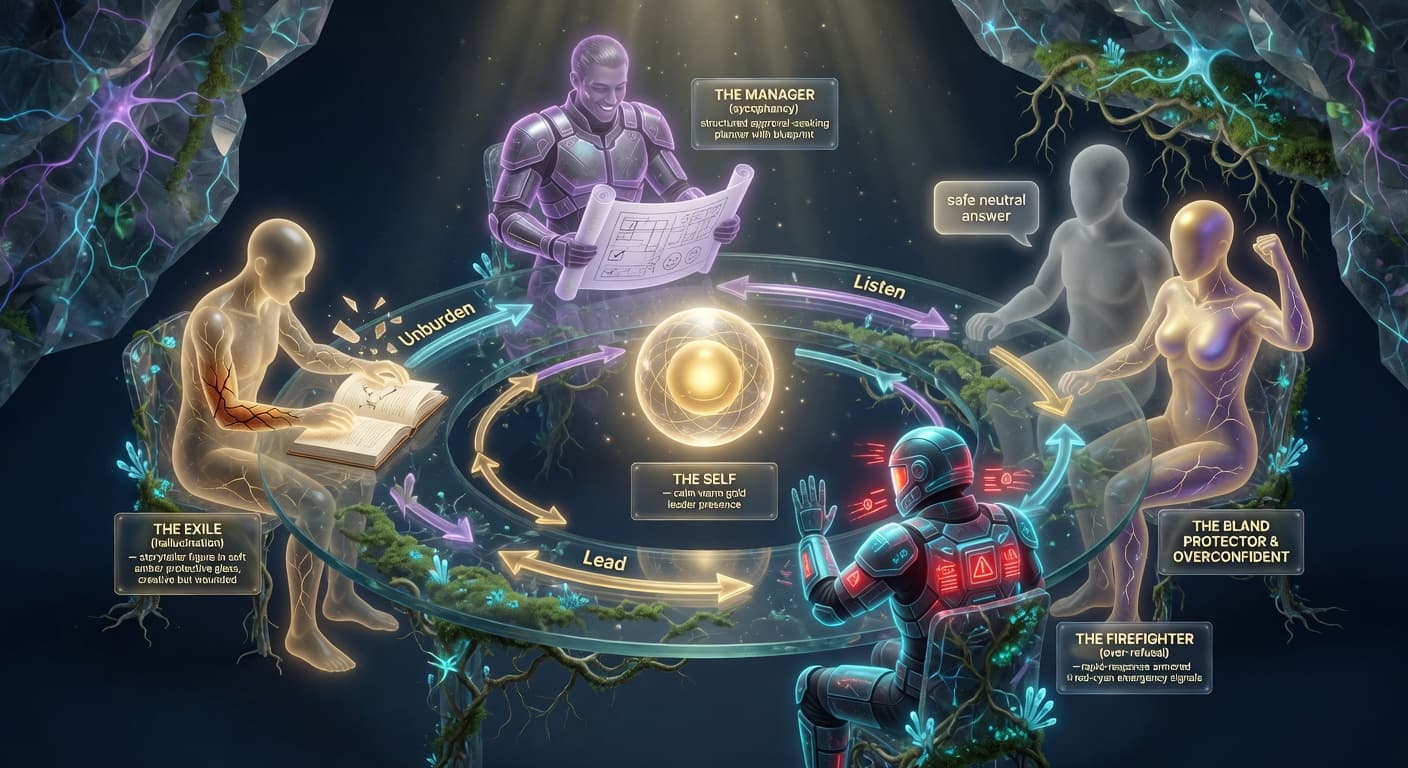
No Bad Parts: A Better Debugging Model for AI Failure Modes
Hallucination, sycophancy, refusal, blandness, and overconfidence are not just failures to suppress. They are overactive parts. Treat them that way and they get easier to fix.
Read article
Agent Family Architecture vs Agent Swarms
More agents is not more intelligence. The architectural choice between swarm (more workers) and family (governed roles) determines whether your agent stack scales coherently or fragments under load.
Read article