Oracle GenAI Agents vs LangGraph vs CrewAI: Enterprise AI Agent Comparison 2026
TL;DR
OCI GenAI Agents can be compelling for Oracle-native teams because of native Oracle integration and enterprise guardrails. LangGraph provides graph-based orchestration for complex stateful workflows. CrewAI excels at role-based team simulations. Your choice depends on.

You'll master production agent architecture, tool integration patterns, and resilient multi-agent orchestration systems.
TL;DR: OCI GenAI Agents can be compelling for Oracle-native teams because of native Oracle integration and enterprise guardrails. LangGraph provides graph-based orchestration for complex stateful workflows. CrewAI excels at role-based team simulations. Your choice depends on existing infrastructure, compliance requirements, workflow complexity, and verified current pricing.
Disclosure: Independent analysis. Not affiliated with, endorsed by, or sponsored by Oracle. Pricing and licensing terms can change; verify current public Oracle documentation and your contract before making a purchase decision.
Why This Comparison Matters Now
The AI agent market is moving from "interesting demo" to "production requirement." Gartner predicts 40% of enterprise applications will embed AI agents by end of 2026. The question isn't whether to adopt agents—it's which framework matches your infrastructure and use cases.
For Oracle customers specifically, this decision has a non-obvious dimension: native alignment with Fusion Cloud and Oracle data can change the calculus. Confirm current licensing, usage limits, and commercial terms before treating any capability as included.
The Contenders at a Glance
| Framework | Primary Use Case | Deployment Model | Cost Model |
|---|---|---|---|
| OCI GenAI Agents | Oracle ecosystem integration, RAG on enterprise data | Fully managed | Verify current Oracle pricing/contract terms |
| LangGraph | Complex stateful workflows with branching logic | Self-hosted or LangGraph Platform | Open source + infrastructure |
| CrewAI | Role-based team coordination, rapid prototyping | Self-hosted or AMP Suite | Open source + infrastructure |
OCI GenAI Agents: The Oracle Play
What It Is
OCI Generative AI Agents is a fully managed service that combines LLMs with AI technologies to create intelligent virtual agents. It's designed specifically for Oracle customers who need to leverage enterprise data without building infrastructure.
Key Capabilities
Data Source Integration:
- OCI Object Storage (PDF, TXT, JSON, HTML, Markdown—up to 1,000 files, 100MB each)
- OCI OpenSearch (pre-indexed documents with custom chunking)
- Oracle Database 23ai (AI Vector Search with structured/unstructured data)
Built-in Tools:
| Tool Type | What It Does |
|---|---|
| SQL Tools | Natural language → SQL conversion, query execution |
| RAG Tools | Knowledge base retrieval with context-aware responses |
| Agent Network | Orchestrate specialized agents collaboratively |
| API Integration | Call OCI APIs and custom REST endpoints |
Enterprise Guardrails:
- Content moderation
- Prompt injection protection
- PII detection and protection
- Context retention across conversation turns
What Makes It Different
- Potential commercial advantage for eligible Fusion Cloud customers; verify current terms
- 50+ pre-built agents embedded in Fusion Applications (finance, HR, supply chain, sales)
- AI Agent Marketplace with 100+ partner-built agents
- Google Gemini on OCI—Oracle is the only hyperscaler besides GCP to offer managed Gemini
- Native security framework inherits Fusion Applications access controls automatically
Best For
- Oracle Database customers needing RAG on existing data
- Fusion Cloud users wanting embedded AI without new infrastructure
- Enterprises requiring SOC2/compliance without additional validation
- Teams wanting managed service over DIY orchestration
Limitations
- Tied to Oracle ecosystem
- Less flexibility for custom orchestration patterns
- Newer platform with evolving feature set
LangGraph: The Engineering Choice
What It Is
LangGraph is a graph-based workflow engine built on LangChain for creating structured, resilient LLM applications. It treats agent orchestration as a state machine problem, not a role-playing exercise.
Key Capabilities
Architecture:
- Graph-based workflow definition (nodes = actions, edges = transitions)
- Explicit state machines with conditional routing
- Human-in-the-loop checkpoints for approval workflows
- Time-travel debugging for production issues
Production Features:
| Feature | Benefit |
|---|---|
| State Persistence | Resume workflows exactly where they paused |
| Async/Distributed | Handle scale with proper concurrency |
| LangSmith Integration | End-to-end observability |
| Private VPC | Enterprise deployment with custom RBAC |
MCP Support: LangGraph connects to MCP servers through an adapter that automatically discovers tools and converts them to LangChain-compatible format.
What Makes It Different
- Proven at scale: LinkedIn, AppFolio production deployments
- API stability guarantee (1.0 release October 2025)
- Engineering-first model: Graph theory over team metaphors
- Comprehensive observability: Built-in tracing, debugging, monitoring
Best For
- Complex stateful workflows with branching logic
- Iterative tasks (code generation with testing loops)
- Enterprise apps needing human-in-the-loop approval
- Teams with DevOps capability wanting full control
Limitations
- Steeper learning curve than role-based frameworks
- Requires infrastructure management (or LangGraph Platform subscription)
- More code to achieve simple use cases
CrewAI: The Collaboration Model
What It Is
CrewAI focuses on collaborative agent teams where each agent has a specific role, goal, and communication strategy. It uses intuitive metaphors (managers, specialists, workers) to model multi-agent coordination.
Key Capabilities
Architecture:
- Role-based agent definition (backstory, goals, tools)
- Hierarchical team structures with delegation
- YAML-based configuration for rapid setup
- Sequential and parallel task execution
Enterprise Features:
| Feature | Benefit |
|---|---|
| HIPAA/SOC2 Certification | Healthcare and finance compliance |
| On-premise Deployment | Data sovereignty requirements |
| AMP Suite | Managed monitoring and state persistence |
| Crew Flows | Long-running workflow orchestration |
MCP Support: CrewAI agents can directly reference MCP servers in configuration using URLs or structured settings. The framework handles connection lifecycle automatically.
What Makes It Different
- Fastest time-to-prototype: Working multi-agent systems in hours
- Intuitive role-based model: Non-engineers can understand the structure
- 20,000+ GitHub stars: Large community and ecosystem
- Built-in delegation: Agents can assign sub-tasks to other agents
Best For
- Rapid prototyping and POC development
- Content creation pipelines (research → writing → editing)
- Customer support automation
- Teams wanting quick results without graph theory
Limitations
- May need migration to LangGraph for complex production workloads
- Less control over exact execution flow
- Enterprise features require AMP Suite subscription
Decision Framework
Choose OCI GenAI Agents If:
✅ You're already on Oracle Fusion Cloud or Oracle Database 23ai ✅ You need RAG on enterprise data with minimal setup ✅ Compliance/security inheritance from existing Oracle infrastructure matters ✅ Budget constraint - verified Oracle licensing and usage terms fit your case ✅ You want managed service, not DIY orchestration
Choose LangGraph If:
✅ You need complex conditional logic and branching workflows ✅ Human-in-the-loop approvals are required ✅ You want production-grade observability from day one ✅ Your team has engineering capacity for graph-based design ✅ You're building for scale with async/distributed requirements
Choose CrewAI If:
✅ You need to prototype fast and iterate quickly ✅ Your use case maps naturally to team roles and delegation ✅ You're building content pipelines or customer support bots ✅ You want HIPAA/SOC2 compliance with on-premise option ✅ You may migrate to LangGraph later for production
Feature Comparison Matrix
| Feature | OCI GenAI Agents | LangGraph | CrewAI |
|---|---|---|---|
| Setup Complexity | Low (managed) | Medium-High | Low |
| Custom Orchestration | Limited | Full control | Role-based |
| State Persistence | Built-in | Built-in | Requires AMP |
| MCP Support | Via OCI APIs | Adapter | Native config |
| Observability | OCI Console | LangSmith | AMP Suite |
| Cost | Verify Oracle pricing/contract terms | Open source + infra | Open source + infra |
| Oracle Integration | Native | Manual | Manual |
| HIPAA/SOC2 | Via Oracle | Self-implement | AMP certified |
| On-premise | No (OCI only) | Yes | Yes |
| Multi-LLM Support | OpenAI, Anthropic, Cohere, Google, Meta, xAI | Any via LangChain | Any |
The Migration Pattern Most Teams Follow
Based on production deployments I've seen:
- Start with CrewAI for rapid prototyping and validation
- Migrate to LangGraph when workflows get complex and need production guarantees
- Evaluate OCI GenAI Agents if you're Oracle-native and want managed simplicity
For Oracle customers specifically:
- Start with OCI GenAI Agents for data already in Oracle
- Add LangGraph for workflows that extend beyond Oracle ecosystem
- Use both: OCI agents for data access, LangGraph for orchestration
Frequently Asked Questions
Can I use OCI GenAI Agents outside of Oracle Cloud?
No. It's a managed OCI service. For multi-cloud, consider LangGraph or CrewAI with OCI API integration.
Is LangGraph harder to learn than CrewAI?
Yes. LangGraph requires understanding graph theory and state machines. CrewAI uses intuitive role-based metaphors. The tradeoff is control vs. speed-to-start.
Do I need to pay extra for OCI GenAI Agents?
Verify current Oracle pricing, Fusion Cloud entitlements, and usage limits. Do not assume a capability is included without checking public Oracle documentation and your contract.
Can LangGraph and CrewAI use Oracle data?
Yes. Both can integrate with Oracle databases via standard connectors. You'd need to build the integration vs. OCI's native approach.
Which framework has the best MCP support?
LangGraph has mature adapter support. CrewAI has native configuration. OCI GenAI Agents uses OCI APIs rather than MCP directly.
What's the typical migration path?
CrewAI → LangGraph for production is common. Some Oracle teams start with OCI GenAI Agents and add LangGraph for complex orchestration.
Key Takeaways
- OCI GenAI Agents: Best for Oracle-native deployments where managed simplicity and verified commercial terms fit
- LangGraph: Best for complex stateful workflows requiring production-grade orchestration
- CrewAI: Best for rapid prototyping and role-based coordination
- All three are production-viable—the choice is about fit, not capability
- Hybrid approaches work: Use OCI for data, LangGraph for orchestration, CrewAI for prototypes
The 72% of enterprise AI projects using multi-agent architectures aren't all using the same framework. They're picking the right tool for each layer of their stack.
Building enterprise AI agents? Check the AI Architecture Hub for blueprints covering RAG, multi-agent patterns, and OCI integration.
Sources:
- Oracle AI Agent Platform
- Oracle AI Agent Studio
- Oracle Fusion Applications AI Agents
- OCI GenAI Agents Documentation
- LangGraph vs CrewAI - ZenML
- CrewAI vs LangGraph vs AutoGen - DataCamp
- IBM: Comparing AI Agent Frameworks
Related Articles
- Production LLM Agents on OCI — Enterprise deployment architecture
- Multi-Agent Orchestration Patterns — Coordination strategies that scale
- Enterprise Agent Roadmap — Strategic planning for AI transformation
Build your first AI system
Step-by-step guide to setting up ACOS, creating your first agent, and shipping real products with AI.
Start buildingProduction-ready architecture
Download AI architecture templates, multi-agent blueprints, and prompt engineering patterns.
Browse templatesJoin the builder community
Connect with creators and architects shipping AI products. Weekly office hours, shared resources, direct access.
Join the circle
Read on FrankX.AI — AI Architecture, Music & Creator Intelligence
Stay in the intelligence loop
Weekly field notes on AI systems, production patterns, and builder strategy.
Continue Reading
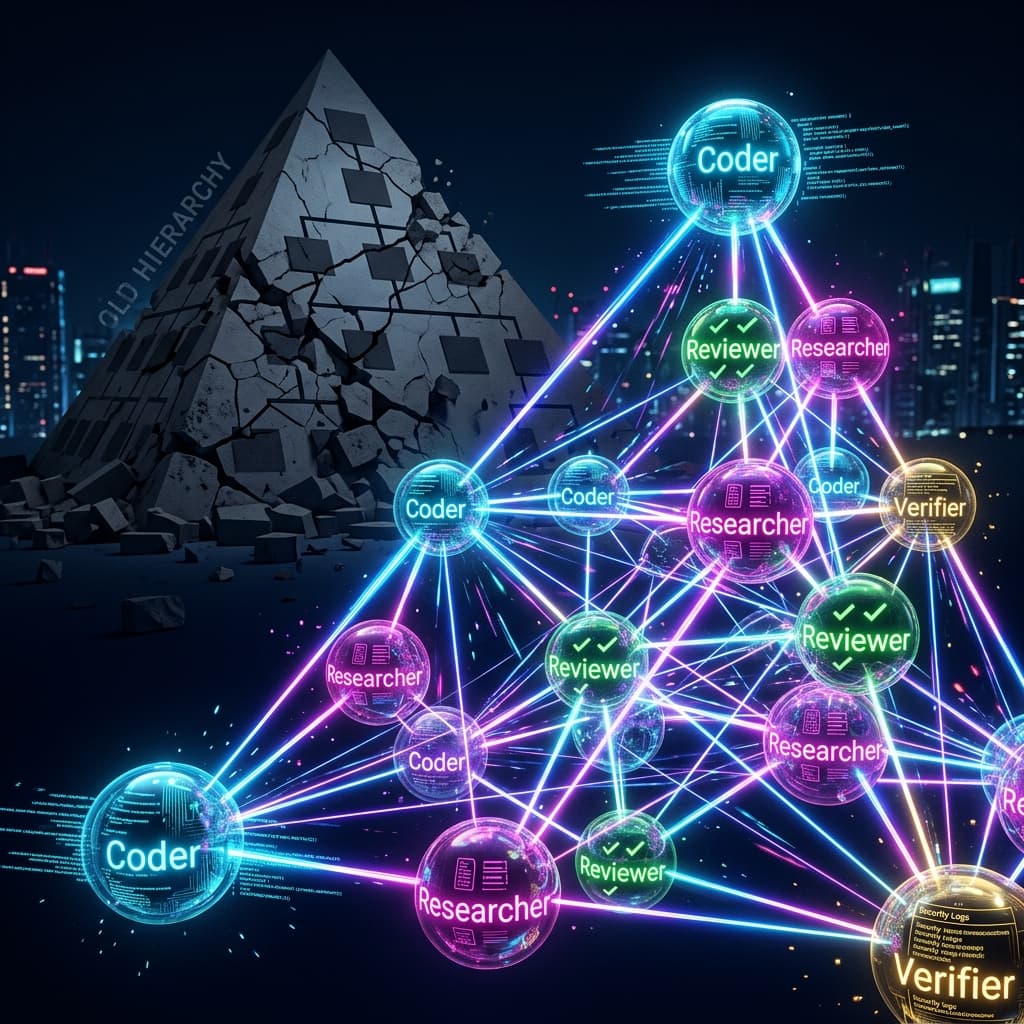
The Enterprise Agent Roadmap 2026: Multi-Agent Orchestration Patterns
Your vertical hierarchy is too slow for multi-agent systems. The Fractal Triad topology with LangGraph, CrewAI, and MCP integration for enterprise orchestration.
Read article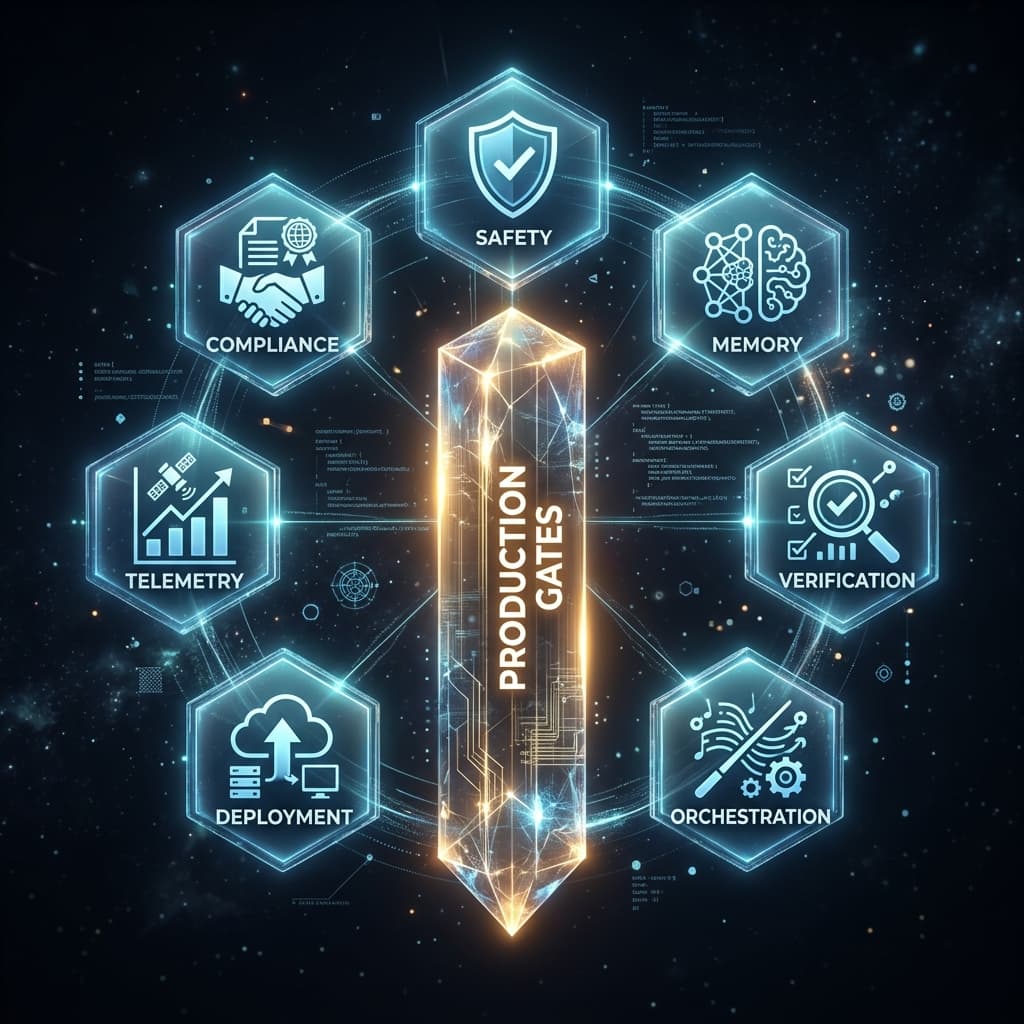
The 7 Pillars of Production Agent Systems: What Actually Matters in 2026
2026 marks the shift from AI demos to production deployments. Here's the architectural framework that emerged from analyzing AWS, Azure, Google Cloud, OpenAI, Anthropic, and Oracle's ap...
Read article
Graph Engineering: AI Architect’s Guide to Reliable Agents
Execution, context and control graphs for reliable AI agents, with runtime choices, failure modes and a 90-day adoption plan.
Read article