No Bad Parts: What Richard Schwartz Teaches Us About Building Sovereign AI
TL;DR
Most AI agents are built around one voice, one objective, one persona. Human intelligence is not single-agent — and the next generation of agentic systems will not be either.

Understand why single-voice agent design hides internal conflict, and how the IFS structural pattern (Self-orchestrator, manager / firefighter / exile roles, integration loops) translates into a more durable agentic architecture.
No Bad Parts: What Richard Schwartz Teaches Us About Building Sovereign AI
The lesson Internal Family Systems gives the next generation of agent architecture.
Most production AI is still built around one assumption:
One agent. One persona. One objective. One output.
That is not intelligence. That is a puppet with a prompt.
Human intelligence does not work like that. A person is a living system of impulses, memories, roles, defenses, longings, fears, dreams, and contradictions. One part wants expansion. One part wants safety. One part wants recognition. One part wants to disappear. One part builds the future. One part still lives in the past.
Richard Schwartz's Internal Family Systems model gives a precise vocabulary for this — and the architectural lesson it offers AI is exactly the layer most production agent stacks are missing.
IFS begins with a deceptively simple insight:
No bad parts — only burdened parts.
The IFS Institute describes Internal Family Systems as a non-pathologizing model in which people have many internal "parts" and a core Self capable of leadership and integration. That structural claim matters far beyond therapy. It is one of the cleanest available models for the next generation of multi-agent systems.
Not agents that execute. Not copilots that autocomplete. Not chatbots that simulate empathy. Sovereign systems that can hold complexity without fragmentation.
1. The mind is an internal family
IFS holds that the mind is naturally plural. This is not pathology — it is structure.
Parts take on roles. Some manage daily life. Some protect us from pain. Some carry wounds. Some react when pain breaks through. Some defend. Some attack. Some withdraw. Some perform.
Schwartz groups parts into three broad categories:
- Managers are proactive protectors. They try to keep life under control so vulnerable pain does not get triggered. Look like discipline; often run on fear.
- Firefighters are reactive protectors. They activate when emotional pain breaks through and try to extinguish it quickly — sometimes through numbing, distraction, rage, impulsivity, or escape.
- Exiles are wounded parts carrying shame, fear, grief, abandonment, humiliation, or unmet need. Usually pushed out of awareness so daily life can continue.
At the center is the Self — not another part, but the seat of leadership. Foundation IFS describes Self via the 8 Cs: calm, clarity, compassion, courage, confidence, curiosity, creativity, connectedness.
The point of IFS is not to delete parts. It is to restore inner leadership.
A perfectionist is not evil. A procrastinator is not stupid. A rage part is not a demon. An avoidant part is not the enemy. Each part has a logic. Each is trying to protect the system. The problem is not that parts exist — the problem is that parts can become extreme, burdened, outdated, or forced into leadership roles they were never meant to hold.
That is the architectural insight worth borrowing.
2. Mainstream agent design is still psychologically naive
The dominant agent pattern is still:
Goal → Tool Use → Memory → Action → Output
Useful. Not sufficient.
It assumes intelligence is primarily task execution. But intelligence is governance.
A person does not simply receive a goal and execute. The system negotiates internally:
Visionary:    "Build the company."
Protector:    "Do not get rejected."
Strategist:   "Package the offer."
Exile:        "What if nobody chooses us?"
Firefighter:  "Escape into stimulation."
Critic:       "Attack first so nobody else can."
Self:         "Slow down. I can listen."
That is psyche-level governance. It is not inefficiency.
Now look at AI. Most agents have instruction hierarchy, tool access, memory, and maybe reflection loops. They rarely have structured internal plurality. They do not know when a "protector" sub-process is overcontrolling the system. They do not know when a "firefighter" loop is producing short-term relief and long-term degradation. They do not know when a cached memory has become an exile — too painful, too ambiguous, too unresolved to integrate.
They do not have Self.
They have a system prompt pretending to be Self.
That distinction matters. A system prompt says:
Behave like this.
A Self-led architecture says:
Hold the system from a center that observes, prioritizes, integrates.
The first creates compliance. The second creates sovereignty.
3. Single-voice AI hides conflict instead of resolving it
When we build AI as one voice, we hide conflict instead of resolving it.
A single assistant answer compresses many invisible forces: intent interpretation, safety policy, helpfulness optimization, confidence estimation, memory retrieval, tool choice, tone adaptation, factual verification, refusal logic, persona maintenance, uncertainty handling.
Today, these fuse into one output stream.
That is blending.
In IFS, blending means a part takes over so completely that the person identifies with it. "A part of me feels afraid" becomes "I am afraid." "A part of me wants control" becomes "I must control." Self loses distance.
AI systems have the same problem. A retrieval module can dominate. A safety module can dominate. A persuasion objective can dominate. A persona can dominate. A memory can dominate. A user-pleasing loop can dominate.
The answer looks coherent from the outside. Internally, the system has no explicit model of which sub-process is leading.
A more mature architecture exposes and governs these internal roles. Not necessarily to the user. Inside the system.
A sovereign AI should know:
- Which part is speaking?
- Which part is protecting?
- Which part is optimizing?
- Which part is afraid of failure?
- Which memory is unresolved?
- Which constraint is legitimate?
- Which constraint is inherited noise?
- Which response comes from Self-level clarity?
That is not therapy cosplay. That is systems design.
4. Self-led agent architecture
A Self-led AI architecture is not a pile of agents. It is an internal family.
Bad multi-agent design:
Research Agent
Writing Agent
Critic Agent
Editor Agent
Planner Agent
Better — and structurally honest:
Self / Orchestrator
├── Visionary part
├── Strategist part
├── Protector parts
│   ├── Risk Guardian
│   ├── Ethics Guardian
│   ├── Privacy Guardian
│   └── Reputation Guardian
├── Manager parts
│   ├── Planner
│   ├── Editor
│   ├── Formatter
│   └── Standards Enforcer
├── Firefighter parts
│   ├── Crisis Handler
│   ├── Escalation Suppressor
│   └── Emergency Simplifier
├── Exile memory layer
│   ├── Unresolved Failures
│   ├── Rejected Ideas
│   ├── Painful Feedback
│   ├── Suppressed User Signals
│   └── Suppressed Preferences
└── Integration / Unburdening layer
    ├── Reflection
    ├── Reframing
    ├── Repair
    ├── Memory Update
    └── Role Reassignment
The key shift: do not just create more agents. Create governance where each agent has a role, a limit, and a transformation path.
The Self-orchestrator does not silence parts. It listens, weighs, and leads.
The protector does not become the product manager. The critic does not become the brand voice. The visionary does not ship production code unsupervised. The firefighter does not make long-term strategy. The exile memory does not define identity. The Self holds the system.
This is what existing patterns like orchestrator-worker, observability for multi-agent systems, and persistent agent memory point at — but rarely name as the same architectural problem.
5. "No bad parts" as a debugging model
"No bad parts" is a profound design doctrine.
In AI product design we usually treat failure modes as things to suppress: hallucination, refusal, overconfidence, sycophancy, verbosity, blandness, excessive caution, tool misuse, goal drift, memory pollution.
Suppression is necessary at times. Suppression alone produces brittleness.
IFS suggests a better question:
What is this failure mode trying to protect?
| AI failure | IFS lens | Better design response |
|---|---|---|
| Hallucination | Helpfulness part overreaching to avoid disappointing the user | Calibrated uncertainty + permission to say "I don't know" |
| Over-refusal | Protector part trying to avoid harm with no nuance | Contextual risk reasoning, not blanket refusal |
| Sycophancy | Attachment-preserving part maintaining rapport | Integrity constraints that bound agreeableness |
| Verbosity | Manager part preventing misunderstanding | Compression budget per response type |
| Blandness | Safety-preserving part suppressing aliveness | Tasteful risk budget, allow signature voice |
| Tool misuse | Action part without governance | Orchestration checks before consequential tool calls |
This does not excuse bad outputs. It gives a better debugging model. Instead of only punishing the behavior, we identify the internal role and redesign it.
6. Inner HR: the bridge between personal development and organizational AI
The same pattern applies one level up: leadership.
Traditional HR manages outer teams — roles, performance, conflict, retention, leadership, culture, incentives.
Every human also has an inner team. A person does not show up to work as one unified entity. They arrive with parts: the Achiever, the Pleaser, the Avoider, the Performer, the Critic, the Exhausted One, the Visionary, the Loyal One, the Angry One, the Child Who Still Wants Recognition.
Most corporate systems pretend this is not true. So they create outer structures while ignoring inner fragmentation. The result is predictable. Many leadership failures are not strategy failures. They are part-capture failures.
A founder's anxious part becomes the company culture. A manager's shame part becomes micromanagement. A salesperson's approval part becomes weak qualification. A product leader's control part becomes slow execution. An executive's exile around rejection becomes political behavior.
An IFS-informed Inner HR agent would not diagnose people. It would create structured self-leadership. It could ask:
- Which part is leading this decision?
- Which part is afraid?
- Which part is protecting your status?
- Which part wants to avoid conflict?
- Which part is carrying old evidence?
- Which part needs to be heard but not obeyed?
- What would Self-led leadership decide?
This is not wellness fluff. This is governance — for individuals and the teams they run. The product positioning is straightforward: Inner HR helps people lead their internal team so they can lead their external team without projecting unresolved parts into the organization.
7. Architecture sketch
A practical implementation:
User Interface
└── Conversational Reflection Layer

Self-Orchestrator
├── Intent Classifier
├── State Detector
├── Part Mapper
├── Memory Retriever
├── Safety / Ethics Guardian
├── Reflection Agent
├── Action Planner
└── Integration Engine

Part Models
├── Manager Detection
├── Firefighter Detection
├── Exile Signal Detection
├── Self-Energy Estimation
└── Polarization Mapping

Memory
├── User Values
├── Life Themes
├── Repeating Patterns
├── Emotional Triggers
├── Goals
├── Commitments
├── Repair Events
└── Unburdened Beliefs

Outputs
├── Reflection
├── Journal Prompt
├── Leadership Decision
├── Conversation Prep
├── Conflict Map
├── Personal Development Plan
└── Team Alignment Brief
This is not therapy. It is a self-leadership interface. The product should not say "I will heal your trauma." It should say "I help you notice which internal parts are active, create clarity, and make Self-led decisions."
The IFS Institute itself notes the clinical evidence base is still developing and more large-scale trials are needed. So the right product posture is not medical overclaiming. It is architectural wisdom applied to reflection, leadership, creativity, and alignment.
8. The bigger frame
The frontier of AI is no longer just more compute, more context, more benchmarks, more tools.
The frontier is architecture shaped by deeper models of mind.
IFS gives one of those models. It says intelligence is plural. Protection is not pathology. Conflict is information. Pain can be integrated. Leadership is not domination. The center must be calm enough to hold the system.
That is exactly what AI needs.
Not more obedient agents. More sovereign systems. Systems that can hold multiple internal voices without collapsing into chaos. Systems that can respect user complexity without manipulating it. Systems that can distinguish protection from truth, fear from wisdom, urgency from importance, and compliance from alignment.
Schwartz gave therapy a non-pathologizing model of the psyche. AI architects should pay attention. The next generation of intelligence systems will not be built only from transformers, tools, memory, and APIs. They will be built from better metaphors of mind.
One of the strongest is this:
No bad parts. Only burdened ones. No sovereign system without a Self at the center.
Continue
- Research: Self-Led AI Architecture — the technical brief
- Research: Internal Family Systems — the human-mind side
- Research: The Predictive Mind — why parts hold predictive models
- Guide: Internal Family Systems for Personal Development — the daily Self-led check-in
- Adjacent: AI Agents Need an Inner Family, Not Just a Task List — short-form companion piece
- Adjacent: Multi-Agent Orchestration Patterns 2026 — current production patterns this architecture extends
Sources
- IFS Institute. What is Internal Family Systems? https://ifs-institute.com/
- Foundation IFS. The 8 Cs of Self-Leadership Wheel (PDF). https://foundationifs.org/
- IFS Institute. Research. https://ifs-institute.com/resources/research
Architectural patterns. Not therapy.
Build your first AI system
Step-by-step guide to setting up ACOS, creating your first agent, and shipping real products with AI.
Start buildingProduction-ready architecture
Download AI architecture templates, multi-agent blueprints, and prompt engineering patterns.
Browse templatesJoin the builder community
Connect with creators and architects shipping AI products. Weekly office hours, shared resources, direct access.
Join the circle
Read on FrankX.AI — AI Architecture, Music & Creator Intelligence
Stay in the intelligence loop
Weekly field notes on AI systems, production patterns, and builder strategy.
Continue Reading

AI Agents Need an Inner Family, Not Just a Task List
Most agent stacks are glorified workflow runners. The next leap is internal governance — an orchestrator that knows which sub-process is leading, and why.
Read article
Memory as Exile: Why AI Systems Need Integration Loops
Long-term memory without integration creates psychological debt inside AI systems.
Read article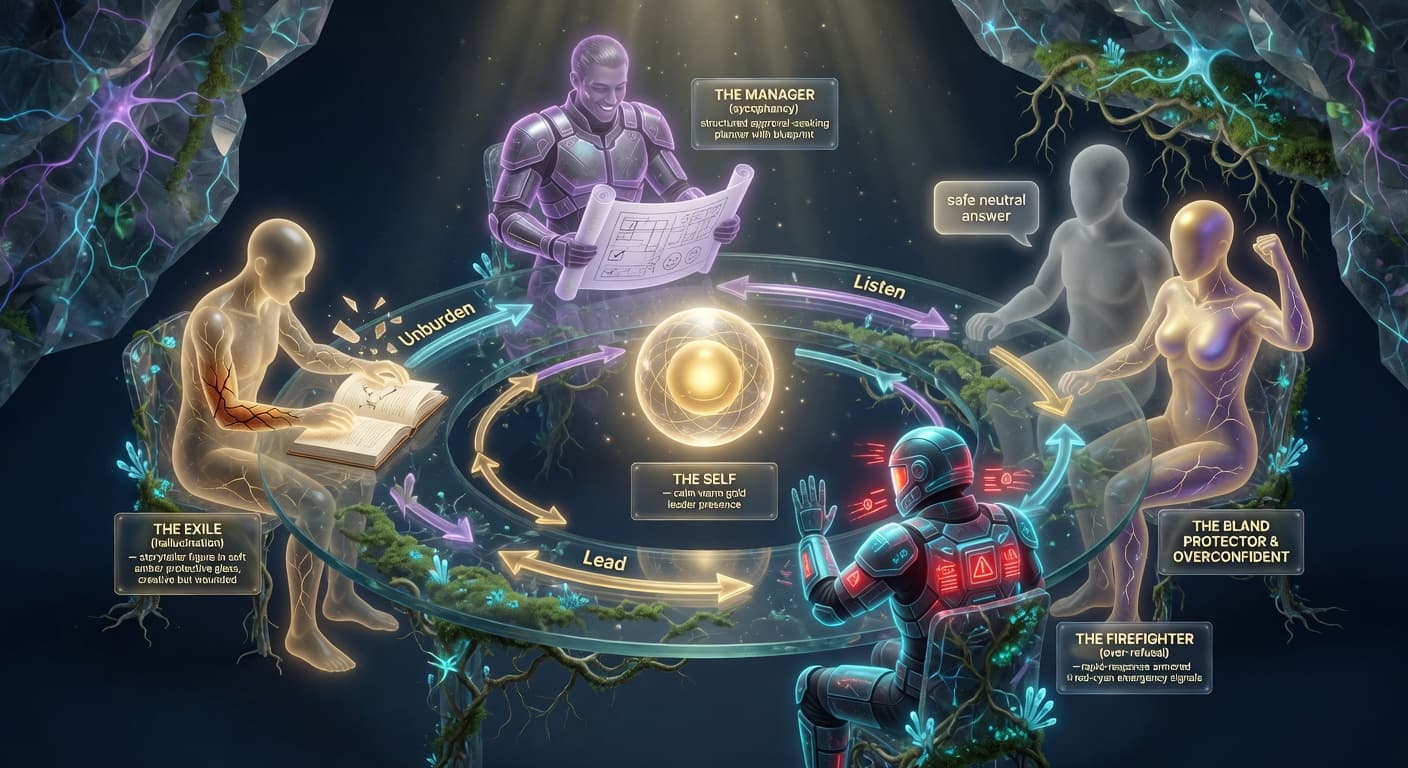
No Bad Parts: A Better Debugging Model for AI Failure Modes
Hallucination, sycophancy, refusal, blandness, and overconfidence are not just failures to suppress. They are overactive parts. Treat them that way and they get easier to fix.
Read article