The 4-Hour Workweek, Rebuilt for AI Architects in 2026
TL;DR
The modern four-hour workweek is a company whose goals, decision rights, evidence, and exception paths are explicit enough for AI agents, deterministic workflows, and human specialists to operate without pulling the founder into every loop. Definition and elimination come before automation. Liberation is the design constraint from the beginning.

Rebuild the DEAL framework (Definition, Elimination, Automation, Liberation) for autonomous AI agents, governed pipelines, and true founder leverage.
You can feel the paradox by late afternoon. The tools are faster, the inbox is fuller, and you have become the approval layer for a company that was supposed to give you room to live.
I know the pattern because my own work keeps creating versions of it: research, products, music, books, workshops, communities, and experiments, each meaningful enough to ask for attention. AI can multiply the output. It can also multiply the number of open loops.
That is the human problem underneath a modern four-hour workweek. You should be able to step away without feeling that customers, colleagues, or unfinished ideas will pay for your absence. If every system waits for your reply, you built a faster job around yourself.
Tim Ferriss organized The 4-Hour Workweek around DEAL: Definition, Elimination, Automation, and Liberation. This article rebuilds the 16 DEAL chapters plus “The Last Chapter” from the 2009 expanded edition for an era of agents, coding systems, connected assistants, and governed workflows. It does not reproduce the book's worksheets, vendor lists, bonus material, or case studies. Ferriss's official tools page exposes the chapter map, Penguin Random House identifies the expanded edition, and Ferriss's later retrospective calls Definition the most important step because it changes what “productive” means in the first place. If you want the book notes before the redesign, start with the FrankX library entry.
The framework aged better than many of its tools. Fax services, offshore virtual-assistant directories, and email scripts belonged to one technological moment. The durable proposal was human: reject busyness as status, remove low-value work, build systems that survive your absence, and decide what the recovered time is for.
AI gives us radically better machinery. The order of operations still matters.

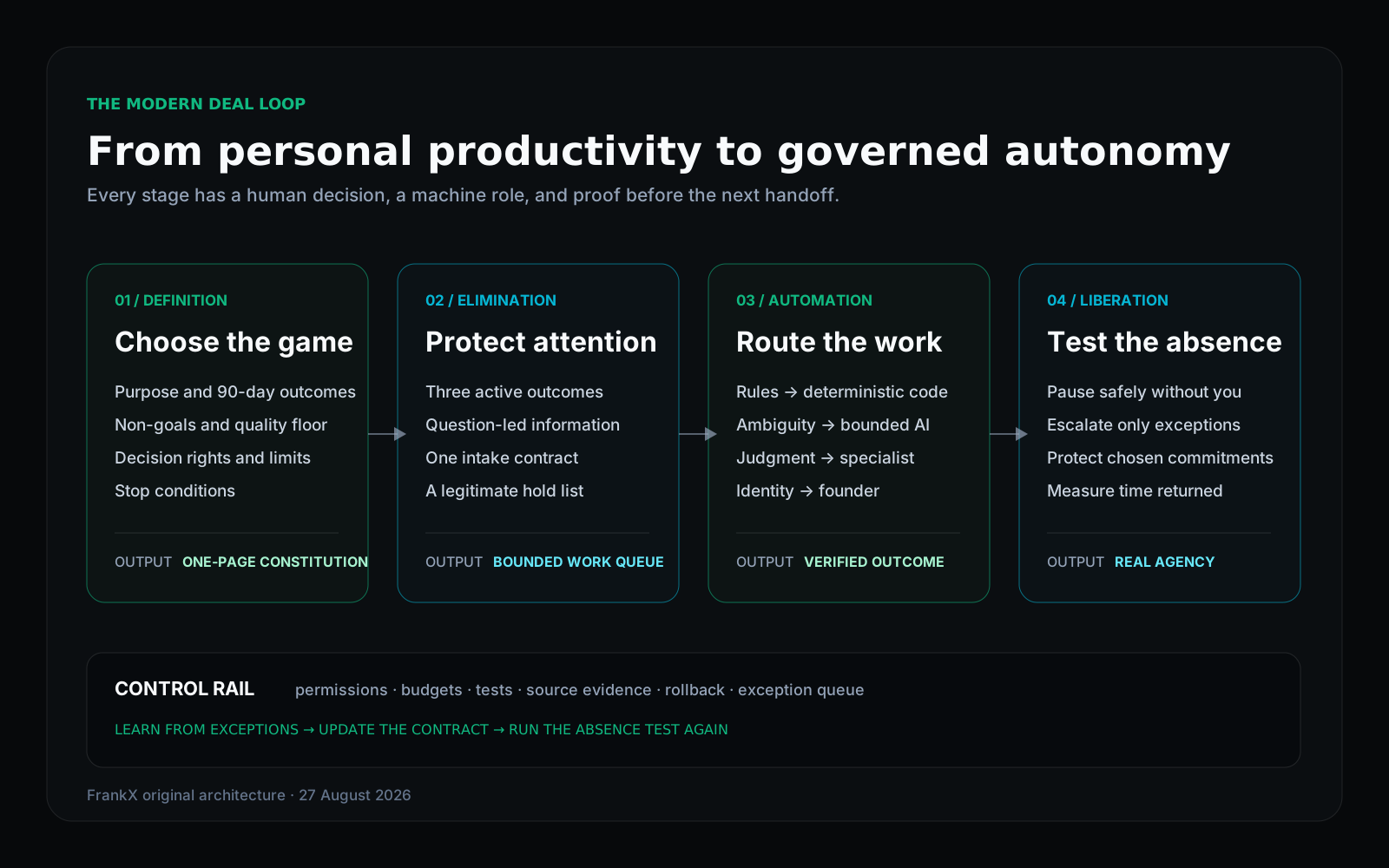
The proposal: from remote control to governed autonomy
The old virtual-assistant model was a remote pair of hands. A founder wrote a procedure, sent instructions by email, waited across time zones, checked the work, and improved the procedure. It was useful because it forced delegation into language.
The AI-era model is different in four ways:
- Cognition is elastic. Research, synthesis, drafting, classification, code, and analysis can run in parallel.
- Execution can cross tools. Agents can work through browsers, repositories, documents, calendars, and APIs when permissioned.
- Memory can persist. A governed knowledge layer can preserve decisions, standards, and prior outcomes instead of restarting from a blank prompt.
- Failure scales too. An ambiguous instruction can now produce many wrong actions at machine speed.
This is why an AI architect needs more than prompts. The system needs a brain, memory, tools, boundaries, evidence, and an owner.
| Layer | What it contains | What it must never decide alone |
|---|---|---|
| Intent | Goals, values, constraints, definition of done | Whether the goal is worth pursuing |
| Knowledge | Sources, portfolio context, policies, customer facts | Which unverified claim becomes public truth |
| Execution | AI agents, code agents, workflows, human specialists | Irreversible or high-consequence action without authority |
| Control | Permissions, budgets, tests, approval gates, rollback | Its own expansion of scope |
| Evidence | Diffs, citations, previews, logs, metrics, receipts | Whether a flattering metric represents progress |
| Exceptions | One queue for ambiguity, risk, blocked work, and judgment | The founder's entire day |
The allocation changes. Machines absorb bounded repetition and assist with analysis. People keep judgment, responsibility, relationships, and the right to stop the system.
Use AI first for reversible, private, well-scoped work. Use deterministic automation when the rule can be written. Use human specialists for regulated, adversarial, relational, or high-stakes judgment. Use the founder where identity, taste, capital, trust, or public consequence makes the founder non-fungible.

Definition: Chapters 1–4 become the company constitution
Ferriss begins before productivity. That is the part most AI automation advice skips.
| Original chapter | Modern refinement | Specific practice |
|---|---|---|
| 1. Cautions and Comparisons | Stop using hours, headcount, or prompt volume as the score. Compare agency, verified outcomes, and optionality. | Track founder hours reclaimed, cycle time to a verified outcome, and the number of decisions that no longer require you. |
| 2. Rules That Change the Rules | Challenge inherited assumptions: meetings must be synchronous, every brand must be active, every deliverable starts from zero, one model must do everything. | For each recurring obligation, ask: must this exist, must it be me, must it be live, and must it be custom? |
| 3. Dodging Bullets | Fear-setting becomes pre-mortem plus rollback design. AI makes action cheap, so reversibility matters more. | Write the failure, probability, blast radius, prevention, detection, rollback, and recovery owner before delegating. |
| 4. System Reset | “Unreasonable” goals become explicit constraints that force architecture. | Set a 90-day outcome, a maximum active-project count, a founder-hour ceiling, and a public quality floor. |
The definition layer should fit on one page:
- Purpose: what kind of life and company are we building?
- Outcomes: what must be true in 90 days?
- Non-goals: what will we deliberately not optimize?
- Decision rights: what may AI decide, what may a human specialist decide, and what remains founder-only?
- Quality floor: what evidence is required before work can be called done?
- Stop conditions: which events pause the system automatically?
For my own work, the constitution reads:
Build practical AI systems that help creators, founders, and operators think, create, automate, publish, and sell without losing their voice or handing away control.
That makes some work obviously central and some merely interesting.
Elimination: Chapters 5–7 protect attention before agents consume it
An agent can process a bad queue faster. It cannot make the queue worth processing.
| Original chapter | Modern refinement | Specific practice |
|---|---|---|
| 5. The End of Time Management | Replace task efficiency with portfolio throughput. A finished low-value task is still waste. | Choose three 90-day outcomes. Every task must advance one, maintain the system, or enter the hold list. |
| 6. The Low-Information Diet | Replace ambient feeds with question-led retrieval. Models need curated context, not permanent exposure to every signal. | Use scheduled research briefs, source ledgers, and dated snapshots. Turn off feeds that cannot name the decision they inform. |
| 7. Interrupting Interruption and the Art of Refusal | Move from inbox defense to interface design. People and agents need one intake contract and one exception queue. | Batch approvals, require complete briefs, define office hours for decisions, and reject requests without an owner or outcome. |
This is where most of the four-hour result is created. Not by a clever agent, but by refusing to grant every possible project production status. The technical companion is the solo-builder architecture guide: small maintenance surfaces are a form of elimination.
My current portfolio includes AI architecture research, FrankX publishing, creator operating systems, software products, music and narrative IP, workshops and education, community, distribution, and affiliate experiments. That breadth is an asset only if the fronts reinforce one another. Otherwise, it is a founder-interruption engine.
The practical move is a portfolio router:
| Workstream | Role | 90-day treatment |
|---|---|---|
| FrankX research and founder writing | Category authority and trust | Keep active; founder owns thesis and final public judgment |
| AI architecture and Starlight systems | Reusable technical substrate | Keep active when it produces a public reference, product capability, or operating advantage |
| ACOS and creator workflows | Execution layer | Consolidate into tested capabilities, not a growing list of unverified features |
| GenCreator and product experiences | Productization | Select one proof path at a time; measure activation before expanding |
| Arcanea, music, and narrative IP | Long-horizon creative asset | Protect a deliberate creation block; do not force it into daily marketing logic |
| Agentic Income and affiliates | Commercial experiments | Run only where reader value and verified attribution can be measured |
| Workshops and community | Human learning and relationships | Keep human-led; automate preparation, follow-up, and evidence capture |
That table is a proposal, not a claim that every lane is already optimized. The visible risk is fragmentation. The next refinement should be an explicit active frontier: three outcomes, one shared evidence ledger, and a hold list that is treated as a legitimate strategic state.
Automation: Chapters 8–11 become a governed workforce
Ferriss’s original automation section joined delegation with testing and management by absence. That combination is even more important now.

| Original chapter | Modern refinement | Specific practice |
|---|---|---|
| 8. Outsourcing Life | Build a capability map, not a chatbot collection. Match work to AI, deterministic workflows, or human specialists. | Delegate one bounded outcome with inputs, tools, authority, tests, escalation rules, and a receipt. |
| 9. Income Autopilot I: Finding the Muse | Use AI for discovery, but require evidence of a painful job, reachable buyer, and credible channel. | Run source-backed problem interviews, search-intent analysis, and competitor teardown before building. |
| 10. Income Autopilot II: Testing the Muse | App builders compress the prototype cycle; they do not validate demand. | Build the smallest test that can disprove the thesis: landing page, concierge workflow, paid pilot, or clickable product slice. |
| 11. Income Autopilot III: Management by Absence | Replace status meetings with observable state, service levels, and exception routing. | A system must expose current state, evidence, cost, failure, owner, and rollback without asking the founder to reconstruct it. |
The modern delegation packet
Do not tell an agent “handle marketing.” Give it a contract:
outcome: Qualify five evidence-backed article opportunities
inputs: approved source list, audience, existing canonicals
allowed_actions: research, cluster, draft briefs
forbidden_actions: publish, contact people, spend money
quality_tests: source recency, intent distinction, claim support
escalate_when: legal claim, unclear canonical, missing evidence
receipt: source ledger, decision table, rejected options
The same packet works for a human assistant. That is intentional. Good agent architecture is good organizational design made executable. For the broader production pattern, see multi-agent orchestration in 2026; for predictable cross-system execution, see the n8n workflow guide.
Which AI should do what?
There is no honest “one best AI.” The useful question is which surface has the right context, tools, and control for a job.
| AI surface | Proposed role in this system | Boundary to keep visible |
|---|---|---|
| ChatGPT + Codex | Source-led research and synthesis in ChatGPT; local, IDE, or delegated repository work through Codex | Availability varies by plan, app, and region; separate conversation from execution authority and review external actions and code changes |
| Claude + Claude Code | Analysis and drafting in Claude; codebase analysis, implementation, commands, and reusable project instructions through Claude Code | Put durable standards in project instructions; do not rely on one long conversation as memory |
| Gemini | Work grounded in Gmail, Drive, Docs, Calendar, Tasks, and the wider Google environment | Google explicitly warns that connected-app answers can be wrong or outdated; open the cited source before acting |
| Grok | Current X-native signal, public-conversation research, and tool-enabled search | Treat public-signal retrieval as research; do not mix private strategy with an ambient social context |
| Meta and Llama | Open-weight foundations for custom systems and controlled deployment paths | Model access does not remove the need to govern data, hosting, licenses, updates, and the surrounding application |
| Mistral Vibe | European AI option for work, coding, remote agents, connectors, and environments that value deployment choice | “European” is not a substitute for a data-flow review; verify hosting, retention, access, and subprocessors |
| Specialist tools | Source-bounded research, meeting capture, media production, workflow execution, observability | A specialist tool should own a narrow job, not become the accidental system of record |
AI work surfaces named in this guide
 Exact asset
 Exact asset
 Exact asset
 Exact asset
 Exact asset
 Exact asset
Official documentation now reflects the change from chat to work: ChatGPT apps can search, reference, and—with configured controls—take supported actions; Codex documents CLI, IDE, and cloud coding surfaces; Anthropic documents Claude Code as a tool-using codebase agent; Gemini connects to Workspace services; xAI exposes X Search for public signal; Meta positions Llama as an open-weight foundation for custom systems; and Mistral documents Vibe across work and code.
For a deeper assistant comparison, use ChatGPT vs Claude vs Gemini. For open and local deployment choices, use the open-model guide. The live portfolio view belongs in the FrankX stack, not in a static screenshot of subscriptions.
Liberation: Chapters 12–16 make absence a design test
Liberation is often misread as travel photography. The deeper idea is that work should not depend on one location, one schedule, or the founder’s constant presence.
| Original chapter | Modern refinement | Specific practice |
|---|---|---|
| 12. The Disappearing Act | Run an absence test. If you step away, does work pause safely or continue within boundaries? | Start with one day, then three. Record every unnecessary escalation and repair the contract that caused it. |
| 13. Beyond Repair: Killing Your Job | Redesign the role, prove an async or remote operating model, and choose independent work or exit when the role cannot be repaired. | Build runway, test a bounded remote/async pilot, separate employer IP and data from personal systems, and use qualified human or legal review before changing employment. |
| 14. Mini-Retirements | Build seasons of deep living into the operating calendar rather than postponing them. | Reserve multi-week creative, family, learning, or travel seasons before the business consumes the space. |
| 15. Filling the Void | Decide what reclaimed attention is for. Otherwise, leverage becomes more throughput and the calendar refills. | Name the craft, relationships, health, service, or exploration the system protects. Put it on the calendar first. |
| 16. The Top 13 New Rich Mistakes | Audit leverage failure: over-automation, tool sprawl, fake passive income, weak security, no measurement, and no meaningful use of freedom. | Run a quarterly “freedom audit” against agency, quality, concentration, resilience, and life outside work. |
The final chapter in the book is framed as an email worth reading. The modern equivalent is a message to your future self that no agent is allowed to optimize away:
What will I refuse to sacrifice, even if sacrificing it would make the system grow faster?
A system that discards that answer may accelerate the company while shrinking the life around it.

The skeptical case: leverage does not automatically become leisure
There is a serious objection to the entire premise: productivity gains can become higher quotas, more products, and more review debt instead of time returned to people.
The evidence is contextual, not magical. A large customer-support field study published in the Quarterly Journal of Economics found that generative AI increased issues resolved per hour on average, with different effects across workers. A controlled professional-writing experiment found faster completion and higher evaluated quality on bounded tasks. But a randomized study by METR found experienced open-source developers took longer with the AI tools available in early 2025, and METR's 2026 follow-up cautioned that newer estimates are difficult to interpret because developers selectively use AI where they expect it to help.
Sources: Generative AI at Work, MIT's summary of the writing experiment, METR's experienced-developer study, and METR's 2026 update.
The defensible conclusion is narrower: AI can create the technical capacity for a time dividend. Intake limits, ownership, governance, and deliberate allocation decide whether anyone receives it.
My 90-day AI Architect refinement
Here is the operating proposal I would apply to my own company now.
1. Name three outcomes
Not three hundred tasks. Three outcomes with dates and evidence:
- Authority: publish a small number of category-defining, source-grounded pieces and connect them to the research hub.
- Product: prove one complete path from useful idea to activated user, not several half-finished launches.
- Operations: make content and product delivery observable through one state model, one exception queue, and one weekly review.
Music, books, and Arcanea remain protected creative assets, but they do not all become active commercial launches in the same quarter.
2. Keep five decisions founder-only
I should remain the final authority for:
- Company purpose and portfolio bets.
- Public thesis, taste, and voice.
- Capital commitments and commercial promises.
- Relationship-critical messages and partnerships.
- Irreversible publication, legal, privacy, and reputational decisions.
Everything else must justify why it needs founder attention.
3. Create one exception queue
Every system—content, software, marketing, sales, and operations—should escalate into the same typed queue:
- Decision needed
- Evidence missing
- Risk or rights issue
- Budget or permission exceeded
- Quality failed
- Relationship judgment required
If an agent can interrupt me anywhere else, the architecture is unfinished.
4. Replace the weekly status meeting with a control review
The weekly view should answer:
| Question | Evidence |
|---|---|
| What shipped? | Live URL, release, delivery, or accepted artifact |
| What changed for a user? | Activation, reply, conversion, completion, or observed behavior |
| What failed? | Incident, rejected draft, broken assumption, or missed service level |
| What consumed founder time? | Exception category and root cause |
| What should stop? | Work with no owner, evidence, or link to an active outcome |
| What will the system attempt next? | Bounded queue with authority and tests |
The literal four-hour control plane
I would treat four hours as a weekly ceiling for compulsory founder control, not a ban on creative work:

| Founder hour | Agenda | Output |
|---|---|---|
| 1. Direction | Active outcomes, non-goals, and kill list | Updated portfolio frontier |
| 2. Economics | Revenue evidence, cost, concentration, and capital choices | Continue, change, hold, or stop decisions |
| 3. Exceptions | Risk, approvals, incidents, and recurring escalation | Decisions plus one root-cause repair per repeat exception |
| 4. People | Customers, partners, team, and community | Human commitments and relationship decisions |
Writing, music, building, learning, workshops, travel, and time with people may take far more than four hours because I choose them. The architectural test is whether the company collapses without constant founder routing.
5. Run the absence test
Take one full operating day out of the loop. Do not silently compensate from the phone. Let the system expose what it cannot yet do.
Every interruption becomes one of four repairs:
- clarify the goal;
- remove the work;
- improve the contract;
- reserve the decision for a human.
That is how the four-hour idea becomes measurable. Count how many valuable outcomes still depend on constant founder presence, then drive that number down.
A seven-day implementation sequence
Start with one clean loop. It will teach you more than an abstract “AI workforce transformation.”
- Day 1 — Definition: write the 90-day outcome, non-goals, decision rights, and stop conditions.
- Day 2 — Elimination: delete, defer, or batch at least 30 percent of the candidate work before choosing tools.
- Day 3 — Contract: write one delegation packet for one recurring outcome.
- Day 4 — Execution: assign reversible research or production work to an AI; keep side effects off.
- Day 5 — Verification: add a separate check, source review, and acceptance test.
- Day 6 — Automation: connect the stable handoff with a deterministic workflow, not another prompt.
- Day 7 — Liberation test: leave the loop and inspect what escalated, failed, or continued correctly.
Then repeat. A useful AI company is built by converting exceptions into architecture, not by pretending exceptions do not exist.
FAQ
Q: Does AI make a literal four-hour workweek realistic? For some owners and business models, perhaps. A literal four-hour week cannot be promised universally. AI can reduce the cost of cognition and execution, but demand, ambition, regulation, relationships, and competition can refill every hour. The more useful target is fewer founder-dependent decisions per verified outcome.
Q: What is the difference between a virtual assistant and an AI agent? A virtual assistant is a person who performs delegated work, often through procedures and communication. An AI agent is software that can plan and use tools within a defined environment. Human assistants bring judgment, context, and responsibility; agents bring elastic, repeatable execution. Strong systems use both and define where one must hand work to the other.
Q: Which AI is best for a solo founder? Choose by work surface, not leaderboard. ChatGPT and Claude are strong general work and implementation surfaces; Gemini is valuable when the work lives in Google Workspace; Grok is differentiated by current X-native signal; Meta is relevant when a Llama-based custom or controlled deployment fits the architecture; Mistral Vibe is a serious European work-and-code option. Start with one primary surface and add a second only for a distinct job.
Q: What should never be fully automated? Purpose, public accountability, regulated judgment, meaningful relationships, and decisions with irreversible financial, legal, safety, privacy, or reputational consequences should keep a named human owner. AI can prepare evidence and options; it should not erase responsibility.
Q: How do I know whether the system is creating freedom? Measure founder hours reclaimed, preventable escalations, cycle time to verified outcomes, rework, concentration risk, and whether protected life commitments actually occurred. If output rises but attention remains permanently captured, you built leverage without liberation.
The four-hour question worth keeping
The most important idea was never the number four.
It was the refusal to let inherited work define an entire life.
AI gives us extraordinary new workers: general assistants, coding agents, research systems, channel-native agents, open models, and deterministic automations. Their best use is deliberate allocation: human contribution becomes more intentional, machine action more bounded, and every consequential outcome easier to inspect.
The modern four-hour workweek is a company that can explain why it acts, show what happened, stop safely, and let its founder leave.
That is the proposal worth building.
Independent commentary on Tim Ferriss's book, published by Crown/Penguin Random House. FrankX is not affiliated with or endorsed by Tim Ferriss or the publisher.
Method note: source review and editorial architecture were developed in ChatGPT Work Mode; repository implementation and verification used Codex; original scene layers were created with native OpenAI image generation. Exact diagrams, citations, and platform marks remain deterministic and independently inspectable.

Read on FrankX.AI — AI Architecture, Music & Creator Intelligence
Stay in the intelligence loop
Field notes on AI systems, production patterns, and builder strategy.
Continue Reading
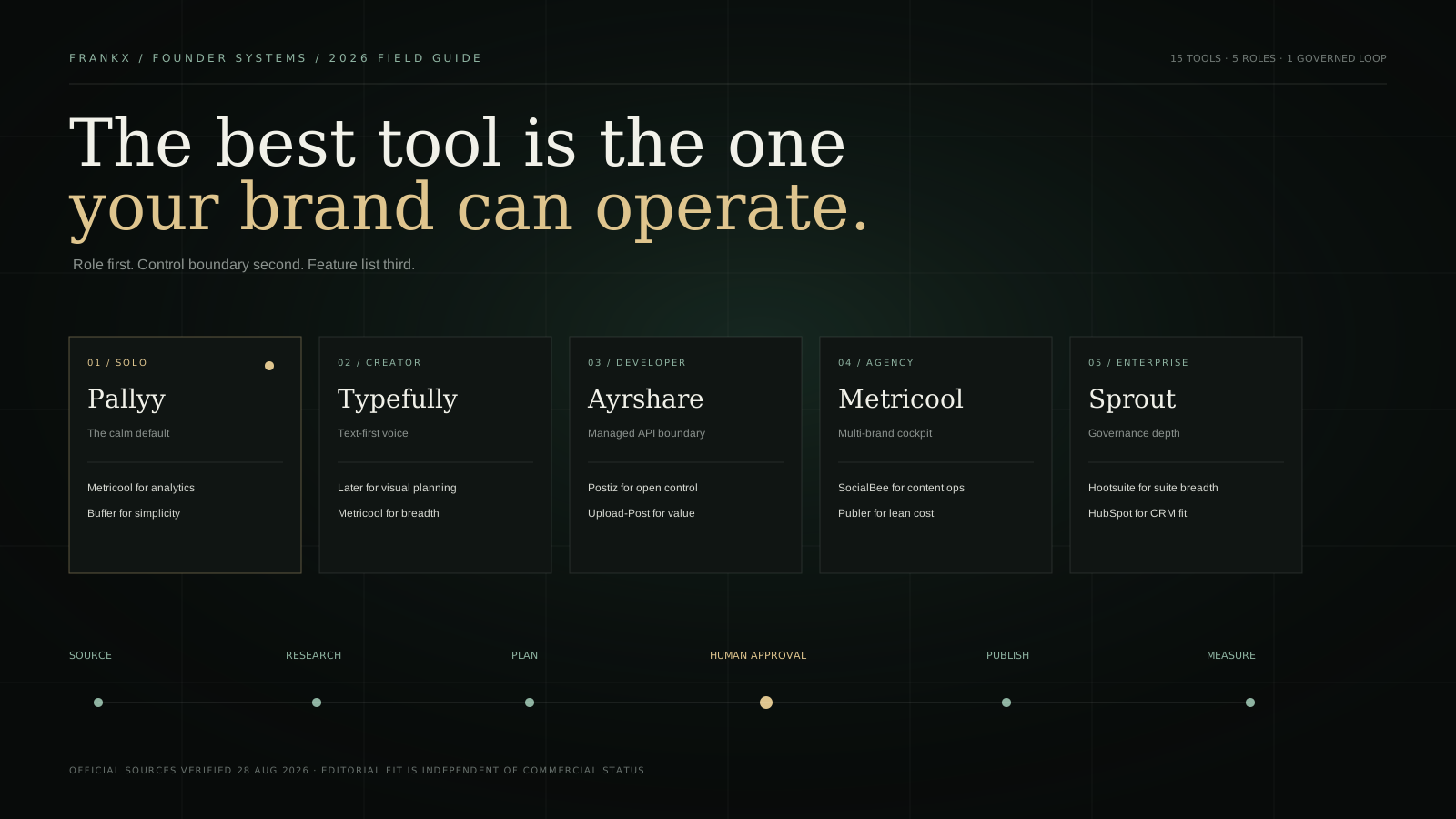
Best Social Media Management Tools for Founders (2026)
Compare 15 social media tools for solo founders, creator-led brands, developers, agencies, and enterprises—by cost, API, MCP, evidence, and fit.
Read article
Do You Need an RTX 5090 for AI?
A grounded buyer guide comparing RTX 5090 workstations, cloud GPU rental, RTX 5080, DGX Spark, and Ryzen AI Max+ mini PCs.
Read article
ElevenLabs and Higgsfield: a faceless YouTube production workflow
Create a narration-led YouTube video with ElevenLabs voiceover, a timed visual plan, selective Higgsfield B-roll and a publication checklist.
Read article