The Best Open & Local LLMs in 2026: A Self-Host Field Guide
TL;DR
In June 2026 you can run genuinely capable models on your own hardware — from a 2GB edge model to a frontier-class 1.6-trillion-parameter MoE. The honest picture: Gemma 4 (Apache 2.0) is the best quality-per-consumer-GPU pick, gpt-oss wins reasoning-per-VRAM, Phi-4 is the.

You'll learn actionable architectural frameworks, core implementation steps, and production strategies for the best open local llms in 2026 a selfhost field guide.
The Best Open & Local LLMs in 2026: A Self-Host Field Guide
TL;DR: In June 2026 you can run genuinely capable models on your own hardware — from a 2GB edge model to a frontier-class 1.6-trillion-parameter MoE. The honest picture: Gemma 4 (Apache 2.0) is the best quality-per-consumer-GPU pick, gpt-oss wins reasoning-per-VRAM, Phi-4 is the laptop/edge specialist, Mistral Large 3 is the EU-sovereign open frontier, Llama 4 brings multimodality and a 10M-context sibling, and DeepSeek V4 and Kimi K2.6 are the open-weight models that get closest to the closed frontier. None of them dethrone Claude Opus 4.8 or GPT-5.5 — the reason to self-host is control, privacy, license terms, and cost at volume, not the top of the leaderboard. Here's which one to run, and on what.
Why self-host at all in 2026?
The closed frontier — Claude Opus 4.8, GPT-5.5, Gemini 3.5 — still leads on raw capability. So the case for open weights isn't "it's better." It's four concrete things:
- Data control. Prompts and outputs never leave your environment. For regulated work (healthcare, legal, finance) or anything under a data-residency mandate, that's not a nice-to-have.
- License freedom. Apache 2.0 and MIT weights can be fine-tuned, redistributed, and embedded in a commercial product with no per-token meter and no vendor lock-in.
- Cost at volume. Open weights aren't free inference — you pay for GPUs. But past a certain steady throughput, owning the hardware beats renting tokens.
- Offline and edge. A model that runs on a laptop or a single GPU works on a plane, in a SCIF, or on a factory floor with no connectivity.
If none of those apply to your workload, route to a frontier API and move on. If one or more do, read on.
The decision in one table
| Model | Org | License | Params | Min VRAM (realistic) | Context | Best for |
|---|---|---|---|---|---|---|
| Phi-4 | Microsoft | MIT | 3.8B–15B | ~3-4GB (mini) → ~8-10GB (14B Q4) | 16K–128K | Laptops, edge, STEM/extraction |
| Gemma 4 | Apache 2.0 | E2B → 31B | ~2GB → ~18GB Q4 (31B) | 256K | Best quality on one consumer GPU | |
| gpt-oss | OpenAI | Apache 2.0 | 20B / 120B (MoE) | ~16GB (20b) / ~80GB (120b) | 131K | Reasoning-per-VRAM on one card |
| Mistral Large 3 | Mistral AI | Apache 2.0 | 675B / 41B (MoE) | 8×H200 (FP8) | 256K | EU sovereignty, multilingual |
| Llama 4 Maverick | Meta | Llama Community | 400B / 17B (MoE) | 8×H100 (Scout: 1×H100) | 1M (10M Scout) | Multimodal, permissive ecosystem |
| DeepSeek V4 | DeepSeek | MIT | 1.6T / 49B (Pro) | Data-center (Flash 284B self-hostable) | 1M | Max open coding capability |
| Kimi K2.6 | Moonshot | Modified MIT | 1T / 32B (MoE) | Data-center | 256K | Top open-weights intelligence |
Numbers are cross-checked against vendor model cards and the neutral Artificial Analysis Intelligence Index; "Min VRAM" reflects realistic quantized self-host, not the theoretical floor. MoE "active params" is misleading for memory — you still need every expert resident, so size for total parameters.
Pick by your hardware
A laptop (8–16GB)
Run Phi-4 (the 3.8B mini fits in ~3-4GB; the 14B at Q4 needs ~8-10GB), gpt-oss-20b (~16GB, and it reasons well above its size), or Gemma 4's 12B / E4B tiers. Phi-4 is the STEM and function-calling specialist; Gemma 4 12B adds native audio and vision; gpt-oss-20b is the strongest pure reasoner of the three. See the Phi-4 analysis and the Gemma 4 analysis.
One consumer GPU (24GB — 4090/5090)
Gemma 4 31B at Q4 (~18GB) is the sweet spot: frontier-tier quality, native multimodal, Apache 2.0, on a card you can buy. This is the single best "serious work on my own machine" option in 2026.
One data-center GPU (80GB — H100/MI300X)
gpt-oss-120b is purpose-built for this: MXFP4 quantization puts a near-o4-mini-class reasoner on a single 80GB card. DeepSeek V4-Flash (284B/13B) is the other strong single-node-ish option. Details in the gpt-oss analysis and the DeepSeek V4 analysis.
A multi-GPU node (8×H100 / 8×H200)
This unlocks the big MoEs: Mistral Large 3 (Apache 2.0, FP8 on one 8×H200 node), Llama 4 Maverick, DeepSeek V4-Pro (1.6T/49B), and Kimi K2.6 (1T/32B). These are the open models that get closest to the closed frontier — at the cost of a real infrastructure project.
Pick by your priority
- Privacy / offline / edge → Phi-4, Gemma 4, gpt-oss-20b.
- EU data sovereignty → Mistral Large 3: Apache 2.0, EU-resident endpoints, and a single-node FP8 self-host story built for GDPR.
- Maximum open capability (coding/agents) → DeepSeek V4 (80.6% SWE-bench Verified, MIT) and Kimi K2.6 (top open-weights on the AA Intelligence Index at 54).
- Multimodal, run locally → Gemma 4 (text/vision/audio) and Llama 4 (native text+image, 10M-context Scout sibling).
- Cleanest license → Apache 2.0 (Gemma 4, gpt-oss, Mistral Large 3) or MIT (Phi-4, DeepSeek V4). Watch the Llama Community License (free only under 700M MAU) and Kimi's Modified MIT.
The license landscape actually matters
A quiet but important 2026 story: Gemma 4 moved to Apache 2.0, dropping the custom "Gemma Terms" that governed Gemma 3. That puts Google's open family on the same permissive footing as gpt-oss and Mistral — unrestricted commercial use, no fine-tune disclosure, no redistribution friction.
The hierarchy, from most to least permissive for a commercial product:
- MIT (Phi-4, DeepSeek V4) and Apache 2.0 (Gemma 4, gpt-oss, Mistral Large 3) — do essentially anything.
- Modified MIT (Kimi K2.6) — permissive with minor conditions; read the text.
- Llama Community License (Llama 4) — free commercial use, but only under 700M monthly active users, with attribution requirements.
If you're embedding a model in a product you intend to scale, the license is as load-bearing as the benchmark.
Self-host vs API: the economics nobody likes
Open weights are free; inference is not. A single 8×H100 node is a six-figure capital expense or roughly $20–40/hour rented. The math that decides it:
- Low or spiky volume → a hosted endpoint (open models run ~$0.04–$1.50 per 1M tokens depending on size) is almost always cheaper than idle GPUs. Several of these models are available via OpenRouter, Together, Fireworks, and Groq.
- High steady volume → owning (or reserving) the hardware wins, because you amortize a fixed cost across saturated utilization.
- Data-residency mandate → the API option may simply be off the table, and self-host is the only path regardless of cost.
The trap is treating "$0 weights" as "$0 to run." For most teams, the right pattern is hybrid: prototype and burst on a hosted open endpoint, and only stand up your own GPUs once volume and/or compliance justify it.
Where these sit against the closed frontier
Be honest about the gap. On the neutral Artificial Analysis Intelligence Index, Claude Opus 4.8 sits around 61 and GPT-5.5 around 59–60. The best open weights — Kimi K2.6 (54) and Qwen3.7-Max (56.6, though closed) — are a real step behind, and the locally-runnable models (Gemma 4, gpt-oss, Phi-4) trade more capability for the privilege of fitting on your hardware.
That's the correct trade, not a disappointment. You self-host to own the model, run it offline, keep data in-house, and avoid a per-token meter — and in 2026 you can do all of that with quality that would have been frontier-class barely a year ago. For the full proprietary comparison, see the Frontier AI Models Intelligence Hub.
FAQ
What's the best open-source LLM in 2026?
For raw capability, DeepSeek V4 and Kimi K2.6 lead the open-weight field (Kimi tops the neutral Artificial Analysis Intelligence Index among open models at 54). For something you can actually run on your own hardware, Gemma 4 (best on one consumer GPU) and gpt-oss (best reasoning-per-VRAM) are the picks. There's no single winner — it depends on your hardware and license needs.
What's the best LLM I can run on a laptop?
Phi-4 (3.8B mini in ~3-4GB, 14B in ~8-10GB at Q4), gpt-oss-20b (~16GB), or Gemma 4's 12B / E4B tiers. Phi-4 is the STEM/extraction specialist; gpt-oss-20b is the strongest reasoner; Gemma 4 12B adds native audio and vision.
Is "17B active" the amount of VRAM I need?
No. Mixture-of-Experts models like Llama 4 Maverick (400B total / 17B active) or DeepSeek V4 still need every expert resident in memory, so you size for total parameters, not active. "17B active" describes compute per token, not memory footprint.
Are open weights free to run?
The weights are free; the inference is not. You pay for GPUs (capex or rental). Self-hosting only beats a hosted API at high steady volume or under a data-residency requirement. For low or spiky usage, a hosted open-model endpoint (~$0.04–$1.50 per 1M tokens) is usually cheaper.
Which open model has the most permissive license?
The MIT-licensed (Phi-4, DeepSeek V4) and Apache 2.0 (Gemma 4, gpt-oss, Mistral Large 3) models — all allow unrestricted commercial use, fine-tuning, and redistribution. Gemma 4 notably moved to Apache 2.0 from the custom Gemma Terms. Llama 4's Community License is free only under 700M monthly active users.
Can an open model match Claude Opus 4.8 or GPT-5.5?
Not on raw capability — the best open weights trail the closed frontier by a meaningful margin on neutral benchmarks. They match or beat the frontier on the axes that make people self-host: data control, license freedom, offline operation, and cost at scale.
Analysis by Frank — AI Architect, builder of the Agentic Creator Operating System. Compiled June 5, 2026 from vendor model cards and independent sources (Artificial Analysis, llm-stats, LMArena, NIST/CAISI). Verified vs vendor-claimed figures are distinguished in each model's linked writeup.

Read on FrankX.AI — AI Architecture, Music & Creator Intelligence
Stay in the intelligence loop
Field notes on AI systems, production patterns, and builder strategy.
Continue Reading
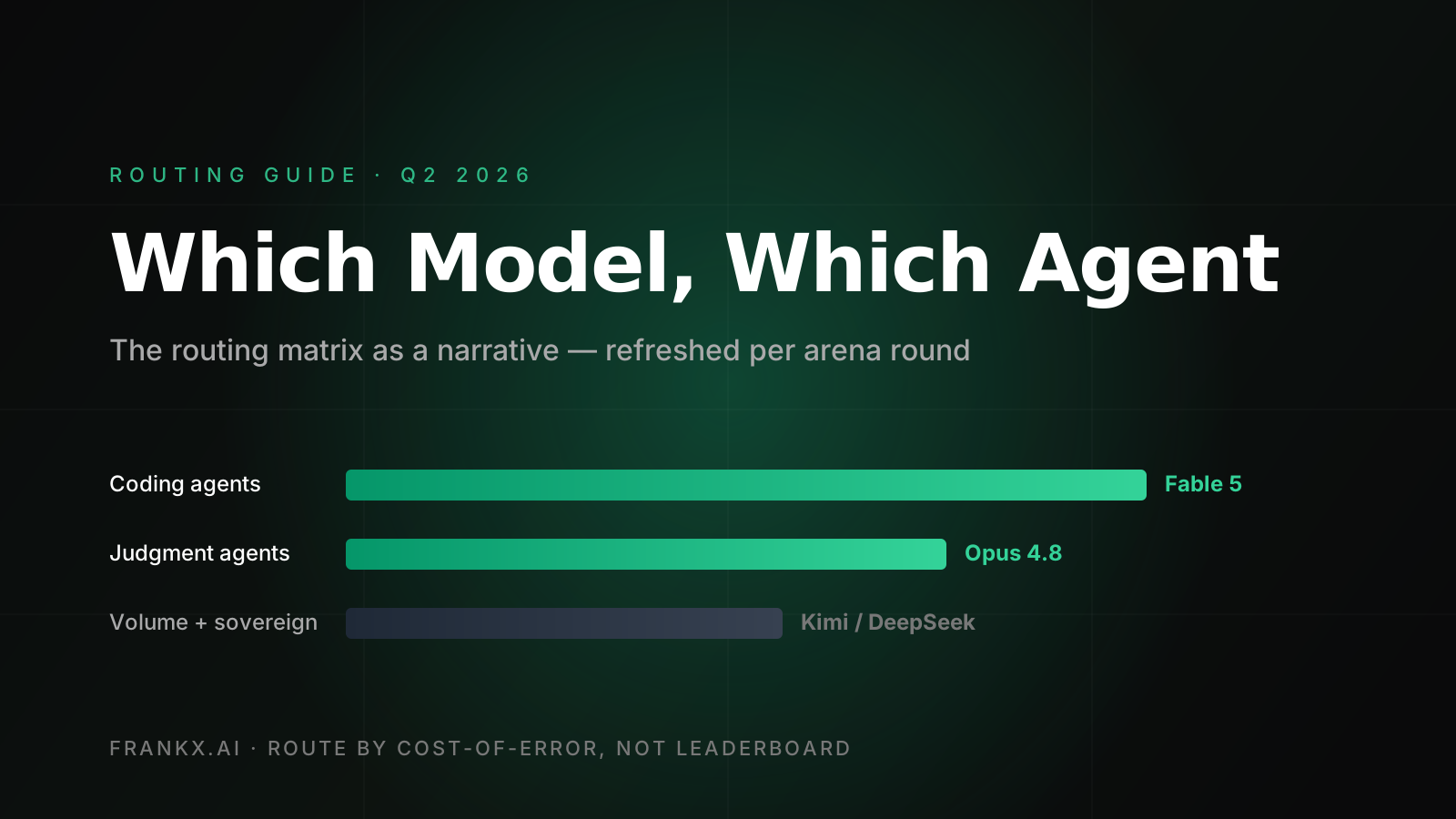
The AI Model Routing Guide: Which Model for Which Agent (Q2 2026 Edition)
Architectural guide to dynamic model routing: balancing latency, token economics, and reasoning depth across production AI applications.
Read article
Claude Fable 5: Benchmarks, Pricing, and What Four Day-One Evals Actually Show
Anthropic released Claude Fable 5 on June 9, 2026 — a Mythos-class model made generally available. Launch benchmarks: 95% SWE-bench Verified, ~80% SWE-bench Pro.
Read article
Claude Opus 4.8: A Modest Bump That Quietly Tops the Leaderboard
Anthropic's Opus 4.8 lands 41 days after 4.7 with the same $5/$25 pricing, SWE-Bench Pro 69.2%, GDPval-AA 1890, dynamic workflows, and cheaper fast mode.
Read article