Do You Need an RTX 5090 for AI?
TL;DR
A grounded buyer guide comparing RTX 5090 workstations, cloud GPU rental, RTX 5080, DGX Spark, and Ryzen AI Max+ mini PCs.

Decide whether to buy an RTX 5090 AI workstation, rent cloud GPUs, or build a smaller local AI setup first.
Short answer: most people do not need an RTX 5090 for AI. They should start with paid frontier tools, the laptop they already own, and a small local LLM. But if you are building a daily creator/founder AI lab - image generation, video, ComfyUI, local model testing, private files, coding agents, and batch production - the RTX 5090 is the cleanest first serious machine in 2026 because 32GB of CUDA VRAM changes what feels practical.
This is the buying question I care about: not "what is the fastest GPU?" but when does local AI hardware become a better business decision than cloud/API spend?
My current verdict for the FrankX stack:
- Keep ChatGPT/Claude/API tools for frontier reasoning.
- Use the current laptop for local LLM learning.
- Buy one RTX 5090 workstation first if the lab will be used daily.
- Do not make an RTX 5080 the flagship AI lab machine.
- Add a Ryzen AI Max+ 395 mini PC or DGX Spark later only when you need an always-on local model node.
I am turning this research into the AI Computer Field Guide, a living FrankX hub for creators and founders choosing between cloud AI, local LLMs, GPU workstations, and private AI factory setups.
What I compared
I looked at five practical lanes:
| Option | What it buys you | Current read |
|---|---|---|
| Cloud/API only | Frontier models, no upfront hardware, rentable GPUs | Best if heavy GPU work is occasional. |
| Current laptop + local LLM | Privacy learning, small models, no major cost | Best first step for almost everyone. |
| RTX 5080 workstation | Strong 16GB CUDA workstation | Good PC, weak flagship AI-lab choice. |
| RTX 5090 workstation | 32GB CUDA VRAM for local creator AI | Best first serious local AI workstation. |
| Ryzen AI Max+ / DGX Spark | Unified-memory local LLM node | Best as Node-02, not the first creator workstation. |
The RTX 5090 matters because NVIDIA's official page positions it as a Blackwell GeForce card with 32GB GDDR7 memory and a USD 1,999 starting price. The RTX 5080 is strong, but NVIDIA lists it with 16GB GDDR7. For local AI, VRAM is not a vanity spec. It decides model size, batch size, image/video headroom, and how often you hit out-of-memory errors.
The money: local vs cloud GPU
RunPod lists RTX 5090 rental at USD 0.99/hour. Using a planning conversion of EUR/USD 0.93, that is about EUR 0.92/hour before any extra storage, idle, or workflow overhead.
For local ownership, I used a conservative Netherlands reference: an Azerty Ryzen 9 9950X3D / RTX 5090 / 64GB / 4TB Windows 11 Pro desktop at EUR 6,999. Then I annualized it over three years, assumed 35% resale value, EUR 0.35/kWh electricity, and about 0.70kW active system draw under heavy GPU work.
| Heavy GPU use | Cloud RTX 5090 rental | Local RTX 5090 annualized | Read |
|---|---|---|---|
| 10h/week | about EUR 479/year | about EUR 1,644/year | Cloud wins financially. |
| 20h/week | about EUR 958/year | about EUR 1,771/year | Cloud still wins if friction is low. |
| 40h/week | about EUR 1,915/year | about EUR 2,026/year | Near break-even. |
| 80h/week | about EUR 3,830/year | about EUR 2,536/year | Local wins. |
| 24/7 | about EUR 8,043/year | about EUR 3,657/year | Local wins strongly. |
The spreadsheet answer is honest: do not buy a 5090 just to save money if you only run heavy GPU jobs a few hours a week.
The strategic answer is more interesting: a serious local machine buys creative speed, privacy, failed-run tolerance, no file-transfer drag, no rented setup every time, and a machine you can build public proof around. If your work is daily and iterative, those are real economics even when they are hard to model.
Why I would not choose the RTX 5080 first
The RTX 5080 is not bad. It is just the wrong compromise for a flagship AI lab.
NVIDIA lists the RTX 5080 at 10,752 CUDA cores, 1,801 AI TOPS, and 16GB of GDDR7. For gaming and general creative work, that is powerful. For local AI, 16GB is the ceiling you will feel first.
That means:
- smaller local models,
- tighter ComfyUI workflows,
- less image/video headroom,
- more compromises on batch size and resolution,
- faster replacement pressure.
If a 5080 desktop costs EUR 3,100-4,500 depending on configuration, the saving can look attractive. But for a public FrankX AI lab, the whole point is to avoid building the flagship around the constraint we already know matters.
What about Ryzen AI Max+ 395?
Ryzen AI Max+ 395 is one of the most interesting local AI chips right now. AMD's official material lists 16 cores, Radeon 8060S graphics, 128GB max memory, LPDDR5x-8000, and 40 graphics cores. AMD also says 128GB Ryzen AI Max+ systems can allocate up to 96GB as Variable Graphics Memory for local AI workloads.
That is extremely useful for large local LLMs. A 128GB Ryzen AI Max+ mini PC can be a quiet, efficient, always-on local model server.
But it is not my first buy for a creator lab because CUDA still dominates the creator AI software lane: ComfyUI workflows, video/image acceleration, PyTorch examples, extensions, and the wider creator GPU ecosystem. Ryzen AI Max+ is a brilliant Node-02. It is not the best first daily creator workstation.
What about DGX Spark?
NVIDIA describes DGX Spark as a personal AI supercomputer with 128GB unified memory, up to one petaFLOP of FP4 AI compute, fine-tuning up to 70B, and inference up to 200B. That is a credible lab appliance.
The issue is role. DGX Spark is not the same thing as a Windows creator workstation with an RTX 5090. It may be a strong second node if your work becomes local model R&D, NVIDIA stack demos, or large local inference. It is not the first machine I would buy for FrankX content creation, local image/video, and daily founder workflows.
The machine stack I would build
Think in phases, not gadgets.
| Phase | Name | Who it is for | Stack |
|---|---|---|---|
| 1 | Subscription CoE | Most creators and founders | ChatGPT, Claude, Perplexity, API budget. |
| 2 | Local starter | Privacy-curious builders | Existing laptop, Ollama, LM Studio, Jan. |
| 3 | AI workstation | Daily creator labs | RTX 5090 desktop, CUDA, ComfyUI, local LLMs, editing, coding. |
| 4 | Private AI factory | Advanced founders and studios | 5090 workstation plus AI Max+ or DGX node, NAS, scheduler, RAG vault. |
The phrase I would use publicly is AI computer. It is plain, searchable, and useful. Internally, you can call the full setup an AI lab. The advanced multi-node version is a private AI factory.
What I would buy right now
For a Netherlands/Germany buying lane, my first shortlist is:
| Vendor | Current reference | Why it matters |
|---|---|---|
| Azerty | Ryzen 9 9950X3D / RTX 5090 / 64GB / 4TB at EUR 6,999 | Strong buy-now Netherlands reference with Windows Pro and local support. |
| ALTERNATE | Premium ASUS-powered RTX 5090 desktop at EUR 7,799 | Good business quote target, but public config is expensive. |
| Caseking | 9950X3D / ASUS TUF RTX 5090 / 64GB / 8TB at EUR 7,199.90 | Strong German reference, especially if storage matters. |
| MemoryPC / Amazon DE | Lower-price RTX 5090 class listings | Interesting value, but only after written BOM and support confirmation. |
| GMKtec | EVO-X2 Ryzen AI Max+ 395 128GB / 2TB at EUR 3,079.99 | Best always-on local LLM Node-02 candidate. |
Before buying any prebuilt, ask for:
- exact GPU model,
- exact PSU model and wattage,
- exact motherboard,
- RAM layout and future expansion,
- SSD model,
- cooling and case airflow,
- warranty path,
- business invoice/VAT handling,
- substitution policy.
If a seller will not name the PSU or motherboard, I would not buy the machine.
Where this fits FrankX.ai
This is not just a hardware purchase. It can become a public research and affiliate engine:
- buyer guides,
- setup checklists,
- local LLM recipes,
- cloud vs local calculators,
- ComfyUI and creator workflow benchmarks,
- vendor questions,
- AI lab architecture diagrams,
- transparent affiliate recommendations.
The public rule is simple: affiliate links are fine only when the recommendation would stay the same without the commission. The reader should always see the logic, the risk, the date researched, and the source trail.
For the surrounding strategy, read Best Local LLM to Run on Your Own Machine in 2026, Build a Personal AI CoE Under $100/Month, and the AI Architecture hub.
Final recommendation
If you are a normal AI user, do not start with a 5090. Start with subscriptions and your current machine.
If you are a daily creator/founder building a local AI lab, buy the RTX 5090 workstation first. Cloud remains part of the stack for frontier reasoning. Ryzen AI Max+ or DGX Spark can come later as a second local model node. The RTX 5080 is the tempting middle path, but for serious local AI it is the wrong flagship compromise.
That is the core of the AI Computer Field Guide: buy capability only when the workflow is real.
Sources
- NVIDIA GeForce RTX 5090
- NVIDIA GeForce RTX 5080
- NVIDIA DGX Spark
- AMD Ryzen AI Max+ 395
- AMD Ryzen AI Max+ 395 local AI memory update
- RunPod GPU pricing
- Azerty RTX 5090 desktop
- ALTERNATE RTX 5090 desktop
- Caseking PC systems
- GMKtec EVO-X2 EU
FAQ
Do I need an RTX 5090 to run local AI?
No. You can run useful local models on a normal laptop with Ollama, LM Studio, or Jan. The RTX 5090 becomes compelling when you need daily high-throughput local AI: image generation, video, ComfyUI, larger models, coding workflows, and private creator production.
Is cloud cheaper than buying an RTX 5090?
For occasional heavy GPU work, yes. At RunPod's listed RTX 5090 price of USD 0.99/hour, cloud rental is cheaper below roughly 40 heavy GPU hours per week. Local ownership wins as usage becomes daily, private, iterative, or close to 24/7.
Is the RTX 5080 enough for AI?
It is enough for many workloads, but I would not choose it as a flagship local AI lab machine. Its 16GB VRAM ceiling is the tradeoff that limits local models and creator workflows first.
Is Ryzen AI Max+ better than an RTX 5090 for local LLMs?
It can be better for memory-heavy local LLM serving because 128GB unified memory and up to 96GB VGM allow much larger quantized models. It is not better for CUDA-heavy creator AI workflows. The best architecture is often both: RTX 5090 for GPU creative bursts, Ryzen AI Max+ as an always-on model node.
What is a private AI factory?
A private AI factory is a local-plus-cloud system that produces useful outputs continuously: research, drafts, images, video tests, code, automations, RAG answers, and business intelligence. It usually starts as one AI workstation, then grows into multiple nodes, storage, queues, and a private knowledge base.

Read on FrankX.AI — AI Architecture, Music & Creator Intelligence
Stay in the intelligence loop
Field notes on AI systems, production patterns, and builder strategy.
Continue Reading
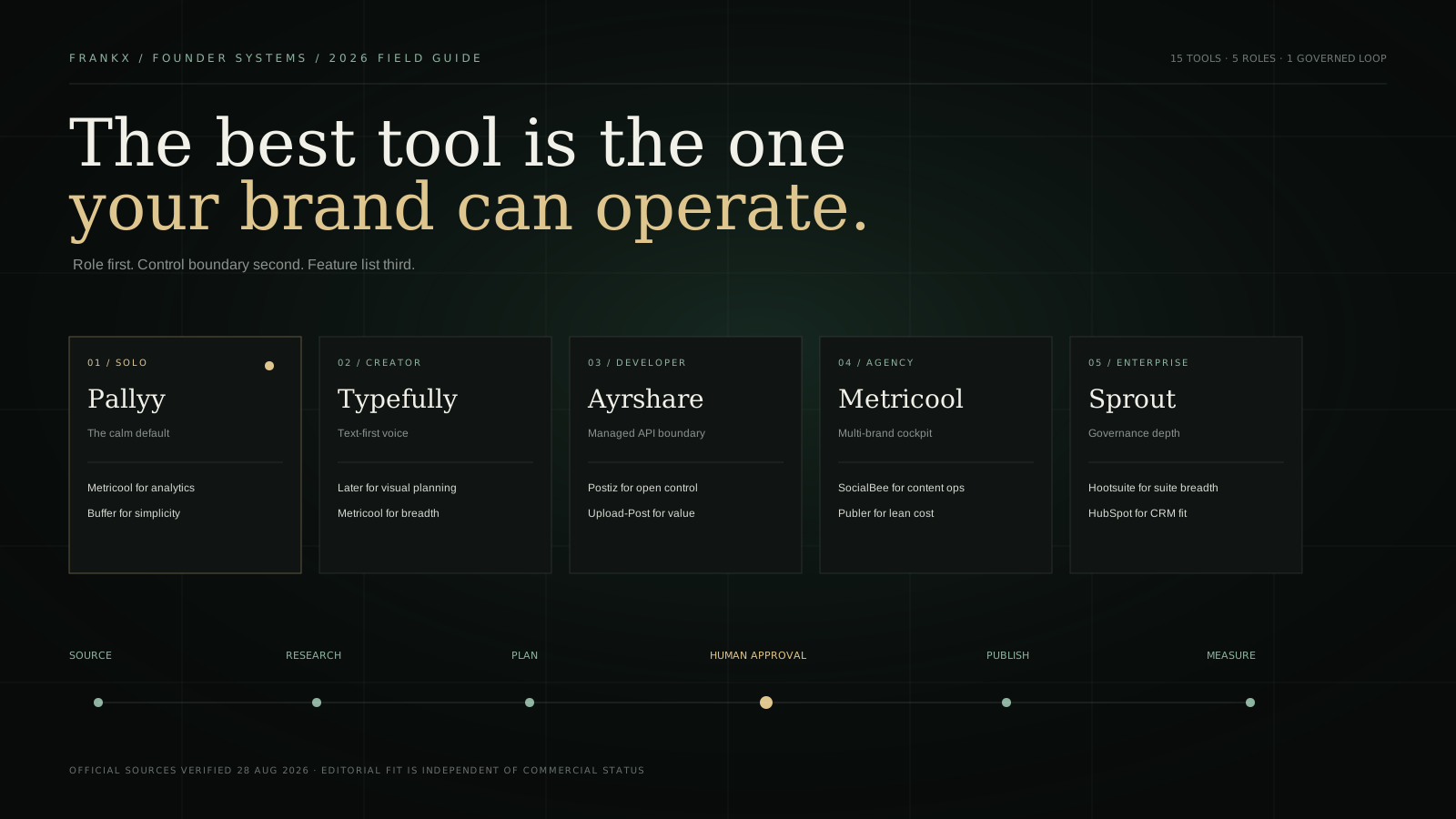
Best Social Media Management Tools for Founders (2026)
Compare 15 social media tools for solo founders, creator-led brands, developers, agencies, and enterprises—by cost, API, MCP, evidence, and fit.
Read article
The 4-Hour Workweek, Rebuilt for AI Architects in 2026
Every DEAL chapter rebuilt for founders using AI agents, governed automation, human specialists, and deliberate freedom.
Read article
ElevenLabs and Higgsfield: a faceless YouTube production workflow
Create a narration-led YouTube video with ElevenLabs voiceover, a timed visual plan, selective Higgsfield B-roll and a publication checklist.
Read article