Best Social Media Management Tools for Founders (2026)
TL;DR
For one compact brand, start with Pallyy. Choose Metricool when analytics, competitor reporting, multi-brand operations, or its official MCP surface will be used. Choose Typefully for a text-first founder voice, Later for visual creator planning, Ayrshare for product-grade social API infrastructure, Postiz or Mixpost for self-hosted control, and Sprout Social or Hootsuite for enterprise governance. HubSpot makes sense when social must connect to an existing CRM and revenue-attribution system.

Choose a right-sized social media control plane, understand its automation boundary, and run a 30-day proof before committing to annual complexity.
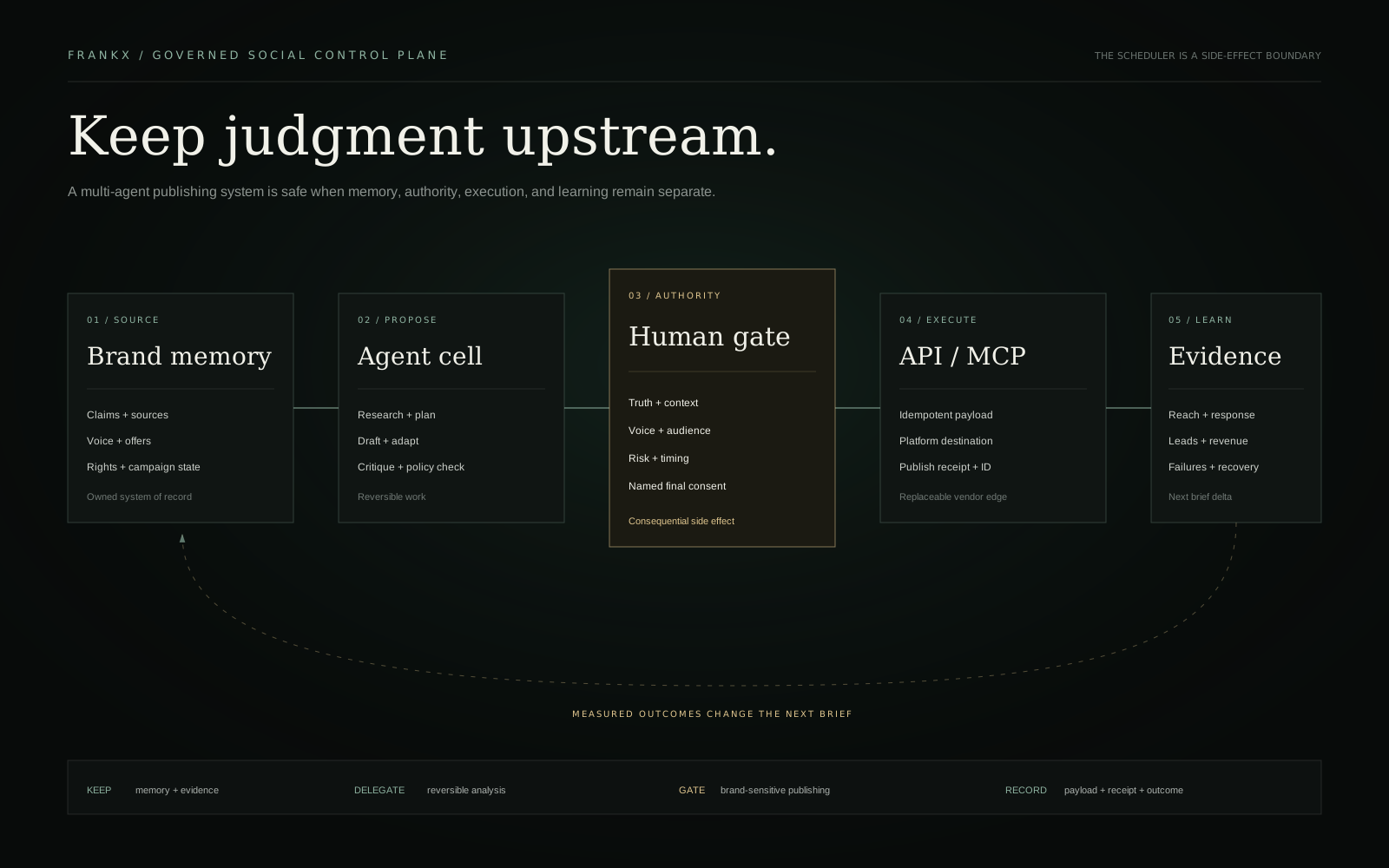
Treat the scheduler as a replaceable side-effect boundary. Keep brand memory and performance evidence in an owned system, require human approval before consequential publication, and select the smallest platform that proves the current operating loop.
AI CoE pillar: Creator operations and governed distribution
- Solo founder: Pallyy first; Metricool when analytics or MCP becomes central
- Creator-led brand: Typefully for text, Later for visual planning, Metricool for broader measurement
- Developer brand: Ayrshare for managed infrastructure; Postiz or Mixpost for control
The best social media management tool for most solo founders in 2026 is Pallyy. It has a focused operating surface, a free entry point, a $15 Starter plan, and a $25 Pro plan with broader accounts, analytics, approvals, inbox, and API access.
Choose Metricool instead when analytics, competitor reporting, multi-brand work, or an official MCP connection to an AI assistant will be part of your weekly system. Choose Typefully if your brand is primarily a founder voice on text-led networks. Choose Ayrshare, Postiz, Mixpost, or Upload-Post when software—not a human calendar—is the primary operator.
That is the short answer. The durable answer starts with a more useful question:
What kind of brand are you operating, and which complexity will you actually use?
The short answer: the best social media tool by operating role
| Your operating role | Start here | Move when | Why |
|---|---|---|---|
| Solo founder, one compact brand | Pallyy | Move to Metricool when reporting, competitors, ads, or MCP become central | The focused surface and one-brand economics are hard to beat |
| Text-first founder or creator | Typefully | Add a broader suite when visual channels, inbox, or service workflows dominate | Writing, scheduling, analytics, API, MCP, and webhooks match a voice-led brand |
| Visual creator brand | Later | Move to Metricool when analytics breadth outweighs visual planning | Visual calendar, link-in-bio, creator workflow, and collaboration fit the job |
| High-output AI content workflow | Blotato | Separate the generator and publisher when credit economics or governance becomes unclear | AI generation, distribution, API, MCP, n8n, and Make sit in one workflow |
| Developer or product team | Ayrshare | Choose Postiz or Mixpost when source and deployment control matter more | API-first infrastructure is the product boundary, not an afterthought |
| Open-source or self-hosted team | Postiz or Mixpost | Choose managed infrastructure when maintenance distracts from product work | Source access and an owned deployment boundary create control—and an operations burden |
| Agency or many brands | Metricool | Consider SocialBee for content operations or Publer for leaner economics | Multi-brand reporting, planning, and team capabilities align with the agency job |
| Enterprise social organization | Sprout Social or Hootsuite | Use HubSpot when the CRM is already the commercial system of record | Governance, listening, service, permissions, and attribution justify suite economics |
Use the interactive FrankX Social Media Tool Decision Atlas to change roles, inspect all fifteen records, open the official sources, and compare any three products.
Metricool is not universally better. It is better at a wider job.
The instinct behind “Metricool feels better” is not wrong. Metricool presents a larger intelligence surface than most founder schedulers: planning, analytics, reports, competitor analysis, inbox, ad-related capabilities, multiple brands, an official MCP connection, and API access on higher plans.
That breadth becomes value only when it changes an operating decision.
For one founder publishing to LinkedIn and Instagram each week, the extra surface can become dashboard debt. Pallyy can cover the core loop with less cognitive overhead. Buffer can be even more familiar. Typefully can be more natural if almost all value comes from writing on LinkedIn, X, Threads, or Bluesky.
Metricool becomes the better system when at least one of these is true:
- You review channel analytics and competitor movement every week.
- You manage several brands and need one reporting cockpit.
- Clients or executives consume exported reports.
- Paid and organic social need to be read together.
- Your AI assistant will query social data through Metricool's documented MCP surface.
- The team needs Advanced-plan collaboration or API capabilities.
If none of those behaviors exists yet, choose the smaller surface and prove the publishing rhythm first. The detailed Pallyy vs Metricool comparison models that decision plan by plan.
The category map most “best tools” lists hide
Flattening every product into one leaderboard creates a popular article and a poor architecture. These products solve different jobs.
| Category | What it optimizes | Representative products | Primary risk |
|---|---|---|---|
| Founder scheduler | A low-friction weekly publishing loop | Pallyy, Buffer, Publer | Outgrowing account or channel economics |
| Analytics cockpit | Measurement, competitors, reports, multiple brands | Metricool | Paying for analysis nobody uses |
| Creator studio | Voice, visual planning, content reuse, AI generation | Typefully, Later, SocialBee, Blotato | Letting the tool homogenize the brand |
| Open control plane | Source access, self-hosting, owned operations | Postiz, Mixpost | Maintenance, upgrades, backups, and channel breakage |
| Social API infrastructure | Product and agent publication through code | Ayrshare, Upload-Post | Treating an API provider as brand memory or approval policy |
| Enterprise social suite | Governance, engagement, listening, service, permissions | Sprout Social, Hootsuite | Per-seat cost and suite complexity |
| CRM-connected suite | Social activity connected to contacts, campaigns, and revenue | HubSpot | Buying Marketing Hub for a scheduling problem |
The category is a stronger predictor of fit than the number of checkmarks on a pricing page.
The 15-tool field guide
Prices below are public list prices as checked on 28 August 2026. They are routing signals, not procurement quotes. Taxes, billing cadence, add-ons, users, brands, channels, profiles, credits, and negotiated terms can change the real bill.
1. Pallyy: best default for one compact founder brand
Pallyy is the most sensible starting point when one person or a small team needs publishing, analytics, inbox, approvals, link-in-bio, and a clear path to API access. Its official pricing lists Free, Starter at $15 per month, and Pro at $25 per month. The official API overview positions API access on paid plans.
Choose it for calm operations. Do not assume its one-social-set model will remain cheapest when you become an agency; calculate additional sets before committing.
2. Metricool: best broad cockpit for analytics and multi-brand work
Metricool's official pricing lists a free plan and Starter from $20 per month with annual billing. Its documentation makes an important distinction: MCP access and API access are not the same. MCP is available much more broadly; API access belongs to Advanced and Custom plans.
Choose it when reporting changes decisions. Do not buy it because “analytics” sounds responsible while nobody owns a weekly review.
3. Buffer: best familiar baseline
Buffer remains the clean reference point for simple scheduling. Its official pricing lists a free plan with three channels and paid plans starting around $6 per channel per month. Buffer also documents a multi-platform posting API.
Channel-based pricing is easy to understand at the beginning and easy to underestimate as the portfolio grows. Model the exact channel count.
4. Typefully: best text-first founder voice
Typefully is not trying to be Sprout Social. It is a writing and publishing studio for text-led networks, with analytics, collaboration, API v2, MCP, Zapier, and webhooks. That narrower ambition is an advantage when the founder's thinking is the product.
Choose it for LinkedIn, X, Bluesky, Threads, Mastodon, and Substack Notes. Choose a different category when social service, visual commerce, or a multi-format inbox becomes the job.
5. Later: best visual creator planning
Later's official pricing starts at $18.75 per month with annual billing and scales by social sets, profiles, users, and capability. It fits visual planning, creator campaigns, link-in-bio, and a calendar-centered workflow.
Its public API story is not a general scheduler control plane. Developer brands that need agent publication should choose an API category rather than forcing a visual creator suite into that role.
6. SocialBee: best structured content operations
SocialBee's official pricing starts at $29 per month and includes founder, team, and agency paths. Its distinctive value is an operating model built around content categories, reuse, AI assistance, collaboration, and analytics.
That model is useful if the team adopts it. If you only need a queue, the extra structure can become ceremony.
7. Blotato: best integrated AI content-to-distribution workflow
Blotato's official pricing lists Starter at $29 per month, Creator at $97, and higher agency capacity. Its product surface connects AI content creation with publication through API, MCP, n8n, and Make-oriented workflows.
The key procurement question is not “Does it have AI?” It is “How do credits, human review, channel adaptation, and failed runs behave at our actual volume?” The trial does not include API access, so an automation evaluation must use an eligible plan.
8. Publer: best lean multi-brand economics
Publer's official plan page uses granular account and team economics, with Professional starting around $5 per month in its public configuration. Its API documentation places API access on Business and Enterprise.
Publer can be attractive for an agency that needs broad scheduling without enterprise per-seat cost. Price the real account and member count rather than quoting the smallest unit price.
9. Postiz: best open-source scheduler with a hosted path
Postiz combines hosted plans with an open-source and self-hosting story. Its official pricing starts at $29 per month for hosted service, and its public API documentation explains API and OAuth behavior, including rate constraints.
Choose Postiz when source control and extensibility are strategic. Do not call self-hosting “free” while ignoring deployment, backups, upgrades, monitoring, secrets, and social-network changes.
10. Mixpost: best one-time-license self-hosted control plane
Mixpost's official pricing lists a free Lite edition, Pro at $299 one-time, and Enterprise at $1,199 one-time. Paid editions add broader networks, multi-tenancy, approvals, API, MCP, and webhooks.
The one-time license changes vendor billing, not total cost of ownership. It is a strong option for teams that already know how they will operate the software.
11. Ayrshare: best managed social API infrastructure
Ayrshare is infrastructure for products. Its official pricing begins at $149 per month, with higher tiers expanding profiles and capacity. It supports a multi-network API and MCP-oriented product surface.
Choose it when customers or agents publish through your application. A solo creator looking for a visual calendar is buying the wrong category.
12. Upload-Post: best cost-conscious API and white-label path
Upload-Post's official comparison lists a free tier and Basic from $16 per month with annual billing or $24 monthly. Higher tiers expand uploads, profiles, and white-label capability.
It is compelling when the job is reliable multi-network uploading through API or MCP. It is not a replacement for enterprise listening, social service, or brand governance.
13. Sprout Social: best dedicated enterprise governance suite
Sprout Social—not “Social Sprout”—lists Essentials from $79 per seat per month with annual billing. Higher tiers expand profiles, reporting, service, sentiment, API, and governance.
For a larger organization, per-seat economics can be justified by control and service quality. For a solo founder, it is normally an expensive answer to a small scheduling problem.
14. Hootsuite: best mature enterprise-suite alternative
Hootsuite's official plans begin at $99 per month and scale through Professional, Advanced, and Enterprise. Its current plan surface includes broad publishing, analytics, engagement, AI, and connector capabilities.
The decision versus Sprout is an enterprise workflow evaluation—not a founder feature-count contest. Pilot permissions, reporting, listening, service handoffs, and adoption with the actual team.
15. HubSpot: best only when CRM attribution is the point
HubSpot's Marketing Hub pricing positions the evaluated social management capability in Professional, which starts at $890 per month. Its official social publishing guide shows how social activity connects to the wider platform.
HubSpot is not the best scheduler. It can be the best commercial system when social, contacts, campaigns, service, automation, and revenue evidence already live in HubSpot.
Best social media tools for AI agents and multi-agent systems
An agent-friendly product is not automatically an agent-safe system.
MCP improves tool discovery and invocation. An API provides a programmable boundary. Neither supplies brand judgment, source truth, permissions design, idempotency, recovery, or a learning loop. Those belong in the architecture around the product.
Use this pattern:
- Source agent: retrieves approved claims, product facts, offers, campaign state, and rights metadata.
- Research agent: identifies audience questions, current conversations, evidence gaps, and useful counterpoints.
- Planning agent: converts the brief into a channel plan with one measurable job per asset.
- Adaptation agents: create channel-native variants without changing the governing claim.
- Critic agent: checks evidence, brand voice, repetition, accessibility, and platform constraints.
- Human approver: owns final truth, context, timing, and reputation risk.
- Publishing adapter: sends an approved payload through API or MCP and stores the platform receipt.
- Measurement agent: returns outcomes and anomalies to the next brief.
The scheduler should never be the only copy of the content or the only record of why it exists.
API, MCP, and self-hosting are different control decisions
| Surface | What it gives you | What it does not give you |
|---|---|---|
| API | Programmatic publication, retrieval, and workflow integration | Good tool discovery, approval policy, or brand memory by itself |
| MCP | A standardized way for an AI client to discover and call exposed tools | Proof that every underlying capability is available or production-safe |
| Self-hosting | Deployment and sometimes source-level control | Freedom from maintenance, upgrades, security, or network-policy changes |
| Native automation | Fast setup inside the vendor's workflow | Portability or an owned system of record |
Metricool's own documentation explicitly separates MCP and API access. That is the right mental model for every vendor: inspect the exact operation your system needs.
A practical founder cost model
Do not compare headline prices without normalizing the unit.
Calculate:
Monthly operating cost = plan + users + brands/sets + channels/profiles + credits + workflow operations + maintenance
Then calculate the value of time actually removed:
Net monthly value = (hours saved × owner value/hour) + incremental contribution − monthly operating cost
This is not an invitation to invent an ROI number. Measure hours, failed approvals, publishing errors, report use, and qualified response during a pilot.
The 30-day adoption plan
Week 1: define the smallest real loop
Choose one brand, two channels, one owner, one approval rule, and one weekly review. Import only the content needed for the next month. Do not redesign the entire marketing organization inside a new dashboard.
Week 2: publish with visible receipts
Ship the planned posts. Record failed media uploads, channel-specific edits, approval friction, and missing permissions. If agents participate, store the approved payload and returned platform ID.
Week 3: use the analytics
Run the report you claimed you needed. If nobody uses competitor analytics, ad reporting, or exported decks, those features should not justify a higher plan.
Week 4: choose the commitment
Review posts shipped, operator time, approval failures, reporting decisions, agent errors, and recovery effort. Continue monthly if the operating model is still changing. Choose annual billing only after the loop is stable.
Affiliate and commercial policy
Some products in this field operate public affiliate or partner programs. That fact is useful when designing a sustainable resource hub, but it must remain subordinate to reader fit.
For this release:
- Product links go to official destinations, not tracked affiliate URLs.
- No tracked FrankX relationship is asserted.
- Public program availability appears beside each tool in the decision atlas.
- A future commercial link must carry adjacent disclosure.
- Commission can never change the role score, category, caution, or recommended architecture.
The intelligent affiliate strategy is not “pick the highest commission.” It is to earn trust with a current decision system, disclose the relationship, and monetize only where the tool remains the right fit.
Frequently Asked Questions
What is the best social media management tool for a solo founder?
Pallyy is the best default for one compact founder brand because it combines a focused workflow with clear Free, Starter, and Pro economics. Metricool is better when analytics, competitor reporting, multi-brand work, or MCP access becomes central. Typefully can be better for a text-first founder voice.
Is Metricool better than Buffer?
Metricool is better for analytics depth, competitor reporting, multi-brand operations, and its official MCP surface. Buffer is better when a familiar, low-learning-curve scheduler and channel-based pricing match the job. Compare the exact number of channels and the reports you will actually use.
Is Postiz better than Blotato?
Postiz is better when open-source control, self-hosting, or a documented publishing API is the governing requirement. Blotato is better when AI content creation and distribution through API, MCP, n8n, or Make are the primary workflow. They belong to adjacent categories rather than one universal ranking.
Which social media tool is best for AI agents?
Ayrshare is the strongest managed API-first starting point in this field. Postiz and Mixpost are strong when open or self-hosted control matters. Upload-Post offers a lean API and white-label route. Metricool and Typefully expose useful MCP surfaces. In every case, keep brand memory upstream and require human approval before consequential publication.
Is HubSpot worth it for social media management?
HubSpot is worth it when social must connect to an existing HubSpot CRM, campaigns, contacts, service, automation, and revenue attribution. It is usually excessive when the only requirement is scheduling posts.
Do affiliate programs affect these recommendations?
No. Commercial-program status is recorded after product fit. This release asserts no tracked FrankX relationship and uses official product URLs. Any future affiliate link must be disclosed beside the link and cannot change the recommendation.
The decision
Start with the smallest system that can publish, approve, and teach you something.
For FrankX today, that means Pallyy first for a compact one-brand operating loop and Metricool when analytics or MCP becomes a weekly behavior. It does not mean ignoring Postiz, Blotato, Buffer, HubSpot, Sprout Social, Hootsuite, or the API platforms. It means placing each product in the architecture where it earns its complexity.
Open the live Social Media Tool Decision Atlas, select your operating role, and compare the three tools that fit the job you have now.

Read on FrankX.AI — AI Architecture, Music & Creator Intelligence
Stay in the intelligence loop
Field notes on AI systems, production patterns, and builder strategy.
Continue Reading
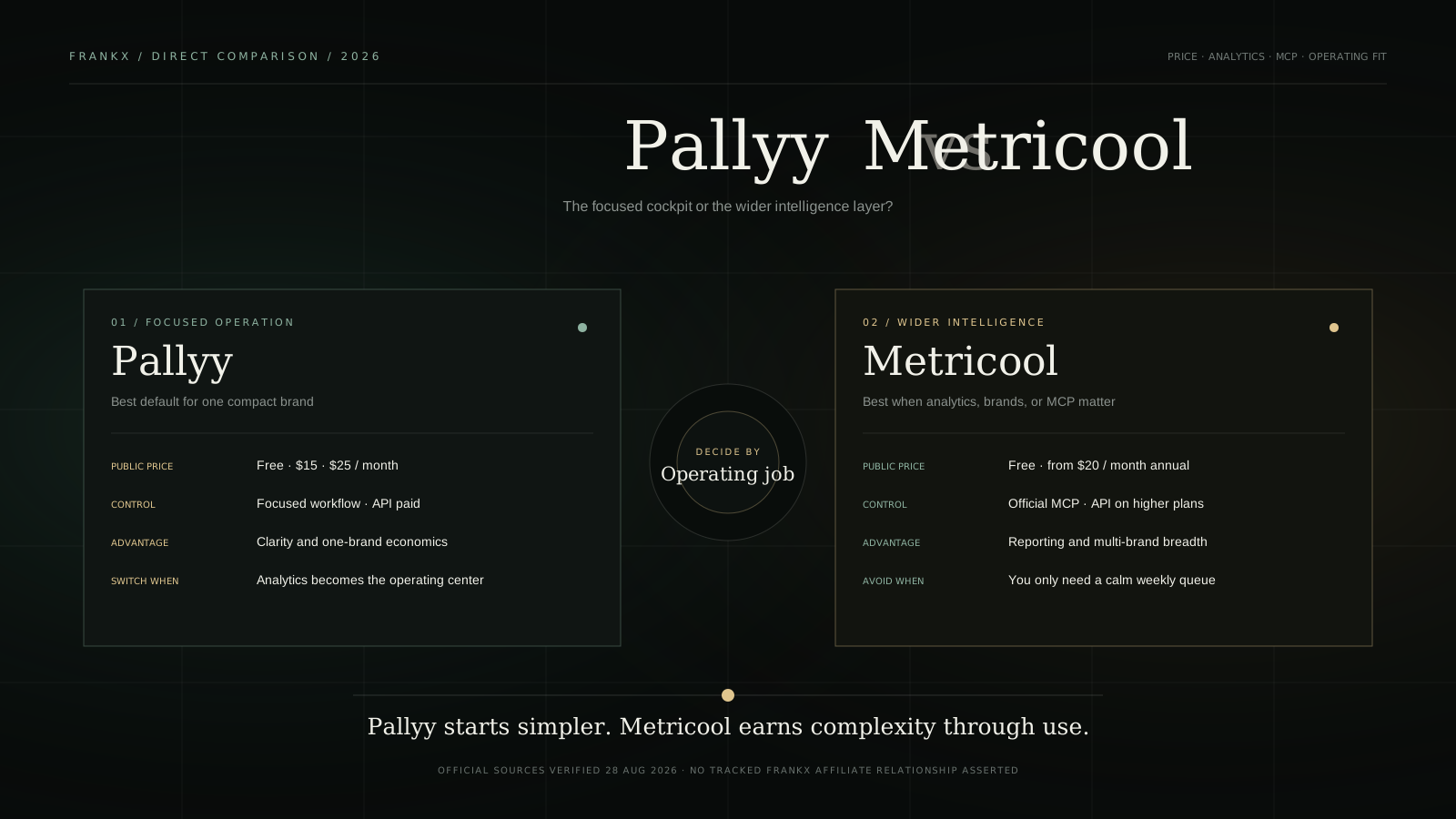
Pallyy vs Metricool (2026): Which Is Better?
Pallyy vs Metricool on price, analytics, publishing, API, MCP, brands, approvals, and founder fit—with a direct 2026 recommendation.
Read article
The 4-Hour Workweek, Rebuilt for AI Architects in 2026
Every DEAL chapter rebuilt for founders using AI agents, governed automation, human specialists, and deliberate freedom.
Read article
Do You Need an RTX 5090 for AI?
A grounded buyer guide comparing RTX 5090 workstations, cloud GPU rental, RTX 5080, DGX Spark, and Ryzen AI Max+ mini PCs.
Read article