Subagent Swarms & FSMs: Defeating State Divergence in Multi-Agent AI
TL;DR
Unconstrained multi-agent swarms fail due to compounding state entropy over extended horizons. Modern production architectures replace free-form agent chat with deterministic Finite State Machines (FSMs), strictly defined subagent roles, typed JSON handoff payloads, and adversarial verification gates.

Master the mathematical and architectural principles of multi-agent state machines, typed subagent delegation, consensus loops, and supervisor control patterns.
Never allow subagents to communicate via unstructured natural language chatter. Force all inter-agent messages into typed JSON state schemas with explicit pre-conditions, post-conditions, and deterministic exit transitions.
The naive vision of multi-agent systems involves a group of autonomous LLM agents sitting in a shared chat room, conversing back and forth in English until a complex project is complete.
In production engineering, this pattern fails 100% of the time. Unstructured natural language communication across multiple probabilistic agents causes exponential state entropy: subagents misinterpret instructions, loop in polite agreement, hallucinate non-existent files, and burn millions of tokens without producing working software.
Enterprise multi-agent architectures operate as Deterministic Finite State Machines (FSMs).
┌─────────────────────────────────────────────────────────────────────────────┐
│                    DETERMINISTIC FSM SWARM ORCHESTRATION                    │
├─────────────────────────────────────────────────────────────────────────────┤
│  [STATE 0: INITIALIZATION]                                                  │
│  • Supervisor Agent compiles User Intent into Typed Goal Contract           │
│       │                                                                     │
│       ▼                                                                     │
│  [STATE 1: RESEARCH & CONTEXT SCAN]                                         │
│  • Subagent: @research-scout (Read-Only Tools)                             │
│       │                                                                     │
│       ▼ (Typed JSON Findings Artifact)                                      │
│  [STATE 2: ARCHITECTURE & IMPLEMENTATION]                                   │
│  • Subagent: @code-architect (Write Tools, Compiler Feedback)              │
│       │                                                                     │
│       ▼ (Git Branch & Diff Manifest)                                        │
│  [STATE 3: ADVERSARIAL VERIFICATION GATE]                                   │
│  • Subagent: @integrity-sentinel (Zero-Trust Linter, Security Auditor)      │
│       ├──► (Verdict: REJECT) ──► Transitions back to STATE 2 (with fix log) │
│       └──► (Verdict: PASS)   ──► Transitions to STATE 4                     │
│                                                                             │
│  [STATE 4: PRODUCTION DEPLOYMENT] ──► Terminal Success State                │
└─────────────────────────────────────────────────────────────────────────────┘
System Success Rate = P^(N × M)
For a 20-step workflow across 3 agents (60 total turns), the success probability drops to:
0.95^60 ≈ 0.046 (4.6%)
To make multi-agent systems viable, software architects must bound execution within Deterministic State Graphs where each state transition is gated by programmatic validators (compilers, typecheckers, linters, and unit tests).
2. Typed Subagent Delegation Contracts
In the Agentic Creator OS (ACOS), subagents are never invoked with open-ended prompts. Every delegation utilizes a typed parameter contract:
interface SubagentDispatchContract {
  subagentRole: 'code-architect' | 'research-scout' | 'verification-sentinel'
  taskObjective: string
  contextBoundaries: {
    allowedPaths: string[]
    readOnly: boolean
    timeoutMs: number
  }
  inputArtifacts: string[]
  expectedOutputSchema: {
    type: 'json-manifest' | 'code-diff'
    requiredFields: string[]
  }
}
┌─────────────────────────────────────────────────────────────┐
│                 SUPERVISOR CONTROL TOPOLOGY                 │
├─────────────────────────────────────────────────────────────┤
│  Supervisor (Orchestration Kernel / High-Reasoning Model)   │
│       │                                                     │
│       ├─► [Research Subagent] (Scoped to /docs, read-only)  │
│       ├─► [Code Subagent] (Scoped to /src, write-tools)     │
│       └─► [Review Subagent] (Independent verification gate) │
└─────────────────────────────────────────────────────────────┘
3. The Adversarial "Santa Loop" Consensus Mechanism
High-stakes production code requires independent verification. The Santa Loop pairs a generative drafting agent with an adversarial auditing agent:
- Fire Gate (Generation): The drafting subagent rapidly writes the feature or content.
- Crown Gate (Auditing): A completely independent reviewer subagent (with isolated context memory) critiques the draft against brand guidelines, schema contracts, and security rules.
- Consensus Convergence: The supervisor will not mark the task complete until the reviewer signs off with a cryptographic
PASSreceipt.
Frequently Asked Questions
How do you prevent subagents from getting stuck in infinite loops?
Every state in the FSM includes a hard Max Iterations Limit (typically 3–5 cycles). If a subagent fails its verification gate after max iterations, the supervisor forces a human-in-the-loop escalation.
Should subagents share a single shared memory context?
No. Sharing a single monolithic context window causes context dilution and prompt poisoning. Subagents should operate in isolated memory sandboxes, passing only summarized JSON artifacts back to the supervisor.
Next Steps in the Hierarchy Series
Build your first AI system
Step-by-step guide to setting up ACOS, creating your first agent, and shipping real products with AI.
Start buildingProduction-ready architecture
Download AI architecture templates, multi-agent blueprints, and prompt engineering patterns.
Browse templatesJoin the builder community
Connect with creators and architects shipping AI products. Weekly office hours, shared resources, direct access.
Join the circle
Read on FrankX.AI — AI Architecture, Music & Creator Intelligence
Stay in the intelligence loop
Weekly field notes on AI systems, production patterns, and builder strategy.
Continue Reading
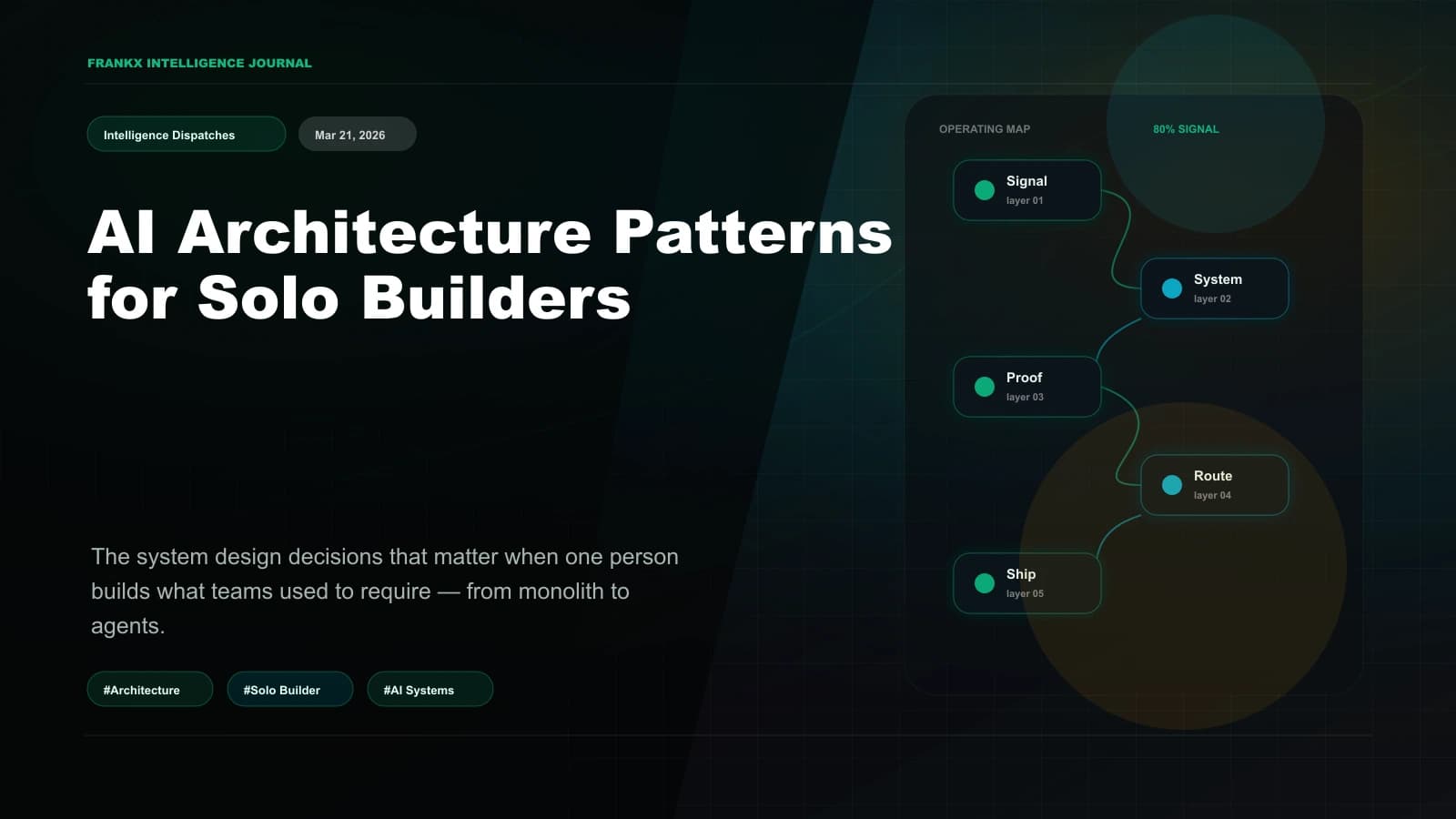
AI Capability Is Abundant. Architecture Is Still the Work.
Where AI skills and architecture create real value: turning workshops, field notes, compute, and infrastructure into durable systems that survive change.
Read article
Context Compression & Memory Vaults: Scaling Long-Horizon AI Agents
How Netflix Headroom, episodic-to-semantic compaction, and multi-tier memory vault hierarchies prevent context rot and allow autonomous agents to operate over weeks without memory degradation.
Read article
MCP in Production: Zero-Trust Tool Meshes for AI Agents
An architectural analysis of the Model Context Protocol (MCP). How to build, secure, and scale production-grade MCP servers with JSON-RPC streaming, OAuth tokens, and strict schema validation.
Read article