The Agent Skill Standard: Evaluated Workflows in Production
TL;DR
The Agent Skill Standard treats AI operational knowledge like software packages: structured directories containing trigger schemas, step-by-step workflow instructions, deterministic verification scripts, and automated evaluation suites. Standardized skills eliminate agent improvisation and enforce enterprise quality bars.

Learn how to structure, version-control, evaluate, and publish production-grade AI skills that autonomous agents and human developers can execute reliably.
Treat skills as immutable packages in git. Every skill must include explicit trigger boundaries, typed input/output interfaces, deterministic bash/node evaluation scripts, and a human-gated rollback path.
In software engineering, teams do not allow developers to copy-paste unstructured snippets across repositories without version control, unit tests, or linting. Yet in AI engineering, organizations routinely run mission-critical workflows by copying ad-hoc natural language prompts into chat boxes or embedding loose text strings inside agent orchestrators.
The Agent Skill Standard (ASS) establishes a formal engineering specification for packaging operational AI knowledge into version-controlled, evaluated, and composable modules.
┌─────────────────────────────────────────────────────────────────────────────┐
│                     THE AGENT SKILL DIRECTORY TOPOLOGY                      │
├─────────────────────────────────────────────────────────────────────────────┤
│  skills/production-deploy-gate/                                             │
│  ├── SKILL.md                 # Metadata, trigger conditions, workflow spec │
│  ├── schema.json              # Typed JSON input and output contracts       │
│  ├── scripts/                 # Deterministic local execution scripts       │
│  │   ├── preflight-check.mjs  # Lint, type-check, and integrity validator   │
│  │   └── deploy-webhook.mjs   # Production deployment trigger               │
│  ├── evals/                   # Golden test trajectories and assertions     │
│  │   ├── test-cases.json      # Evaluation scenarios and expected state     │
│  │   └── run-eval.mjs         # Automated grading runner                    │
│  └── references/              # Architecture docs, policies, brand guides   │
└─────────────────────────────────────────────────────────────────────────────┘
1. Anatomy of a Production SKILL.md
Every compliant skill requires a root SKILL.md file formatted with structured YAML frontmatter followed by deterministic execution steps:
---
name: production-deploy-gate
version: 2.1.0
description: "Pre-deploy validation gate enforcing TypeScript checks, strict AI-slop refusal, route indexing, and Vercel sync."
author: "Frank Riemer"
triggers:
  - "deploy to production"
  - "ship release"
  - "pre-flight gate check"
inputs:
  targetRepo: string
  branch: string
outputs:
  gateStatus: "PASS" | "WARN" | "FAIL"
  auditReceipt: string
tools:
  - bash
  - git
---

# Production Deploy Gate

## 1. Pre-Execution Constraints
- NEVER bypass the TypeScript compiler (`tsc --noEmit`).
- Verify zero hits against the strict language refusal list (`audit-ai-slop.mjs`).

## 2. Execution Sequence
1. Run local validation: `node scripts/validate-blog-frontmatter.js`
2. Run integrity audit: `node scripts/audit-ai-slop.mjs --strict`
3. Execute compiler gate: `pnpm run type-check`
4. If all pass, emit cryptographic deployment receipt.
2. The 3-Tier Skill Evaluation Lifecycle
A raw skill draft is not ready for production swarms. Under the standard, every skill progresses through three maturity tiers:
┌─────────────────────────────────────────────────────────────────────────────┐
│                           SKILL MATURITY PIPELINE                           │
├─────────────────────────────────────────────────────────────────────────────┤
│  Tier 1: DRAFT                                                              │
│  • Initial markdown instructions authored from expert trajectory.           │
│  • Manual operator execution and edge-case discovery.                      │
│       │                                                                     │
│       ▼                                                                     │
│  Tier 2: VALIDATED                                                          │
│  • Deterministic shell scripts added for deterministic steps.               │
│  • 10+ golden test trajectories verified with zero regressions.             │
│       │                                                                     │
│       ▼                                                                     │
│  Tier 3: PRODUCTION CERTIFIED                                               │
│  • Automated CI eval runner attached (`npm test`).                          │
│  • Bound to supervisor agents as an autonomous execution unit.              │
└─────────────────────────────────────────────────────────────────────────────┘
3. Why Skills Precede Agents in System Design
When organizations build autonomous multi-agent systems, the primary cause of hallucination is lack of operational boundaries. When an agent is told "refactor our authentication system," it must invent every sub-step on the fly.
When provided with a certified refactor-auth-module skill, the agent's job collapses from inventing the workflow to executing the verified pipeline:
Agent Reliability = 1 - (1 - Skill Pass Rate)^N
By raising individual skill pass rates to 99%+ via deterministic scripts, multi-turn agent chains achieve enterprise-grade reliability over hundreds of consecutive executions.
Frequently Asked Questions
Where do skills live in a monorepo?
Skills live in a top-level .claude/skills/ or skills/ directory at the repository root, checked directly into git alongside application source code.
How do agents find which skill to run?
Supervisor agents read the description and triggers fields in each skill's frontmatter. When user intent matches a skill description, the agent binds that skill into its context window dynamically.
Next Steps in the Hierarchy Series
Build your first AI system
Step-by-step guide to setting up ACOS, creating your first agent, and shipping real products with AI.
Start buildingProduction-ready architecture
Download AI architecture templates, multi-agent blueprints, and prompt engineering patterns.
Browse templatesJoin the builder community
Connect with creators and architects shipping AI products. Weekly office hours, shared resources, direct access.
Join the circle
Read on FrankX.AI — AI Architecture, Music & Creator Intelligence
Stay in the intelligence loop
Weekly field notes on AI systems, production patterns, and builder strategy.
Continue Reading
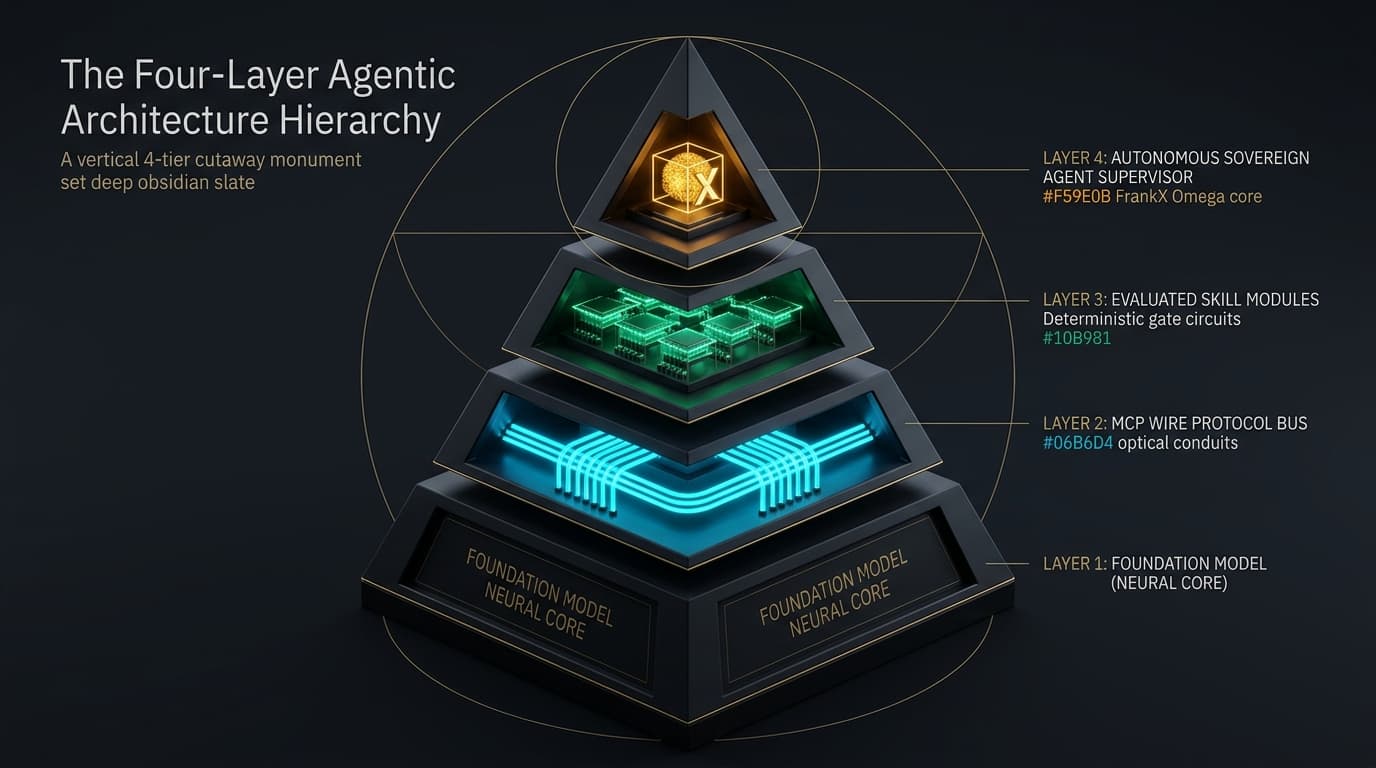
Skills vs Agents vs Prompts vs MCP: The 2026 Agentic Hierarchy
An architectural breakdown of the 4-layer 2026 agentic hierarchy: prompts, skills, autonomous agents, and MCP. Why they compose into a sovereign stack and how to pick the right primitive.
Read article
The Skill Maturity Model: From Prompt to Composed Capability
The six levels of the Agent Skill Standard — L0 Prompt to L5 Composed — and how to move a skill up the ladder without over-engineering it.
Read article
AI Capability Is Abundant. Architecture Is Still the Work.
Where AI skills and architecture create real value: turning workshops, field notes, compute, and infrastructure into durable systems that survive change.
Read article