Modern Agentic Systems Architecture: From ReAct Loops to Trajectory Evals
TL;DR
Simple ReAct loops degrade after 5 turns. Production agentic systems require state-machine orchestration, Model Context Protocol (MCP) standards, Headroom-style context compression, and episodic-to-semantic memory consolidation.

Understand the transition from fragile ReAct loops to deterministic multi-agent operating systems with structured memory and trajectory evaluation.
Never allow agents to execute arbitrary unconstrained loops. Enforce circuit breakers, max tool call limits, and state machines with explicit transition invariants.
The early era of autonomous agents relied on naive ReAct (Reason + Act) prompt loops. While effective for simple three-step demos, unbounded autoregressive loops suffer from catastrophic context dilution, state divergence, and hallucinated tool calls over long horizons.
Production agentic engineering has evolved into a disciplined branch of distributed systems architecture: Autonomous Agent Operating Systems.
┌─────────────────────────────────────────────────────────────────────────────┐
│                 AUTONOMOUS AGENT OPERATING SYSTEM ARCHITECTURE               │
├─────────────────────────────────────────────────────────────────────────────┤
│  User Goal / Dispatch Contract                                              │
│       │                                                                     │
│       ▼                                                                     │
│  [Supervisor Agent & Context Compression Engine]                            │
│       │                                                                     │
│       ├──► [Domain Subagent: Code Architect] ──► [MCP Protocol Tool Mesh]   │
│       ├──► [Domain Subagent: Research Scout]                                │
│       └──► [Domain Subagent: Verification Sentinel]                         │
│                 │                                                           │
│                 ▼                                                           │
│            [Quality Gate: PASS / REVISE Audit Loop]                         │
│                 │                                 ▲                         │
│                 ├──► (PASS)                       │ (REVISE)                │
│                 │      │                          │                         │
│                 ▼      ▼                          │                         │
│  [Memory Vault Substrate] ──► [Production Release] ─────────────────────────┘
└─────────────────────────────────────────────────────────────────────────────┘
1. Why Simple ReAct Loops Fail in Production
Standard ReAct implementations follow an unstructured text cycle: Thought -> Action -> Observation -> Thought. In production codebases, this architecture encounters four hard failure modes:
- Context Window Saturation: Tool outputs (e.g., massive file dumps, ASTs, raw JSON) consume 80%+ of the context window within 4 turns, displacing the original system prompt instructions.
- State Drift & Goal Degradation: Without an explicit state machine, intermediate tool errors lead agents down tangential rabbit holes.
- Non-Deterministic Tool Execution: Free-form parameter generation causes type mismatches, parameter omissions, and silent failure cascades.
- Lack of Verifiable Handoffs: Subagents fail to pass machine-validated artifacts to reviewer agents, leading to compounding errors.
2. The 6-Primitive Production Agent Architecture
Enterprise-grade agentic frameworks (such as the Agentic Creator OS substrate) organize execution around six deterministic primitives:
┌─────────────────────────────────────────────────────────────┐
│               SOVEREIGN AGENT OPERATING SYSTEM              │
├─────────────────────────────────────────────────────────────┤
│  1. SYSTEM KERNEL     → Deterministic State Machine Engine │
│  2. PROTOCOL MESH     → Model Context Protocol (MCP) Mesh   │
│  3. CONTEXT GOVERNOR  → Sliding Headroom & Dynamic Pruning  │
│  4. MEMORY SUBSTRATE  → Two-Tier (Episodic & Semantic)      │
│  5. VERIFICATION GATE → Adversarial Dual-Agent Review       │
│  6. TRAJECTORY LOGGER → Structured JSONL Audit Trails       │
└─────────────────────────────────────────────────────────────┘
Primitive Details
| Primitive | Function | Technical Implementation |
|---|---|---|
| System Kernel | State transition validation | Finite State Machine (FSM) with explicit entry/exit hooks |
| Protocol Mesh | Standardized tool interaction | Model Context Protocol (JSON-RPC 2.0 transport) |
| Context Governor | Token conservation & focus | Sliding window compression, AST summarization, Headroom caching |
| Memory Substrate | Long-term context compounding | SQLite/Vector hybrid (semantic patterns + episodic trajectories) |
| Verification Gate | Independent quality assurance | Adversarial Creator-Verifier paired loops (The Santa Loop) |
| Trajectory Logger | Observability & post-mortem | JSONL execution trees with step-level latency and token telemetry |
3. Model Context Protocol (MCP) as the Universal Substrate
The adoption of the Model Context Protocol (MCP) represents the shift from proprietary tool wrappers to standardized client-server architectures.
MCP decouples model logic from tool infrastructure:
- Lazy Tool Loading: Agents inspect schema metadata without loading thousands of lines of tool definitions into active context.
- Resource Streaming: Structured access to local and cloud file graphs, database connections, and browser automation endpoints.
- Observability Multiplexing: Centralized telemetry routing for all tool invocations across distributed swarms.
// MCP Tool Definition Contract
export interface MCPToolDefinition {
  name: string;
  description: string;
  parameters: {
    type: 'object';
    properties: Record<string, unknown>;
    required: string[];
  };
  timeoutMs: number;
  circuitBreakerThreshold: number;
}
4. Context Compression & Headroom Management
Context is memory bandwidth. Dumping raw file systems or unparsed logs directly into agent context causes attention dispersion.
Modern architectures use Context Compression Layers:
- Semantic Delta Extraction: Passing unified diff blocks rather than entire files.
- Symbolic AST Extraction: Generating high-level interface definitions (classes, method signatures, exports) before granting file edit tools.
- Ephemeral Scratchpads: Writing intermediate calculation scratchpads to disk and loading only the consolidated output into working memory.
5. Trajectory Evals & Quality Gates
An agentic task is only as reliable as its evaluation methodology. Evaluating final text outputs is insufficient; systems must audit the entire execution trajectory:
// Trajectory Evaluation Metrics
export interface TrajectoryEvaluation {
  totalSteps: number;
  unnecessaryToolCalls: number;
  circuitBreakerTrips: number;
  verificationPassRate: number; // 0.0 to 1.0
  costPerOutcomeUSD: number;
}
By enforcing automated gates—type-checking, strict linting, schema validation, and independent reviewer consensus—the agent operating system guarantees that shipped code is robust, documented, and production-ready.
Explore Related Architecture & Research
- The 2026 Agentic Hierarchy — Deconstructing Prompts, Skills, Agents, and MCP.
- The Agent Skill Standard — Writing evaluated, testable SKILL.md packages.
- MCP in Production — Building zero-trust tool meshes with JSON-RPC.
- Subagent Swarm Orchestration — Defeating state divergence with FSM state graphs.
- Context Compression & Memory Vaults — Headroom context compaction and memory tiers.
- FrankX Open-Source Downloads — Production templates and starter packs.
Build your first AI system
Step-by-step guide to setting up ACOS, creating your first agent, and shipping real products with AI.
Start buildingProduction-ready architecture
Download AI architecture templates, multi-agent blueprints, and prompt engineering patterns.
Browse templatesJoin the builder community
Connect with creators and architects shipping AI products. Weekly office hours, shared resources, direct access.
Join the circle
Read on FrankX.AI — AI Architecture, Music & Creator Intelligence
Stay in the intelligence loop
Weekly field notes on AI systems, production patterns, and builder strategy.
Continue Reading

MCP in Production: Zero-Trust Tool Meshes for AI Agents
An architectural analysis of the Model Context Protocol (MCP). How to build, secure, and scale production-grade MCP servers with JSON-RPC streaming, OAuth tokens, and strict schema validation.
Read article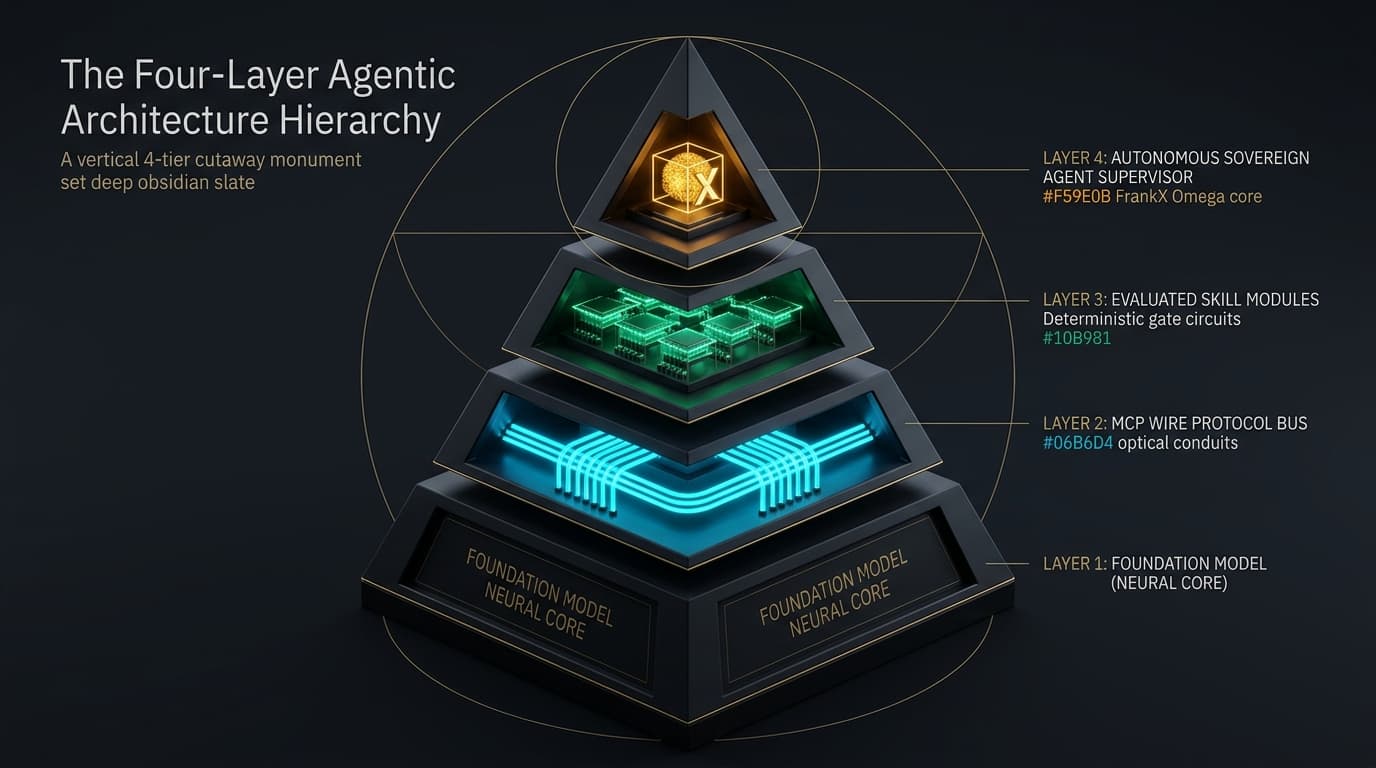
Skills vs Agents vs Prompts vs MCP: The 2026 Agentic Hierarchy
An architectural breakdown of the 4-layer 2026 agentic hierarchy: prompts, skills, autonomous agents, and MCP. Why they compose into a sovereign stack and how to pick the right primitive.
Read article
AI Capability Is Abundant. Architecture Is Still the Work.
Where AI skills and architecture create real value: turning workshops, field notes, compute, and infrastructure into durable systems that survive change.
Read article