MCP in Production: Zero-Trust Tool Meshes for AI Agents
TL;DR
The Model Context Protocol (MCP) decouples AI agent reasoning from system execution. By standardizing JSON-RPC tool contracts and resource endpoints, MCP replaces fragile custom wrappers with a secure, audited, multi-client tool mesh.

Master the protocol mechanics of MCP servers, tool schemas, transport layers (stdio vs. SSE), and zero-trust security boundaries in multi-agent production stacks.
Never expose raw unvalidated shell execution or unauthenticated database credentials over MCP. Always implement rate-limiting middleware, Zod parameter validation, and audit logging on every tool invocation.
Before the Model Context Protocol (MCP), connecting an AI model to an internal system required writing bespoke tool-calling handlers for every client: one for Claude, one for OpenAI, one for Cursor, and one for custom Python agent frameworks. When an API schema changed, every agent integration broke simultaneously.
MCP provides an open, standardized JSON-RPC 2.0 protocol layer that treats tool execution and resource retrieval like a microservices mesh.
┌─────────────────────────────────────────────────────────────────────────────┐
│                       MCP DISTRIBUTED TOOL PROTOCOL                         │
├─────────────────────────────────────────────────────────────────────────────┤
│  AI Clients (Claude Code, Antigravity, Cursor, Grok Build, OpenCode)        │
│       │                                                                     │
│       ▼ (Standard JSON-RPC 2.0 via Stdio or Server-Sent Events SSE)         │
│  [MCP Security & Rate-Limiting Gateway]                                     │
│       │                                                                     │
│       ├──► [Database MCP Server: PostgreSQL / BigQuery / Supabase]          │
│       ├──► [Filesystem MCP Server: Workspace Sandbox & Git Hub]             │
│       ├──► [Cloud Ops MCP Server: Vercel / AWS / Kubernetes]                │
│       └──► [Memory MCP Server: Graphiti Temporal Knowledge Vault]           │
└─────────────────────────────────────────────────────────────────────────────┘
1. The Core Primitives of MCP
MCP exposes three fundamental primitives:
- Tools: Executable functions that allow the model to perform actions (e.g., executing a SQL query, running a compiler check, deploying a service).
- Resources: Read-only data URIs providing structured context (e.g.,
postgres://users/schema,git://repo/diff,file:///logs/prod.log). - Prompts: Parameterized prompt templates managed on the server side for consistent multi-client prompt distribution.
2. Implementing a Production TypeScript MCP Server
A resilient MCP server enforces strict schema validation using Zod and structured error handling:
import { Server } from '@modelcontextprotocol/sdk/server/index.js'
import { StdioServerTransport } from '@modelcontextprotocol/sdk/server/stdio.js'
import { CallToolRequestSchema, ListToolsRequestSchema } from '@modelcontextprotocol/sdk/types.js'
import { z } from 'zod'

const server = new Server(
  { name: 'enterprise-db-gateway', version: '1.0.0' },
  { capabilities: { tools: {}, resources: {} } }
)

const QueryInputSchema = z.object({
  query: z.string().max(1000),
  readOnly: z.boolean().default(true),
})

server.setRequestHandler(ListToolsRequestSchema, async () => ({
  tools: [
    {
      name: 'execute_safe_query',
      description: 'Execute a read-only SQL query against the read-replica database.',
      inputSchema: {
        type: 'object',
        properties: {
          query: { type: 'string', description: 'SQL SELECT query string' },
          readOnly: { type: 'boolean', default: true },
        },
        required: ['query'],
      },
    },
  ],
}))

server.setRequestHandler(CallToolRequestSchema, async (request) => {
  if (request.params.name === 'execute_safe_query') {
    const { query } = QueryInputSchema.parse(request.params.arguments)
    // Execute query securely with parameterized protection
    return { content: [{ type: 'text', text: JSON.stringify({ status: 'success', rows: [] }) }] }
  }
  throw new Error(`Tool not found: ${request.params.name}`)
})

const transport = new StdioServerTransport()
await server.connect(transport)
3. Transport Layers: Stdio vs. SSE
MCP operates over two primary transport protocols:
| Transport | Connection Model | Ideal Environment | Security Boundary |
|---|---|---|---|
| Stdio (Standard I/O) | Process-based pipe (stdin/stdout) | Local developer tools, CLI agents, Cursor, Antigravity | Local OS user permissions & sandboxes |
| SSE (Server-Sent Events) | HTTP/HTTPS streaming over network | Cloud-hosted swarms, multi-tenant enterprise clusters | TLS 1.3, OAuth 2.0, API keys, mTLS |
4. Zero-Trust Security for Production MCP
Exposing live systems to autonomous models introduces security risks: prompt injection causing malicious tool calls, unbounded file system traversals, and credential leaks.
The 4 Security Laws of Enterprise MCP:
- Never Expose Raw Shells Without Sandboxing: Always route terminal execution through isolated Docker containers or ephemeral WASM runtimes.
- Deterministic Argument Validation: Validate all tool arguments with strict Zod/JSON schemas before execution.
- Read-Only by Default: Database and infrastructure MCP servers must default to read-only replica endpoints.
- Audit Logging: Maintain immutable cryptographic audit logs of every model-generated tool call and output payload.
Frequently Asked Questions
Can MCP servers talk to multiple AI models simultaneously?
Yes. MCP is model-agnostic. A single running MCP server can serve Claude Code, OpenAI agents, Gemini CLI, and custom agent swarms simultaneously.
How does MCP handle streaming tool outputs?
MCP supports JSON-RPC streaming notifications, allowing long-running operations (like large builds or dataset exports) to report progress to the agent in real time.
Next Steps in the Hierarchy Series
Build your first AI system
Step-by-step guide to setting up ACOS, creating your first agent, and shipping real products with AI.
Start buildingProduction-ready architecture
Download AI architecture templates, multi-agent blueprints, and prompt engineering patterns.
Browse templatesJoin the builder community
Connect with creators and architects shipping AI products. Weekly office hours, shared resources, direct access.
Join the circle
Read on FrankX.AI — AI Architecture, Music & Creator Intelligence
Stay in the intelligence loop
Weekly field notes on AI systems, production patterns, and builder strategy.
Continue Reading

Modern Agentic Systems Architecture: From ReAct Loops to Trajectory Evals
A comprehensive teardown of production multi-agent systems, Model Context Protocol standards, context compression, and trajectory evaluation gates.
Read article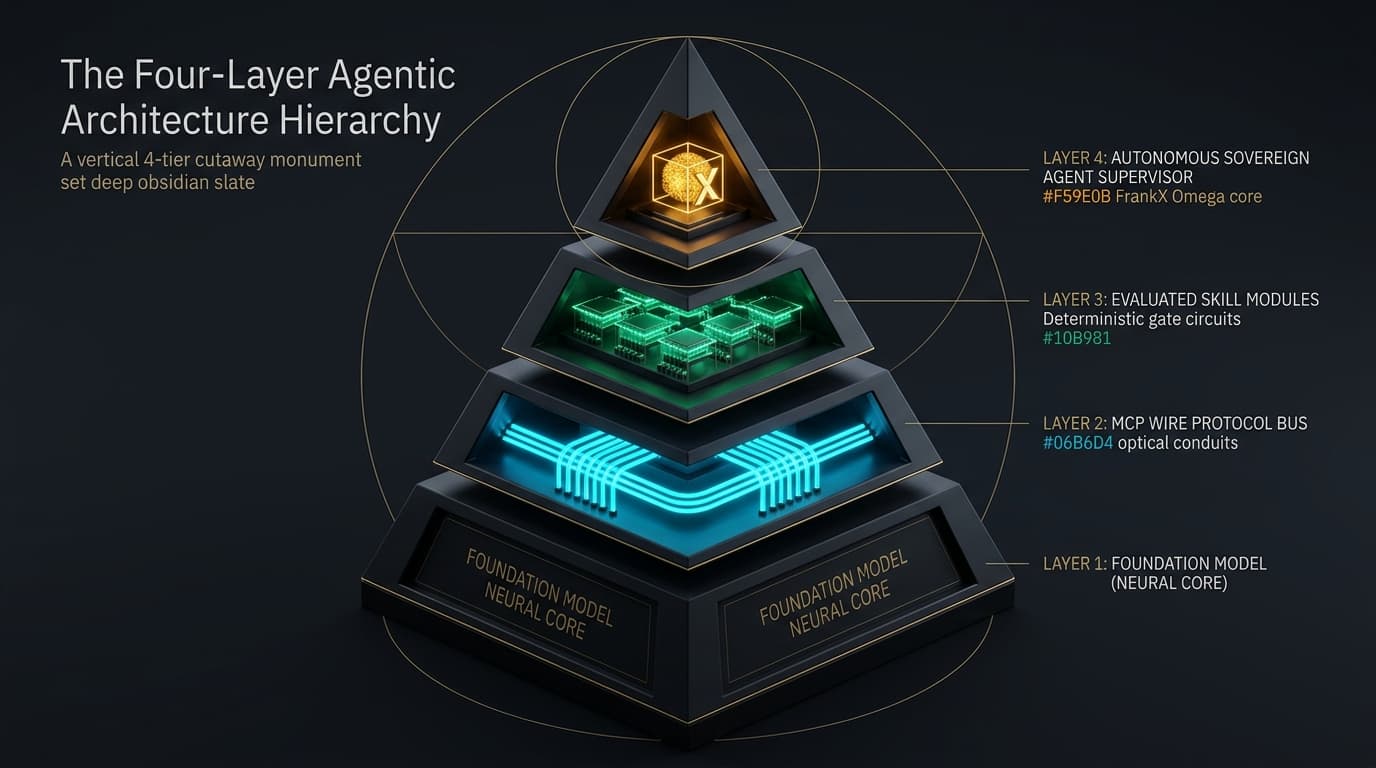
Skills vs Agents vs Prompts vs MCP: The 2026 Agentic Hierarchy
An architectural breakdown of the 4-layer 2026 agentic hierarchy: prompts, skills, autonomous agents, and MCP. Why they compose into a sovereign stack and how to pick the right primitive.
Read article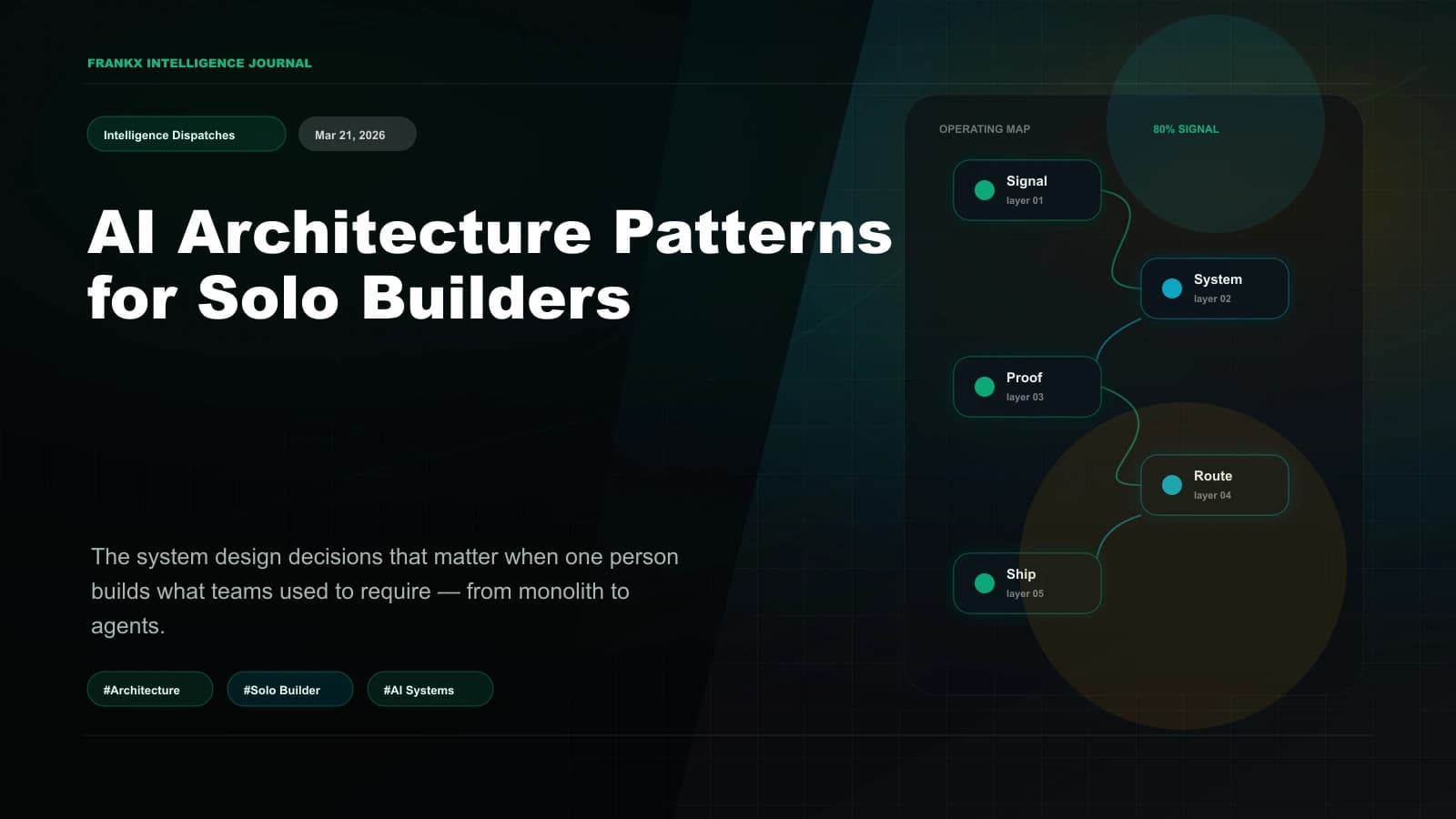
AI Capability Is Abundant. Architecture Is Still the Work.
Where AI skills and architecture create real value: turning workshops, field notes, compute, and infrastructure into durable systems that survive change.
Read article