Stanford CS329Z: The AI Agent Engineering Roadmap
TL;DR
Stanford CS329Z teaches agent engineering as a full system discipline: decompose the task, build retrieval and tools, run an agent loop, collect traces, evaluate failures, optimize the right layer and add safety controls. The Fall 2026 schedule remains tentative, and the course is neither a certification nor a course branded as graph engineering.

Turn Stanford CS329Z’s public syllabus into a rigorous, business-ready agent engineering curriculum
Use the public syllabus as a sequence of engineering gates, not a framework shopping list. Require a measurable task, a typed tool boundary, a trace dataset and an evaluation suite before adding more agents.
AI CoE pillar: Architecture, evaluation and responsible deployment
- AI architects: Own the system decomposition, state contracts and release gates.
- Product leaders: Fund one narrow workflow with a measurable service target before broad autonomy.
Stanford has published one of the clearest academic statements of what agent engineering now requires. The official CS329Z: Engineering AI Agents page does not reduce the work to prompting, framework selection or a large collection of cooperating bots. It starts with a more durable premise: modern AI products are compound systems made from models, retrieval, tools, optimizers, data and evaluation.
That framing matters to an AI Architect. The hard part is no longer getting a model to call a function once. The hard part is deciding what should be probabilistic, what should be deterministic, what evidence must cross each boundary, how failure is measured and when a system has earned more autonomy.
TL;DR
CS329Z offers a strong public learning sequence: foundations, retrieval, tools, agent loops, orchestration, memory, multi-agent coordination, optimization, traces, evaluation, safety and production. Use that sequence as an engineering maturity model. Do not present it as a certification or as Stanford’s definition of graph engineering.
The status facts, before the architecture
As of August 24, 2026, the official course page says Stanford / Fall 2026 and identifies Diyi Yang, Michael Ryan and John Yang as instructors. It lists Monday and Wednesday meetings from 1:30 to 2:50 p.m. in Packard 101, with the first class on September 23. The page also says the schedule is tentative and subject to change. Stanford’s official preliminary Autumn 2026–27 course schedule independently lists CS329Z in the same time block.
Four corrections should travel with every summary of this course:
| Claim | Evidence-based correction |
|---|---|
| “This is a live, completed Stanford course” | It is scheduled for Fall 2026; on August 24 the listed class sequence had not begun. |
| “It gives an official AI architect certificate” | The page describes a three-unit academic course, class number 27855, graded by letter or Credit/No Credit. It does not describe a certification. |
| “Stanford calls this graph engineering” | The official title is Engineering AI Agents. The public page does not use graph engineering as the course name or its declared discipline. |
| “The syllabus is final” | Stanford labels the schedule and deadlines tentative; guest lectures, office hours and the final demo time remain TBA. |
This does not make the syllabus less useful. It makes the right use clear: treat it as a current, public design for learning agent engineering, not as retrospective proof that every planned lecture or assignment has already happened.
The central idea: engineer the compound system
The course description moves through three levels:
- simple LLM pipelines;
- compound AI systems with interacting components;
- autonomous agents.
That progression matches the core argument in the Berkeley AI Research article The Shift from Models to Compound AI Systems, which is assigned in week one. Performance increasingly depends on the surrounding system, not only on the base model.
For business teams, this changes the unit of design. A model score is an input. The product is the full path from request to verified outcome.
| System form | Control pattern | Use it when | Do not add it merely because |
|---|---|---|---|
| Single model call | One request, one response | The task is bounded and errors are low impact | A larger model is available |
| Deterministic pipeline | Fixed stages | The process is known and repeatable | “Agents” sound more advanced |
| Compound system | Retrieval, tools and model calls | Quality depends on evidence or external action | A framework makes wiring easy |
| Single agent loop | Model chooses the next action | The path cannot be fully specified in advance | The task has more than one step |
| Multi-agent system | Delegation, handoffs or collaboration | Specialization or parallel work beats one context | Parallelism looks impressive in a demo |
This is the same restraint I recommend in the AI Architect’s Guide to Graph Engineering: use the smallest topology that meets the service target. A loop is already an adaptive system. A graph becomes valuable when the work needs explicit branches, state transfer, verification or recovery.
What the syllabus actually teaches
The published sequence can be read as five engineering layers.
| Layer | Public syllabus topics | Architect’s deliverable |
|---|---|---|
| 1. Task and context | problem selection, decomposition, model choice, context and RAG | A measurable task contract and a retrieval baseline |
| 2. Action | function calling, MCP, sandboxes, retries and agent loops | Typed tools, permission boundaries and stop conditions |
| 3. Composition | DSPy, LangGraph, LlamaIndex, memory and multi-agent patterns | Explicit state, handoff and orchestration contracts |
| 4. Improvement | traces, demonstrations, data selection and optimization | A versioned trace set and an evidence-based optimization decision |
| 5. Assurance | benchmark design, graders, safety, privacy and observability | Release gates, failure taxonomy and production telemetry |
The course makes students build before abstracting. Its first applied assignment, as currently described, starts with a science-question agent built from retrieval, tool use and an agent loop, then rebuilds key pieces with DSPy. That is good pedagogy because a framework is easier to judge after you understand the contracts it hides.
The second assignment reverses the usual product order. Students receive an agent and must construct the evaluation system: code graders, at least one model judge, benchmark tasks and error analysis. In production, this is not secondary work. It is the mechanism that tells you whether a new prompt, model, tool or route is an improvement.
A practical eight-stage learning roadmap
You do not need to imitate a university calendar. You need to preserve the dependency order.
Stage 1: define one outcome
Choose a task with a real user, a bounded environment and an observable result. Write the request, allowed data, allowed actions, latency budget, cost budget and success criteria. If success cannot be scored, you are not ready to compare architectures.
Stage 2: establish the non-agent baseline
Build the simplest viable path: direct model call, fixed retrieval pipeline or deterministic workflow. Record quality, latency, cost and failure modes. The baseline protects the team from building autonomy that produces no measurable gain.
The foundational references are the original Retrieval-Augmented Generation paper and ColBERT paper. They also remind teams that retrieval quality has its own design surface: indexing, chunking, ranking and evidence presentation.
Stage 3: add one tool boundary
Give the model a small set of typed actions. Define inputs, outputs, timeouts, retry policy, idempotency and permission level. The official Model Context Protocol specification is useful here because it separates protocol contracts from the model’s judgment.
Run tool code in a restricted environment. Do not let an exploratory agent inherit production credentials by default. Every side effect should have a caller, authorization rule and audit record.
Stage 4: build a single agent loop
Add adaptive next-action selection only after the tool boundary is stable. The ReAct paper provides the canonical reasoning-and-action pattern. Your implementation also needs conditions the paper title does not encode: maximum steps, token and cost budgets, duplicate-action detection, tool-error handling and terminal states.
For the operating layer around that loop, see AI Skills as the Operating Layer. Skills should package bounded capability and instructions; they should not become undocumented authority.
Stage 5: make state and orchestration explicit
Now compare hand-built control with an orchestration framework. The DSPy paper is especially relevant because it treats LM programs as optimizable modules rather than strings that developers tune indefinitely.
If work branches or survives multiple contexts, define state schemas and checkpoint boundaries. The lesson is larger than any one library: an edge must specify what artifact moves, under which conditions, with what provenance and who may consume it.
Stage 6: test whether multiple agents earn their cost
The course pairs multi-agent design with coordination failure. Read both the AutoGen paper and Why Do Multi-Agent LLM Systems Fail?. Then compare a single capable agent against your proposed team on the same task set.
Use multiple agents when independent context, specialization or parallel evidence collection creates a measured benefit. If every agent sees the same context and repeats the same reasoning, you have multiplied cost and failure surfaces. The dynamic agent network paper is useful for studying task-conditioned topology, but it is not evidence that every business process needs a changing swarm.
Stage 7: build the evaluation harness
The syllabus describes a benchmark task as a four-part contract: request, environment, stopping criteria and scorer. That is a strong minimum. Add dataset version, system version, randomization settings, allowed tools and trace retention.
Use code-based graders where the outcome is deterministic. Use model judges where semantic judgment is unavoidable, then calibrate them against human preferences. The MT-Bench and Chatbot Arena judge paper documents both the value and biases of model-based judging. The rigorous agent benchmark paper addresses evaluation design at the agent-system level.
Stage 8: earn production access
Red-team prompt injection, privacy leakage, unsafe tool sequences and recovery behavior. Test revoked credentials, partial outages, stale retrieval, timeouts and repeated retries. Define which failures stop, which retry, which require a human and which need compensation.
Software-agent work makes this concrete. SWE-agent, OpenHands and SWE-bench collectively show why the environment, agent-computer interface and evaluator all shape the result. A model cannot be evaluated apart from its harness.
How to apply the roadmap across a business
Treat this as a capability program with gated pilots, not as a mandate for every department to launch an agent.
| Business stage | Team action | Evidence required to advance |
|---|---|---|
| Select | Rank workflows by value, measurability, data access and action risk | One task contract with an accountable owner |
| Baseline | Measure the current human or software process | Quality, time, cost and known failure distribution |
| Pilot | Build retrieval plus one or two bounded tools | Offline evaluation and reviewed traces |
| Control | Add permissions, human approval and recovery paths | Adversarial tests and side-effect auditability |
| Operate | Release to limited traffic with checkpoints | Service metrics by route, model, tool and failure class |
| Scale | Reuse proven skills, evaluators and policies | A demonstrated gain that survives a holdout set |
A customer-support pilot might begin with evidence retrieval and draft generation, while a human retains send authority. A finance pilot might reconcile records with deterministic checks and route exceptions to an analyst. A software pilot might let an agent propose a patch but require tests, review and protected-branch policy before merge.
The common architecture is not “use many agents.” It is “make every consequential transition inspectable.” The multi-agent orchestration patterns guide can help after the single-agent baseline establishes a genuine coordination need. For coding workflows, the Claude Code graph engineering guide shows how local instructions, skills, subagents and hooks fit into that broader contract system.
A decision rubric for leaders
Before funding the next architecture layer, ask:
| Question | If the answer is no |
|---|---|
| Can we score the business outcome? | Stop and define the task and evaluator. |
| Does retrieval beat the direct-call baseline? | Fix the evidence path before adding autonomy. |
| Are tool inputs, permissions and side effects typed? | Stabilize the action boundary. |
| Does an agent loop beat the fixed workflow? | Keep the fixed workflow. |
| Does a multi-agent design beat one agent on a holdout set? | Remove the coordination layer. |
| Can we replay and explain a failed run? | Add trace, state and version capture. |
| Can we stop or compensate a harmful action? | Do not grant production authority. |
This is the practical contribution of CS329Z’s public design. It connects model behavior to systems engineering, and systems engineering to evaluation. The sequence is more valuable than any specific library named in one tentative lecture.
Primary reading map
These are primary course, specification or research sources used above and listed on or directly aligned with the official syllabus:
- CS329Z official course page
- Stanford Computer Science preliminary Autumn course schedule
- The Shift from Models to Compound AI Systems
- Retrieval-Augmented Generation
- ColBERT
- Model Context Protocol specification
- DSPy
- ReAct
- MemGPT
- AutoGen
- Why Do Multi-Agent LLM Systems Fail?
- Dynamic LLM-Powered Agent Network
- Rigorous Agentic Benchmarks
- SWE-agent
- OpenHands
- SWE-bench
- OSWorld
Verification receipt
I audited the official CS329Z page row by row on August 24, 2026: dates, logistics, assignments, grading, prerequisites, and every linked reading available at the time. The page still labels the schedule tentative, and the first class is planned for September 23. No course outcome data exists yet, so this guide treats the syllabus as a learning map—not evidence that its sequence has already produced production systems.
FAQ
Is Stanford CS329Z available now?
The official page lists the course for Fall 2026, with the first class planned for September 23. As of August 24, the class schedule, deadlines and final demo details were still tentative. Check the official page rather than relying on reposted screenshots.
Does CS329Z provide a Claude or AI architect certification?
No. The official logistics describe a three-unit Stanford course with letter or Credit/No Credit grading. Nothing on the page calls it a Claude certification, an Anthropic certification or an AI architect certificate.
Is CS329Z a graph engineering course?
No. Stanford calls it Engineering AI Agents. Its topics—agent loops, orchestration, memory, multi-agent systems, traces and evaluation—can inform graph-engineered systems, but “graph engineering” is an external interpretation rather than the course’s official label.
What should a professional learn first from the syllabus?
Start with a measurable problem, a simple baseline, retrieval, typed tools and a bounded single-agent loop. Build the evaluator alongside the system. Frameworks, memory and multiple agents come later, after evidence shows the simpler design is insufficient.
Can teams copy the coursework for commercial training?
Use the public topics and linked readings as a study map. Do not copy unpublished materials, assignment solutions or student work. The course page explicitly applies Stanford’s Honor Code and allows AI for explanation, debugging and design critique while prohibiting substantial AI completion of assignments.

Read on FrankX.AI — AI Architecture, Music & Creator Intelligence
Stay in the intelligence loop
Weekly field notes on AI systems, production patterns, and builder strategy.
Continue Reading
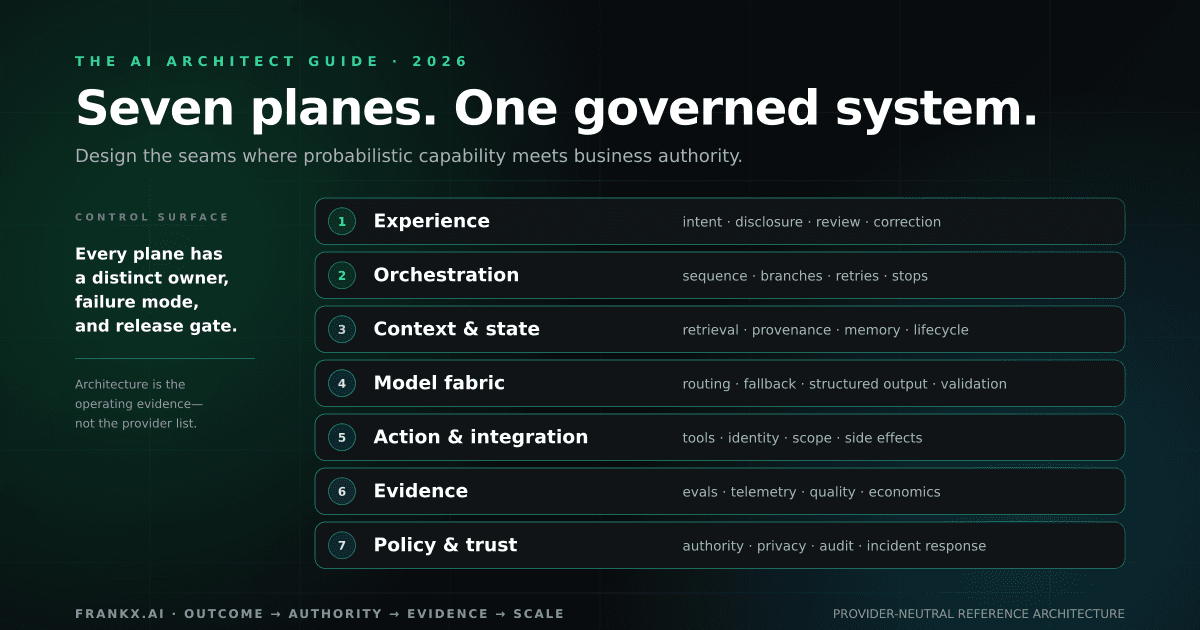
The AI Architect Guide 2026
A field guide to the decisions, system planes, evidence gates, and operating artifacts required to turn AI capability into a reliable workflow.
Read article
Grok Voice vs OpenAI Realtime vs ElevenLabs (2026)
Compare price, latency, architecture, tools, and voice quality—then choose a production voice-agent stack for web, mobile, or phone.
Read article
Autonomous Knowledge Graphs: Graphiti, Mem0, and Persistent Agent Memory
Why naive vector search fails in multi-turn agent execution, and how temporal knowledge graphs, episodic memory tiers, and deterministic recall solve long-term agent coherence.
Read article