Autonomous Knowledge Graphs: Graphiti, Mem0, and Persistent Agent Memory
TL;DR
Vector similarity alone cannot model entity relationships, temporal invalidation, or causal state transitions. Modern agentic operating systems implement a 4-tier memory hierarchy combining working RAM, episodic memory, entity knowledge graphs, and immutable archival stores.

Master the multi-tier memory architecture required to maintain agent state across millions of execution cycles without context degradation.
Implement temporal edge invalidation before scaling agent memory beyond 10,000 entities. Without bidirectional temporal bounds, vector lookups will hallucinate outdated states as truth.
In production agentic architectures, memory is not a storage bucket; it is an active state machine.
Early generative AI deployments relied on naive Retrieval-Augmented Generation (RAG): chunking text, computing dense vector embeddings, and running cosine similarity lookups. While sufficient for document search, naive RAG collapses in autonomous multi-step execution. When an agent updates a user preference, revises an architecture decision, or corrects an error, vector databases store the new chunk alongside the obsolete chunk. Semantic search then retrieves both, inducing hallucinations and state incoherence.
To achieve persistent autonomy, modern systems employ Autonomous Temporal Knowledge Graphs and Hierarchical Memory Tiers.
┌─────────────────────────────────────────────────────────────────────────────┐
│                   4-TIER AGENTIC MEMORY STATE HIERARCHY                     │
├─────────────────────────────────────────────────────────────────────────────┤
│  TIER 1: WORKING MEMORY (L1)     │ In-Context KV Cache, Active Buffer       │
│  TIER 2: EPISODIC LOGS (L2)      │ Vectorized Trajectories & Tool Outcomes  │
│  TIER 3: TEMPORAL KG (L3)        │ Entity-Relation-Entity with Valid Bounds │
│  TIER 4: IMMUTABLE VAULT (L4)    │ Cold Audit Logs, Raw Git Commits, S3     │
└─────────────────────────────────────────────────────────────────────────────┘
1. The Mathematical Failure Mode of Flat Vector Lookups
Flat vector retrieval evaluates semantic similarity in embedding space:
Score(q, d) = (q · d) / (||q|| * ||d||)
This mathematical formulation suffers from three fatal architectural flaws in multi-agent workflows:
- Temporal Blindness: An entity state defined at time $t_0$ has identical geometric proximity to query $q$ as an updated state defined at $t_1$.
- Relational Blindness: Embeddings lose explicit subject-predicate-object constraints. A chunk stating "Service A calls Service B" cannot be reliably distinguished from "Service B calls Service A".
- Context Dilution: As vector indices grow past $10^6$ nodes, dense cluster overlaps increase false-positive retrieval rates during high-stakes tool execution.
To explore the benchmark evidence on memory degradation, review the research in our Agentic Memory & Context Engineering Hub.
2. Temporal Knowledge Graphs: Nodes, Edges, and Time Bounds
Temporal Knowledge Graphs (such as Graphiti and Zep engines) model information as dynamic relational tuples augmented with temporal intervals:
Tuple = (Subject, Predicate, Object, [T_valid_start, T_valid_end], Confidence)
[Agent Session t0] ─── (Database, uses_version, "Postgres 15", [2026-01-01, 2026-06-01]) ───► [Active]
                                                                        │
[Agent Session t1] ─── (Database, uses_version, "Postgres 16", [2026-06-01, ∞]) ──────────► [Active]
When an agent executes an architecture migration, the system executes an automated edge mutation:
- The previous edge is timestamped with
T_valid_end = 2026-06-01. - A new edge is instantiated with
T_valid_start = 2026-06-01andT_valid_end = NULL.
When the agent queries current state, the retrieval engine applies a deterministic temporal filter, ensuring zero obsolete state leakage into the model context.
3. Production Multi-Tier Memory Comparison
| Dimension | Tier 1: Working Context | Tier 2: Episodic Memory | Tier 3: Temporal KG | Tier 4: Archival Vault |
|---|---|---|---|---|
| Storage Substrate | Attention KV Cache | Vector DB (Qdrant / Milvus) | Graph DB (Neo4j / Graphiti) | Object Store (S3 / Git) |
| Lookup Latency | Sub-millisecond | 10ms – 40ms | 15ms – 50ms | 200ms – 1000ms |
| Query Pattern | Direct token attention | K-NN Cosine Similarity | Cypher / Graph Traversal | Deterministic Key/Hash |
| State Lifespan | Single Inference Run | 7 – 30 Days (Rolling) | Permanent (Versioned) | Permanent (Immutable) |
| Failure Mode | Context window overflow | Outdated similarity hits | Graph schema complexity | Slow retrieval overhead |
4. Deterministic Extraction and Graph Construction
In modern architectures like Mem0 and Starlight Memory, knowledge graph ingestion is executed asynchronously:
[Agent Trajectory Output]
           │
           ▼
[Entity Extraction Pipeline (NER + Relational Parsing)]
           │
           ▼
[Deduplication & Entity Resolution Engine]
           │
     ┌─────┴─────────────────────────┐
     ▼                               ▼
[New Entity Node]           [Edge Temporal Invalidation]
     │                               │
     └─────────────┬─────────────────┘
                   ▼
       [Committed Graph State]
By decoupling execution from memory indexing, agents operate with sub-second responsiveness while background daemons reconcile entity graphs and resolve conflicting facts.
5. Architectural Blueprint: Implementing Hybrid Graph-RAG
To implement production-grade persistent memory:
- Step 1: Enforce Entity Resolution: Never write raw user strings directly to vector chunks. Extract normalized entity identifiers (
user:frank,repo:frankx). - Step 2: Dual-Route Queries: Route entity relationship queries ("What database does project X use?") to the Knowledge Graph. Route open-ended conceptual queries ("How did we solve the memory bug?") to Episodic Vector Search.
- Step 3: Combine with Context Compaction: Use token pruning algorithms like Netflix Headroom to compress retrieved graph subgraphs before injecting them into the system prompt.
For deeper implementation specifications, explore our Model Context Protocol & Memory Specs and the Modern Agentic Systems Architecture.
Build your first AI system
Step-by-step guide to setting up ACOS, creating your first agent, and shipping real products with AI.
Start buildingProduction-ready architecture
Download AI architecture templates, multi-agent blueprints, and prompt engineering patterns.
Browse templatesJoin the builder community
Connect with creators and architects shipping AI products. Weekly office hours, shared resources, direct access.
Join the circle
Read on FrankX.AI — AI Architecture, Music & Creator Intelligence
Stay in the intelligence loop
Weekly field notes on AI systems, production patterns, and builder strategy.
Continue Reading
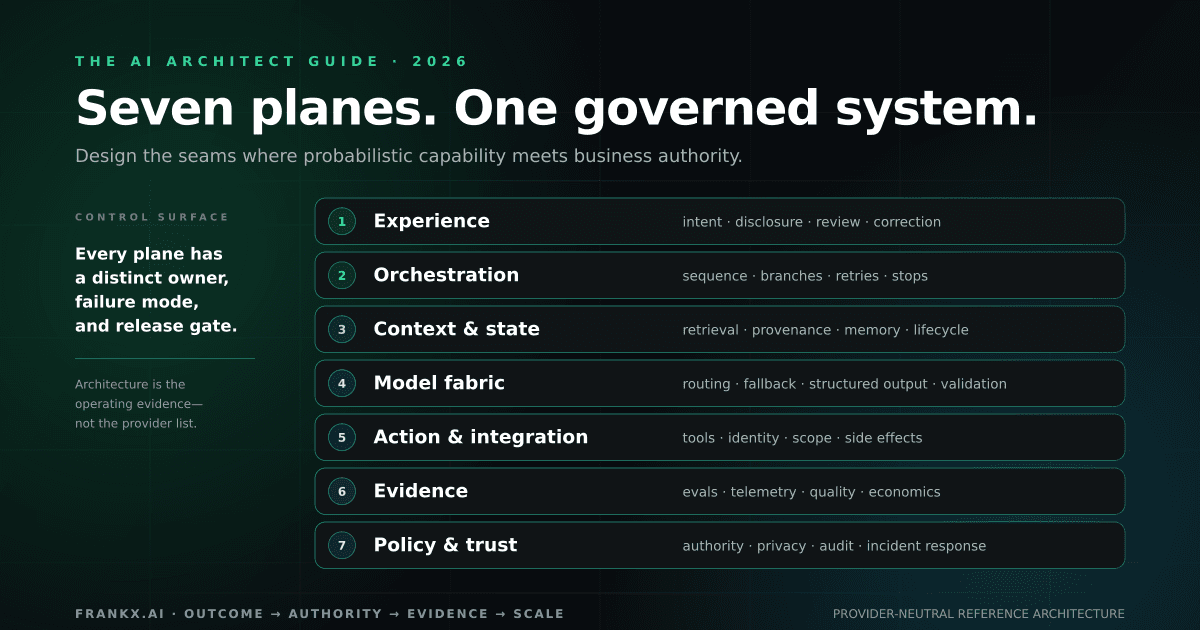
The AI Architect Guide 2026
A field guide to the decisions, system planes, evidence gates, and operating artifacts required to turn AI capability into a reliable workflow.
Read article
Grok Voice vs OpenAI Realtime vs ElevenLabs (2026)
Compare price, latency, architecture, tools, and voice quality—then choose a production voice-agent stack for web, mobile, or phone.
Read article
Stanford CS329Z: The AI Agent Engineering Roadmap
A fact-checked architect’s roadmap to Stanford CS329Z: agent loops, compound systems, evaluation, safety and production adoption.
Read article