AI Skills Are the New Operating Layer
TL;DR
AI skills are not prompt snippets. They are reusable operating knowledge: workflow, context, references, scripts, quality checks, and governance packaged so agents can do repeatable work better. The teams that win will convert their best workflows into skill libraries, then evaluate and govern them through an AI CoE.

You will learn why AI skills should be treated as reusable operating knowledge and how to begin turning repeatable work into governed capability.
AI Skills Are the New Operating Layer
TL;DR
AI skills are not prompt snippets. They are reusable operating knowledge: workflow, context, references, scripts, quality checks, and governance packaged so agents can do repeatable work better.
The next advantage is not having a better prompt library. It is having a better skill library.
I am grateful for the builders who got us here.
Anthropic made Agent Skills concrete. Open-source contributors made the pattern visible. Developers, founders, and enterprise teams are now testing what it takes to make these systems useful outside demos.
The opportunity is not to copy what exists.
The opportunity is to build higher standards on top of it.
The Problem Is Not AI Access
Most teams already have access to good models.
The problem is that useful work stays trapped in private execution:
- one founder's prompt
- one analyst's workflow
- one engineer's debugging pattern
- one sales team's proposal process
- one operator's weekly review ritual
The company gets AI activity, but not AI capability.
That is the difference.
Activity is people using tools.
Capability is reusable work that improves over time.
What a Skill Really Packages
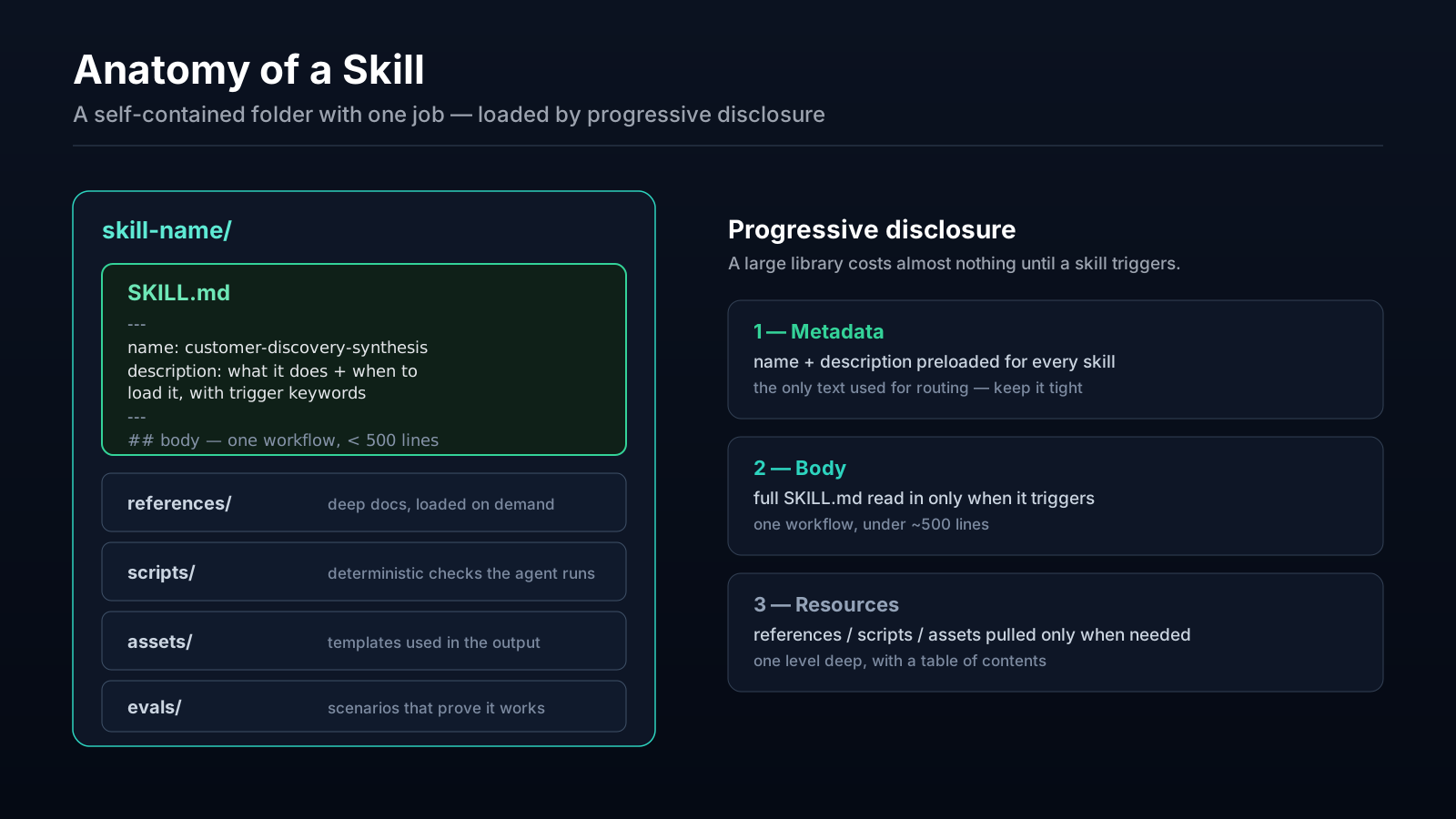
A strong skill packages more than instructions.
It packages:
- when the workflow should activate
- what inputs are required
- which references matter
- what steps must happen
- which checks should be deterministic
- what output format is expected
- what quality bar must be met
- what risks require human review
- who owns the workflow
- how it is evaluated
That is operating knowledge.
It is the difference between "write me a proposal" and "follow our proposal workflow, use approved security language, validate required sections, flag missing deal context, and do not invent pricing."
One is prompting.
The other is a system.
Why This Matters for Founders
Founders repeat the same context constantly.
The offer. The audience. The product. The narrative. The standard. The mistakes to avoid.
A personal skill library turns that context into leverage.
Start with three skills:
- Weekly founder review
- Customer discovery synthesis
- Content or proposal engine
Each one should encode the way you want the work done, not just the topic.
That creates a founder operating system that gets sharper every week.
Why This Matters for Startups
Startups lose knowledge fast.
The best workflows live in the heads of the strongest people. When the team grows, quality fragments.
A skill library gives the team a way to preserve the best way of working:
- PRD writing
- support escalation analysis
- release notes
- sales proposals
- interview synthesis
- investor updates
- internal decision briefs
The skill becomes the shared standard. The agent becomes the execution surface. The team remains accountable for the outcome.
Why This Matters for Enterprises
Enterprises already know they need governance.
The missing piece is that governance should not only apply to models, data, and tools. It should also apply to reusable operating knowledge.
If a skill touches customer data, legal language, financial reporting, regulated content, production systems, HR decisions, or security operations, it needs a higher standard:
- owner
- version
- evaluation suite
- risk tier
- security review
- rollback plan
- data boundary
- approval gate
That is where an AI Center of Excellence becomes useful.
Not as a blocker. As the operating system for safe compounding.
The Agent Skill Standard
Naming a standard after a person is branding, not a standard. So this work is published as an open spec — the Agent Skill Standard — that I steward rather than own. It builds directly on Anthropic's Agent Skills format and adds the layers that make a skill trustworthy in production.
The readiness test:
A skill is ready when it can produce the intended result repeatedly, under representative conditions, with clear boundaries, visible assumptions, and a maintained owner.
That means every serious skill should include:
- a narrow job
- explicit trigger language
- required inputs
- references
- step-by-step workflow
- deterministic scripts when useful
- examples
- anti-patterns
- quality checklist
- evaluations
- governance metadata
If that sounds like software, good. Skills are lightweight software for operating knowledge.
The standard also defines maturity levels, so a team can see exactly where a skill sits and what it needs next — from an ad-hoc prompt (L0) to a governed, composed, attested capability (L5).
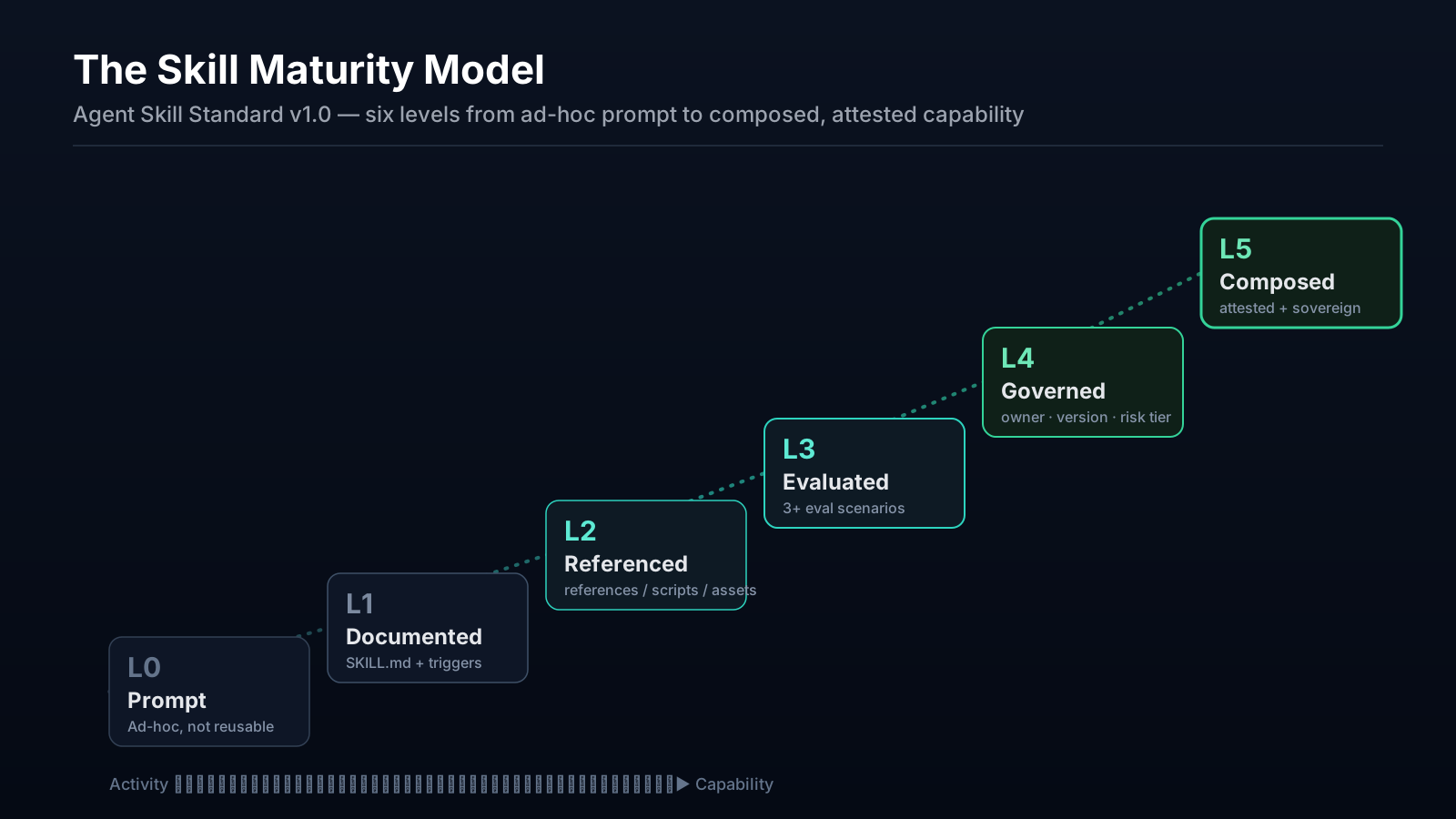
The full specification, maturity model, and conformance validator are open source in the Agent Skill Standard.
The Bigger Shift
Prompts were the first phase.
Skills are the next phase.
Agents will not become useful because they can "do anything." They become useful when they know how a specific organization wants important work done.
That is the new operating layer:
model capability plus tool access plus packaged operating knowledge plus evaluation plus governance.
The teams that build this layer will compound.
The teams that do not will keep rediscovering the same prompts.
What To Do This Week
Pick one repeated workflow.
Write the skill canvas:
- workflow
- trigger
- required inputs
- references
- procedure
- output
- quality checklist
- risk tier
- owner
- three eval scenarios
Then build the first version.
Do not make it perfect. Make it real. Run it on actual work. Improve it after the work teaches you what the skill was missing.
That is how skill libraries become abundant: not by hoarding prompts, but by turning the best work into shared capability.
FAQ
Are AI skills just prompts?
No. A prompt is usually a one-time instruction. A skill packages a repeatable workflow with trigger logic, references, procedures, scripts, output standards, and evaluation criteria.
What is the first skill a founder should build?
Build a weekly founder review skill. It creates the fastest feedback loop because it touches goals, decisions, blockers, customers, and next actions.
How many skills should a startup build first?
Start with three to five workflow-specific skills. More is not automatically better. Reliability matters more than catalog size.
How should enterprises govern skills?
Use owners, versions, risk tiers, evaluations, security review for sensitive workflows, and role-based bundles. Treat important skills like lightweight software artifacts.
Related Reading
Build your first AI system
Step-by-step guide to setting up ACOS, creating your first agent, and shipping real products with AI.
Start buildingProduction-ready architecture
Download AI architecture templates, multi-agent blueprints, and prompt engineering patterns.
Browse templatesJoin the builder community
Connect with creators and architects shipping AI products. Weekly office hours, shared resources, direct access.
Join the circle
Read on FrankX.AI — AI Architecture, Music & Creator Intelligence
Stay in the intelligence loop
Weekly field notes on AI systems, production patterns, and builder strategy.
Continue Reading
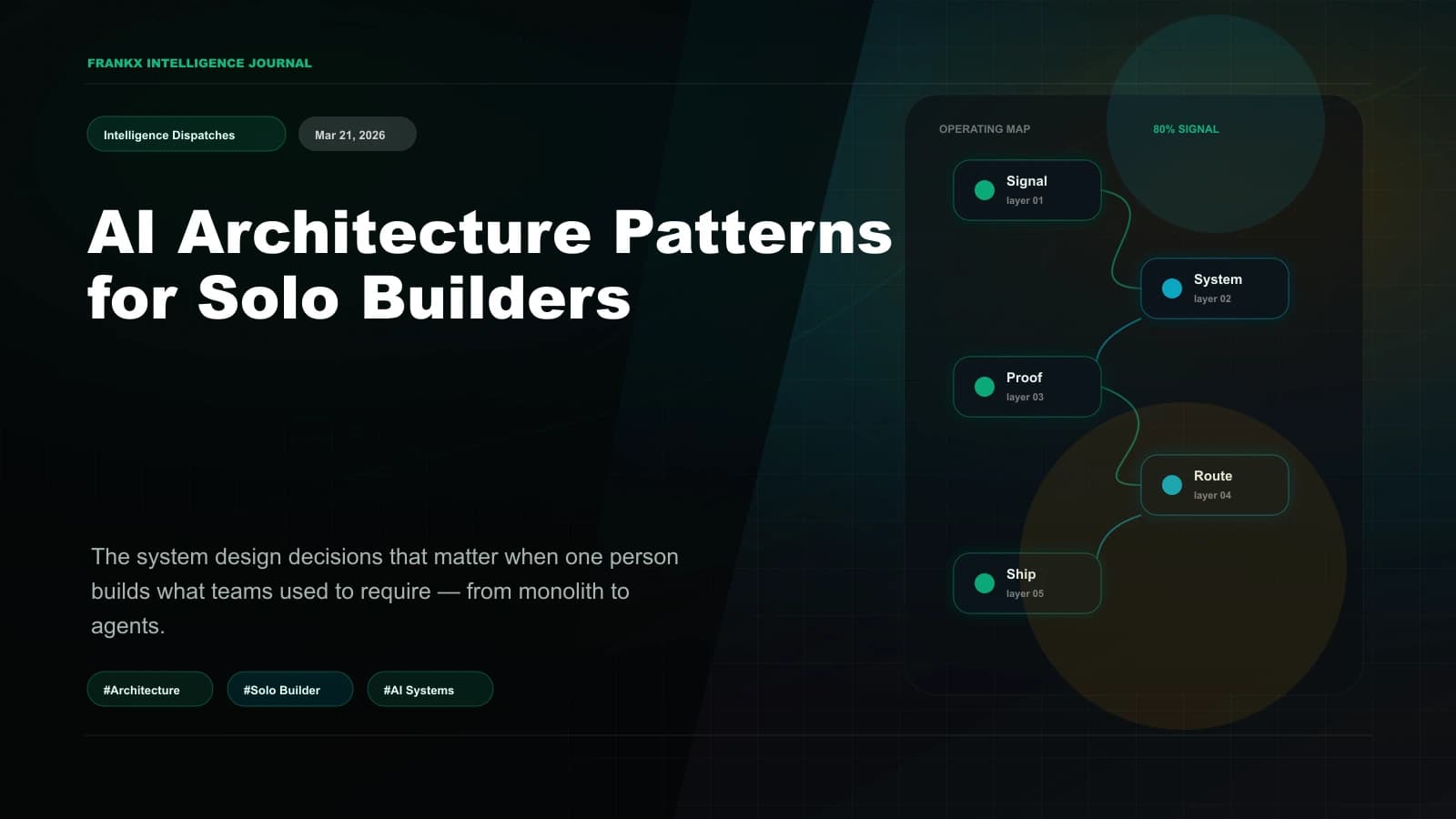
AI Capability Is Abundant. Architecture Is Still the Work.
Where AI skills and architecture create real value: turning workshops, field notes, compute, and infrastructure into durable systems that survive change.
Read article
The Skill Maturity Model: From Prompt to Composed Capability
The six levels of the Agent Skill Standard — L0 Prompt to L5 Composed — and how to move a skill up the ladder without over-engineering it.
Read article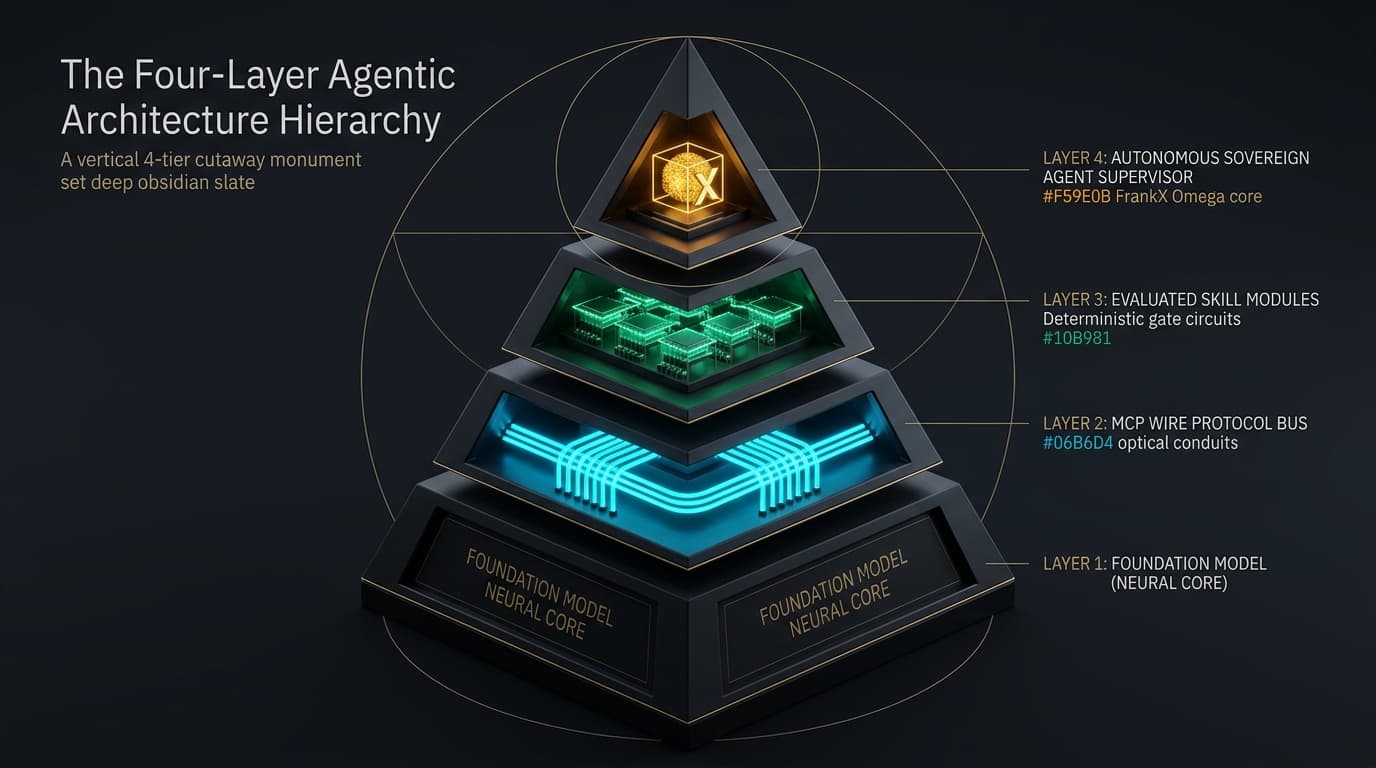
Skills vs Agents vs Prompts vs MCP: The 2026 Agentic Hierarchy
An architectural breakdown of the 4-layer 2026 agentic hierarchy: prompts, skills, autonomous agents, and MCP. Why they compose into a sovereign stack and how to pick the right primitive.
Read article