Multi-Agent Model Fabric 2026: Routing, Evals, and Fallbacks
TL;DR
Single-model architectures are a liability. The frontier in 2026 is the Multi-Agent Model Fabric: a deliberate topology of specialized execution lanes, enforceable handoff contracts, mechanical evaluations, and independent verification gates.

Design and implement a lane-based multi-agent fabric with typed handoff contracts, cost ceilings, and provider-isolated verification.
TL;DR — Relying on a single AI model across an entire business application creates severe single-point vulnerabilities, cost bloat, and context degradation. The modern production standard is the Multi-Agent Model Fabric: an interconnected, lane-based architecture where orchestrators, fast workers, deep reasoning engines, and sovereign local cells coordinate via typed handoff contracts and automated verification gates.
What is a multi-agent model fabric?
A model fabric is the operational substrate that decouples your business logic from underlying AI model providers. Instead of hardcoding API calls directly to a specific LLM, the fabric routes tasks dynamically based on their computational shape, latency requirements, cost tolerance, and security constraints.
┌─────────────────────────────────────────────────────────────────────────────┐
│                   MULTI-AGENT MODEL FABRIC ROUTING TOPOLOGY                 │
├─────────────────────────────────────────────────────────────────────────────┤
│  Task Input & User Dispatch                                                 │
│       │                                                                     │
│       ▼                                                                     │
│  [Fabric Dynamic Router]                                                    │
│       │                                                                     │
│       ▼                                                                     │
│  [Orchestration Lane (Queen): Grok 4.6 / Claude 3.7]                        │
│       │                                                                     │
│       ├──► [Worker Lane: Gemini 2.5 Flash (High-Velocity Tokens)] ──┐       │
│       ├──► [Reasoning Lane: OpenAI o3 / DeepSeek R1 (Formal Math)] ──┼─► [Cross-Model Gate]
│       └──► [Sovereign Lane: Qwen 2.5 / Ollama (Local Privacy)]     ──┘        │
│                                                                               ▼
│                                                                  [Verified Artifact]
└─────────────────────────────────────────────────────────────────────────────┘
By decoupling execution into distinct lanes, you ensure that high-velocity generation runs at ultra-low cost while high-stakes reasoning receives maximum cognitive depth without cross-contaminating contexts.
How are production execution lanes structured?
Every production swarm operates on four primary functional tiers:
| Lane Type | Primary Engine | Secondary / Fallback | Core Responsibilities | Evaluation Metric |
|---|---|---|---|---|
| Orchestration & State (Queen) | Grok 4.6 | Claude Opus 4.6 | Decomposing user goals, assigning subagent tasks, tracking multi-turn state, and validating execution milestones. | State consistency & tool-call precision |
| High-Throughput Workers | Gemini 3.7 Flash | DeepSeek-V4-Pro | Massively parallel file operations, code generation, summarization, and data extraction. | Tokens/sec & schema adherence |
| Deep Reasoning & Architecture | Claude Opus 4.8 / Fable | GPT-5.6 Sol | Red-teaming complex logic, resolving contradictory specifications, and crafting high-fidelity design artifacts. | Nuance & edge-case discovery |
| Local Sovereign Cells | Qwen3.8-27B | DeepSeek-R1-Distill | Air-gapped processing, confidential credential handling, and offline emergency failover. | Latency & zero-egress compliance |
What makes handoff contracts enforceable in code?
In autonomous multi-agent systems, verbal instructions between agents degrade rapidly across multiple turns. Reliable fabrics enforce typed mechanical handoff contracts:
export interface AgentHandoffContract<TOutput = unknown> {
  taskId: string;
  sourceAgent: string;
  targetAgent: string;
  payload: TOutput;
  schemaVersion: string;
  assertions: {
    passed: boolean;
    checks: string[];
  };
  telemetry: {
    model: string;
    tokenCount: number;
    latencyMs: number;
  };
}

export function validateHandoff<T>(
  contract: AgentHandoffContract<T>,
  schema: (data: unknown) => data is T
): boolean {
  if (!contract.assertions.passed) return false;
  if (!schema(contract.payload)) return false;
  if (contract.telemetry.tokenCount > 64000) return false;
  return true;
}
If a subagent produces output that violates the typed schema or fails any assertion check, the orchestrator instantly halts execution, logs the error, and re-routes the sub-task without propagating corrupted data downstream.
How do automated evaluation layers operate?
Production fabrics implement three distinct evaluation tiers:
- Mechanical Assertions (Zero LLM Judges): Type-checking, JSON schema parsing, unit test execution, and static linting. These run in milliseconds and cost zero inference tokens.
- Blind Cross-Provider Evaluation: When assessing qualitative output, a secondary model from an independent provider evaluates the artifact without seeing the original system prompt or model identity.
- Operational Telemetry Scoring: Continuous monitoring of completion rates, retry counts, latency p95, and cost per successful delivery.
How do cost ceilings and circuit breakers protect infrastructure?
High-throughput agent swarms can easily consume thousands of dollars in API credits if caught in an unconstrained retry loop. The fabric enforces strict defensive gates:
- Per-Task Token Quotas: Hard stop limits per subagent execution (e.g., maximum 32,000 output tokens per task).
- Exponential Backoff with Circuit Breakers: If three consecutive subagent calls fail schema validation, the lane trips open and alerts human operators.
- Dynamic Cost-Based Degradation: When daily API thresholds approach 85% of budget, non-critical background jobs automatically downgrade to open-weights local models.
Internal Links & Further Reading
- August 2026 Frontier Model Wave — Benchmarks and routing analysis for the latest frontier models.
- Monday Operator Playbook — Step-by-step rollout schedule for multi-model swarms.
- AI Model Routing Guide — Architectural guide to multi-provider routing.
- Swarm Intelligence & Multi-Agent Orchestration — Multi-agent coordination patterns.
- Production Agentic AI Systems — Enterprise blueprints for sovereign AI platforms.
FAQ
What is the primary benefit of a multi-agent model fabric?
A model fabric eliminates single-provider lock-in, reduces inference costs by 60–80% through smart tiering, and dramatically improves system reliability through independent verification gates.
How does the fabric prevent infinite loops between subagents?
Fabrics utilize deterministic execution depth limits, per-task token ceilings, and circuit breakers that halt and escalate any recurring loop that fails validation across consecutive iterations.
What is the role of local open-weights models in the fabric?
Local models like Qwen3.8-27B act as a zero-cost, air-gapped baseline for routine data transformation, classification, and uninterrupted operations during cloud provider outages.
How does the Cross-Model Verification Gate work?
The Cross-Model Gate ensures that artifacts created by one model provider are reviewed and audited by a model from an entirely separate provider before being deployed or committed.
Can I build a model fabric without complex infrastructure?
Yes. A model fabric begins with simple modular routing logic in your codebase, declaring explicit model assignments per task shape and wrapping tool calls in typed schema validation.
Build your first AI system
Step-by-step guide to setting up ACOS, creating your first agent, and shipping real products with AI.
Start buildingProduction-ready architecture
Download AI architecture templates, multi-agent blueprints, and prompt engineering patterns.
Browse templatesJoin the builder community
Connect with creators and architects shipping AI products. Weekly office hours, shared resources, direct access.
Join the circle
Read on FrankX.AI — AI Architecture, Music & Creator Intelligence
Stay in the intelligence loop
Weekly field notes on AI systems, production patterns, and builder strategy.
Continue Reading

Monday Operator Playbook: Absorbing Grok 4.6, Gemini 3.7 Flash, DeepSeek-V4-Pro
Concrete operational steps, eval contracts, routing changes, and human gates for the August 2026 frontier model wave. One-week implementation plan.
Read article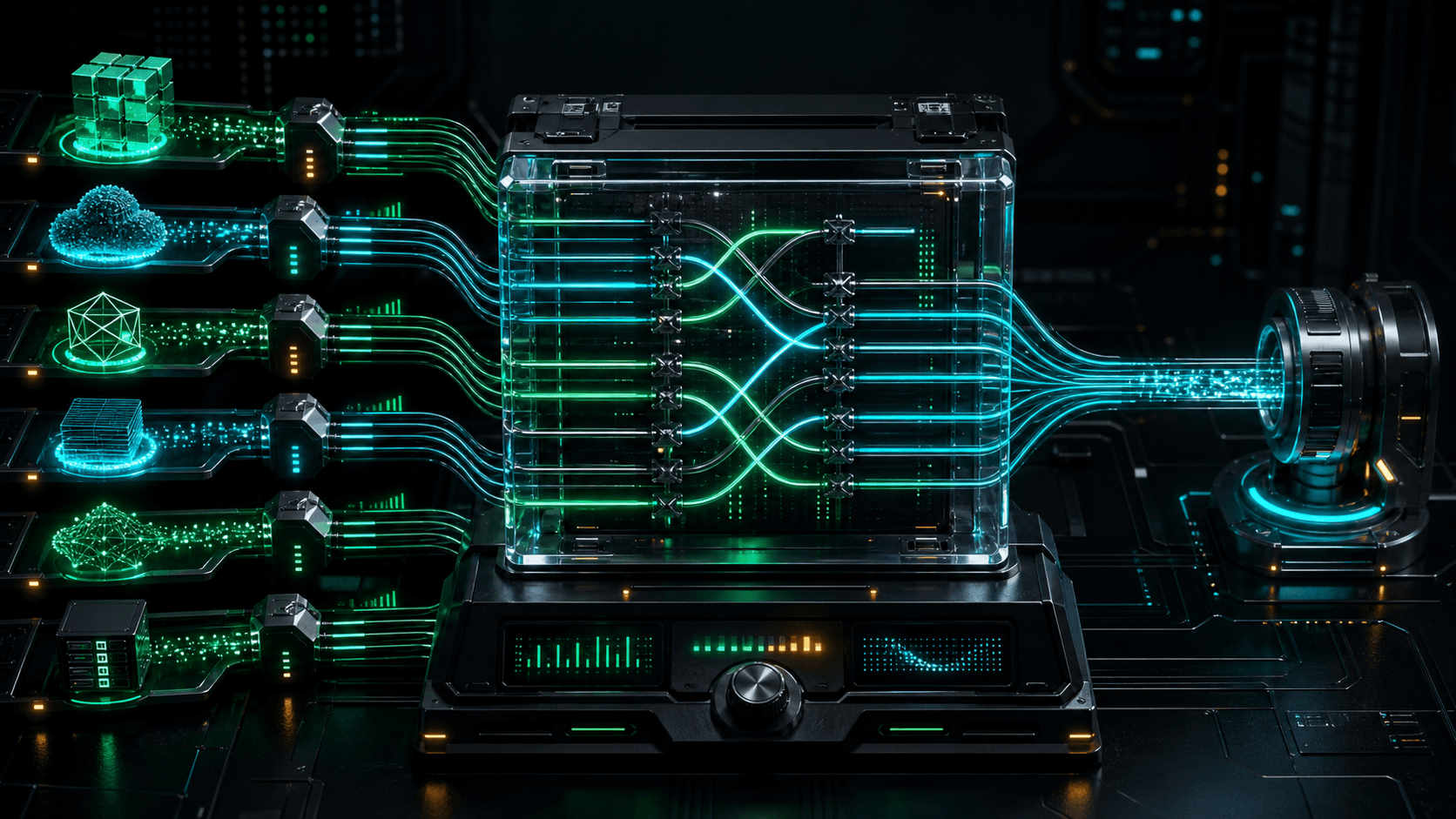
The AI Model Routing Guide: Which Model for Which Agent (Q2 2026 Edition)
The working AI Architect's routing matrix as a narrative: which frontier model runs your coding agents, review gates, fan-out workers, and sovereign stacks — with prices, evidence grade...
Read article
Enterprise Agentic Architecture: Decision Framework for Production
Most agentic AI projects stall at demo because teams optimize for the wrong things. This architectural decision framework separates shipped products from abandoned experiments.
Read article