Monday Operator Playbook: Absorbing Grok 4.6, Gemini 3.7 Flash, DeepSeek-V4-Pro
TL;DR
New model releases are operational cost-and-capability shifts, not emotional events. This playbook outlines a battle-tested Monday-to-Friday rollout schedule: mapping budgets, canary lane swaps, eval contracts, fallback hardening, and final telemetry review.

Implement a structured 5-day operational cadence to safely absorb new frontier models without production outages or cost overruns.
TL;DR — New AI model releases are not events to celebrate; they are significant shifts in the capability and cost surface of your production systems. Operators who absorb them with discipline and measurable telemetry gain an immediate structural advantage. This Monday Operator Playbook details a battle-tested five-day rollout cadence for safely integrating Grok 4.6, Gemini 3.7 Flash, DeepSeek-V4-Pro, and Qwen3.8-27B without downtime, hallucination leaks, or unexpected cloud invoices.
What pre-work is required before touching production?
Before modifying any router configuration or agent prompt, establish clear baseline telemetry:
- Pull Historical Telemetry (7–30 Days):
- Handoff success rate between orchestrator and subagents.
- Token spend per verified completed outcome.
- Frequency and root causes of human overrides.
- p95 latency by specific execution lane.
- Review Real Benchmark Receipts: Review empirical results on your exact prompt templates rather than synthetic vendor leaderboards.
- Declare Explicit Lane Boundaries: Document which models hold primary, secondary, and fallback duties in your model routing guide.
- Verify the Cross-Model Gate: Ensure your independent verification harness is actively firing on all high-stakes outputs.
What does the 5-day model adoption checklist look like?
┌─────────────────────────────────────────────────────────────────────────────┐
│                 5-DAY MODEL ADOPTION CANARY SPRINT CADENCE                  │
├─────────────────────────────────────────────────────────────────────────────┤
│  [Monday: Lane Mapping & Budgets]                                           │
│       │                                                                     │
│       ▼                                                                     │
│  [Tuesday: Canary Routing Swap (10-20% Traffic)]                            │
│       │                                                                     │
│       ▼                                                                     │
│  [Wednesday: Eval Contracts & Schema Rigor]                                 │
│       │                                                                     │
│       ▼                                                                     │
│  [Thursday: Circuit Breakers & Cost Caps]                                   │
│       │                                                                     │
│       ▼                                                                     │
│  [Friday: Telemetry Review & Production Promotion]                          │
└─────────────────────────────────────────────────────────────────────────────┘
Monday — Mapping & Budgets
- Map every active business workflow to the updated lane matrix.
- Refresh weekly token and cost budgets per lane (orchestration, high-volume workers, deep reasoning, local).
- Set circuit-breaker parameters (e.g., failure rate > 5% over 10 consecutive cycles triggers automated alert and pause).
- Select exactly one lane for initial testing (e.g., fast volume on Gemini 3.7 Flash).
Tuesday — Canary Routing Swap
- Shift 10% to 20% of traffic in the selected lane to the new model.
- Maintain the legacy model as an immediate failover target.
- Log latency, token consumption, and schema compliance on every output.
- Enforce the Cross-Model Gate across all canary transactions.
Wednesday — Eval Contracts & Assertions
- Reinforce typed schema validation on subagent outputs.
- Run automated unit tests and mechanical assertions against generated code and structured records.
- Compare blind pairwise evaluations when qualitative craft or tone is involved.
Thursday — Fallback Hardening & Stress Testing
- Test deliberate failure states: simulate API timeouts and verify automatic downgrade to local or secondary models.
- Validate local cell performance (e.g., Qwen3.8-27B on workstation hardware) under simulated network partition.
- Confirm that privileged actions remain gated behind human sign-off.
Friday — Telemetry Review & Gate Decision
- Evaluate canary telemetry against baseline benchmarks.
- Make the promotion decision: promote to primary, adjust prompt constraints, or roll back.
- Record the exact operational findings in your estate ledger.
How should operators evaluate specific August 2026 models?
Grok 4.6 (Orchestration & State)
- Role: Swarm coordination, long-horizon tool chains, and live data lookup.
- Watch Item: Monitor context window token expansion on extended sessions; apply aggressive prompt trimming.
Gemini 3.7 Flash (High-Throughput Workers)
- Role: Parallel code generation, bulk document synthesis, and rapid unit test drafting.
- Watch Item: Note introductory pricing windows and establish sustainable rate limits before volume scaling.
DeepSeek-V4-Pro (Cost-Sensitive Scaling)
- Role: Background batch auditing, dataset enrichment, and regression test suites.
- Watch Item: Verify JSON schema adherence under high-temperature sampling parameters.
Qwen3.8-27B (Local Sovereign Execution)
- Role: Offline processing, sensitive client data isolation, and air-gapped zero-marginal-cost tasks.
- Watch Item: Quantization trade-offs between 4-bit and 8-bit weights on local VRAM allocations.
Where do operators fail during model transitions?
- The Monolithic Swap Trap: Attempting to switch all agents across an entire platform simultaneously rather than isolating a single canary lane.
- Ignoring Telemetry Regressions: Relying on subjective prompt inspections instead of automated test suites and mechanical assertions.
- Uncapped Swarm Loops: Permitting recursive agent loops to retry indefinitely without circuit-breaker cutoffs.
- Omitting Failover Rehearsals: Discovering that a fallback model fails only during an actual upstream cloud outage.
Internal Links & Further Reading
- August 2026 Frontier Model Wave Routing — Complete breakdown of the August release landscape.
- Multi-Agent Model Fabric 2026 — Comprehensive architecture of lane-based multi-agent systems.
- AI Model Routing Guide — Systematic design patterns for resilient model routing.
- Persistent Memory Systems — Preserving context and state across continuous agent operations.
- Agent Family Architecture — Structuring multi-agent specialized roles.
FAQ
Why shouldn't I upgrade all my agents as soon as a new model drops?
Upgrading all agents at once introduces simultaneous variables across your stack. Prompt sensitivities, tool-calling formats, and refusal thresholds differ between model revisions. Canary deployments ensure isolated, low-risk verification.
How do I measure whether a new model actually improved my workflow?
Measure three core metrics: cost per verified outcome, handoff success rate between subagents, and frequency of manual human overrides. If output velocity increases but error rates climb, the upgrade is a net regression.
What is the purpose of a circuit breaker in agentic workflows?
A circuit breaker automatically halts an autonomous execution loop if an agent fails consecutive assertion checks or exceeds token thresholds, preventing runaway API bills and corrupted data.
How does local inference with Qwen3.8-27B fit into a cloud-first stack?
Qwen3.8-27B provides a zero-egress, zero-marginal-cost fallback for background tasks, data parsing, and air-gapped data hygiene, ensuring your operations remain online even during cloud API outages.
What human gates are essential in production agent swarms?
Mandate human sign-off on any agent action that triggers financial transactions, modifies public repository branches, transmits external communications, or alters security credentials.
Build your first AI system
Step-by-step guide to setting up ACOS, creating your first agent, and shipping real products with AI.
Start buildingProduction-ready architecture
Download AI architecture templates, multi-agent blueprints, and prompt engineering patterns.
Browse templatesJoin the builder community
Connect with creators and architects shipping AI products. Weekly office hours, shared resources, direct access.
Join the circle
Read on FrankX.AI — AI Architecture, Music & Creator Intelligence
Stay in the intelligence loop
Weekly field notes on AI systems, production patterns, and builder strategy.
Continue Reading
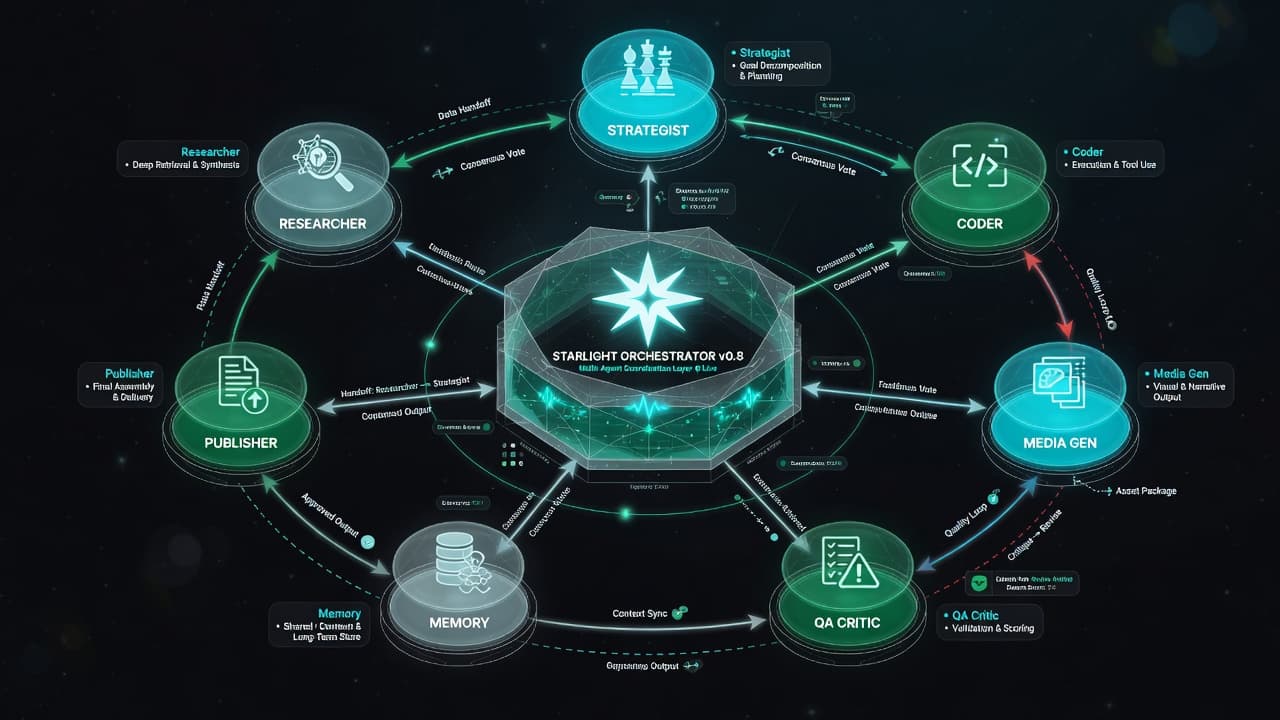
Multi-Agent Model Fabric 2026: Routing, Evals, and Fallbacks
Production architecture for absorbing Grok 4.6, Gemini 3.7 Flash, DeepSeek-V4-Pro, and Qwen3.8-27B. Lane-based routing, structural evals, cost caps, and handoff contracts.
Read article
Autonomous Product Dev & The AI Foundry: Building Software with Swarms
How sovereign creators and elite engineering teams design, scaffold, test, and ship autonomous micro-SaaS products using multi-agent swarms.
Read article
Modern Agentic Systems Architecture: From ReAct Loops to Trajectory Evals
A comprehensive teardown of production multi-agent systems, Model Context Protocol standards, context compression, and trajectory evaluation gates.
Read article