GPT-6 Astra for founders: ChatGPT, Work and Codex
TL;DR
Give Astra a complete business outcome with sources, constraints and acceptance checks. ChatGPT supports the conversation; Work organizes multi-step production; Codex handles repository changes and executable artifacts. Start with one recurring founder workflow, inspect the handoff and compare correction time against your current process. Keep access, billing and deployment decisions explicit rather than assuming the model upgrade supplies them.

Choose the right surface for a founder project and define evidence that the work is ready to use.
Give GPT-6 Astra one complete founder project and judge the handoff. A useful first commission could combine a market brief, campaign assets and a working landing page, with evidence that the claims and interactions hold up.
OpenAI released Astra on September 3, 2026, emphasizing stronger computer use and professional workflows. That provides a reason to reassess work that previously needed frequent intervention. It does not establish a return on investment for your business. OpenAI's launch announcement.
My recommendation is to measure the amount of useful work that reaches a reviewable state. A founder has limited attention. The best upgrade returns some of it without creating a larger correction queue.
Assign the work to the right surface
The model and the place where you use it are separate decisions. Your surface determines the available files, connections, controls and handoff.
| Surface | A useful founder assignment | Acceptance evidence |
|---|---|---|
| ChatGPT | Challenge a positioning hypothesis, compare alternatives or revise a short brief. | A clear decision, assumptions and the evidence that could change it. |
| ChatGPT Work | Research a market, assemble a campaign package or create a resource from connected sources. | Reviewable files, source references and explicit unresolved gaps. |
| Codex | Implement a landing page, interactive calculator or application change in a repository. | A diff, passing relevant checks, a preview and a reversible release. |
Work is designed around multi-step tasks and outputs you can inspect. Connected plugins provide access to relevant context and actions; the assignment still needs an outcome and constraints. Getting started with Work.
Model selection depends on the client, plan, workspace and rollout. OpenAI's model guidance describes different controls across Work and Codex, including a Codex CLI model option. Check the surface you actually use before writing an operating procedure around a setting. Model selection guidance.
An API application is another system. It has its own billing, tool implementation and operational responsibilities. A ChatGPT subscription is not a production API budget.
Commission a campaign around an actual decision
Imagine a founder launching a customer research service. The immediate question is whether a specific audience understands the offer and takes the next step.
Give the project a compact source package: the approved offer, a few consented interview excerpts, the current website, brand guidance and the exact booking destination. Identify which material is authoritative and which is exploratory.
The commission can produce three connected artifacts. The market brief explains the audience's job and the evidence behind the proposed message. The campaign package expresses that message in a page, a short video script and an email draft. The implementation turns the chosen page into a preview with a functioning route to the booking destination.
Each artifact should preserve the same offer version. A stronger headline is a defect if it quietly invents a guarantee that the service cannot deliver.
Create a reviewable launch package for this offer and audience.
Use the approved offer and supplied customer evidence as the source of truth.
Separate supported claims, hypotheses and missing information.
Produce a market brief, three campaign assets and a landing-page preview.
Keep editable sources and show how each asset traces to the approved message.
Check links, mobile layout and the booking journey.
Return the outputs, checks performed, unresolved defects and next decision.
This brief leaves room for intelligent implementation choices while making the result inspectable. For a reusable team setup, the Codex plugin guide explains how shared instructions and capabilities fit into repository work.
Web design needs a working journey
Astra's API guide describes improvements relevant to tool workflows, including asynchronous calls and steering during execution. Those are documented capabilities, not proof that a particular marketing page will convert. Using Astra.
For a website commission, ask for an audience-specific design direction before a component inventory. A research report, a coaching service and a software trial need different reading paths.
Then inspect the actual journey. At phone width, can the visitor understand the offer before decorative material fills the screen? Can a keyboard user reach and operate the form? Does the confirmation reflect a recorded submission? Do the social preview and canonical URL describe the same page?
A practical acceptance record has four columns: requirement, result, evidence and remaining defect. The evidence might be a preview URL, a screenshot at the relevant width, a test result or a submitted sandbox record. The artifact determines the check.
Use ChatGPT Sites for projects that fit its sharing and hosting model. Use repository-based implementation when the project depends on an existing application, release process or integration. Decide from the required handoff.
Marketing gains depend on source discipline
A model can turn a coherent offer into many formats. The harder job is preserving meaning as those formats diverge.
For every derivative, keep the source claim, audience and intended action visible in the brief. Review a short video for the promise it makes aloud. Review an email for the expectation it creates. Review the page for what happens after the visitor clicks.
This also opens more useful content forms. A pricing explanation can become a calculator. A workshop can include an interactive exercise. A product comparison can let the reader select constraints. These are proposed applications; their usefulness follows from the visitor's task, not from the number of generated formats.
The creator article goes deeper into Adobe, Canva, HeyGen and editable creative handoffs.
Run one comparison before changing your operating model
Choose work you already repeat. Give Astra and your current workflow comparable inputs and the same acceptance rules. Record the number of attempts, elapsed time, active correction minutes and outputs accepted. Inspect at least one failure and repeat the commission before treating an early success as typical.
The LLM hub separates published benchmarks from local measurements, and its calculator lets you include review time and retries. The architecture article explains how to turn that evidence into routing and production decisions.
Start with next week's real deliverable. If the upgrade consistently reduces the work between a sound brief and an accepted result, expand its responsibility one workflow at a time.
For the model entry and source-backed specifications, open GPT-6 Astra in the FrankX LLM hub.
Related Research
Agentic Product Development & Autonomous Software Lifecycles
Autonomous PRD generation, self-assembling user stories, automated acceptance testing, and continuous deployment
Autonomous Coding Agents & Full-Stack Software Engineering
Context engineering, codebase indexing, AST refactoring, test-driven generative coding, and PR lifecycle automation
Quality-Adjusted AI Economics & Compute Unit Costs
Quality-Adjusted Cost of Compute, token unit economics, prompt caching ROI, model routing, and EBITDA impact

Read on FrankX.AI — AI Architecture, Music & Creator Intelligence
Stay in the intelligence loop
Field notes on AI systems, production patterns, and builder strategy.
Continue Reading
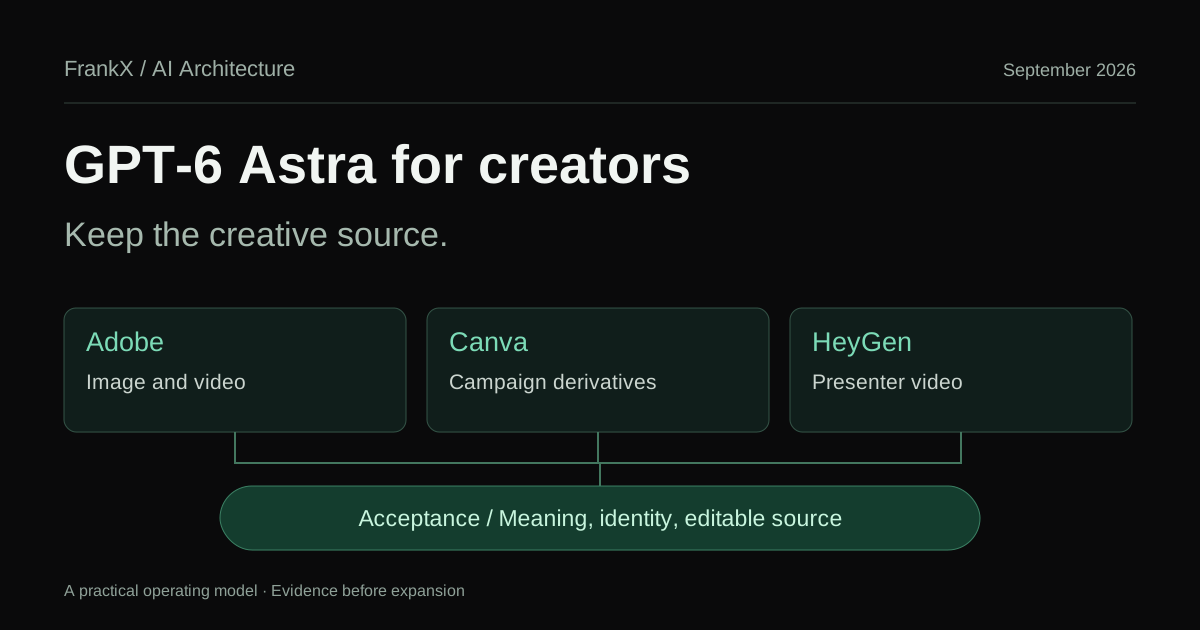
GPT-6 Astra for creators: build a studio that finishes
Evaluate GPT-6 Astra for creative production with Adobe, Canva and HeyGen, including tool access, editable handoffs and the cost of usable results.
Read article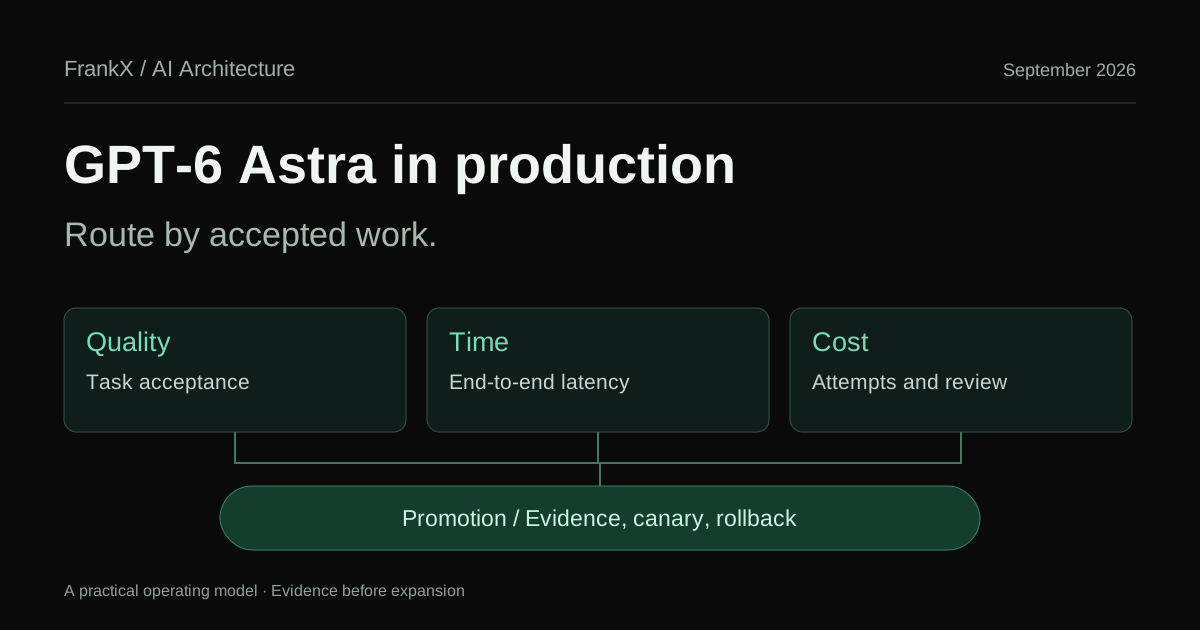
GPT-6 Astra: model economics and production architecture
Evaluate GPT-6 Astra for organizational adoption with workload routing, independent grading, accepted-task economics and a controlled path into production.
Read article
AI Capability Is Abundant. Architecture Is Still the Work.
Where AI skills and architecture create real value: turning workshops, field notes, compute, and infrastructure into durable systems that survive change.
Read article