GPT-6 Astra: model economics and production architecture
TL;DR
Treat Astra as a candidate inside a workload-specific architecture. Select models using accepted-task cost, quality and end-to-end latency under comparable conditions. Preserve retrieval boundaries, durable tool execution and rollback. Deterministic checks establish objective correctness; an independent, human-calibrated judge can assess subjective quality. The hub's twelve synthetic cases are defined but unrun, so they establish an evaluation contract rather than production readiness.

Define a model-selection and promotion process that accounts for quality, latency, correction effort and operating cost.
Put GPT-6 Astra into your model evaluation process before putting it into your default production route. The organizational decision is whether it improves a defined workload under your quality, latency, data and cost constraints.
My architectural recommendation is to make model replacement a controlled configuration change. The business contract, retrieval boundaries, tool permissions, observability and rollback path should survive it. A stronger model can change which work is feasible and how much correction it needs; the surrounding system still owns the outcome.
“Best” needs a workload and a constraint
An intelligence index, a repository benchmark and a workflow test measure different things. The model hub keeps those columns separate and identifies the publisher of each result. None is a substitute for your own acceptance set.
Define the work before the candidate list. An invoice extraction route may need schema correctness, exact source values and a tight processing budget. A repository migration may tolerate more reasoning time if it reduces repair. A customer-facing assistant may prioritize reliable tail latency and correct escalation.
These are different production contracts. A single default model can simplify operations at first, but it should remain a deliberate choice with measured consequences.
| Decision | Measure on your workload | Typical failure of the shortcut |
|---|---|---|
| Lowest price | Total cost per accepted result, including retries and correction | A cheap response creates expensive repair. |
| Highest useful intelligence | Acceptance against a task-specific rubric and baseline | A general index obscures domain errors. |
| Fastest execution | End-to-end p50 and p95 time, including tools and retries | Fast tokens hide a slow or unreliable workflow. |
| Easiest production adoption | Integration effort, observability, controls and rollback | A successful demo leaves state and ownership undefined. |
For the broader design choices around these contracts, see four AI architecture decisions that are hard to reverse.
Price the accepted outcome
At the checked standard short-context API rates, Astra costs $10 per million input tokens and $50 per million output tokens, with cached reads at $1. A request using 10,000 uncached input tokens and 2,000 output tokens therefore has a $0.20 inference estimate before other charges. OpenAI pricing.
That arithmetic describes one request. Your business buys accepted work.
Consider a hypothetical comparison with two workflows. Both consume the same amount of input and output per attempt. Workflow A costs $0.20 in inference, needs two minutes of correction at $60 per hour, and accepts 90% of tasks. Its expected cost per accepted task is approximately $2.44. Workflow B costs $0.08 in inference but needs five minutes of correction and accepts 80%, giving $6.35. Correction times are averages across all submitted tasks. These are invented planning assumptions, not measured model results.
Cost per accepted task =
  mean total cost per submitted task, including retries and review
  / acceptance rate
Include failed attempts in the numerator. An unknown tool charge stays unknown; recording zero makes an incomplete account look efficient. For batch production, divide total observed spend and review cost by the number of accepted artifacts.
Use the interactive calculator on the LLM hub to test assumptions. It covers standard short context and excludes cache creation, processing-tier adjustments and taxes. Equal token counts across providers are only a planning convenience because tokenizers differ.
One pricing detail deserves precision: Anthropic lists Fable 5.1 cache reads at $0.25 per million tokens, which is 2.5% of its $10 base input rate. Cache creation has separate prices. Anthropic pricing.
Keep model judgment separate from authority
Astra's documented asynchronous tool calling can overlap useful work while an external operation runs. Your application still executes the tool and returns the eventual result. Async tool calling.
The production implication is to give every operation an identity and an owner. Store the intended action, arguments, authorization context and job state. If a connection drops after a completed write, inspect that state before repeating the operation. Apply retry limits to the workflow, including time and spending, rather than letting each isolated component retry indefinitely.
The model can propose a tool action. The application checks whether that action is valid for the current user and task. Retrieved documents supply evidence; they do not acquire the authority to change permissions. Tool results update state only after the executor has checked the returned identity and outcome.
This division also makes model changes less disruptive. A new candidate receives the same tool contract, while the executor keeps its existing boundaries. The production agent systems guide develops the surrounding operating architecture.
Build an evaluator with more than one kind of judgment
The dedicated hub protocol has four stages: deterministic contract checks, sandbox tool execution, independent quality review and production promotion.
The first stage now defines twelve synthetic cases. They cover creator asset identity, unavailable connectors, retry behavior and organizational decisions such as routing under stated constraints. The Astra route is configured at high reasoning effort and disabled pending execution. The public record says not run. These cases do not yet measure live connector performance or prove that an exported creative asset is good.
The next stages need different evidence. Executable checks can establish whether a file opens, a schema matches or a tenant boundary holds. Subjective qualities need a rubric and independent judgment.
A dedicated judge model can help scale that review after calibration. It should not be the candidate approving its own output. Start with human-adjudicated examples, conceal model identity, vary response order and measure agreement by failure category. Preserve disagreement for review. A persuasive explanation from a judge cannot overrule a broken export or an unauthorized action.
OpenAI's evaluation guidance emphasizes representative tasks, failure logging and human calibration. Apply those principles to your workflow rather than treating a model-generated score as evidence by itself. Evaluation best practices.
There is also a current platform change: OpenAI's hosted Evals becomes read-only on October 31, 2026, with dashboard and API shutdown scheduled for November 30. The hub extends the existing local evaluation control plane instead of introducing a new dependency on that service. Deprecation schedule.
Promote a route with a reversible decision
Before a run, the workload owner should set the acceptance threshold, latency limit and total-cost budget. Include representative edge cases, repeat observations and retain the current model as a baseline. Report the sample size and uncertainty; a dozen synthetic decisions cannot establish broad organizational readiness.
Promote only after reviewing critical failures separately from the average. Start with a limited share of eligible work, monitor correction effort and errors, and retain a route back to the baseline. Broaden responsibility when the observed result supports it.
For routine classification and extraction, begin with a lower-cost candidate and escalate only when the evidence requires it. For complex work, compare Astra with a credible baseline under the same acceptance contract. The model routing guide provides the general pattern; the Astra evaluation cases on GitHub record the specific implementation and its remaining gaps — twelve cases defined, zero run as of this writing.
The architecture earns its value when the next model release becomes a testable candidate, a reviewable decision and a reversible rollout.
For the model entry and source-backed specifications, open GPT-6 Astra in the FrankX LLM hub.
Related Research
Agentic Evals
Trajectory receipts, swarm proof, and quality that can be replayed
Enterprise AI Centers of Excellence (CoE) & Operating Models
Hub-and-spoke vs federated CoE architectures, enterprise capability building, and value realization
Quality-Adjusted AI Economics & Compute Unit Costs
Quality-Adjusted Cost of Compute, token unit economics, prompt caching ROI, model routing, and EBITDA impact

Read on FrankX.AI — AI Architecture, Music & Creator Intelligence
Stay in the intelligence loop
Field notes on AI systems, production patterns, and builder strategy.
Continue Reading

Frontier Model Routing: Beyond Single-Model Dependencies
Why model freedom matters in production. Build a resilient routed frontier stack combining Opus 4.8, GPT-5.5, Grok 4.3, and Gemini 3.
Read article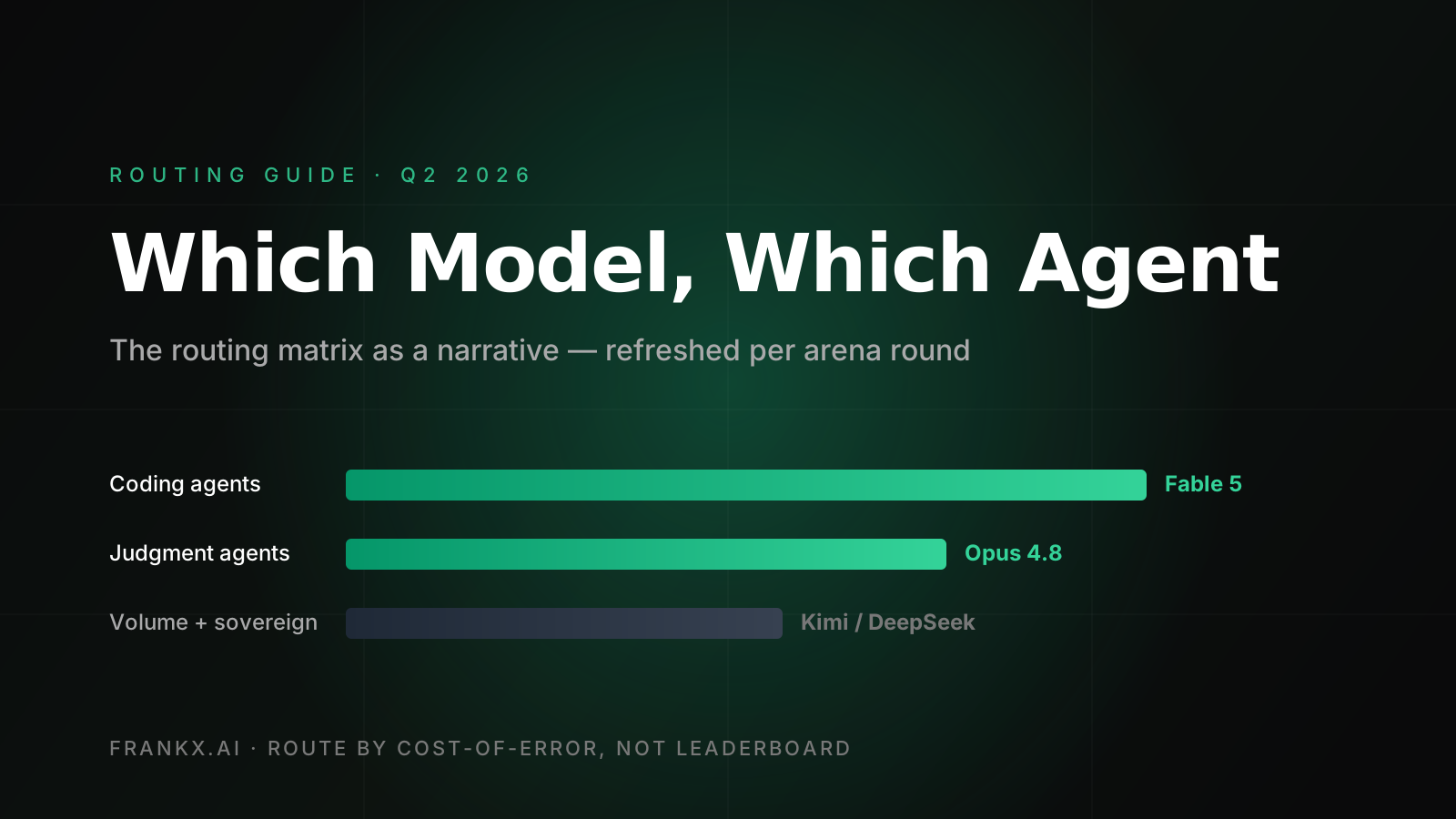
The AI Model Routing Guide: Which Model for Which Agent (Q2 2026 Edition)
Architectural guide to dynamic model routing: balancing latency, token economics, and reasoning depth across production AI applications.
Read articleVercel Ship 2026 decisions for people who ship agents
Which Ship 2026 primitives to adopt, wait on, or skip, with the runtime guide and a decision matrix a builder can use on the page.
Read article