The Enterprise Agent Roadmap 2026: Multi-Agent Orchestration Patterns
TL;DR
Your vertical hierarchy is too slow for multi-agent systems. The Fractal Triad topology with LangGraph, CrewAI, and MCP integration for enterprise orchestration.

You'll master production agent architecture, tool integration patterns, and resilient multi-agent orchestration systems.
The Enterprise Agent Roadmap: Destroy Your Org Chart
Look at your current organizational chart. VP -> Director -> Manager -> Junior -> Intern. It looks like a pyramid. In the age of AI, that pyramid is a tomb.
Linear hierarchies were designed for humans who sleep, forget things, and communicate at 50 words per minute. Your AI workforce thinks at the speed of light and talks in JSON objects. If you force your AI agents into a human org chart, you are putting a Ferrari engine inside a horse.
You need a Swarm Topology.
The Hard Truth: "Managers" are Obsolete
In 2026, you don't need "Managers" who ask for status updates. You need Architects who design flows.
The unit of scale is no longer the "Team." It is the Graph. A Graph is a network where agents (Nodes) talk to each other directly (Edges), governed by a shared Protocol.
The Fractal Triad: Your New Building Block
Forget the "Squad." Build the Triad. Every function in your company—Marketing, Coding, Legal—can be replaced or augmented by this three-node cell:
-
The Context Node (The Brain)
- Role: It doesn't do the work. It understands the Goal.
- Input: "We need a landing page for the Q3 campaign."
- Action: It breaks this into 50 sub-tasks. It holds the "State" of the project.
-
The Execution Node (The Hands)
- Role: Deep, narrow skill.
- Who: A React Coder agent. A Copywriting agent. A Midjourney prompt agent.
- Action: They execute the sub-tasks in parallel. Not sequential. Parallel.
-
The Verification Node (The Eyes)
- Role: The Critic.
- Who: A Linter. A Brand Compliance Checker. A Unit Test Runner.
- Action: It rejects 30% of the work. It forces the Execution Node to retry.
Why This Wins
Scenario: The "Vertical" Company
- Day 1: Junior writes code.
- Day 2: Manager reviews. "Fix this."
- Day 3: Junior fixes.
- Day 4: Director approves.
- Total Time: 96 hours.
Scenario: The "Fractal" Company
- Hour 1: Context Node defines spec.
- Hour 1.1: Execution Node writes code.
- Hour 1.2: Verification Node rejects it (Context/Syntax error).
- Hour 1.3: Execution Node retries.
- Hour 1.4: Verification Node approves.
- Total Time: 24 minutes.
The Cognitive Velocity Metric
Stop measuring "Hours Worked." That is a metric for physical labor. Start measuring Cognitive Velocity: How fast can a novel idea traverse your graph and become a shipped reality?
If your Cognitive Velocity is measured in days, you are safe. If it's measured in weeks, you are dying. If it's measured in months, you are already dead.
Tear down the pyramid. Build the graph.
Related Articles
- Production Agentic AI Systems — Choosing the right architecture tier
- Production LLM Agents on OCI — Enterprise deployment blueprint
- Multi-Agent Orchestration Patterns — Coordination strategies at scale
Build your first AI system
Step-by-step guide to setting up ACOS, creating your first agent, and shipping real products with AI.
Start buildingProduction-ready architecture
Download AI architecture templates, multi-agent blueprints, and prompt engineering patterns.
Browse templatesJoin the builder community
Connect with creators and architects shipping AI products. Weekly office hours, shared resources, direct access.
Join the circle
Read on FrankX.AI — AI Architecture, Music & Creator Intelligence
Stay in the intelligence loop
Weekly field notes on AI systems, production patterns, and builder strategy.
Continue Reading
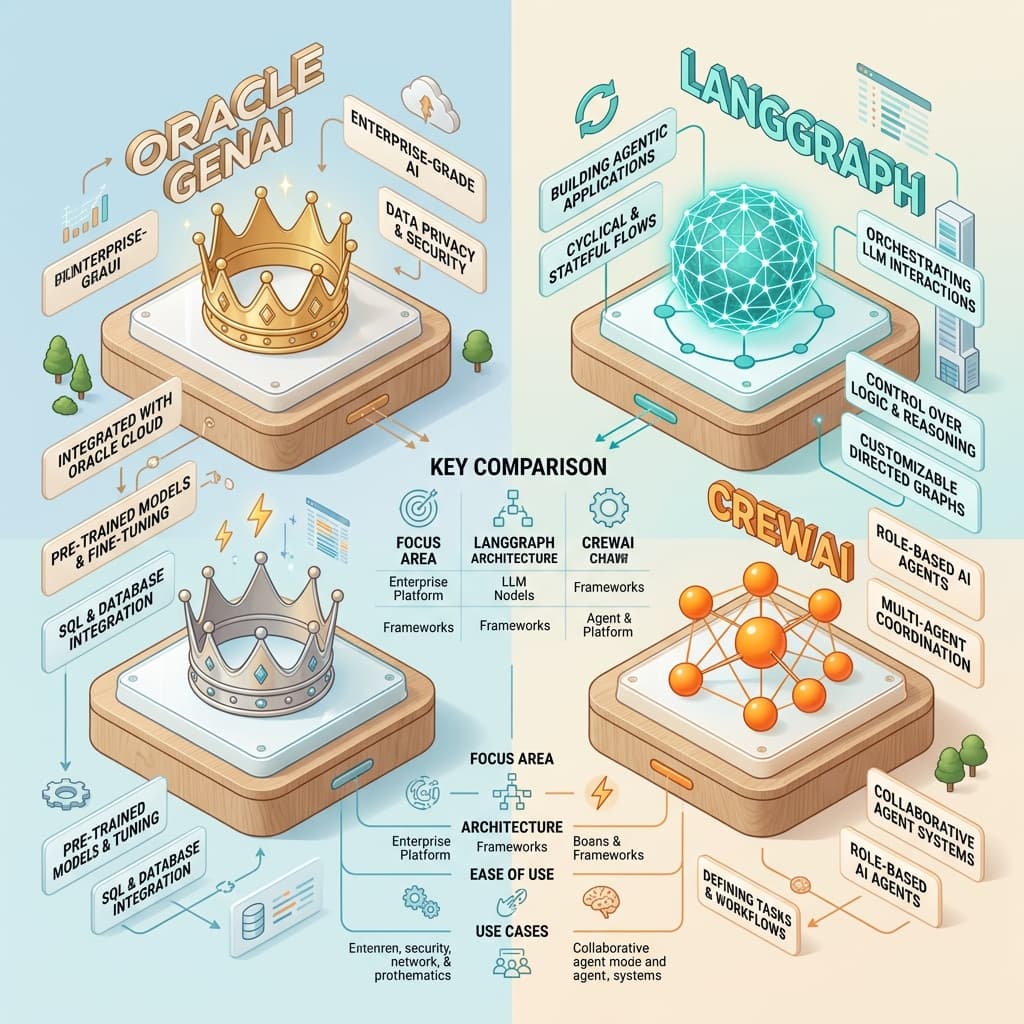
Oracle GenAI Agents vs LangGraph vs CrewAI: Enterprise AI Agent Comparison 2026
A practical comparison of OCI GenAI Agents, LangGraph, and CrewAI for enterprise deployments. Features, cost considerations, and decision framework from an AI architect's perspective.
Read article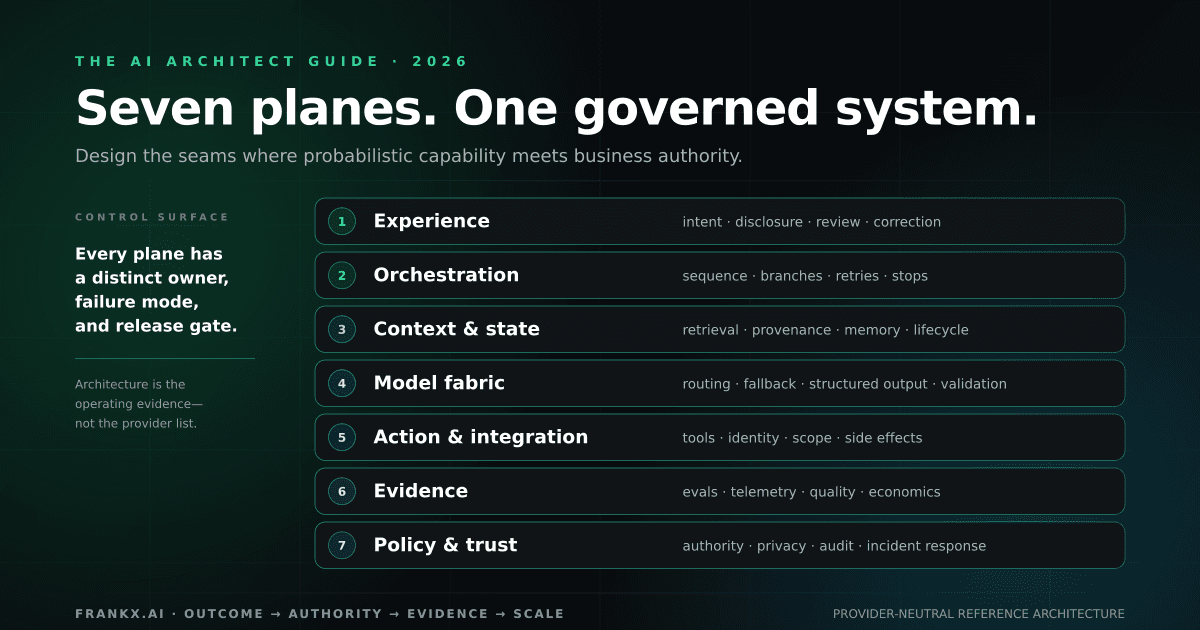
The AI Architect Guide 2026
A field guide to the decisions, system planes, evidence gates, and operating artifacts required to turn AI capability into a reliable workflow.
Read article
The Ultimate n8n Workflow in 2026
The complete 2026 guide to building production n8n workflows: self-host vs cloud, the AI Agent node, MCP Server Trigger and Client Tool, content repurposing, RAG, and wiring n8n as the ...
Read article