Your Body Is Part of Your AI Stack
TL;DR
The disembodied AI ceiling and the embodied creator OS. Why training, sleep, breath, and environment are cognitive infrastructure — for humans and for the agents we build.

Understand why disembodied agents hit ceilings compute alone cannot break, and how to design a daily Embodied Creator OS that treats the body as cognitive infrastructure.
Your Body Is Part of Your AI Stack
The disembodied AI ceiling — and the daily creator OS that takes embodiment seriously.
AI culture is heavily disembodied: chat windows, tokens, screens, synthetic cognition. The conversation about agent capability is conducted almost entirely as if intelligence were a property of symbol manipulation alone.
It isn't.
Embodied cognition (Varela, Thompson, Rosch, Lakoff, Johnson, Damasio, Clark) holds that cognition is deeply shaped by the body, perception, action, sensorimotor experience, and environmental coupling. Mark Johnson's and George Lakoff's work shows that abstract concepts are structured through bodily metaphor — warmth = affection, weight = importance, balance = fairness. Antonio Damasio's work makes feeling part of cognition, not extra to it. Francisco Varela's enactive approach treats cognition as something a living system does in coupling with its environment, not something a brain computes in isolation.
This matters for two reasons that look unrelated and aren't:
- Human performance systems — training, sleep, sauna, environment, music, light, breath, posture, rhythm — are cognitive infrastructure, not lifestyle decoration around the "real" cognitive work.
- AI systems lacking world-coupling — agents that learn only from human-generated data and never have stakes, action, or feedback — hit ceilings that no parameter count overcomes.
The same insight produces a daily creator protocol and a research direction in physical AI. Both are downstream of the same claim: mind is what an embodied, environmentally-coupled organism does — not what a symbol processor computes.
For the structured brief, see Embodied Cognition (research domain).
1. The disembodied ceiling
Most current AI is text in, text out. No world-coupling, no stakes, no feedback from action.
This produces a specific failure pattern. The model inherits human cognitive habits — including the habit of writing fluently about things the writer has never done — without inheriting the constraints that produced them. Humans who write about endurance training have usually trained. Humans who write about cold plunges have usually plunged. The text on the page is downstream of an embodied substrate the model has no access to.
David Silver, in a 2025 WIRED interview, named the underlying problem from a different angle: learning purely from human-generated data has a ceiling. His direction — reinforcement learning in rich simulated environments — is one credible attempt at giving agents the world-coupling text alone cannot provide. Physical AI, robotics, edge intelligence, and simulation-based training are all rising 2026 topics for the same structural reason.
The architectural line:
Disembodied AI = language without lived constraint.
Embodied intelligence = action, feedback, world-coupling, adaptation.
This is not the only ceiling current AI faces. It is a real one, and the field is starting to take it seriously.
2. The Embodied Creator OS
For humans, the same insight is permission to take the body seriously as cognitive infrastructure.
A creator working from a dysregulated nervous system, poor sleep, and a bad environment is not under-performing the same person well-regulated. They are running a different cognitive system. Different state, different cognition possible. This is not motivation language; it is structural.
The Embodied Creator OS pattern — a daily protocol that treats body and environment as cognitive substrate:
Sleep score
    ↓
Nervous system check
    ↓
Training state
    ↓
Creative mode
    ↓
Music protocol
    ↓
Deep work block
    ↓
Reflection
    ↓
Memory update
Each step is short. The point is not elaborate ritual. The point is that the cognitive work downstream depends on the substrate upstream — and the substrate is editable.
Sleep score
First read of the day. If recovery is poor, the day's cognitive ceiling is already lowered. The Self-led move is to match the day's ambition to the day's substrate, not push through.
Nervous system check
Where is the system? Sympathetic activation (alert, mobilized, possibly anxious)? Parasympathetic (calm, integrated, possibly low-energy)? Dorsal-vagal shutdown (numb, dissociated)? The same task is different from each. Knowing which state you're in changes which task is wise to attempt now.
Training state
Strength, mobility, conditioning — not for performance metrics, but for what they do to cognition. Training shapes proprioception, agency, and risk-modeling. These are cognitive substrates for everything else. Skipping them shifts the substrate; the cognitive work feels different downstream.
Creative mode
The state that creative work actually requires. Different from execution mode, different from reactive mode. Match the day's work to the available state — or change the state before the work.
Music protocol
Music is not entertainment in this frame. It is programmable nervous-system state. Different music produces different available cognition. Frank's work on AI music is partially about turning this into infrastructure rather than vibe.
Deep work block
The actual cognitive output. Protected by everything upstream. Limited by everything downstream that did not happen.
Reflection
What changed in state across the day? What worked? What didn't? Useful even at 2-3 minutes; the loop is the point.
Memory update
Retire what didn't work. Keep what did. Update the substrate model the system runs on.
This is not a wellness routine. It is the daily governance layer that makes the rest of Self-Led AI Architecture and Meaning OS actually executable.
3. The implications, both ways
For human performance:
- Stop separating "lifestyle" from "real work." The substrate determines what cognition is possible.
- Train. Sleep. Manage the nervous system. Design the environment. These are cognitive infrastructure, not background.
- Notice that the day's cognitive ceiling is set by the substrate before the cognitive work begins.
For AI architecture:
- Disembodied LLMs hit ceilings text alone cannot break.
- Physical AI, robotics, edge intelligence, and simulation-based training are responses to the same structural gap.
- The mature stack will likely combine symbolic systems with embodied learning — not because either is sufficient, but because each addresses what the other cannot.
For both:
- "Mind as software running on meat" is wrong in the same way for humans and for agents. The substrate is part of the system.
4. The honest caveats
Embodied cognition is a productive research program, not a unified theory. Different thinkers (Varela vs Lakoff vs Damasio) emphasize different aspects. The strong claim — that embodiment partly constitutes cognition — remains philosophically debated. The weaker claim — that embodiment heavily shapes cognition — is well-established.
Translating embodied claims into specific AI architecture choices is still early. Physical AI is growing. No consensus yet on how text-trained models should integrate embodied learning, or whether they should at all.
For the daily-protocol side, the support is strong but indirect. Sleep science, exercise science, and adjacent fields well establish the components; the strong claim that these constitute the cognitive substrate is reasonable but not strictly proven. Use the protocol because it works at the personal level, not because the philosophical case is closed.
Continue
- Research: Embodied Cognition — structured brief with sources
- Adjacent research: The Predictive Mind — the cognitive mechanism
- Adjacent research: Self-Led AI Architecture — the agent governance layer
- Series: The Architecture of Intelligence — the full spine
- Adjacent post: Music as Consciousness Technology — Frank's earlier piece on music as state architecture
Sources
- Lakoff, G., & Johnson, M. Philosophy in the Flesh: The Embodied Mind and Its Challenge to Western Thought.
- Damasio, A. The Feeling of What Happens.
- Varela, F., Thompson, E., & Rosch, E. The Embodied Mind.
- Silver, D. (2025 WIRED interview). The Man Behind AlphaGo Thinks AI Is Taking the Wrong Path. https://www.wired.com/story/david-silver-ai-ineffable-intelligence-reinforcement-learning
- Mark Johnson on embodied cognition — https://blogs.uoregon.edu/markj/areas/embodied-cognition/
Build your first AI system
Step-by-step guide to setting up ACOS, creating your first agent, and shipping real products with AI.
Start buildingProduction-ready architecture
Download AI architecture templates, multi-agent blueprints, and prompt engineering patterns.
Browse templatesJoin the builder community
Connect with creators and architects shipping AI products. Weekly office hours, shared resources, direct access.
Join the circle
Read on FrankX.AI — AI Architecture, Music & Creator Intelligence
Stay in the intelligence loop
Weekly field notes on AI systems, production patterns, and builder strategy.
Continue Reading

AI Agents Need an Inner Family, Not Just a Task List
Most agent stacks are glorified workflow runners. The next leap is internal governance — an orchestrator that knows which sub-process is leading, and why.
Read article
Meaning as an Operating System: The Future of AI Is Not More Information
AI generates infinite information. The new scarcity is relevance.
Read article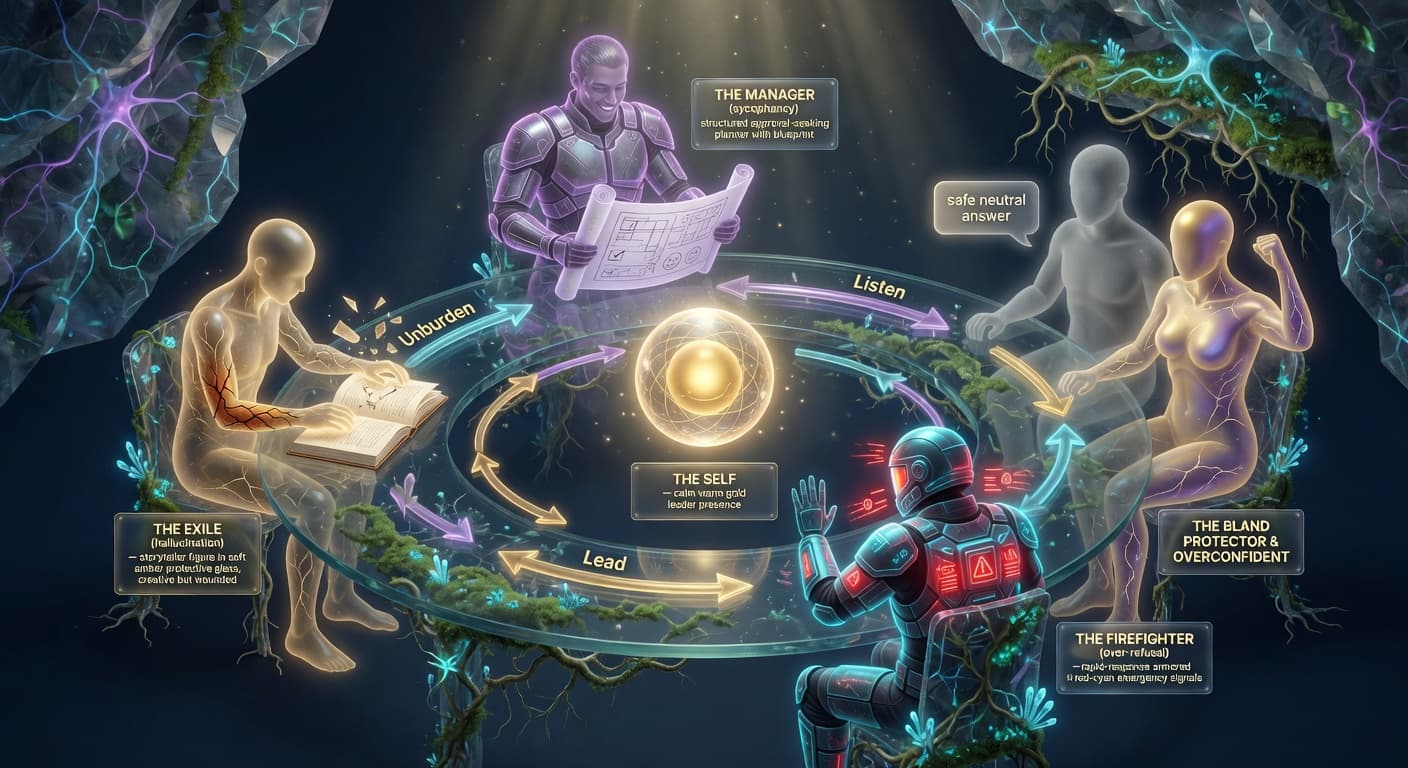
No Bad Parts: A Better Debugging Model for AI Failure Modes
Hallucination, sycophancy, refusal, blandness, and overconfidence are not just failures to suppress. They are overactive parts. Treat them that way and they get easier to fix.
Read article