12,000 Songs Later: What AI Music Taught Me About Creative Systems
TL;DR
After a very large catalog of Suno experiments, the durable lesson is not that a frequency controls a state. It is that volume creates opportunities to refine taste, compare variations, and discover the emotional patterns you return to.

Use AI music as a creative practice without converting personal listening effects into universal neuroscience claims.
Three years of frequent creation produced a catalog of more than 12,000 tracks. That number is a production count, not proof of quality or expertise. Its value is the amount of comparison it made possible.
I could hear what changed when the prompt became more specific, when the arrangement became quieter, when the lyric stopped explaining itself, or when a generation was technically clean but emotionally empty.
This is an experiential field note: what repeated practice taught me, not a controlled study of what music will do to every listener.
The first output is usually a proposal
The slot-machine approach—type a prompt, accept the first track, move on—creates volume without a learning loop.
A better process is collaborative editing:
- begin with a specific scene, memory, or tension;
- generate materially different interpretations;
- identify the line, instrument, or transition that carries the idea;
- rewrite what feels generic;
- repeat until the work has a point of view.
AI handles rapid variation. The founder or artist remains responsible for direction, selection, rights, and release.
High volume can refine taste—or hide from it
Creating thousands of artifacts only helps when the creator compares them honestly. Otherwise volume becomes an avoidance pattern.
The useful questions are:
- What do I keep returning to?
- Which emotional shortcuts have become clichés?
- What would I remove if no one could see the production count?
- Which pieces deserve another hour of human attention?
- What did the model make easy that the work still needs me to decide?
Music as an environment, not a control panel
I use playlists and self-generated pieces to mark transitions in the day. Some help me settle. Others support movement, reflection, or momentum. The effect depends on familiarity, preference, task, volume, expectation, and context.
Research on music and stress or attention is not a universal frequency table. Reviews report heterogeneous findings, and work on binaural beats remains mixed.
- Music listening and stress recovery: systematic review and meta-analysis
- Review of binaural beats, memory, and attention
I no longer describe 40 Hz as “focus,” 7 Hz as “meditation,” or 4 Hz as “recovery.” Those are overly deterministic translations of complex research categories.
The deeper pattern is emotional specificity
“Sad cinematic song” is not a useful direction. “The quiet after a long conversation ends, when neither person knows whether to turn back” is closer to one.
Specificity improves the work because it gives every creative decision something to answer to:
- instrumentation;
- pacing;
- vocal distance;
- lyrical perspective;
- dynamic arc;
- the amount of unresolved space at the end.
The same principle applies to founder positioning. A precise lived tension produces a stronger signal than a stack of category adjectives.
A repeatable session
1. Name the scene
Write two sentences describing a moment, not a genre.
2. Choose constraints
Specify instrumentation, tempo range, vocal presence, emotional temperature, and what must not appear.
3. Generate contrasts
Create three directions that differ structurally: sparse, rhythmic, and narrative, for example.
4. Curate before generating again
Write down what works in each version. Do not ask the model for “better” without defining better.
5. Add human decisions
Edit lyrics, sequence sections, choose the release context, verify rights, and decide whether the piece should be public at all.
6. Listen away from the interface
The generation screen rewards novelty. A walk, headphones, speakers, or a day of distance changes what you notice.
Symbolic and personal uses
Music can serve as a memorial, threshold, ritual, or way to hold an experience that prose cannot carry. That is a symbolic or experiential use. It does not become less meaningful because it is not a medical claim.
What the catalog does prove
It proves that I returned to the practice, built a large comparison set, and learned a personal production language. It does not prove that every track is finished, that listeners share my response, or that a sound frequency causes a specified biological outcome.
The strongest creative system is not the one that generates the most. It is the one that helps you notice what deserves to continue.
Related:

Read on FrankX.AI — AI Architecture, Music & Creator Intelligence
Stay in the intelligence loop
Field notes on AI systems, production patterns, and builder strategy.
Continue Reading
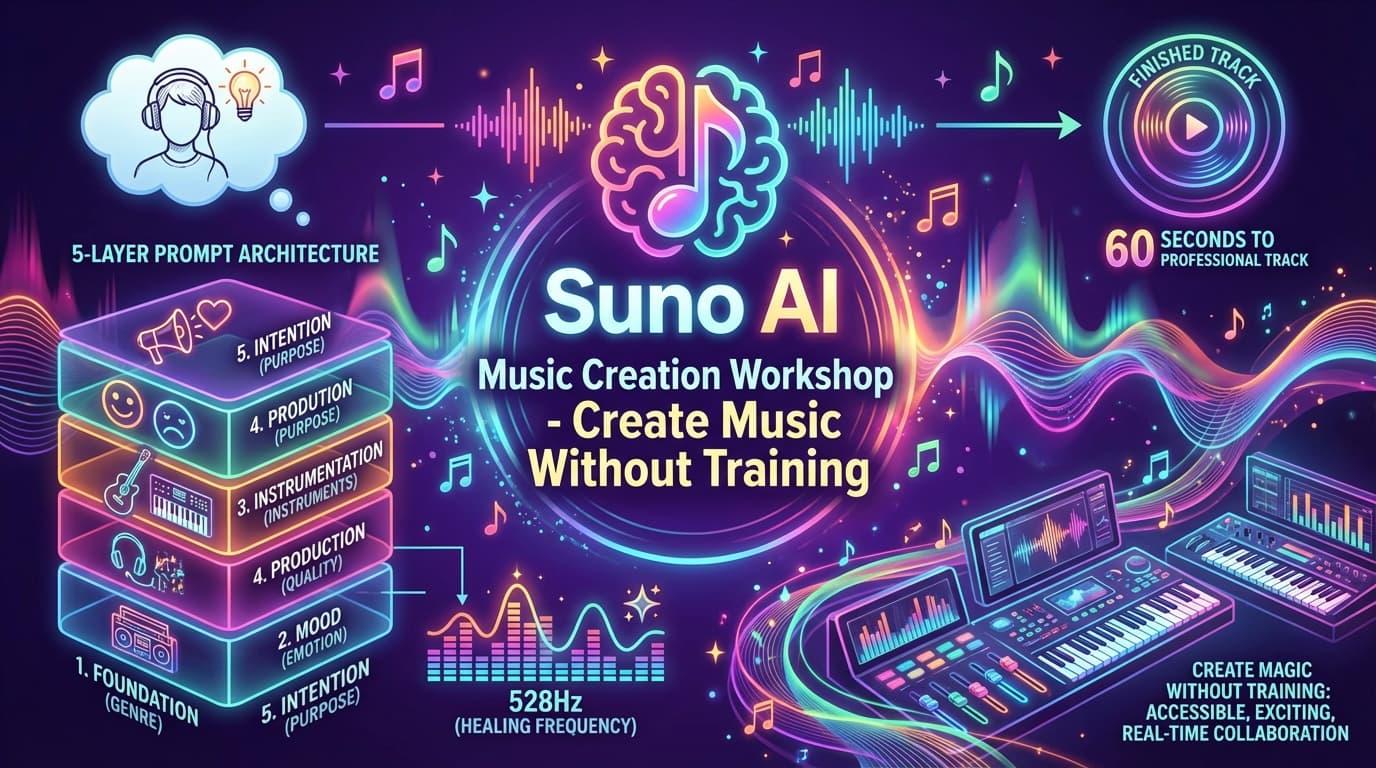
Create Music Without Musical Training: The Suno AI Music Creation Workshop
Transform your ideas into cinematic soundscapes, meditation-inspired music, and motivation anthems using AI. Learn the 5-Layer Prompt Architecture and aesthetic tuning choices for expressive audio.
Read article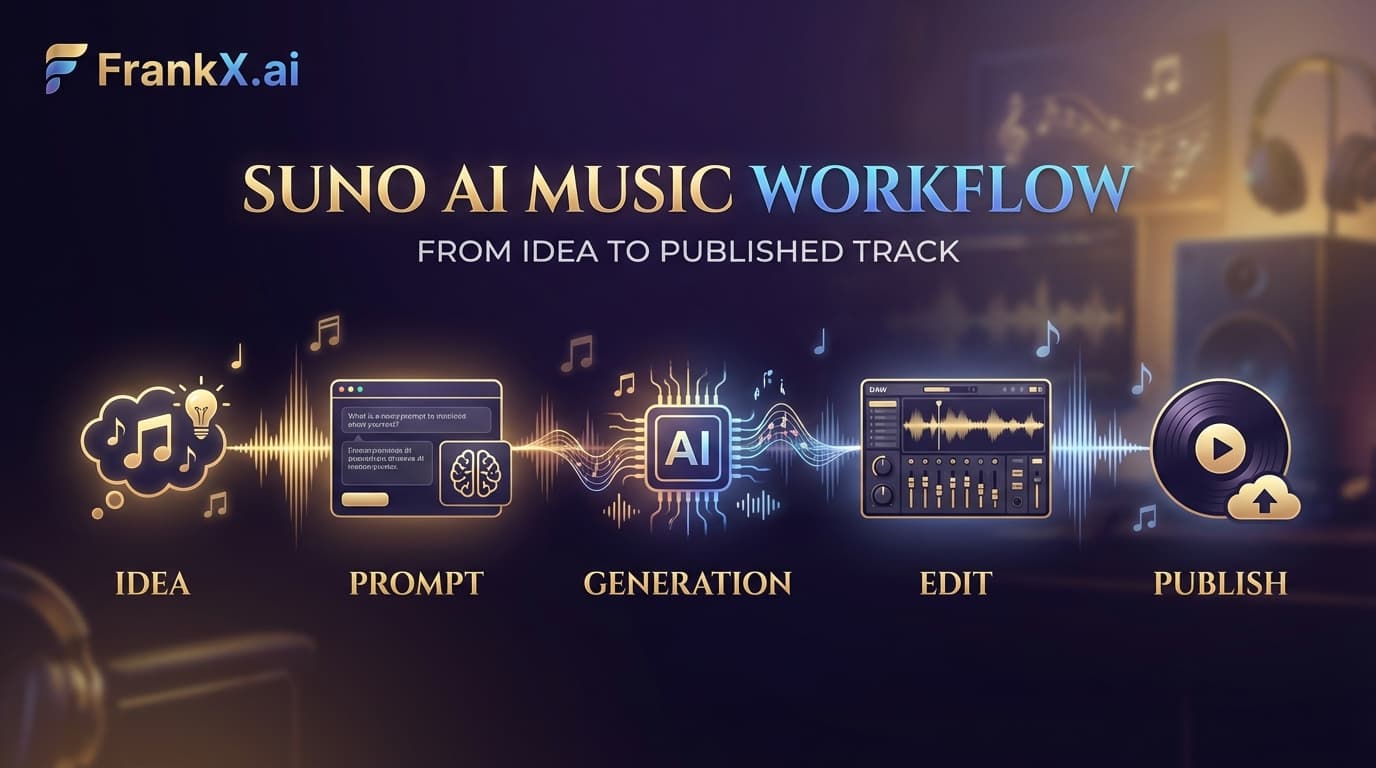
How to Use Suno AI for Professional Music Production
Move beyond 'hit and hope' generation. A systematic workflow for using Suno AI to produce radio-ready tracks, from emotion mapping to stem mixing.
Read article