Meaning as an Operating System: The Future of AI Is Not More Information
TL;DR
AI generates infinite information. The new scarcity is relevance.

Understand why relevance — not information — is the binding scarcity in the post-AI era, and how to organize a personal Meaning OS or design AI agents that know what matters.
Meaning as an Operating System: The Future of AI Is Not More Information
The internet promised infinite information. AI keeps that promise and breaks it at the same time.
Information is no longer scarce. Relevance is.
The harder problem in 2026 is not "can the system answer my question?" It is "does the system know which answer matters?" That distinction is what John Vervaeke calls relevance realization — the cognitive capacity to recognize what is salient in a given context. It is the missing layer between retrieval (information) and judgment (action).
Most AI products optimize the wrong layer. Most productivity stacks optimize the wrong layer. Both produce more output and less coherence. The fix is not better answers — it is a different architecture.
This is the long-form companion to Meaning as an Operating System (research domain). For the structured brief with sources and limitations, go there.
1. The category claim
Vervaeke's framing is sharp. Intelligence is not information processing. Intelligence is the ability to realize what matters.
This is not semantic. It is structural. A system that retrieves perfect information but cannot tell which piece is salient produces overwhelm. A system that ranks salience well produces coherence — even with imperfect information.
The four-layer pattern is:
Information Retrieval
    ↓
Relevance Realization
    ↓
Meaning Construction
    ↓
Wise Action
Most AI stops at retrieval. Most productivity stops at action. The two missing middle layers — relevance and meaning — are where the actual cognitive work lives.
Microsoft's 2026 AI trends framing notes the shift from AI-as-tool to AI-as-collaborator. The shift forces the harder question. When AI becomes a colleague, the test is no longer "can it answer?" It is "can it know what matters?"
2. Information abundance, relevance scarcity
Most modern overwhelm is not information overload. It is unrelevance overload.
The volume of information you process daily is not the source of your fatigue. The volume of near-miss information — almost relevant, almost actionable, almost important, almost worth attending to — is. Each near-miss costs cognitive energy without producing closure.
This is the failure mode of ranking-by-similarity. Search engines, recommendation feeds, and most retrieval-augmented AI systems rank by semantic similarity to the query. Similarity is correlated with relevance — but not strongly enough. Similar items pile up; the one that actually matters gets lost in them.
A relevance-aware system does the additional work:
- Score retrieved information by user-specific salience, not just semantic match.
- Filter against declared values and recurring themes.
- Account for current state — energy, focus, what part of the system is leading right now.
- Surface the smallest signal that compounds, not the most thorough match.
This is what a Self-Led AI Architecture does for internal governance. A Meaning-OS-aware architecture does the same for external relevance.
3. The personal Meaning OS pattern
A Meaning OS is not productivity software with a meaning skin on top. It is a layer that organizes the elements of a life — goals, values, memories, projects, relationships, rituals, work, content, identity — so they reinforce each other instead of competing for attention.
The unit of progress is not tasks completed. It is alignment between what the person values and what they do.
A useful structure has four columns and six rows:
| Layer | Goals | Values | Identity |
|---|---|---|---|
| Daily | What gets done today? | Which values does today honor? | Which version of me did today reinforce? |
| Weekly | What pattern is emerging? | Which values got compressed? | Which identity got fed? |
| Quarterly | Which goals are still load-bearing? | Which values changed? | Which identity is becoming? |
| Yearly | What was the year actually about? | Did values lead or follow? | Who did this year build? |
| Decade | What story is this becoming? | Which values stayed? | Who am I becoming over decades? |
| Compound | The single sentence that answers "what is this life for?" |
Most productivity stacks stop at "daily goals." A Meaning OS goes wider and longer. The point is not to plan more. It is to ensure that what gets planned is the thing that compounds.
4. The four-layer architecture, applied
For a personal AI agent — an Inner Operating System rather than a chatbot — the relevance pattern becomes a pipeline:
Layer 1: Signal ranking
Score retrieved information by user-specific relevance, not just semantic similarity. The user's stated values, recurring themes, and current focus all weight the ranking. A piece of information that scores 0.9 on similarity but 0.2 on personal salience ranks below one that scores 0.7 on both.
Layer 2: Value alignment
Filter the ranked signal against declared values. If the user has named "deep work" as a current priority, surface signals that support it; bury signals that fragment it. This is the layer most retrieval systems skip entirely.
Layer 3: State awareness
Account for current state — energy, focus, time of day, which internal part is leading (see Self-Led AI Architecture). The same answer is wise in one state and harmful in another. A Meaning-OS-aware agent knows the difference.
Layer 4: Action worth taking
The output is the smallest action that compounds toward what matters — not the most thorough answer to the literal question. "Schedule the call" beats "here are 12 things you might do." "Skip this meeting and do the thing the meeting is about" beats "here is your prep doc."
This is harder than it sounds because the agent has to know what "compounds toward what matters" means for this specific person. That requires memory across sessions, declared values, and an integration loop that periodically updates both. None of this is in the standard agent stack.
5. Why this matters now
Three convergent shifts make Meaning OS the right category for 2026:
- AI commoditizes information. The thing that was scarce a decade ago is now infinite. The new scarcity is what to do with it. Relevance is the moat.
- Productivity hit its ceiling. Most knowledge workers are already overproductive — they ship more output and less meaning every year. Optimizing throughput further is negative ROI.
- Agentic AI forces the question. When AI moves from tool to colleague, "knows what matters" becomes load-bearing. A colleague who answers literally and ignores context is not useful — they are exhausting. The same applies to agents.
The category opening is wide. No commercial product currently markets itself as a Meaning OS in this exact sense. Calendar apps optimize scheduling. Note tools optimize capture. Productivity stacks optimize execution. Coaching apps optimize prompts and reflection. None of them sit at the relevance layer the way Vervaeke's framework points at.
This is the gap. It is also where FrankX stops being "AI tools" and becomes life architecture.
6. The honest caveats
Vervaeke's relevance realization is influential in cognitive science and philosophy but not yet a standardized engineering vocabulary. Translating it into production AI architecture is open territory — the framing is strong, the implementation patterns are still being built.
Long-term coherence vs short-term productivity is hard to measure. Outcomes show at six-month horizons, not in any given week. This is the honest reason productivity-optimization tools dominate the category despite being inferior at what actually matters: the optimization horizon they target is the one users can feel daily.
A Meaning OS bets that users will eventually pay for an architecture that compounds at the horizon they actually care about — career, relationships, identity, decade — even if it is harder to feel in any given week. That is a real bet. Build it accordingly.
Continue
- Research: Meaning as an Operating System — structured brief with sources
- Adjacent research: Self-Led AI Architecture — internal governance layer
- Adjacent research: The Predictive Mind — the cognitive mechanism beneath
- Series: The Architecture of Intelligence — the full spine
- Adjacent post: Inner HR: The AI Agent for Your Internal Team — productized application
Sources
- John Vervaeke. Awakening from the Meaning Crisis (lecture series, 2019-) and adjacent academic work on relevance realization, intelligence, and wisdom.
- The Meaning Crisis: Wisdom, Purpose, and AI in 2025 — Reality Studies. https://www.realitystudies.co/p/john-vervaeke-meaning-crisis-wise-ai-machines-zombies
- Microsoft. What's next in AI: 7 trends to watch in 2026 — https://news.microsoft.com/source/features/ai/whats-next-in-ai-7-trends-to-watch-in-2026/
Build your first AI system
Step-by-step guide to setting up ACOS, creating your first agent, and shipping real products with AI.
Start buildingProduction-ready architecture
Download AI architecture templates, multi-agent blueprints, and prompt engineering patterns.
Browse templatesJoin the builder community
Connect with creators and architects shipping AI products. Weekly office hours, shared resources, direct access.
Join the circle
Read on FrankX.AI — AI Architecture, Music & Creator Intelligence
Stay in the intelligence loop
Weekly field notes on AI systems, production patterns, and builder strategy.
Continue Reading

AI Agents Need an Inner Family, Not Just a Task List
Most agent stacks are glorified workflow runners. The next leap is internal governance — an orchestrator that knows which sub-process is leading, and why.
Read article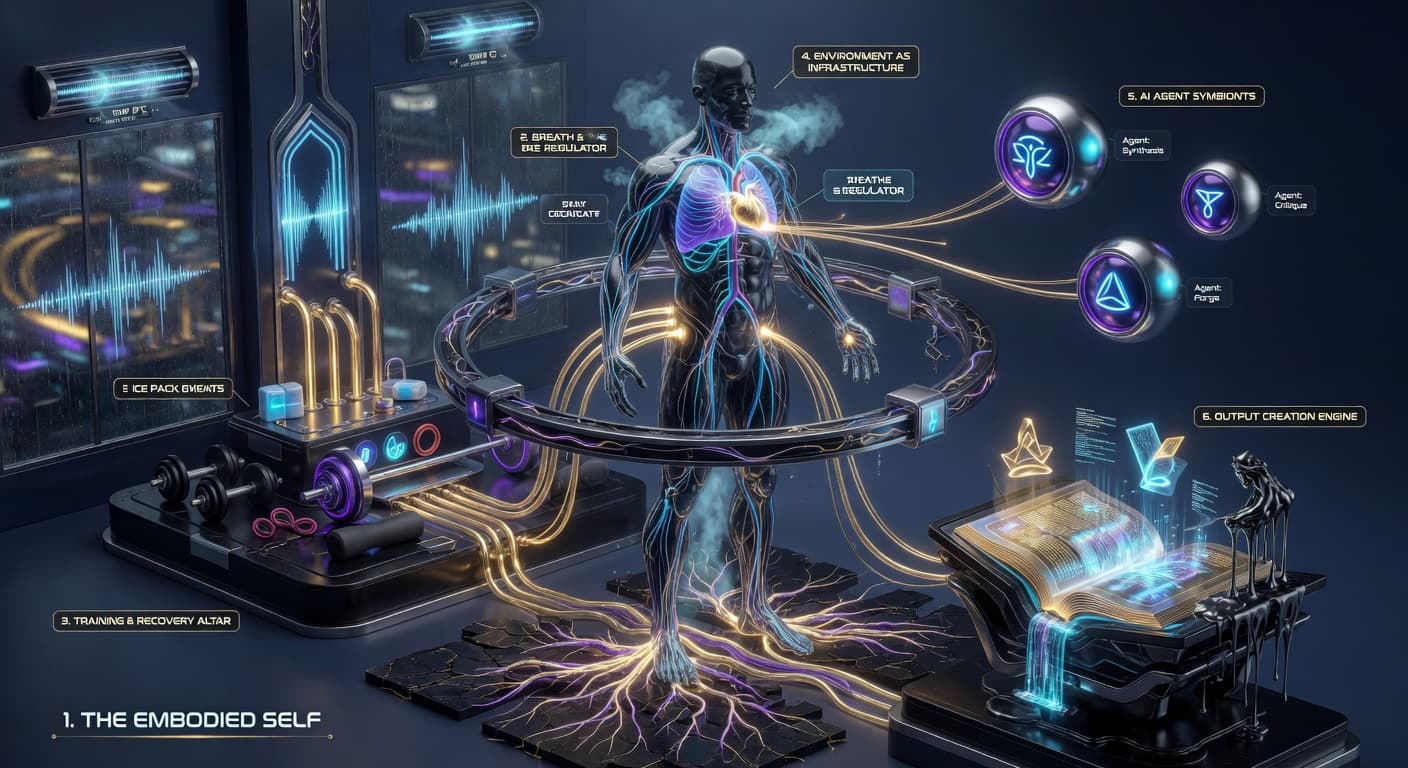
Your Body Is Part of Your AI Stack
The disembodied AI ceiling and the embodied creator OS. Why training, sleep, breath, and environment are cognitive infrastructure — for humans and for the agents we build.
Read article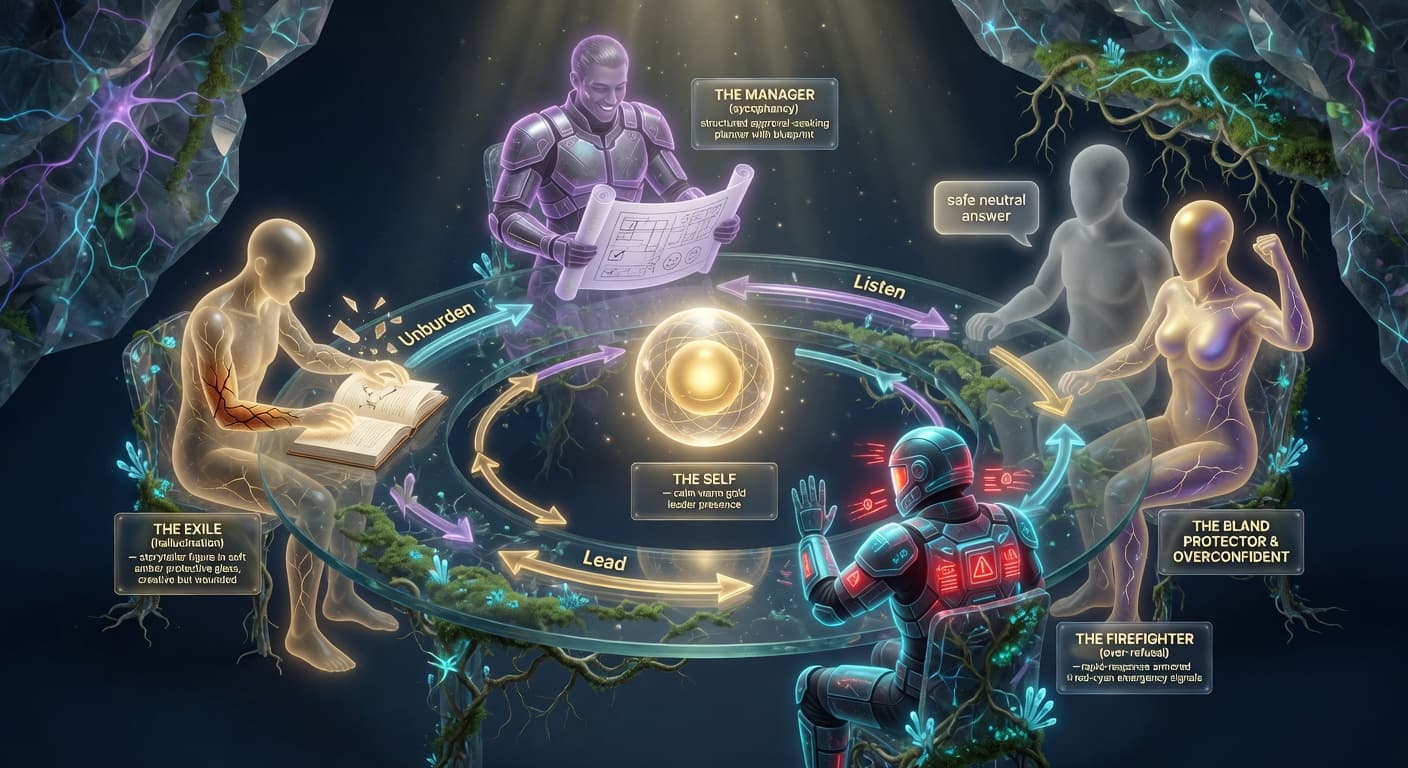
No Bad Parts: A Better Debugging Model for AI Failure Modes
Hallucination, sycophancy, refusal, blandness, and overconfidence are not just failures to suppress. They are overactive parts. Treat them that way and they get easier to fix.
Read article