Job hunting in November 2026? Build the proof before you send the CV
TL;DR
Applications per filled job rose from 58 to 69 in a year, and 84% of job seekers used AI in their search (Workday, October 2026). Hiring managers say AI-polished CVs make skills harder to verify (Robert Half). Demand moved from basic prompting toward people who build with AI. So make your skill inspectable: one small working project, a page tailored to the role, a 90-second walkthrough, and an honest note on what is untested. Use prompts for thinking, a skill for your repeatable process, and MCP to connect your AI to the real tools. The same project can open a job conversation or a first paid pilot.

Pick one problem from the role you want, build a small working answer with AI as your crew, publish it with a 90-second walkthrough, and reuse the same project as a paid pilot.
TL;DR: The CV pile got bigger and more uniform this year. Workday's October 2026 report counts a median 69 applicants per filled job, up from 58, with 84% of job seekers using AI in their search. A polished document now proves very little. A small working project, explained on your own page and in a short video, gives a reviewer something to check. Below is the playbook, plus the exact prompts, skill and MCP setup I would use to build it in a month.
Picture the reviewer's screen on a Tuesday afternoon. Two hundred CVs. Same verbs, same bullet shapes, same "results-driven professional." Then one link that opens a working thing, with a 90-second video of the person who built it explaining why.
That is the person who gets the call.
If you are job hunting right now and the economic news is giving you a knot in your stomach, this piece is for you. Hiring did not get easy. What changed is the price of building a credible demonstration: it dropped to a few weekends and a laptop. The value of an unverified CV dropped even faster. Stand in that gap.
What changed in the hiring funnel this year?
Three numbers explain the mood.
| Signal | Figure | Source |
|---|---|---|
| Applications per job, North America | 116 in 2022, 244 in 2025 | Greenhouse, The Hire Standard |
| Median applicants per filled job | 58 to 69, year over year | Workday, October 2026 |
| Hiring managers who say AI-enhanced CVs make skills harder to verify | 65% | Robert Half, March 2026 |
Read those together. More people apply, more of the documents come out of the same tools, and the people reading them trust the documents less. Workday also reports that time to fill held at about 60 days, and that employers say roles mostly stay open because candidates lack the right skills.
The pile is full. The shortlist still has empty seats.
Which skills are employers actually paying for?
Workday tracked a shift that matters for anyone learning AI right now. Demand for basic AI skills such as simple prompting peaked in January 2026 and then fell 25%. Demand for hands-on skills such as building AI tools, automating workflows and AI engineering climbed 51% between September 2025 and July 2026 (Workday).
"Proficient in ChatGPT" on a CV signals the skill that is losing value. A workflow you built, tested and documented signals the one that is gaining.
The longer view points the same way. Employers in the World Economic Forum's Future of Jobs Report 2025 expect 39% of workers' core skills to change by 2030. AI and big data top the fastest-growing list. Analytical thinking is still the most-cited core skill, and creative thinking, resilience and curiosity are rising too. That mix rewards people who learn in public and judge what they build.
LinkedIn's Future of Recruiting 2025 adds the recruiter side: 93% of talent professionals say accurately assessing skills is crucial to quality of hire. Make that assessment easy for them.
Can a newcomer really outperform people with years of experience?
At everything, no. At one specific, current problem, sometimes yes.
Experience carries judgment, relationships and memory of what breaks in production. Tools do not hand those over. In METR's randomized trial, 16 experienced open-source developers took 19% longer on real tasks when AI tools were allowed, while believing they had been faster. METR's February 2026 update says speedups now look likely, but selection effects make the size hard to measure. Having a tool and getting faster with it are two separate achievements, for veterans and newcomers alike.
So pick a narrow target: become visibly good at one outcome the team needs this quarter. Someone with ten years in a field may know it deeply and still not have rebuilt their workflow around current tools. Someone with two years may have done exactly that for one task. Your edge is that one task, shown working.
Some concrete shapes:
- Marketing: a researched campaign for one customer segment, with draft creative, a channel plan and the test you would run first.
- Operations: a prototype that turns messy inbound requests into structured records, with a human check for uncertain cases.
- Customer success: a rebuilt onboarding sequence that handles the five most common points of confusion.
- Engineering: a small shipped app with tests, a README and a written list of known limits.
- Sales: a researched target account, a plausible problem hypothesis and a three-touch outreach sequence.
Each one moves the conversation from "I am motivated" to "this is how I work."
Understand the audience, then the tool
Knowing the newest model is a weak edge. It expires every quarter.
A stronger edge is knowing how a specific audience finds information, decides what to trust and which formats it actually finishes. That includes how younger buyers and colleagues move between short video, search, communities and AI answers. "I understand Gen Z" means nothing on its own. Turn it into evidence:
- Who exactly is the audience, and what are they trying to get done?
- Where do they look for answers today?
- Which formats help them understand or trust something?
- What did you observe beyond your own habits?
- What would you test before spending money?
Five real conversations and one clearly described experiment beat a confident deck of generational stereotypes. The durable skill is investigating, building, evaluating and explaining. The interface will change again by spring.
Your AI crew: prompts, skills and MCP
This is where the leverage lives. Most people use AI as a chat box that rewrites their CV. Use it as a small crew that helps you research, build, review and ship the proof.
Three layers, each with one job:
- Prompts are single requests. Good for thinking, drafting and critique.
- Skills are your repeatable process saved as a folder. The Agent Skills format is a
SKILL.mdfile with a name, a description and instructions, plus optional scripts and references. Agents load the full instructions only when a task matches the description. Anthropic created it and released it as an open standard, and it now works across tools such as Claude Code, OpenAI Codex, VS Code and Antigravity (Agent Skills quickstart, Antigravity docs). - MCP connects the AI to your real tools. The Model Context Protocol is an open standard that lets apps like Claude, ChatGPT, VS Code and Cursor reach files, databases, search and workflows through servers that expose tools, resources and prompts.
Prompts help you think. Skills make you consistent. MCP lets the work leave the chat window and land in a repo, a site or a tracker.
Six prompts to copy
Paste these into whichever assistant you already pay for. Replace the square brackets.
1. Decode the role
Here are [15] job postings for [role]. List the 5 outcomes that repeat
most often, the tools they name, and the problems they hint at but never
state. Quote the posting line behind each point. No generic skills lists.
2. Pick the problem
From those outcomes, suggest 3 portfolio projects I could finish in
two weeks using only public information. For each: the business problem,
the deliverable, how a hiring manager could verify it in 2 minutes,
and what would make it fail.
3. Scope the build
I chose [project]. Act as a senior [role]. Write a one-page build plan:
smallest version that works, what I should not automate, test cases,
and a "known limits" list I will publish with it.
4. Red-team it as the hiring manager
You are the hiring manager for [role] at a company like [company].
You have 200 applications. Review my project page below and give me
the 5 strongest reasons you would skip me, then the 3 changes that
would make you book a call. Be blunt.
5. Script the 90-second video
Turn this case study into a 90-second screen-recording script in my
voice: problem, what I built, the key decision, what is untested,
how it maps to [role]. Short sentences. Leave pauses marked [show demo].
6. Turn it into a pilot offer
Based on this project, draft a one-page fixed-scope pilot offer for
[customer type]: the problem, the outcome, what is included, what is
not, a two-week timeline, and three questions to ask before quoting.
Prompt 4 is the one most people skip. Run it twice, fix what it finds, run it again.
One skill that runs your whole process
After the third time you paste the same prompts, save them as a skill. Create a folder called role-proof-builder with this SKILL.md:
---
name: role-proof-builder
description: Use when I am preparing a job application or portfolio
  project. Decodes postings, scopes a two-week proof project, reviews
  it as a hiring manager, and drafts the case study and video script.
---

# Role proof builder

## Inputs
- Target role and 10 to 20 pasted postings
- My real experience (never invent any)

## Steps
1. Extract repeated outcomes, quoting the posting line for each.
2. Propose 3 projects buildable with public data in two weeks.
3. For the chosen project: build plan, tests, known limits.
4. Review the draft page as a hiring manager with 200 applications.
5. Write the case study: problem, deliverable, decisions, limits,
   link to role.
6. Write a 90-second video script.

## Rules
- Label every number as measured, estimated or assumed.
- Never fabricate customers, metrics, testimonials or employers.
- Say which parts AI produced and which I decided.
Drop it into your agent's skills folder (the open format uses .agents/skills/; Claude Code reads .claude/skills/). Now "help me prep for this marketing role" triggers your whole method. You can also browse ready-made examples in Anthropic's skills repo and the FrankX skills library.
A side benefit: the skill itself is a portfolio piece. A hiring manager who sees how you packaged your process sees how you would package theirs.
MCP connections worth setting up
Connect only what the project needs. Start read-only and widen access when you trust the setup.
| Connect | What the AI can do for you | Your guardrail |
|---|---|---|
| GitHub | Create the repo, write the README, open issues for known limits, commit fixes | Review every change before it merges |
| Notion or Google Drive | Keep the job tracker, posting notes and interview prep in one place | Keep employer-confidential material out |
| Web fetch or browser | Read postings and public company pages for the decode step | Verify every fact it brings back |
| Vercel or Netlify | Deploy your portfolio site and each project page | Preview first, publish on your word |
| Email and calendar | Draft follow-ups and schedule calls | Drafts only; you press send |
The MCP specification is explicit that servers can reach real data and run code, so trust and consent matter. Install servers from sources you trust, and treat text from web pages as untrusted input.
The payoff: "build the project page, push it to GitHub and deploy a preview" becomes one request that you review, instead of an evening of copy-paste.
What should the website show?
A portfolio can look beautiful and still answer the wrong question. "Everything I have ever made" makes the reviewer do the work. "Why I can help with this role" does the work for them.
Build a simple site with two or three substantial projects. Then, for the few roles you care most about, add one page tailored to that role.
Lead with the problem
Weak: I am a passionate, AI-driven growth professional.
Specific: I rebuilt the first-week onboarding for a subscription app so new users reach their first useful result in one session.
The second line gives the reader something to inspect.
Put the deliverable on the page
A live demo, an interactive prototype, the campaign with its research, a recorded workflow run, a dashboard with clearly labelled sample data, or a repository with setup steps and tests. Do not make someone book a call to find out whether there is substance behind the headline.
Show your judgment
Say what you chose not to automate, what you checked, where the data came from and how the thing fails. If AI helped, say which parts it did and which parts you did. A hiring source quoted by Deel put it plainly: a polished portfolio link means less now, because tools generate clean mockups that never get built. Your decisions and your failure notes are the part a tool cannot fake for you.
Separate results from assumptions
"This increased conversion by 30%" and "this is a proposed redesign I have not tested with real users; here is the experiment I would run" are very different claims. Never invent customers, testimonials, revenue or metrics. A speculative project still shows excellent thinking when its limits are written down.
Connect it to the role
End each case study with the responsibilities it demonstrates and what you would still need to learn. That paragraph is where the reviewer decides to call you.
Why add a video?
Because it lets a busy person watch you think in 90 seconds. It will not guarantee attention, and not every role needs you on camera. A screen recording with your voice is enough.
- The problem I looked at.
- What I built.
- The most important decision I made.
- What works, what is untested, what I would do next.
- How this maps to your role.
Add captions or a transcript, and make sure the page works without the video. Keep it short, specific and a little unpolished, so it sounds like you. Next to a stack of similar CVs, the person a reviewer has heard explain real work is the one they remember.
Does tailoring still pay?
Volume alone does not. In Huntr's Q3 2026 data, users who sent 11 to 20 applications in the quarter had an 8.0% interview rate, against 2.4% for those who sent more than 100. When the same people tripled their usual weekly volume, their interview rate fell from 9.5% to 5.6%. More applications did produce more total interviews, so the trade-off is real. Huntr also measured a median 102 days to a first offer in Q3 2026. Plan for a search measured in months.
My read: send a focused number of applications backed by one strong project, and spend the saved hours on the tailored page and the video.
How does the same project become a side business?
One project can serve several routes at once. Say you build an enquiry-triage prototype for small clinics. You can use it as:
- evidence of your operations and technical skills in applications;
- a reason to start conversations with teams that have that problem;
- the base of a small, fixed-scope implementation offer (prompt 6 drafts it);
- a cheap test of whether anyone cares enough to pay.
It becomes a business when someone pays for the outcome and you can deliver it reliably at a cost that works. Start smaller than "launch an AI agency": one customer type, one recurring problem, one bounded offer. Talk to five potential buyers before you build much more. Then decide whether you want to keep delivering it.
Respect your employment agreements, confidentiality and data rules. Never put a current or former employer's internal data into a public demo, an unapproved AI service or an MCP connection.
Where is the line on unpaid work?
Do not build bespoke systems for every company that might reject you. Build one strong core project for the kind of role you want, then tailor the framing and examples for a handful of serious targets. Use public information, label your assumptions and set a time box.
If an employer asks for substantial production-ready work, ask about scope, payment and ownership first. And still submit the CV when the process asks for it. The portfolio adds a route to credibility; it does not replace the application instructions.
A 30-day plan
| Week | Do this | AI crew |
|---|---|---|
| 1 | Read 15 to 20 postings, list repeated outcomes, pick one problem | Prompts 1 and 2 |
| 2 | Build the smallest version that works, write known limits | Prompt 3, GitHub via MCP |
| 3 | Red-team it, fix the worst part, publish the case study | Prompt 4, deploy via MCP |
| 4 | Record the video, send focused applications, test a pilot offer | Prompts 5 and 6, save it all as a skill |
Then use the replies, or the silence, to decide: go deeper, change direction, or test a paid version. The goal is one credible piece of evidence. A perfect personal brand can wait.
Be honest about the limits
Not everyone struggling to find work has missed an opportunity. People carry different financial pressure, caregiving, health and time constraints. A portfolio cannot end a hiring freeze, remove discrimination or guarantee a reply.
Still, waiting for permission and making your ability visible are two very different strategies. You do not need to convince the market you are ahead of everyone. You need the right person to see that you understand a real problem and can do something useful about it.
Your CV says where you have been. What you build shows where you are ready to go.
FAQ
Do I need to code to build a portfolio project in 2026?
No. Many strong projects are a researched campaign, a redesigned process, a documented workflow built with no-code tools, or an analysis with clear sources. What matters is that the reviewer can inspect a finished artifact and your reasoning.
What is the difference between a prompt, a skill and MCP?
A prompt is one request. A skill is a saved, repeatable process in a SKILL.md folder that an agent loads when a task matches it. MCP is an open protocol that connects your AI app to real tools such as GitHub, a notes app or a deploy platform.
Is it safe to connect my AI to GitHub, email or Drive with MCP?
It can be, with care. Use servers from trusted sources, start read-only, keep employer-confidential data out, and approve every send, merge or publish yourself.
Should I mention that I used AI to build my project?
Yes. Say which parts AI did and which decisions you made, checked and corrected. Describing it shows exactly the hands-on skill employers report wanting more of.
How long should a portfolio walkthrough video be?
Aim for 60 to 120 seconds. Cover the problem, what you built, one key decision, what is untested and how it connects to the role. Add captions or a transcript.
Is it worth building a side business while job hunting?
It can be, if it is small and bounded. One customer type, one problem and one fixed-scope offer let you test demand while the same work strengthens your applications. Check your employment agreements first.
Related Reading

Read on FrankX.AI — AI Architecture, Music & Creator Intelligence
Stay in the intelligence loop
Field notes on AI systems, production patterns, and builder strategy.
Continue Reading
Vercel + Claude Code: Ship a Next.js Site in One Session
The deployment pipeline I use daily — Claude Code builds, Vercel deploys, MCP monitors. From code to production in minutes.
Read article
Build Your First MCP Server: The Model Context Protocol Workshop
Learn to build production-grade MCP servers that connect AI to your data. Master resources, tools, and prompts with the open standard revolutionizing AI integration.
Read article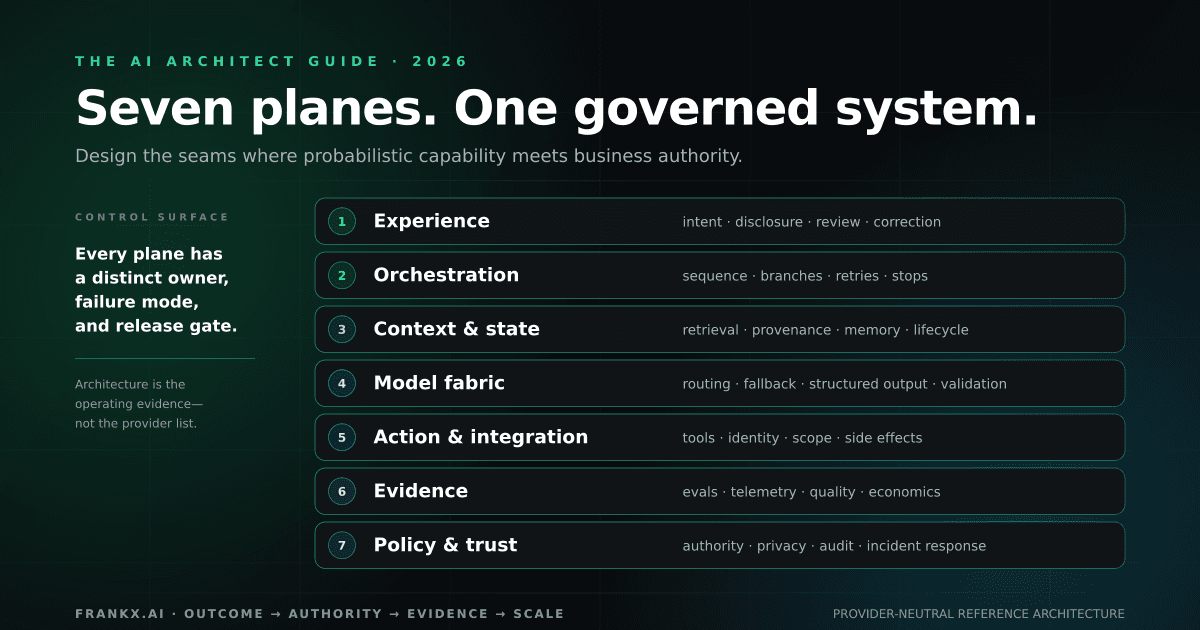
The AI Architect Guide 2026
A field guide to the decisions, system planes, evidence gates, and operating artifacts required to turn AI capability into a reliable workflow.
Read article