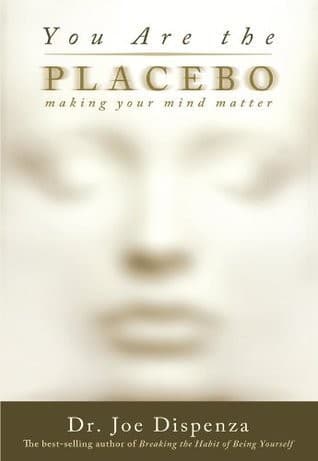
The short answer
The most empirically defensible Dispenza book. Documents the long, well-replicated history of the placebo effect — surgical, pharmacological, prognostic — and argues we can self-administer it deliberately. The first half is mainstream medical literature; the second half is a meditation protocol designed to trigger placebo-style healing without the deception.
Key Insights
- The placebo effect is not a confound to control for — it is the body's actual healing system, activated by belief and expectation
- Conditioned response, expectation, and meaning are the three measured ingredients of every placebo result — all three can be deliberately cultivated
- Belief is biology: a single thought, repeated and felt, produces measurable changes in gene expression, immune function, and tissue regeneration
- The same suggestibility that lets a sugar pill heal also lets fear-laden words sicken — words from authority figures (doctors, parents) act as nocebos
- You can be the placebo: deliberately install belief through expectation + emotion + repetition, the same machinery the sugar pill borrows
Quotes Worth Remembering
12 recorded excerpts. Check the named edition and location before sharing the wording.
You are not doomed by your genes and hardwired to be a certain way for the rest of your life.
Chapter 4 — The Placebo Effect in the Brain
Your body believes every word you say.
Chapter 1 — Is It Possible?
Dispenza quoting holistic healer Bernie Siegel. The line that compresses the whole book.
When you believe in your future, you can begin to live in your future.
Chapter 7 — The Quantum Mind
The placebo response is the body's ability to heal itself when given the right environment, the right belief, and the right expectation.
Chapter 4 — The Placebo Effect in the Brain
A thought, when repeated and felt long enough, becomes a belief, and a belief becomes a state of being.
Chapter 2 — The Placebo Effect Through the Ages
When you change your beliefs, you change your biology.
Chapter 7 — The Quantum Mind
You don't need to know the how — you only need to be clear on the what and the why.
Chapter 9 — The Three Stages of Meditation
The diagnosis is not the prognosis.
Chapter 6 — Suggestibility
Dispenza's rebuttal to medical fatalism. A diagnosis names a condition; it does not determine the trajectory.
It's not the affirmation that creates the change. It's the elevated emotion that creates the change.
Chapter 8 — The Quantum Mind
The hardest thing about change is wanting it more than you want what is familiar.
Chapter 10 — Putting It All Together
Belief is a thought you keep thinking — until you can't imagine thinking otherwise.
Chapter 6 — Suggestibility
The body is the unconscious mind, and it does not know the difference between an event in the world and an event in the imagination.
Chapter 7 — The Quantum Mind
Chapter-by-Chapter
Each chapter carries a key idea and a short summary, so you can find the argument again.
01Chapter 1 — Is It Possible?
Documented spontaneous remissions and inexplicable recoveries are not anomalies — they are data.
OpenClose
Dispenza opens with a series of case studies — religious healings, sham surgeries that "worked," recoveries that medicine couldn't explain. The argument: medicine has long had a category called "spontaneous remission" for cases it can't account for. This book proposes accounting for them.
02Chapter 2 — The Placebo Effect Through the Ages
From Mesmer's magnets to fake heart surgeries, the history of medicine is partly a history of placebo successes mistaken for active treatment.
OpenClose
A historical survey. Mesmer, Voodoo deaths, Henry Beecher's WWII saline injections, the Helsinki sham knee surgery, the antidepressant placebo gap, the inert acupuncture studies. Pattern: belief plus ritual produces effects that often equal or exceed the "active" treatment.
03Chapter 3 — The Placebo Effect in the Body
Placebo and verum produce overlapping biochemistry — sometimes identical.
OpenClose
Dispenza details specific mechanisms. Endogenous opioid release in placebo pain studies; measurable dopamine in placebo-treated Parkinson's patients; immune marker changes in conditioned-response studies. The placebo machinery is not "all in your head" — it is in your bloodstream, measurable.
04Chapter 4 — The Placebo Effect in the Brain
fMRI shows placebo and active drug lighting up the same neural circuits.
OpenClose
The most scientifically dense chapter. Placebo activates the prefrontal cortex, ventral striatum, dorsolateral prefrontal regions — the same areas active when "real" medication works. The brain is not deceived; it is operating its own pharmacy. Belief, expectation, and meaning are the prescription.
05Chapter 5 — How Thoughts Change the Brain and Body
Thinking about an action lights up the same circuits as doing the action — and conditions the body the same way.
OpenClose
Dispenza covers motor imagery research (visualizing exercise produces strength gains) and cognitive simulation studies. If thinking can do this, sustained, emotional, repeated thinking can do considerably more. The conceptual bridge from peer-reviewed research to the book's practical claims.
06Chapter 6 — Suggestibility
Most people are more suggestible than they realize — for both healing and harm.
OpenClose
Dispenza walks through hypnotizability research, source credibility effects, and the way medical authority figures shape patient outcomes. Practical: the language you accept from authorities (doctors, family, your own internal critic) acts as conditioning. Curating that input is medical hygiene.
07Chapter 7 — Attitudes, Beliefs, and Perceptions
Beliefs are subconscious thoughts that have been repeated until they feel like reality.
OpenClose
Dispenza distinguishes thought (conscious, transient) from belief (unconscious, durable). Beliefs are the operating system; thoughts are the apps. To change health outcomes, you must change beliefs — which requires getting under the conscious mind into the subconscious where they live.
08Chapter 8 — The Quantum Mind
The mind that thinks beyond present circumstances opens the body to possibilities not yet present.
OpenClose
Dispenza's metaphysical chapter. Stripped of the quantum framing: when you imagine a future state with sustained elevated emotion, the brain rehearses the neurology of being there, and the body begins conditioning toward that state. The science holds even if you reject the quantum metaphor.
09Chapter 9 — The Three Stages of Meditation
Awareness, then unlearning, then becoming — each stage prepares the next.
OpenClose
Practical chapter. Stage 1 (awareness): observe your unconscious thoughts and emotional defaults. Stage 2 (unlearning): refuse to feed them, sit with the discomfort of withdrawal. Stage 3 (becoming): hold the future-self state with elevated emotion until the body memorizes it. Each stage is daily, sustained, multi-week.
10Chapter 10 — Putting It All Together
The full meditation: change is non-negotiable, and so is the daily practice.
OpenClose
Dispenza walks through the complete meditation script. 30-60 minutes daily. Identifies the unwanted state, releases the body's attachment to its chemistry, holds the new state with focused gratitude or love until physiology shifts. Repeated until the new state becomes the body's default.
11Chapter 11 — Case Studies
The case studies are the book's evidence — read them critically.
OpenClose
Dispenza presents detailed case studies — autoimmune reversal, mobility return, depression remission, etc. Names, before-and-after measurements, follow-ups. Each features sustained daily meditation as the variable change. Read the cases skeptically and look for the pattern; the pattern, not any single case, is the evidence.
12Chapter 12 — Transforming Your Belief and Perception: A Meditation
A specific meditation script for replacing one belief with another.
OpenClose
The book's closing meditation, given as a script. Identify a belief that limits you (financial, health, relational), feel its emotional charge, observe it without identifying with it, then deliberately install a new belief with the elevated emotion that would accompany it being true. Repeat until the body cannot remember the old belief's chemistry.
Best For
Frequently Asked Questions
Is the placebo effect real or just statistical noise?
+
Real — and large. The placebo effect appears robustly across thousands of double-blind trials, with measurable biochemical signatures (endogenous opioid release, dopamine in Parkinson's, immune marker shifts). The size varies: roughly 30% in pain studies, up to 60% in depression and IBS. It is not noise. It is a parallel pharmacology the body manufactures from belief.
How is You Are the Placebo different from the rest of the Dispenza trilogy?
+
It's the most clinically grounded. Where Becoming Supernatural pushes into quantum metaphysics, You Are the Placebo stays close to peer-reviewed medical literature for the first half. The meditation protocol in the second half is similar to Breaking the Habit but specifically targeted at health outcomes.
Can the placebo effect treat serious illness?
+
For some conditions, yes — pain, depression, autoimmune flare-ups, IBS, Parkinson's motor symptoms. For structural conditions (broken bones, tumors), the evidence is weaker but not zero. Dispenza's case studies include some serious-illness reversals; these should be read as suggestive, not as substitutes for medical care. The honest framing: placebo is an adjunct that can be substantial, not a replacement for proven treatment.
What is the "nocebo" effect?
+
The placebo's evil twin — negative outcomes produced by negative expectation. A doctor's pessimistic prognosis statistically worsens outcomes. Anti-cancer commercials that list side effects produce more side effects in placebo arms. The same machinery that makes belief healing makes belief harmful. Practical implication: treat your inner monologue and the voices you trust as biochemistry, because they are.
Does the meditation actually replace medication?
+
Some readers report being able to taper medications under medical supervision after sustained practice; many do not. The book is explicit: do not stop prescribed medication unilaterally. The meditation is a complement — adding the placebo machinery on top of whatever else you're doing — not a replacement.
Continue Reading
If You Are the Placebo opened a door, these books walk you through it. Curated for reason, not algorithm — each entry explains why it pairs with this book.
Breaking the Habit of Being Yourself
by Joe Dispenza
The foundational text — neuroscience and meditation framework that You Are the Placebo extends into health specifically. Essential read either before or alongside.
Get the bookBecoming Supernatural
by Joe Dispenza
Dispenza's 2017 sequel that pushes into more speculative territory. Read after for the advanced practice; the placebo framework here is the credible foundation.
Get the bookThe Biology of Belief
by Bruce Lipton
Lipton's cellular epigenetics gives Dispenza's "thoughts change biology" claims a mechanism. Read for the science under the metaphors.
Get the bookMeaning Response
by Daniel Moerman
Anthropologist Moerman's scholarly treatment of placebo. He renames it "meaning response" — the body's reaction to the meaning of treatment, regardless of pharmacological content. Closer to peer-review than Dispenza is.
Get the bookCure
by Jo Marchant
Science journalist Marchant's rigorous tour of mind-body medicine. Even-handed where Dispenza is enthusiastic. The two together produce a balanced view.
Get the bookWhen the Body Says No
by Gabor Maté
The shadow side of the placebo argument — Maté shows how chronic stress and unprocessed emotion produce illness through the same body-mind machinery Dispenza uses for healing. Necessary balance.
Get the bookGo Deeper — Videos
Each link opens a YouTube search for this book. Pick a named speaker before you treat a recording as a source.
Joe Dispenza on the Placebo Effect (London Real)
London Real
Long-form Dispenza on this specific book. Best video for the book's argument in his own voice.
You Are the Placebo — Talk by Dr Joe Dispenza
Dr Joe Dispenza
Lecture format presenting the book's framework and case studies. The 90-minute version of the book's argument.
Ted Kaptchuk on the Power of the Placebo
Various
Harvard's Ted Kaptchuk is the leading academic placebo researcher. Watching Kaptchuk alongside Dispenza is the responsible reading: same field, more conservative voice.
Guided Meditation: Changing Your Beliefs and Perceptions
Dr Joe Dispenza
Free guided version of the Chapter 12 meditation. Try this before deciding whether to buy the book's extended audio meditations.
If You Liked This, Read Ours
Our Book
The Art of Self-Development
Seven Pillars of a Complete Life
A systematic approach to building every dimension of your life — energy, mind, soul, craft, capital, circle, and legacy. Not theory. Routines that work.
Read freeThe FrankX Newsletter
One book breakdown like this. One spotlight from the operating loop. Every Friday.