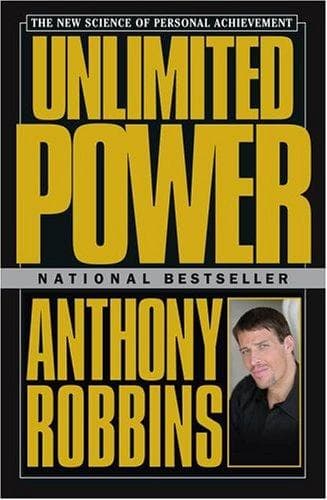
The short answer
Robbins's first book and the book that put NLP into the mainstream. Centers on modeling — the principle that any human excellence can be reverse-engineered and replicated by studying the specific mental, physical, and linguistic strategies of those who already have it. The Ultimate Success Formula is the spine: know your outcome, take action, develop sensory acuity, change approach until you succeed.
Key Insights
- Modeling — extracting and replicating the strategies of excellence — is the fastest path from where you are to where you want to be
- The Ultimate Success Formula: know your outcome, take action, notice the result, change your approach until the outcome arrives
- Physiology directly produces emotion — change posture, breath, and movement to change state immediately, with no thought required
- The seven lies of success — beliefs that successful people hold whether or not they're technically true — are the operating beliefs to install
- Communication mastery (rapport, calibration, language patterns) is leverage — your outcomes scale with the quality of the people you can move
Quotes Worth Remembering
12 recorded excerpts. Check the named edition and location before sharing the wording.
The path to success is to take massive, determined action.
Chapter 1 — The Commodity of Kings
Success leaves clues.
Chapter 2 — The Difference That Makes the Difference
Robbins's slogan for the modeling principle. People who succeed leave behind specific replicable patterns; the work is finding them.
Most people fail in life because they major in minor things.
Chapter 11 — The Magic of Rapport
There is no such thing as failure. There are only results.
Chapter 5 — The Seven Lies of Success
The most important thing you can model is the way successful people think.
Chapter 2 — The Difference That Makes the Difference
If you do what you have always done, you will get what you have always gotten.
Chapter 1 — The Commodity of Kings
Live with passion!
Closing
Robbins's sign-off in this book and the rest of his work. The compressed expression of state-management as a way of life.
Whatever you hold in your mind on a consistent basis is exactly what you will experience in your life.
Chapter 4 — The Birth of Excellence
Setting goals is the first step in turning the invisible into the visible.
Chapter 12 — Distinctions of Excellence
It's not what you have, it's what you do with what you have.
Chapter 9 — Energy: The Fuel of Excellence
The only thing keeping you from getting what you want is the story you keep telling yourself about why you can't have it.
Chapter 5 — The Seven Lies of Success
Communication is power. Those who have mastered its effective use can change their own experience of the world and the world's experience of them.
Chapter 11 — The Magic of Rapport
Chapter-by-Chapter
Each chapter carries a key idea and a short summary, so you can find the argument again.
01Chapter 1 — The Commodity of Kings
Personal power — the ability to direct your own experience and influence others — is the genuine commodity, more valuable than money, status, or fame.
OpenClose
Robbins opens with a survey of historical figures who exercised personal power against extraordinary odds. The argument: external resources amplify internal capacity, but cannot substitute for it. The book teaches the internal capacity directly.
02Chapter 2 — The Difference That Makes the Difference
Modeling — extracting and replicating excellence — is the most reliable accelerant for human change.
OpenClose
The book's methodology chapter. Robbins introduces NLP's core principle: any specific human excellence can be reverse-engineered by mapping the beliefs, mental strategies, syntax, and physiology of someone who has it. Then you replicate the map.
03Chapter 3 — The Power of State
You don't access resources by trying — you access them by being in the state where they're available.
OpenClose
Robbins's argument that state (your moment-to-moment emotional and physiological condition) determines what behaviors and ideas are available to you. State is engineered through physiology and focus, not willpower. Practical: every difficult task starts with deliberately producing the state in which the task is easy.
04Chapter 4 — The Birth of Excellence: Belief
Beliefs precede ability — you cannot do what you do not believe is possible.
OpenClose
Robbins surveys the placebo effect, athletes breaking previously "impossible" records, and similar evidence that belief reorganizes capacity. Practical: identify the beliefs that gate the result you want, and install them deliberately. Without the belief, the technique is a closed door.
05Chapter 5 — The Seven Lies of Success
Empowering beliefs are not always factually true — but they reliably produce better outcomes.
OpenClose
The seven beliefs successful people hold: every event has purpose, no failure only outcomes, take responsibility, don't need to understand to use, people are the greatest resource, work is play, no success without commitment. Robbins calls them "lies" because their truth is irrelevant — what matters is the behavior they produce.
06Chapter 6 — Mastering Your Mind: How to Run Your Brain
You can re-encode any memory by changing its submodalities (size, color, distance, sound, association).
OpenClose
NLP's submodality work. Robbins teaches that any internal experience has a structure — visual size, location, color, sound volume, etc. Change the structure and the felt meaning changes. Some of the most experiential exercises in the book live here. The science is questionable; many readers report the experiential effect is real.
07Chapter 7 — The Syntax of Success
Excellent strategies have a specific internal sequence — find the sequence, replicate it.
OpenClose
Each excellent performance has a strategy: a sequence of internal representations (visual, auditory, kinesthetic) that the performer runs. Spelling, decision-making, motivation — each has its own sequence. Map another's sequence with calibrated questions; install it in yourself by deliberate practice.
08Chapter 8 — How to Elicit Someone's Strategy
Specific calibrated questions surface the unconscious strategy that produces a given excellence.
OpenClose
Practical chapter on the questions that extract a strategy: "How do you know when to do this? What do you see? What do you hear? What do you tell yourself?" The technique is uncommon and surprisingly effective. Robbins gives detailed scripts; the chapter alone justifies the book for any coach or trainer.
09Chapter 9 — Energy: The Fuel of Excellence
Mental excellence requires physical excellence — diet, oxygenation, lymphatic flow.
OpenClose
Robbins's health chapter. Heavy on natural-hygiene and food-combining ideas that have aged poorly. The general principle (vital state requires vital body) holds; the specific dietary recommendations have been superseded by modern evidence. Read for the framework, supplement with current sources.
10Chapter 10 — The Power of Precision Questions
The questions you ask shape what you see — and what you don't.
OpenClose
A precursor to the Awaken chapter on questions. Robbins shows how disempowering questions ("Why does this happen to me?") and empowering questions ("What can I learn from this?") generate radically different cognitive responses to identical situations.
11Chapter 11 — The Magic of Rapport
Rapport is built through matching — physiology, voice, language patterns — not flattery.
OpenClose
NLP rapport techniques: pacing and leading, mirroring posture, matching speech rate and vocabulary, predicate matching (visual/auditory/kinesthetic). The chapter is operationally concrete. Sales people, therapists, and negotiators have used these techniques for forty years; effective when subtle, off-putting when overdone.
12Chapter 12 — Distinctions of Excellence: Metaprograms
Metaprograms are the meta-filters of perception — towards/away, internal/external, similarity/difference.
OpenClose
Robbins introduces metaprograms — the broad cognitive sorting patterns that determine what someone notices and ignores. Knowing your own and others' metaprograms is communication leverage. The chapter is dense; many readers find it the most valuable in the book on second read.
13Chapter 13 — How to Deal with Resistance and Solve Problems
Reframing — changing the meaning attached to an event — is the fastest problem-solving technique you have.
OpenClose
Two reframing techniques: content reframe (changing what something means) and context reframe (changing where it applies). Examples are vivid: stubborn child = persistent leader; failure = data. Practical exercises end the chapter. The reframing skill alone changes daily life.
14Chapter 14 — Value Hierarchies: The Ultimate Judgment of Success
Conflict between people and within yourself is almost always a values conflict — surface and rank them.
OpenClose
Precursor to Awaken's values chapter. Robbins teaches eliciting your top moving-toward and moving-away values, then ranking them. Internal conflict reveals where two top values disagree. Most life decisions become clear once the value hierarchy is explicit.
15Chapter 15 — The Five Keys to Wealth and Happiness
Handle frustration, rejection, financial pressure, complacency, and "always do more than expected."
OpenClose
Robbins's closing operational chapter. Five distinct skills he's extracted from the wealthy and happy: master frustration (most quit before the win), master rejection (sales is rejection management), master financial pressure (don't let scarcity warp decisions), master complacency (success is more dangerous than struggle), and the bonus — always do more than expected.
16Chapter 16 — Trend Creation: The Power of Persuasion
Influence at scale rests on the same patterns as personal change — articulated for groups instead of individuals.
OpenClose
The book's leadership and persuasion chapter. Robbins extracts the patterns common to public figures who shifted public sentiment — Reagan, Iacocca, Gandhi. Vision, conviction, repetition, rapport with the audience, willingness to be misunderstood. Much of modern political and corporate communication theory is here in early form.
17Chapter 17 — Living Excellence: The Human Challenge
Personal mastery is not destination — it is the daily practice of using the tools.
OpenClose
Closing chapter. Robbins synthesizes the book's tools into a daily practice: morning state-setting, deliberate value alignment, sensory acuity, language hygiene, action measured against outcome. The challenge: not to read this book and feel inspired, but to install the practices and live them.
Best For
Frequently Asked Questions
Should I read Unlimited Power or Awaken the Giant Within?
+
Awaken the Giant Within (1991) if you read only one — it's the more polished, integrated, comprehensive book. Unlimited Power (1986) if you want the NLP-heavy precursor with more technical detail on modeling, sensory acuity, and language patterns. Both reward the time; the systems substantially overlap.
What is "modeling" in NLP terms?
+
The deliberate replication of someone else's excellence by extracting the specific mental, physical, and linguistic patterns that produce their result. You watch what they do, ask what they think while doing it, ask what they believe, and replicate the full pattern. Modeling is NLP's most actionable contribution.
Is NLP scientifically valid?
+
Mixed. The submodality work, eye-accessing cues, and "neurological levels" have not held up well in academic studies. The pragmatic techniques — modeling, anchoring, rapport-building, reframing — have largely survived in coaching, therapy, and sales training. NLP works as practical methodology even where its scientific claims are questionable.
What is the Ultimate Success Formula?
+
Four steps Robbins repeats throughout the book. (1) Know your outcome with precision. (2) Take action. (3) Develop the sensory acuity to notice what your action produced. (4) Have the behavioral flexibility to change your approach until you get the outcome. The formula is deceptively simple. Most failures trace to skipping step 3 or step 4.
What are the Seven Lies of Success?
+
Robbins's seven beliefs that successful people hold regardless of whether they're strictly true. (1) Everything happens for a reason and a purpose, and it serves us. (2) There is no such thing as failure, only outcomes. (3) Whatever happens, take responsibility. (4) You don't need to understand everything to use everything. (5) People are your greatest resource. (6) Work is play. (7) There's no abiding success without commitment. He calls them "lies" with a wink — they're self-fulfilling beliefs that produce better results.
Continue Reading
If Unlimited Power opened a door, these books walk you through it. Curated for reason, not algorithm — each entry explains why it pairs with this book.
Awaken the Giant Within
by Tony Robbins
Robbins's 1991 sequel and mature synthesis. Covers similar territory in more polished form. If Unlimited Power is the technical foundation, Awaken is the integrated operating system.
Get the bookFrogs Into Princes
by Richard Bandler & John Grinder
The original NLP source text Robbins draws from. Less accessible than Robbins's polished version, but the unmediated source for serious NLP students.
Get the bookInfluence
by Robert Cialdini
The academic counterpart to Robbins's persuasion chapters. Cialdini's six principles of influence are research-grounded; Robbins's rapport techniques are practitioner-grounded. Read together for both lenses.
Get the bookThe Structure of Magic
by Bandler & Grinder
NLP's deeper academic-style text. Heavy linguistic analysis. For readers who want the technical foundation of language patterns Robbins simplifies.
Get the bookPsycho-Cybernetics
by Maxwell Maltz
Robbins acknowledges Maltz throughout. Maltz's self-image psychology runs parallel to Robbins's identity work — same problem, earlier vocabulary.
Get the bookThink and Grow Rich
by Napoleon Hill
The 1937 great-grandparent of the genre. Robbins extends Hill's framework with NLP technical specifics. Read Hill for the lineage; Robbins for the operationalization.
Get the bookGo Deeper — Videos
A link marked YouTube search opens YouTube results. Any other link opens the page saved with this book.
Tony Robbins — Unleash the Power Within (Documentary clips)
Various
Footage from Robbins's flagship UPW seminar. Best way to see the modeling, anchoring, and state-management work in live action.
Tony Robbins — Modeling and the Ultimate Success Formula
Various
Talks specifically on the modeling concept that anchors Unlimited Power. Best for readers who want to see Robbins teach the method directly.
Tony Robbins — Why We Do What We Do (TED)
TED
Robbins's TED talk on the Six Human Needs. Compressed framework that makes Unlimited Power's motivation chapters land harder on re-read.
I Am Not Your Guru (Netflix Documentary)
Joe Berlinger / Netflix
Documentary tracking a Date with Destiny seminar. The most honest visual representation of what Robbins's in-person work actually looks like.
If You Liked This, Read Ours
Our Book
The Art of Self-Development
Seven Pillars of a Complete Life
A systematic approach to building every dimension of your life — energy, mind, soul, craft, capital, circle, and legacy. Not theory. Routines that work.
Read freeThe FrankX Newsletter
One book breakdown like this. One spotlight from the operating loop. Every Friday.