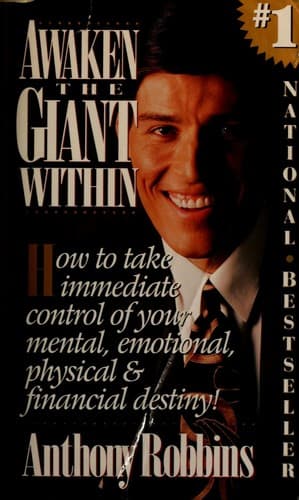
The short answer
Robbins's 500-page magnum opus and the foundation for nearly every modern motivational system that followed. Synthesizes NLP, behavioral psychology, decision-theory, and his own "Neuro-Associative Conditioning" into a single self-improvement architecture. The argument: master the meanings you assign, the questions you ask, the metaphors you live by, and you control the trajectory of your life.
Key Insights
- Decisions, not conditions, shape your destiny — and decisions are made or avoided in moments measured in seconds, not years
- The quality of your life equals the quality of the questions you habitually ask yourself — change the questions, change the life
- You move toward pleasure and away from pain, but the meanings you assign to each are constructed and changeable
- NAC (Neuro-Associative Conditioning) — interrupt the pattern, then condition pleasure to the new behavior — is the lever for real behavior change
- Your emotional home — the emotion you spend most of your time in by default — is the most underdiscussed determinant of life outcomes
Quotes Worth Remembering
14 recorded excerpts. Check the named edition and location before sharing the wording.
It is in your moments of decision that your destiny is shaped.
Chapter 2 — Decisions: The Pathway to Power
The book's anchor line. Robbins repeats it across his work — destinies are shaped at the dinner table, not in destiny's office.
The quality of your life is the quality of the questions you habitually ask yourself.
Chapter 8 — Questions Are the Answer
If you do what you've always done, you'll get what you've always gotten.
Chapter 5 — Belief Systems
The path to success is to take massive, determined action.
Chapter 2 — Decisions: The Pathway to Power
People are not lazy. They simply have impotent goals — that is, goals that do not inspire them.
Chapter 12 — Designing Your Destiny
Beliefs have the power to create and the power to destroy.
Chapter 4 — Belief Systems
The two master skills of life are the science of achievement and the art of fulfillment.
Chapter 17 — Reclaiming the True You
The pain you are experiencing is the price of the change you have not yet made.
Chapter 6 — Can Change Happen in an Instant?
Where focus goes, energy flows.
Chapter 8 — Questions Are the Answer
Setting goals is the first step in turning the invisible into the visible.
Chapter 12 — Designing Your Destiny
What we can or cannot do, what we consider possible or impossible, is rarely a function of our true capability. It is more likely a function of our beliefs about who we are.
Chapter 4 — Belief Systems
Stay committed to your decisions, but stay flexible in your approach.
Chapter 2 — Decisions: The Pathway to Power
A real decision is measured by the fact that you've taken a new action. If there's no action, you haven't truly decided.
Chapter 2 — Decisions: The Pathway to Power
Identity is the strongest force in the human personality. People will always remain consistent with their identity, regardless of the consequences.
Chapter 17 — Reclaiming the True You
The chapter James Clear later elevated into Atomic Habits' identity-based-habits chapter.
Chapter-by-Chapter
Each chapter carries a key idea and a short summary, so you can find the argument again.
01Chapter 1 — Dreams of Destiny
You are designing your future right now, whether deliberately or by default.
OpenClose
Robbins opens by establishing stakes: ordinary decisions made daily aggregate into the life you have. Reframes self-improvement from luxury to necessity — most people are not failing to act, they are unconsciously acting in directions they never chose.
02Chapter 2 — Decisions: The Pathway to Power
Decisions are the wheel of destiny — and most people's wheel is locked.
OpenClose
The book's engine. Three decisions you're always making: what to focus on, what things mean, what to do. Master those three and you've mastered the levers of your experience. Robbins details how to convert wishes into commitments via specificity, deadline, and immediate action.
03Chapter 3 — The Force That Shapes Your Life
Pain and pleasure — the meanings you assign to each — are the force.
OpenClose
Robbins's reading of behavioral psychology. People will pursue what they associate with pleasure and avoid what they associate with pain. But these associations are constructed, not given. Re-associate (smoking with disgust, exercise with pride) and behavior follows automatically.
04Chapter 4 — Belief Systems: The Power to Create and Destroy
Beliefs are constructed from references — collect different references, get different beliefs.
OpenClose
Beliefs feel like facts but are conclusions drawn from selected experiences. Robbins introduces the "tabletop" metaphor — a belief is the tabletop, references are its legs. Cut the legs and the table falls. The chapter is operational training in becoming agnostic about your own beliefs long enough to upgrade them.
05Chapter 5 — Can Change Happen in an Instant?
Yes — when leverage, pattern interruption, and conditioned alternative all hit simultaneously.
OpenClose
Robbins's controversial claim that lasting change is instantaneous, not gradual. The mechanism: when the pain of the current pattern becomes overwhelming, a new pattern installs in seconds and persists. The book argues most change feels gradual because the leverage was never sufficient to trigger the instant shift.
06Chapter 6 — Neuro-Associative Conditioning™
Six steps that interrupt the pattern, install the new pattern, and condition pleasure to it.
OpenClose
The book's technical core. NAC: (1) decide what you want, (2) get massive leverage on the old pattern, (3) interrupt the pattern, (4) create a new empowering alternative, (5) condition the new pattern, (6) test it. Each step gets a chapter's detail. NAC is the most actionable framework in the book.
07Chapter 7 — How to Get What You Really Want
The wanting-to-doing gap is closed by reasons, not willpower.
OpenClose
Robbins's case for "reasons come first, answers come second." Most people want vaguely; effective people want with reasons compelling enough to power them through obstacles. Without reasons, willpower runs out. With sufficient reasons, you become resourceful in ways that previously seemed impossible.
08Chapter 8 — Questions Are the Answer
Your brain answers any question you ask it — so ask better questions.
OpenClose
A chapter the entire field of life-coaching descends from. Examples of disempowering questions ("Why does this always happen to me?") vs. empowering ones ("What am I learning, and how can I use it?"). Robbins gives a daily practice of seven morning questions and three evening questions — most readers report this single practice changes the quality of their thinking.
09Chapter 9 — The Vocabulary of Ultimate Success
The words you habitually use shape the emotions you habitually feel.
OpenClose
"Frustrated" feels different from "stretched." "Furious" feels different from "peeved." Robbins documents how vocabulary expansion produces emotional precision and emotional self-regulation. Practical exercise: identify ten words you overuse for negative states; replace each with a milder synonym for two weeks; observe the felt difference.
10Chapter 10 — Destroying the Blocks, Creating the Breakthroughs
Identify and rewire global metaphors that compress your worldview into a phrase.
OpenClose
Robbins's "global metaphors" chapter. People often live by hidden metaphors ("life is a battlefield," "love is a game," "money is rare"). Surface them, replace them with intentionally chosen ones, and the embedded behavior shifts. NLP origins, simplified for general readers.
11Chapter 11 — The Ten Emotions of Power
Specific emotions can be deliberately cultivated; cultivating them is the work.
OpenClose
Robbins's ten "emotions of power": love/warmth, appreciation/gratitude, curiosity, excitement/passion, determination, flexibility, confidence, cheerfulness, vitality, contribution. The chapter argues most lives are spent emotionally cycling through a small set of default emotions. Deliberate cultivation of these ten is a quality-of-life multiplier.
12Chapter 12 — Designing Your Destiny
Specific written goals across all life areas, with deadlines, work — and most people never write them.
OpenClose
The goal-setting chapter. Robbins walks through a specific exercise: list goals across personal-development, career-economic, toys-adventure, contribution. Pick the most important. Identify why you must achieve it. Schedule action. The mechanics are simple; almost no one does them. The chapter argues that simple consistent practice is the gap between dreamers and creators.
13Chapter 13 — The Ten-Day Mental Challenge
Ten consecutive days of consciously chosen empowering thoughts and emotions resets the default.
OpenClose
Robbins's practice container. Ten days of: refusing to dwell on negative thoughts/emotions for more than 60 seconds, asking the empowering daily questions, focusing on solutions rather than problems. If you slip, restart day 1. The challenge is harder than it sounds; doing it once shifts the baseline observable for months.
14Chapter 14 — The Master System
Your behavior is generated by an integrated system: state, beliefs, references, values, rules, identity.
OpenClose
The book's integrating chapter. Robbins maps how state → beliefs → references → values hierarchy → rules → identity → behavior all chain together. To predict or change behavior, work the layer beneath. Surface symptoms (procrastination, overspending, anger) trace down through all six. The deepest leverage is at identity.
15Chapter 15 — Life Values: Knowing What You Truly Want
Most internal conflict is undeclared values colliding — surface and rank them.
OpenClose
Robbins walks through values clarification: list the moving-toward values (love, success, growth) and moving-away values (rejection, failure). Rank them. Notice the conflicts (success ranked above love produces predictable life patterns). Adjust the hierarchy deliberately. The book's most underused chapter.
16Chapter 16 — Rules: If You're Not Happy, Here's Why
Your rules for happiness are usually impossibly strict for happiness and trivially easy for misery.
OpenClose
Most people have rules that make positive emotions hard ("I'll be happy when I make $1M") and negative emotions easy ("I feel disrespected if anyone interrupts me"). Inventory the rules. Loosen the conditions for positive emotion; tighten the conditions for negative. A simple rule audit can transform daily emotional life.
17Chapter 17 — Reclaiming the True You: Identity
You will always remain consistent with who you believe yourself to be — so choose the identity carefully.
OpenClose
The book's most cited chapter. Identity is the deepest layer of the master system. The famous "I am a non-smoker" framing originates here. To change behavior, change the identity that generates the behavior; behavior change without identity change reverts.
18Chapter 18 — Make Your Life A Masterpiece: A Challenge to Personal Excellence
Personal mastery is a domain-by-domain commitment, not a general aspiration.
OpenClose
Robbins outlines the seven days of mastery — physical body, emotional, relationships, finances, work, time, and contribution. Each day focuses on one domain. The argument: you cannot work on "your life" — you can only work on specific areas, sequentially, with focused attention. Generic improvement is generic regression.
19Chapter 19 — A Lesson in Destiny: A Final Thought
You are far more than what you have done — and what you have done is far more than you remember.
OpenClose
Closing chapter. Robbins reframes the reader's sense of their own potential by surveying ordinary humans who did extraordinary things from ordinary starting points. The argument: the gap between potential and actual is smaller than it feels. The book ends as a personal challenge: live as if your potential were already realized, and watch what becomes possible.
Best For
Frequently Asked Questions
Is Awaken the Giant Within still relevant 30+ years later?
+
Yes. The frameworks (decisions, questions, NAC, the six human needs, the master system) are timeless. Some examples are dated. The audio version updates well. The book is the foundational text for modern self-help — almost everything since references it explicitly or implicitly.
What is Neuro-Associative Conditioning (NAC)?
+
Robbins's six-step behavior-change protocol. (1) Decide what you want and what's preventing it. (2) Get leverage — link massive pain to staying the same. (3) Interrupt the limiting pattern. (4) Create a new empowering alternative. (5) Condition the new pattern with rewards. (6) Test it. NAC is essentially classical conditioning applied to your own behavior with deliberate intent.
What are the Six Human Needs?
+
Robbins's framework for what motivates everyone: certainty, variety, significance, love/connection, growth, contribution. The first four are personality needs; the last two are spirit needs. People feel chronically unfulfilled when their behavior meets the lower four needs but starves the higher two. The framework is usefully simple and surprisingly explanatory.
Is Tony Robbins more than motivation?
+
Yes — though motivation sells the seats. The book's frameworks (the master system, values hierarchy, beliefs, references, identity) are operational tools. Robbins's strength is integrating ideas from NLP, Erickson hypnosis, Vincent Peale, and behavioral psychology into a single coherent system. The motivation is delivery; the operating system is the content.
Where should I start with Tony Robbins?
+
Awaken the Giant Within (this book) is the comprehensive system. Unlimited Power (1986) is the earlier, NLP-heavy precursor. Money: Master the Game (2014) is the financial-specific application. Start with Awaken; it's the operating system the others run on.
Continue Reading
If Awaken the Giant Within opened a door, these books walk you through it. Curated for reason, not algorithm — each entry explains why it pairs with this book.
Unlimited Power
by Tony Robbins
Robbins's 1986 first book. NLP-heavy, more technical, less polished. Awaken the Giant Within is the mature version, but Unlimited Power has chapters Awaken doesn't — the precursor for completists.
Get the bookMoney: Master the Game
by Tony Robbins
Robbins applied to personal finance. Awaken is the operating system; Money is one specific application of it. 600 pages of interviews with billionaire investors plus Robbins's synthesis.
Get the bookHow to Win Friends and Influence People
by Dale Carnegie
Robbins acknowledges Carnegie throughout. The 1936 book remains the foundation for nearly every interpersonal skill Robbins extends. Read both for the lineage.
Get the bookThe 7 Habits of Highly Effective People
by Stephen Covey
Covey's framework runs parallel to Robbins's — same era, same problem, more principle-centered approach where Robbins is more state-centered. Read together for the breadth of the genre.
Get the bookAtomic Habits
by James Clear
Clear's identity-based habits chapter is Robbins's identity chapter, modernized and behaviorally specific. Read Clear for the implementation; Robbins for the philosophy.
Get the bookMindset
by Carol Dweck
The empirical version of Robbins's belief work. Dweck's growth-fixed mindset distinction is what Robbins teaches as "beliefs you can change" — with academic studies.
Get the bookGo Deeper — Videos
A link marked YouTube search opens YouTube results. Any other link opens the page saved with this book.
I Am Not Your Guru (Documentary)
Joe Berlinger / Netflix
Behind-the-scenes documentary of a Date with Destiny event. The closest visual approximation to a Robbins seminar without paying $5K. Best first exposure for skeptics.
Tony Robbins on the Tim Ferriss Show
Tim Ferriss Show
Multi-hour interview where Ferriss extracts Robbins's actual frameworks rather than his stage presence. Best for serious students who want method, not motivation.
Tony Robbins — Why We Do What We Do (TED)
TED
The Six Human Needs framework in 22 minutes. Robbins's most-watched short-form content. Best entry point.
Tony Robbins on the Joe Rogan Experience
JRE
Rogan and Robbins range across personal change, business, and contemporary culture. The version of Robbins for people who don't do seminars.
If You Liked This, Read Ours
Our Book
The Art of Self-Development
Seven Pillars of a Complete Life
A systematic approach to building every dimension of your life — energy, mind, soul, craft, capital, circle, and legacy. Not theory. Routines that work.
Read freeThe FrankX Newsletter
One book breakdown like this. One spotlight from the operating loop. Every Friday.