The short answer
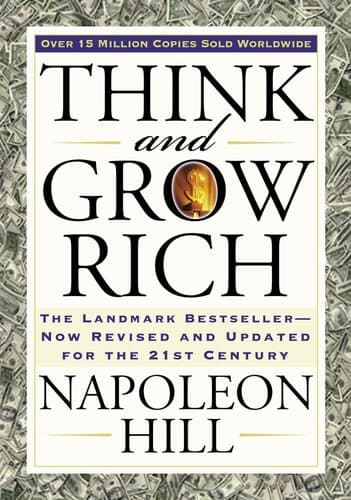
Napoleon Hill's 1937 synthesis of interviews with Andrew Carnegie, Thomas Edison, Henry Ford, and ~500 other wealthy Americans. Hill extracts 13 "steps" — a philosophy of definite-purpose, auto-suggestion, mastermind collaboration, and persistence. Uneven, often mystical, still foundational for every self-development book that followed.
Key Insights
- Desire is the starting point of all achievement — not a wish, not a hope, but a burning, definite desire backed by a plan
- Auto-suggestion: the subconscious mind can be programmed through repeated, emotionally charged affirmation
- The Mastermind Principle: two or more minds working in harmony toward a definite objective create a force greater than the sum of their parts
- Persistence is the direct result of habit. The person who persists is not different — they have simply trained the response
- Every adversity carries the seed of an equivalent or greater benefit — but only for the mind prepared to find it
Quotes Worth Remembering
12 recorded excerpts. Check the named edition and location before sharing the wording.
Whatever the mind of man can conceive and believe, it can achieve.
Author's Preface
The book's thesis compressed. Hill repeats it as a mantra throughout — controversial precisely because it sounds simple.
Desire is the starting point of all achievement, not a hope, not a wish, but a keen pulsating desire which transcends everything.
Chapter 2 — Desire
Most great people have attained their greatest success just one step beyond their greatest failure.
Chapter 8 — Persistence
Every adversity, every failure, every heartache carries with it the seed of an equal or greater benefit.
Chapter 8 — Persistence
You are the master of your destiny. You can influence, direct and control your own environment. You can make your life what you want it to be.
Chapter 15 — The Sixth Sense
The starting point of all achievement is DESIRE. Keep this constantly in mind. Weak desires bring weak results.
Chapter 2 — Desire
Strong, deeply rooted desire is the starting point of all achievement, just as the atom is the beginning of all matter.
Chapter 2 — Desire
Patience, persistence and perspiration make an unbeatable combination for success.
Chapter 8 — Persistence
There are no limitations to the mind except those we acknowledge.
Chapter 13 — The Subconscious Mind
A quitter never wins — and a winner never quits.
Chapter 8 — Persistence
The man who does more than he is paid for will soon be paid for more than he does.
Chapter 6 — Organized Planning
If you do not see great riches in your imagination, you will never see them in your bank balance.
Chapter 5 — Imagination
Chapter-by-Chapter
Each chapter carries a key idea and a short summary, so you can find the argument again.
01Chapter 1 — Thoughts Are Things
Thoughts, when mixed with definiteness of purpose and burning desire, become material forces.
OpenClose
Hill's thesis chapter. Opens with the Edwin Barnes story — a man who wanted to partner with Edison and made the wanting so absolute that circumstances arranged themselves. Sets up the "conceive and believe, you can achieve" frame used throughout.
02Chapter 2 — Desire: The Starting Point of All Achievement
Six definite steps transmute desire into its monetary equivalent.
OpenClose
Hill's six-step formula: (1) fix exact amount, (2) determine what you'll give, (3) fix definite date, (4) create plan, (5) write it all down, (6) read the statement twice daily. Not magic — a commitment device that forces specificity and daily visualization.
03Chapter 3 — Faith: Visualization of, and Belief in Attainment of Desire
Faith is a state of mind that can be induced through repeated affirmation — not a religious claim.
OpenClose
Hill treats faith as an emotional condition the subconscious responds to. Distinction between wishful thinking and trained belief. The practical reading: if you genuinely cannot believe your plan is achievable, you need either a different plan or more evidence; neither is a moral failure.
04Chapter 4 — Auto-Suggestion: Medium for Influencing the Subconscious
The subconscious cannot distinguish between real and imagined stimuli — feed it intentionally.
OpenClose
Hill's mechanism for installing belief: daily verbal affirmation charged with emotion. Modern reading: auto-suggestion partially anticipates cognitive behavioral therapy (Beck) and self-efficacy theory (Bandura). The technique works, if imperfectly explained.
05Chapter 5 — Specialized Knowledge
General education is cheap; specialized knowledge in service of a definite plan is expensive and scarce.
OpenClose
Henry Ford example: Ford was accused of ignorance, responded he could push a button to summon any specialist he needed. Hill extracts the principle — you don't need to know everything, you need to organize knowledge toward a specific end. Generalist knowledge without application dissipates.
06Chapter 6 — Imagination: The Workshop of the Mind
Synthetic imagination (recombination) and creative imagination (novelty) are the two engines of wealth.
OpenClose
Hill distinguishes between combining existing ideas (most business fortunes) and generating new ones (inventors, artists). Both are trainable. The chapter argues every idea worth pursuing should be written, shaped, and repeatedly revisited — imagination is a muscle, not a gift.
07Chapter 7 — Organized Planning: The Crystallization of Desire Into Action
A plan that fails is not a failed plan — it is information for the next plan.
OpenClose
The chapter reframes plan failure. Hill cites Thomas Edison failing "10,000 times" before the electric light. The practical method: make a definite plan, test it, revise on failure, never abandon the purpose. Distinguishes plan (replaceable) from purpose (durable).
08Chapter 8 — Decision: The Mastery of Procrastination
Wealth accumulates for those who decide quickly and change their minds slowly.
OpenClose
Hill surveys his ~500 wealthy interviewees and reports a common trait: quick, firm decisions once the facts are in; rare and reluctant revisions. The opposite — slow decisions and frequent revisions — tracks with the poor. The chapter is less about decisiveness than about commitment.
09Chapter 9 — Persistence: The Sustained Effort Necessary to Induce Faith
Persistence is a habit, not a virtue — which means it can be built.
OpenClose
The book's most cited chapter. Hill argues most people fail within sight of success because their persistence was never trained. The formula: definite purpose + definite plan + mastermind + willpower to ignore discouragement. The trainability is the key point — persistence is behavior, not character.
10Chapter 10 — Power of the Master Mind: The Driving Force
Two or more aligned minds produce a third intelligence greater than either alone.
OpenClose
Hill's most durable contribution. Modern peer groups, founders' circles, mastermind groups, and even agile development teams descend from this chapter. Carnegie credited the principle for the steel industry; Hill argues the same applies to any complex objective.
11Chapter 11 — The Mystery of Sex Transmutation
Creative energy of any kind can be redirected into productive work.
OpenClose
Dated in framing, durable in principle. Hill's claim is that libido is one instance of a broader creative drive, and great achievers have historically channeled it into work. Modern reading: this is a crude early theory of sublimation (Freud), later refined by flow psychology (Csíkszentmihályi). The principle holds; the language is of its era.
12Chapter 12 — The Subconscious Mind: The Connecting Link
The subconscious acts on whichever stimuli reach it most often and most emotionally.
OpenClose
Hill's model of attention is prescient: what you repeatedly expose yourself to, emotionally, becomes your operating assumption. The practical lever: curate inputs, use visualization deliberately, repeat a small set of definite statements daily. Later research (Bandura, Duhigg) validates most of this.
13Chapter 13 — The Brain: A Broadcasting and Receiving Station for Thought
Minds influence each other at distance through shared ideas and emotional resonance.
OpenClose
The most mystical chapter in a practical book. Hill claims brains literally broadcast thoughts. Modern reading: there is no such mechanism, but the observation that emotional states propagate through groups is correct — it is simply explained by social psychology, not radio physics.
14Chapter 14 — The Sixth Sense: The Door to the Temple of Wisdom
After the first 12 principles are installed, a new intuitive capacity emerges.
OpenClose
Hill describes his "Invisible Counselors" technique — imaginary nightly conversations with nine historical figures (Emerson, Darwin, Lincoln, Edison, etc.). Explicitly metaphorical, but Hill credits it with breakthrough ideas. Modern version: mentor visualization, dialogue journaling. Useful; not literal.
15Chapter 15 — How to Outwit the Six Ghosts of Fear
Fear of poverty, criticism, ill health, loss of love, old age, and death — name them to defang them.
OpenClose
Closing chapter. Hill argues all procrastination traces to one or more of these six fears. The remedy is diagnostic: identify which fear is behind a specific hesitation, examine its actual basis, act in the direction of the fear. Sound psychological advice, delivered in 1937 before most of the vocabulary existed.
Best For
Frequently Asked Questions
What are the 13 principles in Think and Grow Rich?
+
Desire, Faith, Auto-Suggestion, Specialized Knowledge, Imagination, Organized Planning, Decision, Persistence, Power of the Master Mind, The Mystery of Sex Transmutation, The Subconscious Mind, The Brain, The Sixth Sense. Hill treats these as sequential steps; most readers find the first eight practical and the last five increasingly mystical.
Is Think and Grow Rich scientifically valid?
+
Partly. Several principles (definite purpose, organized planning, persistence, specialized knowledge) have strong modern empirical support. Others (auto-suggestion in the 1930s meaning, Sex Transmutation, Sixth Sense) are mystical frameworks now better served by cognitive science and behavioral psychology. Read the book for the framework; consult modern sources for the mechanisms.
What is the Mastermind Principle?
+
Two or more minds working in harmony toward a definite objective create a third, greater intelligence. The principle explains why peer groups, founding teams, and committed partnerships outperform solo effort on complex goals. Carnegie himself told Hill this was the principle most responsible for his wealth.
Is the "Secret" in Think and Grow Rich the same as The Secret (2006)?
+
The Secret explicitly credits Hill as its foundational source. Byrne's version (Law of Attraction) is a narrower, mystical-only interpretation of Hill's broader principle of intentional thought shaping action. Hill requires action + planning + persistence; The Secret often omits those.
Which chapter matters most for modern readers?
+
Persistence. Every self-help book since 1937 rediscovers this chapter's thesis — that persistence is a trained response, not a personality trait, and most people quit roughly where success begins. If you read only one chapter, make it this one.
Continue Reading
If Think and Grow Rich opened a door, these books walk you through it. Curated for reason, not algorithm — each entry explains why it pairs with this book.
How to Win Friends and Influence People
by Dale Carnegie
The other foundational 1930s self-improvement book. Carnegie focuses on the interpersonal mechanics of success; Hill focuses on the intrapersonal. Read together for the complete 1930s practical philosophy.
Get the bookThe Richest Man in Babylon
by George S. Clason
Hill's contemporary working the same territory from a different angle — Clason via parable, Hill via principle. Clason is easier to apply immediately; Hill is more ambitious.
Get the bookPsycho-Cybernetics
by Maxwell Maltz
The 1960s scientific upgrade of Hill's auto-suggestion framework. Maltz was a plastic surgeon who noticed patients' self-image persisted after physical change — which led him to codify what Hill had described intuitively.
Get the bookMindset
by Carol Dweck
The modern empirical version of what Hill asserted. Where Hill said "whatever the mind can believe," Dweck proved "fixed vs. growth mindset." Read Dweck if you want the evidence behind Hill's intuition.
Get the bookThe 7 Habits of Highly Effective People
by Stephen Covey
Covey explicitly extends Hill's framework. Where Hill offers principles, Covey offers habits. The continuity of tradition is obvious when read in sequence.
Get the bookAtomic Habits
by James Clear
Hill's persistence chapter, modernized. Clear's Four Laws are a behavioral refinement of Hill's intuition that persistence is a trainable habit.
Get the bookGo Deeper — Videos
Each link opens a YouTube search for this book. Pick a named speaker before you treat a recording as a source.
Think and Grow Rich — Full Audiobook
Public Domain / Multiple channels
Hill's book is public domain (1937). Multiple full-audio versions exist on YouTube. Free and complete — skip paid versions unless you want premium narration.
Think and Grow Rich Summary by Dan Lok
Dan Lok
Entrepreneur walk-through of the 13 principles with modern business examples. Useful bridge between 1937 language and 2020s application.
Napoleon Hill — Your Right to Be Rich (Full Lecture Series)
Napoleon Hill Foundation
Hill lecturing in his own voice in the 1950s. Historical artifact as much as instruction. The delivery is period-specific; the ideas are not.
The Secret — documentary (Hill credited)
Rhonda Byrne
The 2006 film that reintroduced Hill's framework to the 21st century — with significant oversimplification. Useful for understanding the cultural reception; not a substitute for Hill's own 15-chapter argument.
If You Liked This, Read Ours
Our Book
Manifestation
The Architecture of Reality
Not wishful thinking. Not magic. The grounded, psychological, and strategic approach to turning thought into reality — updated for the AI age.
Read freeThe FrankX Newsletter
One book breakdown like this. One spotlight from the operating loop. Every Friday.