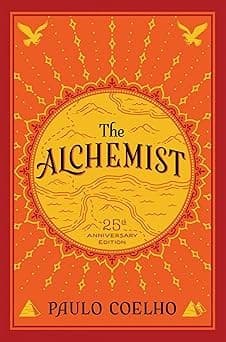
The short answer
A shepherd named Santiago leaves everything he knows to chase a recurring dream of treasure at the Pyramids. The novel is ostensibly about the journey; it is actually a parable about how purpose, attention, and the willingness to begin shape reality. Short, simple, often life-redirecting.
Key Insights
- The Personal Legend: everyone has a unique purpose, and the universe conspires to help those who pursue it with courage
- The treasure is often found where you began — but only after the journey has transformed you into someone who can see it
- Fear of failure is the only thing that makes a dream impossible
- The Language of the World: everything is connected, and learning to read the signs is a skill that develops with attention
- The principle of favorability: when you want something, the entire universe moves to help you achieve it — but only after you begin
Quotes Worth Remembering
12 recorded excerpts. Check the named edition and location before sharing the wording.
When you want something, all the universe conspires in helping you to achieve it.
Part One
The book's most quoted line. Coelho's shorthand for the principle of favorability — the universe favors initiative, not intention.
It's the possibility of having a dream come true that makes life interesting.
Part One
The secret of life, though, is to fall seven times and to get up eight times.
Part Two
There is only one thing that makes a dream impossible to achieve: the fear of failure.
Part Two
People need not fear the unknown if they are capable of achieving what they need and want.
Part Two
Remember that wherever your heart is, there you will find your treasure.
Part Two
The fear of suffering is worse than the suffering itself.
Part Two
Every search begins with beginner's luck, and every search ends with the victor being severely tested.
Part Two
The structure of the hero's journey, stated as a practical warning. Coelho prepares the reader for the part most books skip.
When you really want something, it's always possible. The soul of the world is nourished by people's happiness. And also by unhappiness, envy, and jealousy. To realize one's destiny is a person's only real obligation.
Part One
Tell your heart that the fear of suffering is worse than the suffering itself. And that no heart has ever suffered when it goes in search of its dreams.
Part Two
Maktub — It is written.
Part One
The Arabic word Coelho weaves throughout the desert sections. A call to surrender striving without surrendering effort.
When each day is the same as the next, it's because people fail to recognize the good things that happen in their lives every day that the sun rises.
Prologue
Chapter-by-Chapter
Each chapter carries a key idea and a short summary, so you can find the argument again.
01Prologue — The Story of Narcissus
Even the pond that held Narcissus misses him for his own reasons.
OpenClose
Coelho retells the Narcissus myth with a twist: the lake weeps when Narcissus dies, not for his beauty, but because it could see itself in his eyes. The opening primer for the whole book — everything in the universe is looking for its own reflection in the beauty of others.
02Part One — The Shepherd's Call
A recurring dream is a message from the Soul of the World — if you have ears for it.
OpenClose
Santiago, a young Andalusian shepherd, dreams twice of treasure buried at the Pyramids. A mysterious old man claiming to be the King of Salem tells him this is his Personal Legend. Santiago sells his sheep and crosses to Africa to begin the journey. In Tangier he is robbed of everything.
03Part One — The Crystal Merchant
The dream deferred becomes a dream dishonored — even the merchant's comforts cannot fill the hole.
OpenClose
Broke, Santiago finds work with a crystal merchant in Tangier. Over a year he transforms the shop with innovations, earns enough to either return to Spain or continue to Egypt. The merchant himself dreams of pilgrimage to Mecca but will never go — he has chosen comfort over Personal Legend. Santiago sees the warning and continues.
04Part Two — Crossing the Sahara
The desert teaches by stripping — it will give you the Language of the World if you survive the silence.
OpenClose
Santiago joins a caravan across the Sahara. He meets the Englishman, a scholarly seeker of the Philosopher's Stone, and learns that books contain maps but not territory. The caravan reaches the oasis of Al-Fayoum, where Santiago meets Fatima — the woman he recognizes as the desert's gift, not obstacle.
05Part Two — The Alchemist
A true teacher shows you what you already know.
OpenClose
At Al-Fayoum, Santiago's attention has grown sharp enough to read omens in the flight of hawks. He warns the tribal chiefs of attack and is rewarded. The Alchemist finds him, tests him, and takes him on the final leg of the journey across a landscape now more dangerous than the first desert — the desert of the tribal wars.
06Part Two — The Soul of the World
To transform into wind, you must understand that the wind and you share one substance.
OpenClose
Captured by tribesmen, Santiago must save both their lives by turning himself into the wind. The extended ordeal is the book's mystical heart: Santiago speaks with the desert, the wind, the sun, and finally with the hand that wrote everything. He accomplishes the impossible because he has stopped seeing himself as separate from the elements.
07Part Two — Epilogue — The Return
The treasure was under the roots of the tree Santiago slept beneath on the first night — the journey was the only way to earn the right to dig.
OpenClose
Santiago reaches the Pyramids, digs, finds nothing, and is beaten by thieves. One thief mocks him with a story of his own recurring dream — of treasure buried under a sycamore in a ruined Spanish chapel. Santiago laughs, returns to Spain, digs, and finds the chest of gold. He knew, the entire time. The journey was what built the eyes to see.
Best For
Frequently Asked Questions
What is a Personal Legend in The Alchemist?
+
Coelho's term for the unique life purpose every person is born with. Everyone begins knowing their Personal Legend; most abandon it over time under pressure from family, society, or fear. The novel argues pursuing it is the one thing that makes life fully meaningful.
Is The Alchemist religious?
+
Spiritual rather than religious. Coelho draws on Islamic Sufism, Christian mysticism, and alchemical tradition, but the book is portable across belief systems. You can read it as metaphysical (the universe really does conspire), psychological (attention and commitment reshape perception), or just as a good story.
Why does Santiago find the treasure at his starting point?
+
The question is the point. The treasure had always been there, but Santiago could not see it until the journey transformed him. The story's argument: the external goal is scaffolding — the real reward is who you become while pursuing it.
Is the book too simple to be taken seriously?
+
Its simplicity is deliberate. Coelho writes in the tradition of wisdom literature — Rumi, Khalil Gibran, biblical parables — where the surface reads like a children's story and the depth reveals on re-reading. Critics who dismiss it as shallow usually read it once.
Who is the Alchemist, and why is the book named for him?
+
The Alchemist Santiago meets in the desert is not primarily a chemist — he is a teacher who transforms lead into gold and students into seers. The title points at the real subject: the transformation of the self, using experience as the catalyst.
Continue Reading
If The Alchemist opened a door, these books walk you through it. Curated for reason, not algorithm — each entry explains why it pairs with this book.
The Prophet
by Kahlil Gibran
The other foundational wisdom-literature short book of the twentieth century. Same lineage of parabolic philosophy — Coelho would call Gibran a predecessor. Read together for the tradition The Alchemist is working in.
Get the bookSiddhartha
by Hermann Hesse
The same arc — young man leaves tradition to find his own truth — told by a more disciplined literary stylist. If you loved The Alchemist, Siddhartha will feel like a rigorous cousin.
Get the bookThe Pilgrimage
by Paulo Coelho
Coelho's own first book, written before The Alchemist, based on his walk of the Santiago de Compostela. The non-fiction root of the fiction you just read — many images and arguments appear here first.
Get the bookThe Hero with a Thousand Faces
by Joseph Campbell
The monomyth — Campbell's structural analysis of hero narratives across cultures. The Alchemist follows the pattern precisely. Read Campbell to see the skeleton beneath Coelho's flesh.
Get the bookZorba the Greek
by Nikos Kazantzakis
A different answer to the question "how should I live." Kazantzakis's Zorba is the anti-Santiago — the treasure is not at the Pyramids, it is dancing on the beach tonight. Worth reading against Coelho to see where each lands.
Get the bookMan's Search for Meaning
by Viktor Frankl
Frankl makes the same argument as Coelho — meaning, not pleasure, is the basis of a well-lived life — but from inside a concentration camp instead of a shepherd's tale. Dark mirror; same conclusion.
Get the bookGo Deeper — Videos
Each link opens a YouTube search for this book. Pick a named speaker before you treat a recording as a source.
Paulo Coelho on The Alchemist, Writing, and Manifestation
Various long-form interviews
Long-form interviews with Coelho in his own voice. He speaks frankly about the early rejection of the book, his writing ritual, and what he means by the Soul of the World.
The Alchemist — Animated Summary
Multiple channels
Whiteboard-style summaries for readers who want the core narrative before committing to the book. Useful for book clubs or for deciding whether to buy.
Paulo Coelho at Davos — On Writing and Destiny
World Economic Forum
Coelho addresses a business audience about how writers see the world and what the Personal Legend means for people who have already "made it."
Will Smith on The Alchemist
Various clips
Smith has discussed The Alchemist's influence on him multiple times. Short, emotional clips that work as motivation fuel — not substitute for the book.
If You Liked This, Read Ours
Our Book
Manifestation
The Architecture of Reality
Not wishful thinking. Not magic. The grounded, psychological, and strategic approach to turning thought into reality — updated for the AI age.
Read freeThe FrankX Newsletter
One book breakdown like this. One spotlight from the operating loop. Every Friday.