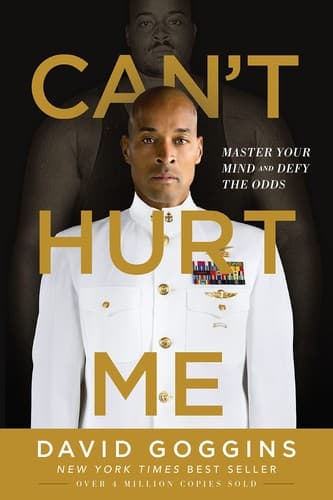
The short answer
Part autobiography of a Navy SEAL / Army Ranger / ultramarathoner who weighed 297 lbs at 24, part operating manual for deliberate suffering as a life strategy. Goggins argues mental toughness is not a trait but a trained response — you callus the mind the way you callus hands. Unpleasant. Effective.
Key Insights
- The 40% Rule: when your mind tells you to quit, you have only used 40% of your actual capacity
- The Accountability Mirror: confront the truth about where you are and who you need to become — no filters, no excuses
- Callusing the mind: deliberately expose yourself to discomfort to build mental toughness the same way calluses form on hands
- Taking Souls: use the energy of doubters as fuel rather than letting their negativity drain you
- The Cookie Jar: store memories of past victories to draw on when current challenges feel impossible
Quotes Worth Remembering
12 recorded excerpts. Check the named edition and location before sharing the wording.
When you think that you are done, you're only at 40 percent of your body's capability. That's just the limits that we put on ourselves.
Chapter 7 — The Most Powerful Weapon
The 40% Rule, stated directly. Goggins learned this during Hell Week in BUD/S.
Most of this generation quits the second they get talked to. Get your ass off the couch, in fact, don't ever sit on the couch again.
Chapter 1 — I Should Have Been a Statistic
The only way out is through.
Chapter 3 — The Truth, My Only Alternative
You are in danger of living a life so comfortable and soft that you will die without ever realizing your true potential.
Chapter 10 — The Empowerment of Failure
A warrior is a guy that goes, I'm here again today, I'll be here again tomorrow and the next day.
Chapter 8 — Talent Not Required
We all have heard the saying "hard work beats talent when talent doesn't work hard." That's not just a bumper sticker.
Chapter 8 — Talent Not Required
Greatness is pure suffering.
Chapter 9 — Uncommon Amongst Uncommon
The book in three words. Goggins does not sell the result; he sells the cost honestly.
The most important conversations you'll ever have are the ones you'll have with yourself.
Chapter 3 — The Truth, My Only Alternative
Suffering is the true test of life.
Chapter 4 — Taking Souls
Callusing your mind is about doing the work when you don't feel like doing it, when it's hard, and when you're tired.
Chapter 7 — The Most Powerful Weapon
Everybody comes to a point in their life when they want to quit. But it's what you do at that moment that determines who you are.
Chapter 9 — Uncommon Amongst Uncommon
You have to build calluses on your brain just like how you build calluses on your hands.
Chapter 7 — The Most Powerful Weapon
Chapter-by-Chapter
Each chapter carries a key idea and a short summary, so you can find the argument again.
01Chapter 1 — I Should Have Been a Statistic
Your story is whatever you refuse to accept as final.
OpenClose
Goggins's childhood — physical abuse, poverty, dyslexia, a racist community, a father who beat his mother. The statistics said he'd be dead or incarcerated. He starts by describing how the environment formed him so the reader understands what he is working against, not just with.
02Chapter 2 — Truth Hurts
The Accountability Mirror is the foundation — face what is actual, not what is aspirational.
OpenClose
Goggins at 19 weighs 297 pounds, sprays bugs for a living, eats chocolate donuts daily. He sees an ad for the Navy SEALs, realizes he is everything a SEAL is not, and institutes the Accountability Mirror: Post-its of hard truths stuck to glass. Loses 106 pounds in three months.
03Chapter 3 — The Truth, My Only Alternative
You can rewrite your story at any age, but the first draft must be brutally true.
OpenClose
Goggins fakes his ASVAB enlistment score, gets into the Navy, washes out of Pararescue with sickle-cell trait, decides to become a SEAL. The chapter is about the decision architecture of impossible goals — you don't manage the distance, you commit to the next step under full truth.
04Chapter 4 — Taking Souls
When someone tries to break you, break them instead by refusing to give the expected response.
OpenClose
In BUD/S Hell Week — the SEAL selection crucible — Goggins develops "Taking Souls" as a mental technique. Instructors want to see you crack; refuse, and the energy they put into breaking you becomes yours. He makes it through Hell Week three times (stress fractures, pneumonia).
05Chapter 5 — Armored Mind
Visualization is not positive thinking — it is tactical rehearsal of the specific pain ahead.
OpenClose
Goggins begins visualizing every worst-case scenario for missions and races in precise detail. When the worst actually happens, he has already lived through it mentally. Distinguishes his practice from generic "manifestation" — his visualization is specifically pain-rehearsal, not outcome-rehearsal.
06Chapter 6 — It's Not About a Trophy
The reward for the work is never the trophy — it's the person you became to earn it.
OpenClose
Goggins attempts the 2005 Badwater 135 — 135 miles through Death Valley — with almost no ultra experience. He runs, walks, crawls, bleeds, hallucinates, finishes 5th. The chapter rejects the usual motivation-book framing of achievement. What you get is not the medal but the new baseline of what you can bear.
07Chapter 7 — The Most Powerful Weapon
The mind gives up long before the body — reset the threshold.
OpenClose
The chapter containing the 40% Rule. Goggins argues mental toughness is not a gift but a trained response. The training: deliberate, frequent, specific discomfort. Cold showers, hard runs, fasting, silence. The goal is not the discomfort — it is familiarity with it.
08Chapter 8 — Talent Not Required
Preparation, scheduled and audited, beats talent every time.
OpenClose
Goggins breaks down his schedule — military, training, recovery, family — and argues that what looks like superhuman output is actually ordinary time accounted for with uncommon ruthlessness. Time audits, early wake-ups, and the refusal to waste minutes on activities that don't serve the goal.
09Chapter 9 — Uncommon Amongst Uncommon
Once you reach the top 1%, the real competition is with who you could still become.
OpenClose
Goggins at the peak of his military career realizes most elites stop improving once they reach elite status. He pushes further — setting the Guinness pull-up record, running 100 miles on no training. The argument: the most dangerous plateau is the one that looks like a summit.
10Chapter 10 — The Empowerment of Failure
Failing at something you actually tried beats succeeding at something you didn't.
OpenClose
Goggins fails the Guinness pull-up record twice before setting it. The chapter is about the asymmetry of ambitious failure — you leave stronger, more specific, and with information you couldn't have obtained safely. Closing charge: aim at something hard enough to fail at.
Best For
Frequently Asked Questions
What is the 40% Rule?
+
Goggins's claim — originally from a military SERE instructor — that when your mind tells you you're done, you've actually only tapped 40% of your full capacity. The rule is not scientifically precise; it's behavioral. Treating exhaustion as halfway rather than endpoint is the trick.
Is Can't Hurt Me a typical motivational book?
+
No. Most motivation books sell comfort dressed as insight. Can't Hurt Me is the opposite — it sells discomfort dressed as necessity. Goggins's voice is crude, his standards are extreme, and the book explicitly tries to repel readers who want the easy version. Either it resonates immediately or it doesn't.
What is the Accountability Mirror?
+
A practice Goggins invented as a teenager: write the hard truths about yourself on Post-it notes and stick them on the bathroom mirror — your weight, your grades, your weaknesses. Every morning, face them. Most self-improvement fails because people avoid this step. The mirror is the pre-requisite for the work.
What are the "Challenges" in the book?
+
Goggins ends each chapter with a specific, escalating challenge for the reader. Examples: write your accountability list; do physical exercise to the point of failure; call someone you've been avoiding. The book is deliberately designed as experiential, not informational. Reading without doing misses the point.
Is Goggins's approach sustainable long-term?
+
Honest answer: his own life contains injuries, relationship difficulties, and extreme cost. The book is not a template for a balanced life. It is a corrective for people who have drifted into under-effort. Apply the mindset selectively; Goggins himself has moderated in later work (Never Finished, 2022).
Continue Reading
If Can't Hurt Me opened a door, these books walk you through it. Curated for reason, not algorithm — each entry explains why it pairs with this book.
Never Finished
by David Goggins
Goggins's 2022 follow-up. Where Can't Hurt Me is the autobiography, Never Finished is the refined methodology — what he's learned since about sustaining the mindset without destroying the body.
Get the bookExtreme Ownership
by Jocko Willink & Leif Babin
Adjacent SEAL-origin philosophy, more leadership-focused. Willink's framework (if it's broken, you're responsible) is the organizational version of Goggins's Accountability Mirror.
Get the bookDiscipline Equals Freedom
by Jocko Willink
Shorter, more aphoristic version of the Goggins/Willink camp. If you want the core argument compressed to daily readings, this is it.
Get the bookThe Obstacle Is the Way
by Ryan Holiday
Same conclusions, different lineage. Goggins comes from pain-forging; Holiday comes from Stoicism. They agree on the obstacle-as-opportunity framing but recommend different practices.
Get the bookBorn to Run
by Christopher McDougall
For readers pulled toward Goggins's ultrarunning story. McDougall's Tarahumara chapters provide the anthropological and physiological context that makes Badwater comprehensible.
Get the bookMan's Search for Meaning
by Viktor Frankl
A different kind of survival literature. Frankl in a concentration camp reaches some of the same conclusions Goggins reaches in SEAL training — suffering is bearable when attached to meaning. Worth reading against Goggins to see what each gets right.
Get the bookGo Deeper — Videos
Each link opens a YouTube search for this book. Pick a named speaker before you treat a recording as a source.
David Goggins on the Joe Rogan Experience
JRE
The interview that introduced most people to Goggins. Multiple appearances over the years. Rogan does not try to moderate him, which is the right call.
David Goggins on the Rich Roll Podcast
Rich Roll
Roll is an ultramarathoner, so this conversation goes deeper on training methodology than most. Best video for athletes specifically.
David Goggins on the Tim Ferriss Show
Tim Ferriss Show
Ferriss pushes on the methodology layer — what training schedule, what recovery, what mental techniques in what sequence. Closer to operations manual than biography.
David Goggins — Stay Hard (Motivational compilation)
Multiple channels
Short-form motivational compilations. Useful for morning anchoring; not a substitute for the book's nuance. Pick whichever channel's editing style you can tolerate.
If You Liked This, Read Ours
Our Book
Spartan Mindset
The Discipline of One More
A manual for the relentless. Discipline, training, and the philosophy of pushing past limits. Every chapter is a rep you didn't think you had.
Read freeThe FrankX Newsletter
One book breakdown like this. One spotlight from the operating loop. Every Friday.