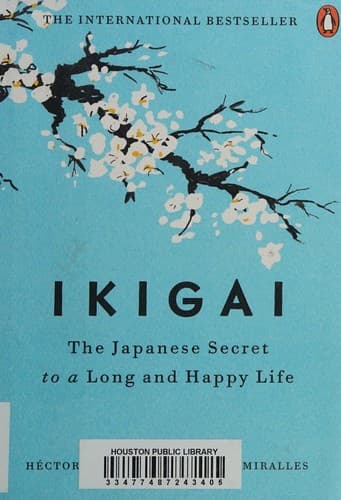
Ikigai: The Japanese Secret to a Long and Happy Life
by Héctor García & Francesc Miralles
The short answer
Two Spanish authors — a Tokyo-resident software engineer and a Barcelona-based novelist — travel to Ogimi, the Okinawan "village of longevity," and interview its centenarians about why they live so long and stay so engaged. The book is the one responsible for ikigai's global pop-culture moment (3M+ copies, 60+ languages). It is a useful entry, especially for the Ogimi village fieldwork, but it also imports the 2014 four-circle Venn as if it were Japanese — which it is not. Read for the Okinawan voices, hold the Venn loosely.
Key Insights
- Ogimi village is structurally engineered for engagement — gardens, multi-generational households, daily community ritual; the structure produces the outcome
- Centenarians, when asked their secret, reliably name three things — friends, plants in the garden, and a clear daily reason to get up — in roughly that order
- The moai (committed friendship circle) is described in detail through Okinawan interviewees as a near-universal practice, not optional
- García & Miralles import the Marc Winn 2014 Venn diagram as if it were the Japanese definition; it is the book's weakest section and should be treated as scaffolding, not source
- The chapters on flow, antifragility, and movement (radio taiso, tai chi, yoga) connect ikigai to mid-2010s Western frameworks (Csíkszentmihályi, Taleb) — useful synthesis when read consciously
Quotes Worth Remembering
7 recorded excerpts. Check the named edition and location before sharing the wording.
Only staying active will make you want to live a hundred years.
Chapter I — Ikigai
Attributed to a 102-year-old Ogimi villager interviewed by García & Miralles. The book uses this as the opening operating principle for everything that follows.
Your ikigai is the reason you get up in the morning.
Chapter I — Ikigai
The book's tagline definition. Closer to Kamiya's clinical sense than to the four-circle Venn the book also includes — the contradiction is unresolved.
In Okinawa, people don't retire. There isn't even a word for retirement in their language. Instead, there is one word — ikigai — that runs through everything they do.
Chapter II — Antiaging Secrets
The grand essentials of happiness are something to do, something to love, and something to hope for.
Chapter VIII — Resilience and Wabi-Sabi
García & Miralles citing Allan K. Chalmers (American clergyman, 1897-1972) as a Western parallel to ikigai. The line is not from the Okinawan tradition but is used as a thematic frame in Chapter VIII.
We are what we repeatedly do. Excellence, then, is not an act, but a habit.
Chapter VI — Ikigai at Work
Aristotle, frequently cited in Chapter VI on flow and ikigai. Demonstrates the book's habit of pairing Japanese concepts with familiar Western framings.
Don't worry, just live. Have plenty of friends. Live well, eat well, sleep well.
Chapter XI — Lessons from Japan's Centenarians
Composite distillation of the Ogimi interview material. The repeated structure across centenarian responses was striking enough that García & Miralles dedicated a chapter to it.
Hara hachi bu — eat until your stomach is 80 percent full.
Chapter IV — Eat to Live to 100
The single most actionable Okinawan practice the book transmits. Confucian-derived, repeated as a pre-meal mantra in Ogimi households.
Chapter-by-Chapter
Each chapter carries a key idea and a short summary, so you can find the argument again.
01Ikigai — The Art of Staying Young While Growing Old
Ikigai is the daily reason to get up — and it correlates with longevity, especially in Okinawa.
OpenClose
García & Miralles open with the operating definition. Ikigai is presented as the small daily thing — gardening, friends, caring for grandchildren — that gives a centenarian their reason to wake. The chapter introduces the Venn diagram (the book's weakest move) but also the Kamiya/Buettner lineage. Read the prose, hold the Venn loosely.
02Antiaging Secrets — Little Things That Add Up to a Long and Happy Life
Longevity is built from many small daily practices, not one heroic intervention.
OpenClose
A survey chapter — Blue Zones overview, telomere research, neurogenesis, the long-term effect of social engagement on cognitive ageing. The argument is that ikigai-aligned daily activity drives the biological variables, not the other way round. A useful but not original synthesis chapter.
03From Logotherapy to Ikigai — How to Live Longer and Better by Finding Your Purpose
Ikigai and Logotherapy converge — meaning is a primary driver of health.
OpenClose
García & Miralles pair Viktor Frankl's Logotherapy with ikigai, arguing the two traditions independently discovered the same variable. The most intellectually serious chapter in the book — explicitly cites Frankl, Naikan therapy, and Mihaly Csíkszentmihályi's flow. The strongest connection of ikigai to Western clinical psychology in the popular literature.
04Find Flow in Everything You Do
Flow states are the experiential side of ikigai — the doing that doesn't feel like effort.
OpenClose
Csíkszentmihályi for ikigai readers. Seven conditions for flow, paired with examples from the Ogimi interviews of elderly artisans, gardeners, and cooks who describe their daily work in precisely these terms. The chapter is a bridge between Japanese ikigai practice and Western flow research.
05Masters of Longevity — Words of Wisdom From the Longest-Living People in the World
The longest-lived people share a remarkably consistent set of practical answers when asked their secret.
OpenClose
A short chapter compiling centenarian quotes from Okinawa and elsewhere — Jiroemon Kimura (then world's oldest man), Misao Okawa, and Ogimi villagers. The consistency of the answers (friends, garden, daily reason to wake, eat lightly, move continually) across cultures is the chapter's argument.
06Lessons from Japan's Centenarians — Traditions and Proverbs for Happiness and Longevity
Okinawan culture encodes longevity practices in everyday traditions, not in optimization protocols.
OpenClose
Yuimaaru (mutual help), moai (committed friend circles), the multi-generational household, daily greetings to neighbours, the practice of communal mealtime. The chapter's argument is structural — Okinawan elders don't practise these things; the culture practises them, and the elders simply live inside it.
07The Ikigai Diet — What the World's Longest-Living People Eat and Drink
The Okinawan diet is ~95% plant-based, eaten slowly, in community, until 80% full.
OpenClose
Hara hachi bu, the sweet potato as staple, soy as protein, bitter melon, seaweed, jasmine and sanpin tea, occasional fish, rare meat. The chapter mostly summarizes Buettner's diet findings but adds detail from Ogimi household interviews — how meals are paced, who cooks, what the table conversation pattern looks like.
08Gentle Movements, Longer Life — Exercises From the East That Promote Health and Longevity
Movement should be daily, gentle, and embedded — not occasional and intense.
OpenClose
Radio taiso (Japanese morning calisthenics broadcast daily on national radio for ~90 years), tai chi, qigong, yoga, and shiatsu. Buettner's "move naturally" rendered as specific practices Westerners can adopt. The strongest practical chapter.
09Resilience and Wabi-Sabi — How to Face Life's Challenges Without Letting Stress and Worry Age You
Resilience is built through acceptance of impermanence (wabi-sabi) and structured antifragility (Taleb).
OpenClose
García & Miralles pair Japanese wabi-sabi (the acceptance of impermanence, asymmetry, incompleteness) with Nassim Taleb's antifragility (gaining from shocks). The argument: Okinawan resilience is structural — built into the cultural relationship with impermanence — not psychological grit. The chapter does the rare thing of taking two unfashionable Western and Eastern frameworks and showing they describe one underlying pattern.
10The Ikigai of the Centenarians — Stories from Ogimi
The Ogimi fieldwork is the book's actual contribution — listen to the elders themselves.
OpenClose
The closing chapter. Direct quotes from Ogimi centenarians on what they wake up for, how they spend their days, what their moai looks like, what they regret, what they don't. The least theoretical chapter, the most valuable. Read this chapter first if reading selectively.
Best For
Frequently Asked Questions
Is the four-circle Venn in this book the original Japanese definition of ikigai?
+
No. The Venn is a 2014 Western blog-post invention by Marc Winn, who adapted it from a 2011 "purpose" Venn by Spanish astrologer Andrés Zuzunaga and re-labelled the center "Ikigai." García & Miralles include it in the early chapters, which gave it an authoritative gloss it never earned. None of the Okinawan centenarians they interviewed describe ikigai this way; neither does Kamiya, Mogi, or Buettner. The Venn is useful Western scaffolding, not the Japanese concept. The Ogimi fieldwork in later chapters is the actual contribution of this book.
How does this book differ from The Little Book of Ikigai by Ken Mogi?
+
García & Miralles are Westerners writing about Japan; Mogi is Japanese writing about Japan. García & Miralles import the Venn; Mogi explicitly rejects it and offers the Five Pillars (start small, release yourself, harmony, joy of little things, here and now) as the Japanese-native alternative. Read García & Miralles for the Ogimi fieldwork, Mogi for the conceptual frame, and Buettner's Blue Zones chapter for the empirical grounding. Together they reconstruct what ikigai actually is.
What is "the Ogimi village"?
+
Ogimi is a small village on the northern coast of Okinawa Island. Local government describes it as "the village of longevity" — it has, per capita, the highest centenarian density in Okinawa and one of the highest in the world. García & Miralles spent extended time interviewing its elders. The Ogimi fieldwork is the part of the book that no other ikigai title has matched and the reason to read it.
What does the book say about diet, exercise, and longevity?
+
Mostly summarizing Buettner — Okinawan plant-forward diet (sweet potato, soy, bitter melon, seaweed), hara hachi bu (80% full), structural daily movement, moderate alcohol in community. Two original additions are useful — the chapters on radio taiso (Japanese morning calisthenics) and on engineered antifragility through small daily challenges (Taleb-derived). The diet section repeats Blue Zones; the movement and antifragility sections add something.
Why is it the bestselling ikigai book if it has these flaws?
+
Because it arrived at the right time (2016, post-Buettner, mid-mindfulness wave), was written in plainspoken Spanish-translated-to-English prose, was short (under 200 pages), and packaged a Japanese cultural concept inside Western career-coaching scaffolding. Reach is not synonymous with rigour. The book has been responsible for far more first exposures to ikigai than any other source — Frank's honest position is that the book is useful as an entry, problematic as a definitive source, and best read alongside Buettner and Mogi.
Continue Reading
If Ikigai: The Japanese Secret to a Long and Happy Life opened a door, these books walk you through it. Curated for reason, not algorithm — each entry explains why it pairs with this book.
The Little Book of Ikigai
by Ken Mogi
The Japanese-native counterweight. Where García & Miralles import the Western Venn, Mogi explicitly rejects it and gives the Five Pillars. Read both for the inside-out and outside-in views.
Get the bookThe Blue Zones
by Dan Buettner
The empirical grounding García & Miralles build on. The Okinawa chapter in Buettner is what first put "ikigai" into Western consciousness in 2005; García & Miralles went deeper in 2016.
Get the bookMan's Search for Meaning
by Viktor E. Frankl
García & Miralles explicitly cite Frankl in Chapter III. The Logotherapy-ikigai pairing is one of the book's strongest moves; reading Frankl directly is the natural next step.
Get the bookFlow: The Psychology of Optimal Experience
by Mihaly Csíkszentmihályi
Chapter IV is essentially flow-applied-to-ikigai. Csíkszentmihályi's original is denser but the foundation. Read for the Western research base of one of the book's key chapters.
Get the bookAntifragile
by Nassim Nicholas Taleb
The other Western framework García & Miralles import (Chapter IX). Antifragility — gaining from shocks — read against wabi-sabi (accepting impermanence) is a productive pairing.
Get the bookGo Deeper — Videos
Each link opens a YouTube search for this book. Pick a named speaker before you treat a recording as a source.
Héctor García on Ikigai — long-form interviews
Multiple podcasts
García is the more frequent media spokesperson of the two authors. Several long-form podcast interviews discuss the Ogimi fieldwork and the book's reception. Best audio entry to the authors' own framing.
Ogimi, the Village of Longevity — documentary footage
Various
Documentary clips and travel-channel footage of the village García & Miralles visited. The visual companion to the book's strongest chapter.
What is your Ikigai? — TEDx and similar
Various TEDx speakers
The pop-culture diffusion of the book's framing. Most of these talks present the four-circle Venn as if it were Japanese — useful for understanding the book's downstream effect, not for understanding ikigai itself.
Ikigai: The Japanese Secret to a Long and Happy Life — Book Summary
Multiple channels
Short summaries for readers who want the frame before committing. Most preserve the four-circle Venn uncritically — prefer the versions that contextualize it as a 2014 Western adaptation.
If You Liked This, Read Ours
Our Book
The Art of Self-Development
Seven Pillars of a Complete Life
A systematic approach to building every dimension of your life — energy, mind, soul, craft, capital, circle, and legacy. Not theory. Routines that work.
Read freeThe FrankX Newsletter
One book breakdown like this. One spotlight from the operating loop. Every Friday.