Your Moat Was Never the Model
Five frontier models shipped in six weeks. My stack barely noticed. Here is the Substrate Test: four questions that tell you whether you own anything durable.

Leave able to answer, in four questions, whether your AI stack owns anything a model release can't take away, and what to build if the answer is no.
Between late June and the end of July 2026, five frontier models shipped: Claude Opus 5, GPT-5.6, Grok 4.5, Gemini 2.5 Pro with Deep Think, and Meta's Muse Spark 1.1. Anthropic locked down 300 megawatts at Colossus 1 to feed the next one. It was the densest release cluster the industry has had.
I run an agentic system across a dozen surfaces. When I swapped the model underneath it, almost nothing downstream changed. That is not a complaint. That is the whole point, and most people have it backwards.
TL;DR: Model capability is now a commodity that arrives on someone else's schedule and leaves on someone else's schedule. The durable assets are the three things a model card never contains: the memory you own, the orchestration you control, and the taste you enforce. If swapping a frontier model breaks your product, you didn't build a product. You built a wrapper. The Substrate Test below is four questions that settle it in about ten minutes.
Why did five frontier releases change so little?
Because the thing that improved was the part you were always renting.
A frontier model is a capability ceiling. It moves up, everyone's ceiling moves up together, and relative position stays roughly where it was. What did not move: your context, your data, your workflows, your judgment about what is worth shipping. Those live in your stack or they live nowhere.
Watch how people actually reacted to the July cluster. The teams with a substrate changed one line in a router config and went back to work. The teams without one spent two weeks re-prompting, re-benchmarking, and re-writing the same product against a new API, and finished in the same competitive position they started in, minus two weeks.
That second group is doing unpaid QA for a lab.
What is a substrate, concretely?
A substrate is the layer between your intent and whichever model happens to be best this month. Four components, none of them glamorous:
- A memory store you own. Files, a local database, a vault, something on disk you can grep. Not a hosted "memory" feature with an API key attached to it.
- A routing layer. One place that decides which model gets which task, changeable without touching business logic.
- A protocol boundary. MCP or an equivalent, so tools and data attach to any model rather than one vendor's function-calling dialect.
- A taste gate. An explicit, written standard that rejects output. Not vibes; a checklist that produces a binary verdict.
Swap any model behind those four and your system keeps its identity. Remove any one of them and a model release becomes a migration.
The Substrate Test
Four questions. Answer honestly; the failure modes are more interesting than the passes.
1. If your primary model were deprecated tomorrow, how long until you're back to full capability?
Under a day. You have a router; the model is a config value. A week. You have prompts coupled to one model's quirks. Fixable, but you're paying rent. A month or more. The model is your product. That is not a business, it's a dependency with a landing page.
The tell is where model names appear in your codebase. If claude-opus-5 shows up in forty files, you have forty migrations queued.
2. What does your system know that a fresh session doesn't?
If a new chat with the same model gets you 90% of the way there, you have no memory advantage. You have a good prompt, and prompts are copyable in one screenshot.
Real memory compounds: prior decisions and why they were made, what you tried that failed, your voice as evidence rather than adjectives, the shape of your specific domain. This is the only asset in the stack that gets more valuable over time instead of less. Everything else depreciates on a lab's release schedule.
3. Can a second agent pick up where the first left off?
Orchestration is not "I run several agents." It's whether state survives a handoff.
If your agents share a filesystem, a git history, and a written contract about who owns what, you have a system. If each one starts from a blank context and you're the integration layer, carrying findings between windows by hand, you don't have orchestration, you have several assistants and a tired human.
4. What have you refused to ship?
This is the one everybody fails, and it's the one that actually separates people.
Generation is free now. Everyone can produce infinite competent output. The constraint moved entirely to selection, and selection requires a standard you can state out loud and apply against your own work when you don't want to.
If you can't name three things your system generated and you killed, you have no taste gate. You have a firehose. In an environment of infinite competent output, the firehose is worth approximately zero, and it is actively negative if it trains an audience to skim you.
The failure mode I know best
Here's mine, since the Substrate Test is worth nothing if I only aim it outward.
I have a content system with 29 registered publishing surfaces across five brands. Sixteen linked databases. Five publishing adapters. A schema-validated brand registry with signatures. A nineteen-specialist editorial manifest. Ten configured brand-operations agent profiles. Twenty staged pieces sitting in the pipeline.
Published, all-time, through that system: zero.
Every component passed its own local test. The registry is well-designed. The schemas validate. The publish contract correctly separates what an agent may automate from what a human must approve. And the whole assembly produced nothing, because I kept adding surfaces instead of shipping through the six that were already live.
Question 4 caught it. Not questions 1–3; the architecture was genuinely fine. It failed on refusal: I had no standard that said "no new surface until the existing ones ship," so every week the most interesting available work was building rather than publishing. Building is the most sophisticated form of procrastination available to a technical person. It produces artifacts, it feels like progress, and it can continue indefinitely.
The fix wasn't more architecture. It was subtraction: 29 surfaces cut to six, all three synthetic personas turned off, and one rule: nothing enters a distribution channel that didn't come from a piece that shipped first.
I'm writing the full post-mortem in a few weeks. It's the least flattering thing I'll publish this year and probably the most useful.
So what should you actually build in August?
In rough order of durability:
Own your context. Get your decisions, your failures, and your voice out of chat history and onto disk in a format you can search. This is the highest-return hour you will spend this quarter, and it is boring enough that almost nobody does it.
Put a router in front of your models. One file. Task class in, model out. Then swapping Opus 5 for whatever lands in September costs a line, not a sprint.
Standardize on a protocol. MCP for tools and data. The point isn't that MCP is perfect; it's that a protocol boundary makes your integrations survive vendor churn, and vendor churn is now the base rate.
Write your taste standard down. One page. What you will not publish. Then run your last ten outputs against it and see how many survive. If all ten pass, the standard is too weak to be doing work.
Then use the frontier model. Aggressively. Use the best one available. Just make sure that when it changes (and it will change again before October), the change is a config value and not an identity crisis.
The uncomfortable version
Labs are going to keep shipping. The cadence is accelerating, not stabilizing, and the compute deals signed this summer guarantee at least another year of it. Every few weeks something will land that makes the previous best look slow.
None of it will build your moat, because none of it is yours. The lab's moat is compute and research talent. Yours has to be somewhere the lab isn't standing: your specific context, your accumulated judgment, your relationship with a particular audience, and your willingness to not publish the ninety percent that clears the bar of "competent" and fails the bar of "worth someone's attention."
The model is the brush. It got a lot better this summer. It still isn't the painter.
FAQ
Is model choice irrelevant, then?
No. It's high-impact and low-durability. Use the best model available; just make the choice cheap to revisit. Caring which model you use is fine. Building so that the answer is expensive to change is the mistake.
Doesn't a router add latency and complexity?
A routing layer is typically a dictionary and a function. The complexity it removes, coupling business logic to one vendor's API shape, is an order of magnitude larger than the complexity it adds.
What counts as "memory I own"?
Anything you could still read if every AI vendor went dark tomorrow. Markdown in git counts. A vector store you host counts. A hosted memory feature behind a proprietary API does not. That's a rental with good UX.
How do I write a taste standard without it becoming bureaucracy?
One page, binary criteria, and it must be capable of rejecting things you want to publish. If it has never killed anything you were attached to, it isn't a standard. It's a description.
Is this just "don't build on a platform"?
Almost the opposite. Build on the platform, use it hard, pay for the best tier. Just don't let the platform hold the parts of your system that took years to accumulate and can't be regenerated.
Related: The Ultimate Guide to AI Coding Agents in 2026 · Why Everyone Needs Their Own AI Center of Excellence · The Ultimate n8n Workflow in 2026 · Why Vercel AI SDK is the right first-agent stack in 2026

Read on FrankX.AI — AI Architecture, Music & Creator Intelligence
Stay in the intelligence loop
Field notes on AI systems, production patterns, and builder strategy.
Continue Reading
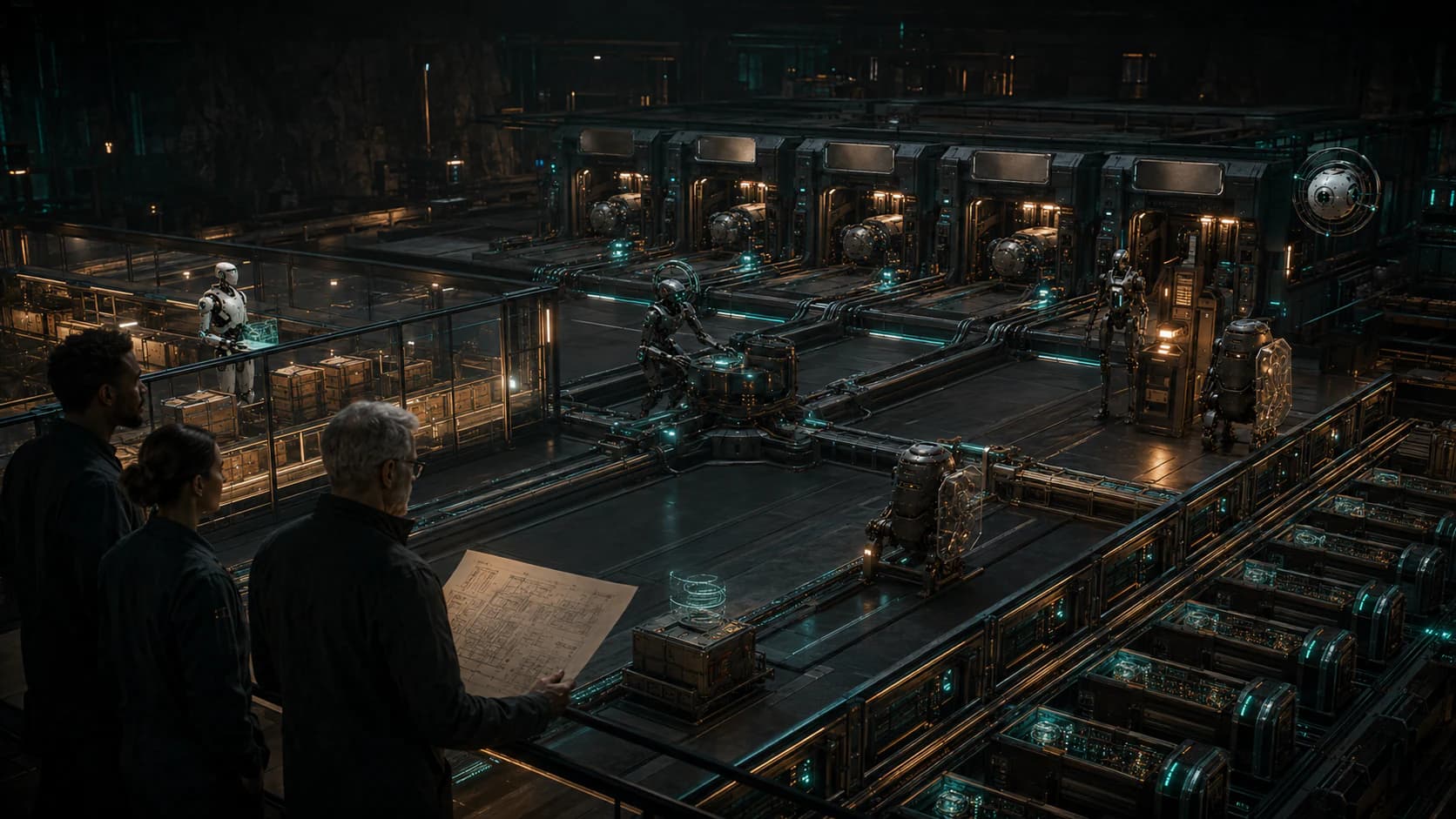
AI Architecture 2026: Four Decisions Hard to Reverse
Most AI system decisions are cheap to change. Four are not: the vendor boundary, the orchestration shape, the trust boundary, and where a long run lives.
Read article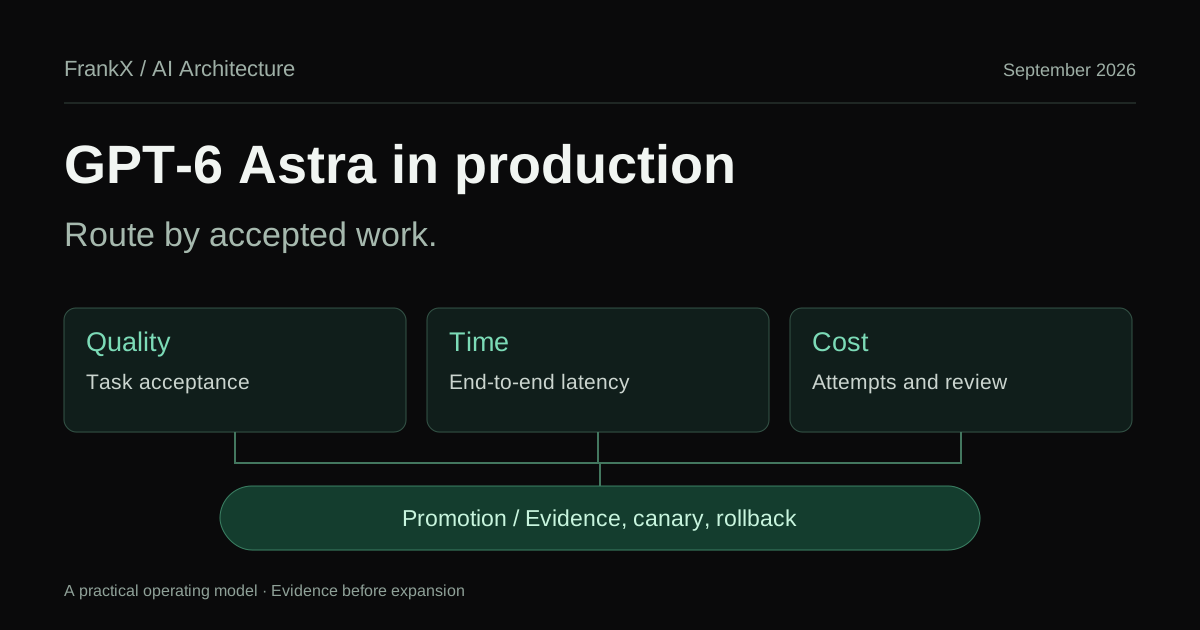
GPT-6 Astra: model economics and production architecture
Evaluate GPT-6 Astra for organizational adoption with workload routing, independent grading, accepted-task economics and a controlled path into production.
Read article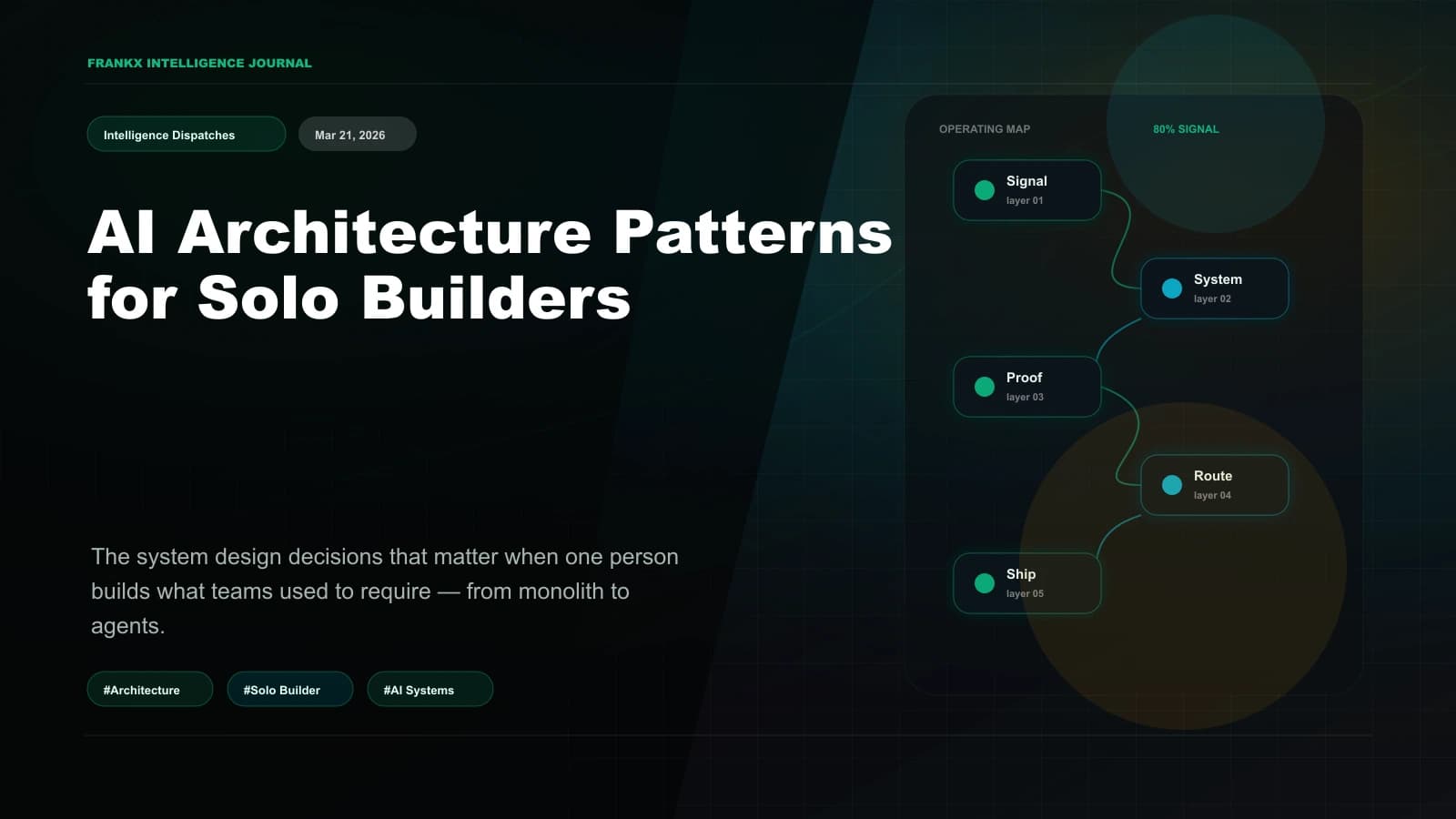
AI Capability Is Abundant. Architecture Is Still the Work.
Where AI skills and architecture create real value: turning workshops, field notes, compute, and infrastructure into durable systems that survive change.
Read article