Your Mind Is a Temporary Library
TL;DR
Your mind contains observations, decisions, failures, and methods that no system can recover once they disappear. Publishing converts that private intelligence into durable artifacts. AI agents can reduce the production friction, but humans still own the experience, judgment, truth, taste, and responsibility behind what enters the system.

Turn one hard-won insight into a durable artifact that another person can understand, apply, and improve without you in the room.
During a session at Mindvalley University in Tallinn, I wrote down one line from John Lee that kept expanding in my mind:
“We are not supposed to live forever. We are meant to take whatever we learned and have in our head and share it with people to create impact and evolve.”
John Lee, speaking at Mindvalley University, as captured in my field notes
It sounds like a statement about mortality. I hear an operating instruction inside it.
Every mind is a temporary library.
It contains observations no search engine has indexed. It holds decisions whose reasoning vanished into old calendars, failures that cost years, and methods we perform instinctively but have never explained. As long as that knowledge remains inside one person, it remains biologically bound to that person.
Mortality is therefore a publishing constraint.
An idea becomes durable only when it leaves its original container and becomes something another person can carry.
What dies when a mind stays private?
Knowledge has two deaths.
The first is biological: the person carrying it is no longer here.
The second is operational and far more common. An insight disappears because it never became transferable. It remained an intuition, a private note, a story told once, or a process only one founder understood.
This is where a great deal of human intelligence vanishes. The problem is rarely that nobody learned. The problem is that what they learned never crossed the boundary between private experience and shared capability.
Possessing knowledge is not the same as transferring it.
A note proves that we noticed something. It does not mean another person can understand it. A post proves that we expressed something. It does not mean another person can use it. Even a book can preserve words while losing the judgment behind them.
The complete transfer chain looks like this:
Experience → recognition → articulation → artifact → adoption → evolution
Experience without reflection remains a memory. Reflection without language remains private intuition. Language without a durable artifact stays fragile. An artifact without adoption becomes an archive. Adoption without evolution turns into doctrine.
Knowledge becomes alive when another person can understand it, act on it, challenge it, and make it better.
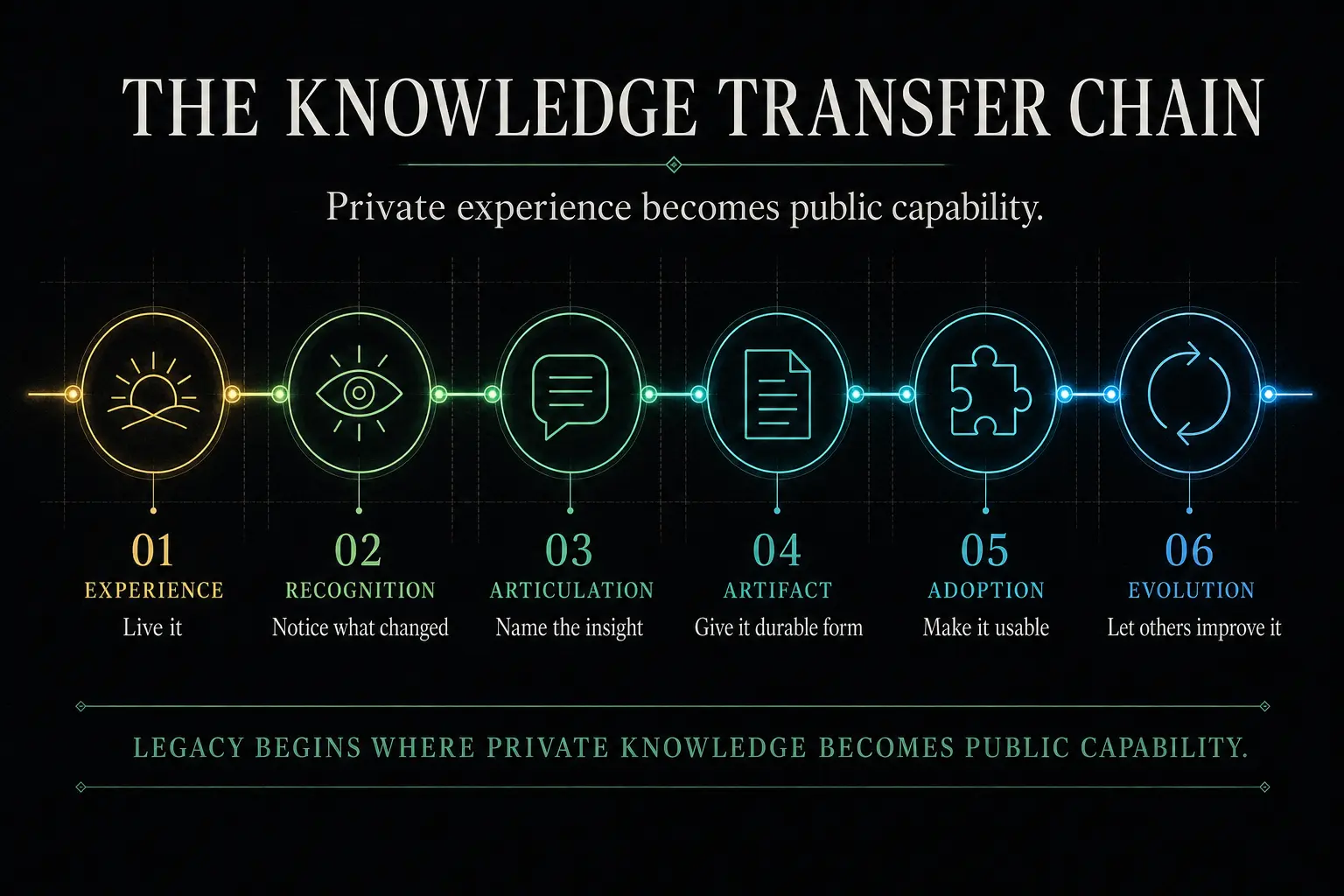
Legacy begins where private knowledge becomes public capability.
The unit of legacy is not attention. It is changed capability.
When does sharing become impact?
We often use sharing and impact as though they describe the same event. They do not.
Sharing is an action performed by the source. Impact is a change produced in the receiver.
The relevant test is not whether an idea was published. It is whether somebody can use it without requiring its author to be in the room.
Can it improve a decision?
Can it shorten somebody’s path through a problem?
Can a builder instantiate it, a teacher transmit it, or a critic test its assumptions?
Can the next person adapt it to a context the original author never encountered?
This changes the purpose of publishing. Publishing becomes infrastructure for transferring intelligence.
The artifact might be an essay, diagram, story, playbook, piece of software, dataset, song, checklist, course, or protocol. The format matters less than the conversion. Something previously trapped in one mind becomes addressable, inspectable, reusable, and capable of travelling.
It receives a name. A shape. A URL. A structure others can reference.
A strong artifact keeps meeting people while its creator is sleeping, building something else, or no longer alive.
That is why I care about building a research intelligence system, not merely producing a feed. Field notes should compound into a body of work that can be searched, connected, tested, and turned into action.
The conversion is straightforward:
Field note → thesis → visual model → reusable protocol → application → new evidence
Not every experience deserves publication. Not every thought deserves scale. But ideas capable of increasing another person’s agency should not remain trapped in private memory because the author has not made them perfect.
Perfection is often knowledge refusing to leave home.
What changes when agents enter the chain?
Until recently, production was a real bottleneck.
One person could accumulate insight faster than they could edit, design, illustrate, translate, distribute, and maintain it. Valuable knowledge remained unpublished because turning thought into a complete artifact required too much time.
Agents reduce much of that friction.
A conversation can become a transcript. A transcript can become an argument, diagram, presentation, short film, multilingual edition, indexed research object, or product module. Earlier ideas can be connected to current decisions. A corpus can remain searchable instead of becoming a folder nobody revisits.
This is genuine multiplication. It also creates a harder responsibility.
Agents amplify what they receive. Noise multiplied at machine speed remains noise. The scarce input is earned judgment.
The human remains responsible for lived experience, selection, point of view, truthfulness, taste, and accountability. Agents handle capture, structure, synthesis, visualization, translation, retrieval, and distribution. The network contributes application, criticism, adaptation, and further teaching.
Each layer has a distinct job.
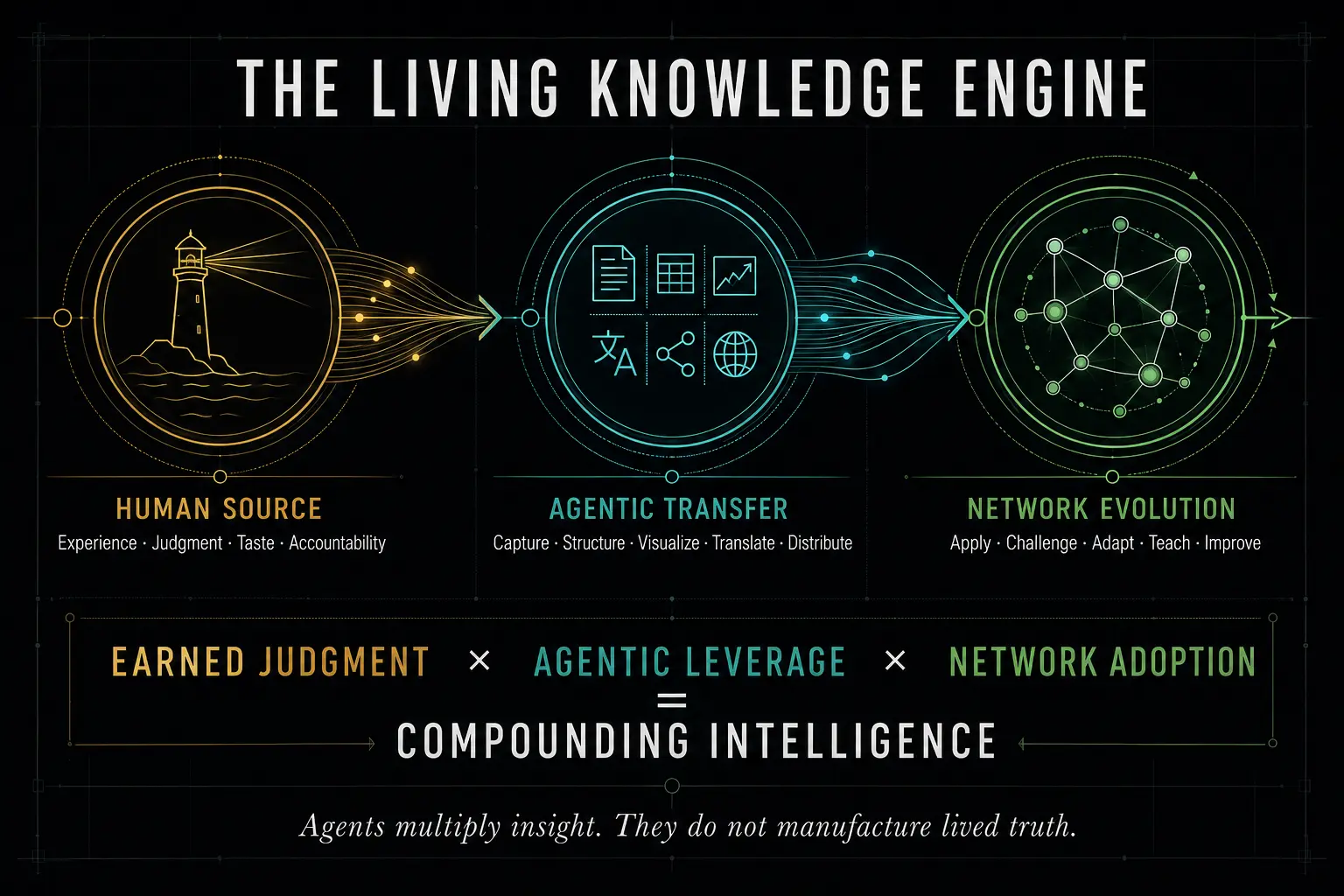
Agents multiply insight. They do not manufacture lived truth.
AI should reduce the distance between genuine insight and useful artifact. It should not remove the author from responsibility for what enters the system.
AI should not become a ghostwriter for an unlived life. It should become a transmission system for a deeply lived one.
This is the difference between content automation and a creator intelligence system. The first produces more material. The second preserves provenance, connects ideas, routes work through the right agents, and learns from what happens after publication.
The advantage is not simply producing more. It is converting high-quality human judgment into a living body of knowledge without losing its source, specificity, or soul.
Should legacy be a monument or a protocol?
Traditional legacy is imagined as a monument: a name, an institution, or a body of work that keeps pointing back to its creator.
A stronger model is a protocol.
A monument asks to be remembered. A protocol asks to be used.
Consider the harder test. Somebody adopts one of your ideas, improves it, teaches it to others, and produces meaningful results without ever remembering your name.
Did the work fail?
No. It reached a purer form of success.
The purpose of knowledge transfer is not perfect preservation. Evolution requires mutation, selection, combination, and new context. An idea that remains permanently dependent on its creator has not become infrastructure. It is still a performance.
Once released, we cannot control every interpretation or application. Our responsibility is to make the original artifact clear, honest, and useful enough to survive intelligent transformation.
The standard is demanding:
- Open enough to travel.
- Structured enough to survive.
- Specific enough to be useful.
- Traceable enough to be challenged.
- Unfinished enough to evolve.
Legacy is not merely what remains of us. It is what continues through others.
Can your knowledge survive without you?
A thought becomes a durable knowledge asset when it passes five tests.
1. Capture it close to reality
Record the decision, contradiction, failure, or discovery before memory simplifies what happened. Capture the raw note, including the uncertainty and context that made the insight possible.
2. Distill the change
Identify what the experience changed in your model of reality. A chronology records events. A thesis transfers learning.
3. Encode it beyond explanation
Add the diagram, example, decision rule, prompt, checklist, schema, or code that makes the idea executable. A reader should leave with something they can run, test, or teach.
4. Publish with provenance
Separate observation from inference. Name sources. Preserve uncertainty. Trust compounds when readers can see how a conclusion was formed.
5. Design for intelligent mutation
Let another person teach, test, implement, or improve the idea without requiring constant interpretation from its originator.
Then ask the final question:
Can this knowledge survive without me?
When the answer becomes yes, the idea has crossed from memory into infrastructure.
For a practical implementation layer, the Codex plugins operating guide shows how reusable methods become versioned workflows with ownership, review, permissions, and rollback.
What this writing is for
This is what I want this writing to become: a living transfer layer for what I am learning across AI architecture, venture building, creativity, and human potential.
Not a stream of polished certainty.
A body of field-tested thinking that becomes more precise through use.
Every meaningful entry should leave the reader with at least one of three things:
- A distinction that changes how they see.
- A model they can reuse.
- An action they can execute.
Over time, the artifacts form a compounding system. Essays connect to frameworks. Frameworks become tools. Tools create outcomes. Outcomes produce new field notes. Readers become practitioners, critics, collaborators, and eventually sources of new intelligence.
The journal then stops behaving like an archive.
It becomes an engine.
Before the library closes
One day, every private library closes.
That fact does not diminish what we build. It clarifies the assignment.
Take what life has taught you. Separate signal from memory. Give it a form another person can carry. Allow it to enter decisions, businesses, art, relationships, and systems you will never personally see.
Write the page.
Draw the model.
Record the story.
Release the code.
Teach the method.
Let somebody surpass you with it.
We are not required to publish everything. Everything important deserves the chance to become transferable.
Living forever is not the assignment.
Increasing the intelligence, courage, and creative capacity available after our moment is.
The question is whether we will leave information behind, or leave usable intelligence.
Join the FrankX newsletter for field notes on AI architecture, agentic systems, creative work, and the models emerging where they meet.
FAQ
What does it mean to call the mind a temporary library?
A person can hold valuable experience and judgment for only one lifetime. Unless that knowledge is made transferable, it disappears with the person or becomes unusable long before then. The metaphor turns mortality into a design constraint: important insight needs an external form.
What is the difference between sharing and knowledge transfer?
Sharing describes what the author publishes. Transfer occurs when another person understands the idea well enough to apply it, challenge it, teach it, or improve it. Publication is the beginning of that chain, not its completion.
How can AI agents support knowledge transfer?
Agents can capture, structure, visualize, translate, retrieve, and distribute an insight. They cannot supply the lived experience, judgment, truthfulness, taste, or accountability that makes the insight worth transmitting. The human remains responsible for the source material and the claim.
What makes a knowledge artifact durable?
It has a clear claim, useful examples, visible provenance, an executable form, and enough openness for other people to adapt it. Durability is not static preservation. It is the capacity to remain useful while later readers test and improve it.
What is the purpose of the FrankX newsletter?
The FrankX newsletter turns field observations from AI architecture, venture building, creativity, and human potential into models, tools, and protocols that readers can use. The intended output is changed capability, not temporary attention.
Source note: The John Lee quotation is reproduced from my live notes at Mindvalley University in Tallinn. It is not an official transcript and may differ slightly from the speaker’s exact wording. Event context: Mindvalley University 2026.

Read on FrankX.AI — AI Architecture, Music & Creator Intelligence
Stay in the intelligence loop
Field notes on AI systems, production patterns, and builder strategy.
Continue Reading
Official OpenAI plugins worth knowing: a builder’s guide
A practical guide to OpenAI-published plugins for building products, creating content, managing knowledge, and packaging repeatable AI workflows.
Read article
Graph Engineering: AI Architect’s Guide to Reliable Agents
Execution, context and control graphs for reliable AI agents, with runtime choices, failure modes and a 90-day adoption plan.
Read article
The AI Agents Worth Evaluating in August 2026: The Definitive Field Guide
Claude Code, ChatGPT Work, Hermes Agent, Manus, Devin, Cursor, and Viktor compared by job, autonomy, and unit economics. What to evaluate on August 21, 2026.
Read article