Intent Compilers: Why Prompt Engineering Died and Dynamic Routing Won
TL;DR
Manual prompt engineering is fragile and non-deterministic. Intent compilers parse natural language into typed Abstract Syntax Trees (ASTs), validate constraints with deterministic schemas, and route execution to specialized model tiers.

Understand why natural language prompt engineering has been superseded by structured intent compilation and dynamic model orchestration.
Treat LLMs as semantic decoders, not execution engines. Enforce schema compilation and type validation immediately after LLM output before passing payloads to downstream APIs.
For three years, the industry operated under the premise that crafting magical English sentences ("prompt engineering") was the core interface for artificial intelligence. In production software, however, raw prompt engineering failed: minor punctuation changes caused schema breaks, model updates degraded output formats, and hallucinations corrupted downstream databases.
Production systems have transitioned from manual prompts to Intent Compilers.
┌─────────────────────────────────────────────────────────────────────────────┐
│                    THE INTENT COMPILER RUNTIME PIPELINE                     │
├─────────────────────────────────────────────────────────────────────────────┤
│  Natural Language Intent (Voice / CLI / API)                                │
│       │                                                                     │
│       ▼                                                                     │
│  [Deterministic Lexer & Intent Parser]                                      │
│       │                                                                     │
│       ▼                                                                     │
│  [Abstract Syntax Tree (AST) Generator]                                     │
│       │                                                                     │
│       ▼                                                                     │
│  [Zod / Typed JSON Schema Validation Gate]                                  │
│       ├──► (Schema Invalid) ──► Deterministic Re-parsing Loop               │
│       └──► (Schema Valid)                                                   │
│                 │                                                           │
│                 ▼                                                           │
│            [Dynamic Multi-Model Orchestrator & Dispatcher]                  │
│                 │                                                           │
│                 ▼                                                           │
│            [Specialist Agent Swarm: Flash / Reasoning / Tools]              │
│                 │                                                           │
│                 ▼                                                           │
│            [Verified Deterministic Execution State]                         │
└─────────────────────────────────────────────────────────────────────────────┘
1. The Death of the Prompt: The Semantic Compiler Paradigm
An Intent Compiler treats natural language input the same way a compiler like gcc or rustc treats source code:
- Lexing & Parsing: Tokenizing unstructured human intent and identifying semantic verbs, target entities, and constraints.
- Abstract Syntax Tree (AST) Construction: Mapping the request into a strongly typed data structure.
- Type Checking & Constraint Validation: Verifying that all required fields, permissions, and security policies are satisfied before invoking expensive compute.
- Target Code Generation: Emitting strictly formatted JSON tool calls or API requests for specialized model execution.
// Sample Compiled Intent AST
export interface CompiledIntentAST {
  action: 'REFRACTOR_COMPONENT' | 'GENERATE_TEST_SUITE' | 'AUDIT_SECURITY';
  targetPaths: string[];
  constraints: {
    maxLatencyBudgetMs: number;
    preserveComments: boolean;
    strictTypeScript: boolean;
  };
  requiredCapabilities: Array<'code-generation' | 'file-system' | 'type-checking'>;
}
2. Multi-Model Consensus and Speculative Verification
In high-stakes enterprise workflows, relying on a single model is an unacceptable single point of failure. Modern intent compilation uses Speculative Consensus Swarms:
┌─────────────────────────────────────────────────────────────┐
│                 SPECULATIVE CONSENSUS SWARM                 │
├─────────────────────────────────────────────────────────────┤
│  STEP 1: FAST DRAFTING     → High-speed LPU / Flash Model   │
│  STEP 2: FORMAL VERIFY     → Reasoning Model (o3 / Sonnet)   │
│  STEP 3: COMPILER AUDIT    → Native TypeScript / Rust AST   │
│  STEP 4: CONSENSUS MERGE   → Shipped to Production          │
└─────────────────────────────────────────────────────────────┘
This pattern achieves the speed of sub-second inference models while maintaining the mathematical correctness of frontier reasoning systems.
3. Production Patterns: Schema-First Agentic Loops
To eliminate runtime errors in production applications:
- Never Accept Free-Form Strings: Always use structured output formats (Zod, Pydantic, JSON Schema) enforced at the LLM decoding layer.
- Isolate Side Effects: Ensure intent compilation is pure and deterministic; side effects (database writes, API mutations) only execute after explicit verification.
- Graceful Degradation: If a model fails to emit valid schema parameters after two attempts, fall back to a deterministic rule-based template.
Key Takeaways
- Prompts are ephemeral; schemas are permanent: Design software around robust data contracts rather than fine-tuned prompt verbiage.
- Intent compilers provide safety rails: Converting text to typed ASTs prevents dangerous hallucinated mutations in mission-critical environments.
Build your first AI system
Step-by-step guide to setting up ACOS, creating your first agent, and shipping real products with AI.
Start buildingProduction-ready architecture
Download AI architecture templates, multi-agent blueprints, and prompt engineering patterns.
Browse templatesJoin the builder community
Connect with creators and architects shipping AI products. Weekly office hours, shared resources, direct access.
Join the circle
Read on FrankX.AI — AI Architecture, Music & Creator Intelligence
Stay in the intelligence loop
Weekly field notes on AI systems, production patterns, and builder strategy.
Continue Reading
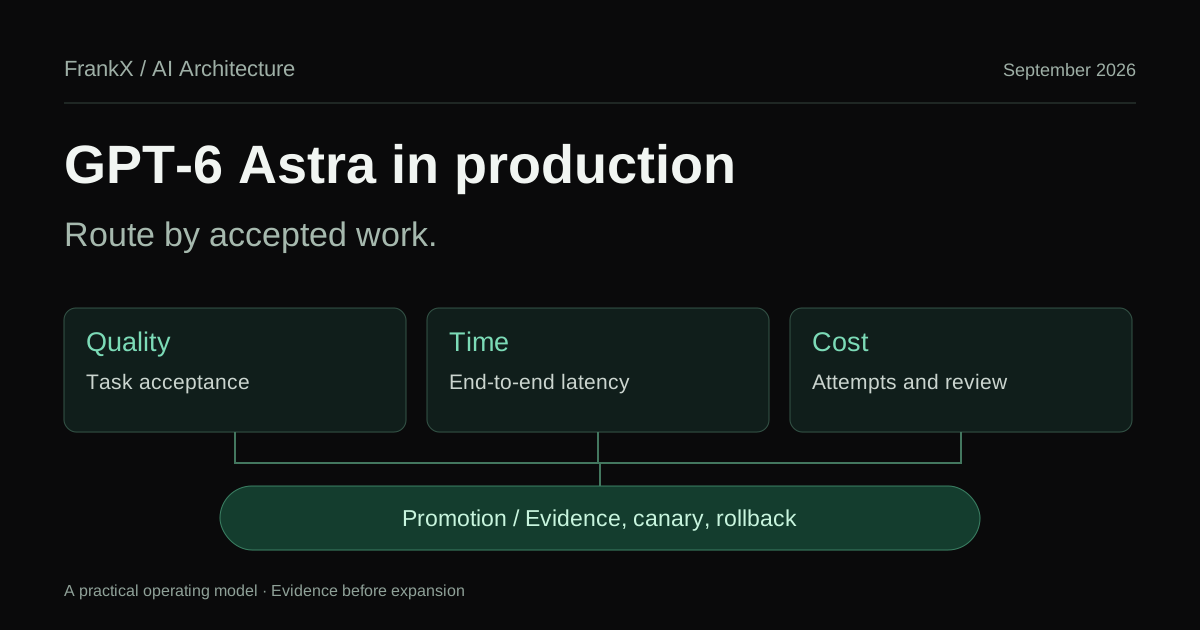
GPT-6 Astra: model economics and production architecture
Evaluate GPT-6 Astra for organizational adoption with workload routing, independent grading, accepted-task economics and a controlled path into production.
Read article
Frontier Model Convergence: Test-Time Compute and the Reasoning Wave
Architectural breakdown of inference-time search scaling, Process Reward Models, RLVR, and model routing across Claude 3.7, o3, Gemini 2.5, and DeepSeek R1.
Read article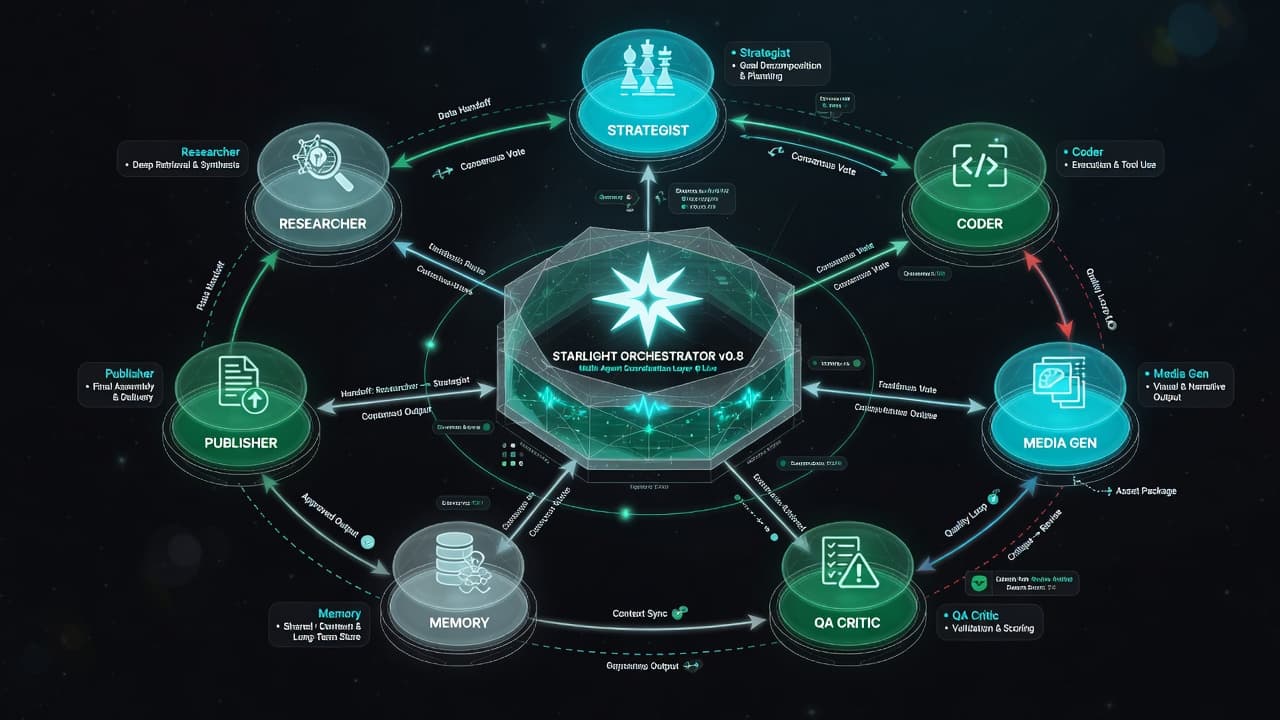
Multi-Agent Model Fabric 2026: Routing, Evals, and Fallbacks
Production architecture for absorbing Grok 4.6, Gemini 3.7 Flash, DeepSeek-V4-Pro, and Qwen3.8-27B. Lane-based routing, structural evals, cost caps, and handoff contracts.
Read article