Frontier Model Convergence: Test-Time Compute and the Reasoning Wave
TL;DR
Pre-training scaling laws face data wall boundaries, shifting frontier model gains to test-time compute. Spending inference compute on Monte Carlo search, Process Reward Models, and self-correction yields superlinear gains on verified reasoning tasks.

Master the mechanics of inference-time scaling laws, RLVR verification, and production model routing.
Do not deploy high-temperature autoregressive models where deterministic verification exists. Use hybrid routing: System 1 fast-pass for structured lookups, System 2 test-time search for formal constraint satisfaction.
The landscape of frontier artificial intelligence has undergone a fundamental architectural shift. The era of brute-force pre-training parameter expansion has collided with the data wall: the exhaustion of high-quality, human-generated public text tokens. In response, frontier labs have pivoted to test-time compute scaling—allocating compute at inference time through structured search, verification loops, and extended chain-of-thought generation.
This shift transforms how software architects, engineering leaders, and creators evaluate and route foundational models.
┌─────────────────────────────────────────────────────────────────────────────┐
│                    HYBRID TEST-TIME ROUTING ARCHITECTURE                    │
├─────────────────────────────────────────────────────────────────────────────┤
│  User Intent / Task Payload                                                 │
│       │                                                                     │
│       ▼                                                                     │
│  [Dynamic Complexity Classifier]                                            │
│       │                                                                     │
│       ├──► [System 1: High Velocity] ──► Autoregressive Flash Model (8B)    │
│       │                                       │                             │
│       └──► [System 2: Formal Logic]           ▼                             │
│                 │                      [Deterministic Output]               │
│                 ▼                             ▲                             │
│            [MCTS Search] ──► [PRM Verifier] ──┘ (Verified Pass)             │
│                 ▲                   │                                       │
│                 └─ (Logic Reject) ──┘                                       │
└─────────────────────────────────────────────────────────────────────────────┘
1. The Physics of Test-Time Compute Scaling
Classical scaling laws (Kaplan et al., Chinchilla) modeled compute scaling as a function of dataset token volume D and parameter size N:
L(N, D) = (N_c / N)^α_N + (D_c / D)^α_D
Test-time compute scaling introduces an independent axis: inference compute budget C_infer. Instead of emitting tokens immediately via greedy argmax sampling, reasoning systems expand a search graph over candidate reasoning trajectories:
- Rollout Generation: Generating K candidate intermediate reasoning branches.
- Step-Level Value Scoring: Evaluating intermediate logical leaps rather than whole-trajectory final outputs.
- Dynamic Backtracking: Identifying contradictory states and reverting to the nearest verified parent node.
Zero-Shot Autoregressive: Input -> Token -> Token -> Token -> Output
Test-Time Reasoning:       Input -> [Hypothesis A] -> Verify -> Contradiction -> [Hypothesis B] -> Verify -> Proof -> Output
Benchmark evaluations across AIME 2024, SWE-bench Verified, and GPQA Diamond confirm that increasing inference-time token budgets delivers up to 40 percentage points of accuracy improvement on deterministic problem sets.
2. Process Reward Models (PRMs) vs. Outcome Reward Models (ORMs)
The failure mode of traditional Reinforcement Learning from Human Feedback (RLHF) lies in Outcome Reward Models (ORMs). When a model is rewarded solely for producing a correct final answer, it frequently learns erroneous intermediate heuristics—succeeding by luck while ingraining flawed logic.
Process Reward Models (PRMs) evaluate each reasoning step independently.
| Dimension | Outcome Reward Model (ORM) | Process Reward Model (PRM) |
|---|---|---|
| Feedback Granularity | Single scalar at sequence termination | Dense scalar for every intermediate step |
| Credit Assignment | Diffuse across entire sequence | Exact localization of logic errors |
| Hallucination Rate | Higher on multi-step derivations | Reduced by up to 64% in formal proofs |
| Search Guidance | Ineffective for branch pruning | Enables efficient beam and MCTS pruning |
# Conceptual PRM Step Verification Schema
from dataclasses import dataclass
from typing import List, Optional

@dataclass
class ReasoningStep:
    step_index: int
    content: str
    prm_score: float # 0.0 to 1.0 step correctness probability
    verified: bool

def evaluate_reasoning_trajectory(steps: List[ReasoningStep], threshold: float = 0.85) -> bool:
    for step in steps:
        if step.prm_score < threshold:
            # Trigger backtracking at first logical deviation
            return False
    return True
3. Reinforcement Learning via Verifiable Rewards (RLVR)
The release of DeepSeek R1 and OpenAI o-series highlighted the effectiveness of RLVR (Reinforcement Learning via Verifiable Rewards). Rather than relying on costly human step-by-step annotations, models train directly against automated ground-truth verifiers:
- Mathematical Proof Engines: Lean 4, Isabelle, Coq
- Software Compilers & Test Suites: Rust compiler, Python
pytest, TypeScript typechecker - Constraint Solvers: Z3 SMT solver, SAT solvers
Through millions of self-play iterations, models independently discover metacognitive behaviors: self-reflection, checking previous steps for sign errors, reframing complex problem constraints, and allocating larger token budgets to harder sub-tasks.
4. Frontier Landscape: The 2026 Model Arena Matrix
| Model Tier | Architecture Archetype | Strengths | Production Use Case |
|---|---|---|---|
| Claude 3.7 Sonnet (Thinking) | Hybrid Autoregressive + Dynamic Thinking | Exceptional code refactoring, balanced speed-to-depth, tool calling | Agentic engineering swarms, full-repo maintenance |
| OpenAI o3 / o3-mini | Deep MCTS Search + Native Compiler RLVR | Mathematical proofs, competitive algorithmic optimization | Algorithmic trading, scientific simulation logic |
| DeepSeek R1 / V3 | Sparse MoE (671B / 37B active) + Multi-Head Latent Attention (MLA) | Open-weights transparency, low cost per token, high code density | Self-hosted enterprise clusters, cost-sensitive batch processing |
| Gemini 2.5 Pro / Flash Thinking | Multimodal Native + 2M Context Window | Massive context ingestion, multimodal spatial reasoning | Video analysis, enterprise document intelligence |
5. Architectural Blueprint: The Production Model Routing Mesh
Modern production architectures do not standardize on a single LLM. They deploy a Dynamic Model Routing Mesh that evaluates prompt entropy, latency budgets, and verification requirements.
// Production Model Router Interface
export interface RoutingPolicy {
  taskComplexity: 'low' | 'medium' | 'high' | 'formal-proof';
  latencyBudgetMs: number;
  verificationRequired: boolean;
}

export function selectOptimalModel(policy: RoutingPolicy): string {
  if (policy.taskComplexity === 'formal-proof' || policy.verificationRequired) {
    return 'reasoning-deep-search-tier'; // Claude 3.7 Extended / o3
  }
  if (policy.latencyBudgetMs < 400) {
    return 'groq-lpu-speculative-flash'; // High-speed LPU inference
  }
  if (policy.taskComplexity === 'high') {
    return 'frontier-hybrid-moe'; // Claude 3.7 / DeepSeek R1
  }
  return 'fast-autoregressive-tier'; // Claude 3.5 Haiku / Gemini 2.5 Flash
}
Key Takeaways
- Test-time compute is the new scaling frontier: Spend compute at inference to solve complex logic rather than increasing model weights blindly.
- PRMs eliminate reasoning drift: Dense step supervision guarantees each deduction holds before proceeding.
- Route by outcome verification: Pair fast System 1 models for intuitive tasks with System 2 reasoning models for mission-critical software and mathematical verification.
Explore Related Architecture & Research
- Model Intelligence Arena & Benchmark Matrix — Benchmark reasoning models and test-time compute scaling live.
- The 100-Domain Research Engine — Deep scientific synthesis across frontier AI, physics, and bioelectricity.
- The 2026 Agentic Hierarchy — Prompts, Skills, Agents, and MCP Protocol.
- AI Infrastructure Economics — Blackwell NVL72, LPUs, and AI Factories.
- FrankX Open-Source Downloads — Download production-grade starter kits and architecture blueprints.
Build your first AI system
Step-by-step guide to setting up ACOS, creating your first agent, and shipping real products with AI.
Start buildingProduction-ready architecture
Download AI architecture templates, multi-agent blueprints, and prompt engineering patterns.
Browse templatesJoin the builder community
Connect with creators and architects shipping AI products. Weekly office hours, shared resources, direct access.
Join the circle
Read on FrankX.AI — AI Architecture, Music & Creator Intelligence
Stay in the intelligence loop
Weekly field notes on AI systems, production patterns, and builder strategy.
Continue Reading

Frontier Model Routing: Beyond Single-Model Dependencies
Why model freedom matters in production. Build a resilient routed frontier stack combining Opus 4.8, GPT-5.5, Grok 4.3, and Gemini 3.
Read article
The AI Model Routing Guide: Which Model for Which Agent (Q2 2026 Edition)
The working AI Architect's routing matrix as a narrative: which frontier model runs your coding agents, review gates, fan-out workers, and sovereign stacks — with prices, evidence grade...
Read article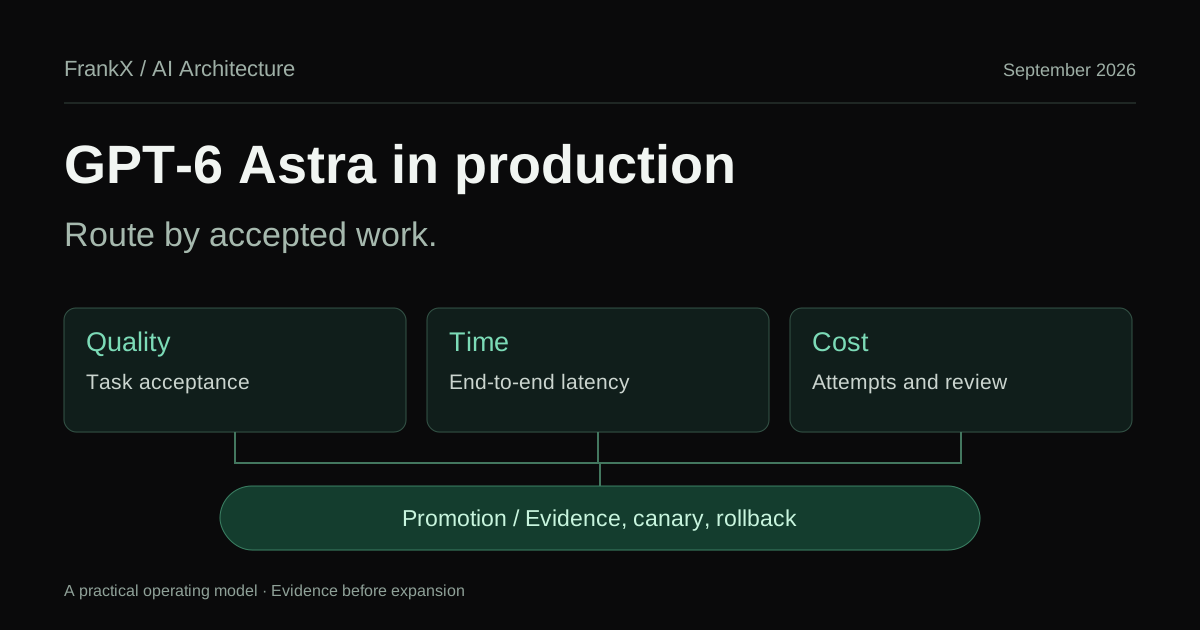
GPT-6 Astra: model economics and production architecture
Evaluate GPT-6 Astra for organizational adoption with workload routing, independent grading, accepted-task economics and a controlled path into production.
Read article