Vercel Ship 2026 decisions for people who ship agents
TL;DR
Ship 2026 put the Agent Stack, Connect, containers, Services, and Vercel Agent on the record. October then split the statuses: Python and Drives are generally available, while Daemons, Services, MCP Events, Enterprise-Managed Authorization, and Vercel Agent's approved actions are still beta. Founders adopt the model edge. Architects wait on Agent. Creators skip Daemons. SaaS builders adopt the Python runtime.

Vercel Ship 2026 decisions for people who ship agents
Which Ship 2026 primitives to adopt, wait on, or skip, with the runtime guide and a decision matrix a builder can use on the page.
Leave with one call for your audience and the primary Vercel page that call depends on.
Vercel Ship 2026 is the launch record for Vercel's agent infrastructure, and the 15 October 2026 changelog is the status record. This note is for founders, AI architects, creators, and people who ship SaaS or an agent platform and need one call they can act on. The constraint is that a keynote sentence and a changelog status are different documents. The launch record is the Ship 2026 recap. The status record starts at Python on Vercel.
Read the long version in two guides. Vercel Ship 2026: a sourced recap for builders holds the Agent Stack, Connect, containers, Services, and Vercel Agent. Vercel agent runtimes: Python, Daemons, Drives holds the October runtime split. The table you can use while you decide is the audience decision matrix.
Watch the recording
Opening Keynote - Ship 26 NYC is the official Vercel recording of the New York opening keynote. The chapters on that recording walk Fluid compute, Docker, Services, the Agent Stack, eve, and Vercel Agent. The London keynote, Keynote - Ship 26 London, is the other room. The Ship page points its livestream replay at Vercel Ship 2026.
The four calls
These match the matrix. If a primary page changes the status, the matrix changes and this list follows it.
Founders adopt the model edge. The Agent Stack gives you the AI SDK as one model interface and AI Gateway as one endpoint with failover. That is a shipping decision. A new worker runtime is not.
AI architects wait on Vercel Agent. Chat, investigations, and approved actions are in public beta for Pro and Enterprise. Agent is read-only until a person approves a scoped plan. Wait until that approval path has been reviewed. The production context is the reason to care. The beta is the reason to wait.
Creators skip Daemons. Daemons are a public beta for processes that pull work and keep running. A site, a course, or a media workflow that finishes inside a request does not need one. Skip the beta until the job outlives the response.
SaaS and agent-platform builders adopt Python where the backend is already Python. The 15 October changelog makes the runtime generally available, including FastAPI, Flask, and Django. Services stay beta in the Services docs. MCP Events stay public beta, and the SDK names are experimental, on the MCP Events note. Adopt the runtime. Leave the betas on a branch until a workload forces them.
What changed between the tour and 15 October
Connect launched at Ship as scoped, short-lived access and is now generally available. The page to implement is Vercel Connect is now generally available: request a token at runtime instead of storing a long-lived provider secret.
Containers from Run any Dockerfile on Vercel are HTTP processes. They listen on $PORT and they do not keep state. Daemons are the other shape, and they are still public beta.
Drives are the persistence story for Sandbox, and they are generally available. The Drives changelog says files outlive the sandbox and a fork gives each worker its own writes. That is a workspace. It is not a reason to throw away the database.
Enterprise-Managed Authorization is a separate public beta for workforce sign-in, documented at Vercel Connect adds Enterprise-Managed Authorization. Use it when an administrator must grant service access in the identity provider. Do not treat it as the same switch as MCP Events.
A mistake that will waste a quarter
The mistake is shipping the June diagram with October traffic. The Ship recap is the right history of London, Berlin, New York, and Sydney. It is the wrong status page for Python, Daemons, Drives, and Connect events. Open the changelog URL on the matrix row, then decide.
If you only have time for one page after this note, make it the audience decision matrix.
Frequently asked questions
Where is the decision matrix?
The audience decision matrix is on the runtime guide at https://www.frankx.ai/guides/vercel-agent-runtime-decisions#decision-matrix. Each row is one audience, one call, and the primary Vercel URL that call cites.
Which Ship 2026 pieces are still beta?
Services are marked beta in the Services docs. Daemons, MCP Events, Enterprise-Managed Authorization, and Vercel Agent's chat, investigations, and approved actions are in public beta. Python as a runtime and Vercel Drives are generally available. Connect has been generally available since the 25 August 2026 changelog.
Which recording should I watch first?
Watch Opening Keynote - Ship 26 NYC at https://www.youtube.com/watch?v=w6bjGDwn4ZY for the New York walkthrough of Docker, Services, the Agent Stack, and Vercel Agent. The Ship page's livestream replay is Vercel Ship 2026 at https://www.youtube.com/watch?v=Fr5vzNknYJE.
Does the Python announcement make the Python agent SDKs generally available?
No. The Python GA changelog marks the AI SDK for Python, the Workflow SDK for Python, and Queues as beta. The runtime and the framework detection for FastAPI, Flask, and Django are the generally available part.
Do I need a Daemon to run an agent?
No. An agent that calls a model, waits on Workflow SDK checkpoints, and returns inside a request can stay on the Agent Stack without a Daemon. Add a Daemon only when the process must pull work and keep running after the response. That product is still a public beta.

Read on FrankX.AI — AI Architecture, Music & Creator Intelligence
Stay in the intelligence loop
Field notes on AI systems, production patterns, and builder strategy.
Continue Reading
ChatGPT Images 2.5: what creators and founders should build
Test complete image workflows, and turn approved references into campaigns, stories and reusable product assets.
Read article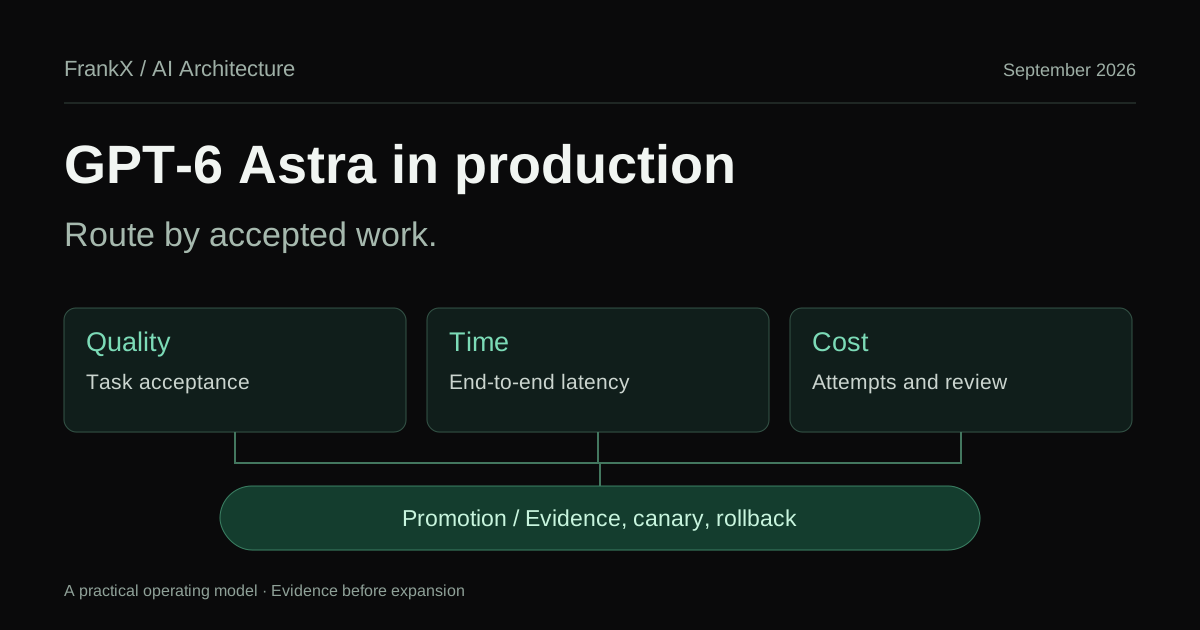
GPT-6 Astra: model economics and production architecture
Evaluate GPT-6 Astra for organizational adoption with workload routing, independent grading, accepted-task economics and a controlled path into production.
Read article
AI Capability Is Abundant. Architecture Is Still the Work.
Where AI skills and architecture create real value: turning workshops, field notes, compute, and infrastructure into durable systems that survive change.
Read article