Build, Fine-Tune, or Buy an AI Model?
TL;DR
Do not begin by asking whether to build an AI model. Ask which layer of intelligence must be yours. Most startups should own their data rights, evals, customer feedback loop, agent skills, and critical interfaces; rent externally supplied frontier capability; and test adapters or specialist models only when repeated evidence exposes a quality, cost, latency, sovereignty, or governance ceiling. Pretraining from scratch is rational when the model itself is the product.

You will be able to choose the lowest model-ownership layer that creates a defensible advantage—and define the evidence required before moving higher.
The short answer
Do not begin by asking whether to build an AI model.
Ask a harder and more useful question:
Which layer of intelligence must be ours?
For most startups, it is not the foundation-model weights. It is the lawful data access, representative evaluations, agent workflow, skills, customer feedback, distribution, and operating knowledge that let the system improve.
Rent externally supplied frontier capability while demand is uncertain. Preserve a route out. Test a small adapter when the same behavioral failure keeps recurring. Bring a specialist model under your control when quality, latency, sovereignty, availability, or quality-adjusted economics makes that control valuable. Train from scratch only when the model—not merely the application around it—is the product.
That is the default. It is not a law.
Frontier models are not interchangeable by assumption. They differ in tool behavior, modalities, latency, safeguards, context handling, and harness compatibility. Regulated use cases can require control before favorable unit economics appear. A cheap PEFT experiment can produce technical learning long before self-hosting makes economic sense.
The objective is not to avoid model ownership. It is to own the right layer, at the right time, for a reason you can measure.
The dated source registry and claim boundaries behind this field guide live in the AI Model Strategy research hub.
Why this decision is unusually hard
I have looked at this decision from several sides: as an AI architect, with startups trying to preserve runway, with enterprise teams working inside security and governance boundaries, and across the cloud and model-serving layers that turn a model demo into an operating system.
The incentives point in different directions.
The research team wants control. The product team wants speed. Finance wants predictable cost. Security wants containment and auditability. Legal wants clear data rights and license terms. The founder wants a moat. The customer mostly wants a reliable outcome.
All of them can be right.
The mistake is collapsing their questions into one binary:
- build or buy;
- open or closed;
- RAG or fine-tuning;
- API or self-hosted;
- generalist or specialist.
These are separate decisions. A company can use a closed frontier model for difficult reasoning, an open-weight specialist for high-volume classification, retrieval for private knowledge, skills for procedure, and a private adapter for institution-specific behavior. NVIDIA now describes the future as an ecosystem of open and proprietary models rather than one replacing the other. At the 5 August 2026 cutoff, OpenAI paired proprietary APIs with Apache-2.0 gpt-oss weights; Google paired Gemini with Apache-2.0 Gemma; and Meta had launched the Meta Model API in public preview for Muse Spark 1.1 alongside downloadable Llama weights. (NVIDIA, OpenAI, Google, Meta)
The architecture is a portfolio. The strategy is deciding which parts deserve ownership.
Start with the transformation, not the model
Before choosing a model, write the outcome in operational language:
For this user, the system will make or prepare this decision or action, within this time, at this quality threshold, while keeping these failures below an agreed limit.
Then build a representative evaluation set.
Not a generic leaderboard. Not a favorite demo. Use real task distributions, difficult edge cases, adversarial inputs, abstention cases, and the failure modes that cost money, safety, trust, or regulatory exposure.
OpenAI's documented optimization framework, currently housed in its legacy documentation, and Anthropic's agent guidance converge on the same discipline: define success and evaluate before adding complexity or tuning. (OpenAI, Anthropic)
Separate at least four surfaces:
| Surface | Question | Typical repair |
|---|---|---|
| Product outcome | Did the user reach the intended result? | Workflow, UX, human boundary, or business process |
| System trajectory | Did retrieval, tools, memory, routing, and handoffs behave correctly? | Harness, tool schema, permissions, middleware, context |
| Model behavior | Does the model repeatedly fail the same task pattern? | Prompting, model choice, PEFT/fine-tuning, distillation |
| Operations | Did latency, availability, cost, security, or residency fail? | Deployment mode, routing, capacity, provider, control plane |
A model can appear weak because retrieval missed a document, a tool returned the wrong schema, pagination silently dropped records, or the harness discarded context. Fine-tuning the weights will not repair those failures.
The Model Ownership Ladder
Use the lowest intervention that crosses the required outcome, latency, economics, and governance threshold. Move upward only when the current layer fails a representative evaluation or violates a hard constraint.
| Level | Intervention | What changes | Choose it when |
|---|---|---|---|
| 0 | Outcome and evaluation | Success criteria, error cost, evidence | Before architecture decisions |
| 1 | Prompt, context, structured output | Current inference input | Instructions are articulable and knowledge is bounded |
| 2 | Retrieval, tools, skills | Facts, actions, and procedures | Knowledge changes, needs provenance/deletion, or work needs systems |
| 3 | Routing and harness | Runtime model choice, memory, orchestration, handoffs | Workloads differ by cost, risk, privacy, or capability |
| 4a | PEFT, fine-tuning, preference optimization | Behavior in an existing model or adapter | A stable behavioral gap remains after lower layers work |
| 4b | Distillation | Selected teacher behavior or capabilities in a student model | A smaller student can meet the target and derivative use is permitted |
| 5a | Continued pretraining | Representations learned through an additional pretraining objective | The base model has a demonstrated domain-representation gap |
| 5b | Modality adaptation | Encoders, projectors, architecture, data, or multimodal training | The product requires a modality the existing system cannot use adequately |
| 6 | Pretraining from scratch | Architecture, tokenizer, corpus, base weights | The foundation model is the venture |
Level 1: prompt and structure
Start with the strongest appropriate base model and make the contract explicit:
- instructions;
- examples;
- required and forbidden outputs;
- structured schemas;
- context-selection rules;
- abstention and escalation;
- deterministic validation outside the model.
This is not “just prompting.” It is the cheapest test of whether the capability already exists.
If the model can do the task with the right context but does not know current or private facts, the problem is not weight adaptation. It is knowledge access.
Level 2: retrieval, tools, and skills
Retrieval and fine-tuning solve different problems.
Retrieval teaches the system what it needs to know now. Fine-tuning teaches the model how it should behave repeatedly.
Retrieval is usually the better home for knowledge that is changing, citable, correctable, deletable, or best kept outside model weights. Privacy alone does not determine whether retrieval or secured weights are appropriate. Retrieval can preserve provenance when the system retains and exposes retrieved evidence, and it lets a team update one source without retraining a model.
Tools give the system live data and actions. Skills package procedural knowledge, scripts, references, and quality checks without changing weights. Anthropic describes Agent Skills as reusable resources that specialize an agent; Hugging Face now provides official skills through which Claude Code, Codex, Gemini CLI, and other coding agents can prepare, submit, monitor, and publish training jobs. (Anthropic, Hugging Face)
The coding agent is orchestrating the lifecycle. It is not internally updating model weights.
Level 3: routing and the harness
An agent harness is the software around a model: context handling, tools, memory, planning, permissions, handoffs, tracing, evaluation, and recovery.
This is often the highest-leverage layer because agent performance emerges from the interaction between model and system. NVIDIA documented an evaluation-driven middleware change for Nemotron 3 Ultra that repaired a tool-use failure without weight tuning. Anthropic's long-running-agent work also emphasizes structured handoffs, context management, and independent evaluators. These are vendor experiments, not universal cost ratios, but they demonstrate why the harness must be evaluated before the weights are blamed. (NVIDIA, Anthropic)
For a solo founder, begin with one primary model and one tested contingency. Routing is not free. Multiple providers multiply schemas, safety behavior, caches, observability, security reviews, and regression combinations. Add a route only when a workload segment has enough volume, risk, or capability separation to justify that operating tax.
Keep the harness thin and disposable. Own critical interfaces, traces, tests, policies, and data contracts—not complexity for its own sake. Stronger models may make yesterday's planner or evaluator unnecessary.
A clarification on Hermes Agent
Hermes Agent and Hermes 4 are different things.
- Hermes Agent is an MIT-licensed, model-agnostic agent harness from Nous Research, with memory, skills, tools, subagents, sandboxing, and trajectory export.
- Hermes 4 is a separate fine-tuned open-weight model family.
- NVIDIA did not build Hermes Agent. NVIDIA says Nemotron 3 Ultra was post-trained for Hermes Agent and other harnesses.
The distinction matters because a harness problem and a weight problem call for different interventions. (Nous Research, Hermes Agent documentation, NVIDIA)
Level 4a: adapters, fine-tuning, and preference optimization
Fine-tuning becomes rational when all four are true:
- a representative baseline exists;
- the remaining failure is repeated and behavioral;
- lawful, high-quality examples represent the target distribution;
- the improvement has an economic or governance path to production.
Good candidates include stable formatting, classification, tool-call patterns, a repeated specialist task, or moving a proven task from an expensive model to a smaller one.
Start with parameter-efficient methods such as LoRA or QLoRA when they fit. They train adapters while freezing most or all base parameters, reducing compute and storage. NVIDIA's NeMo guide says PEFT often updates less than 1% of parameters; Google's official Gemma QLoRA guide demonstrates a small workflow on a 16 GB T4. These examples establish feasibility, not a universal hardware promise. (NVIDIA, Google)
Use preference optimization when reliable rankings or preference pairs validly express the target behavior. Use reinforcement learning when rewards are verifiable and the task genuinely benefits.
PEFT-first is a capital-efficient default. Full fine-tuning needs comparative evidence or a documented task, architecture, or deployment reason. PEFT lowers training cost. It does not solve data rights, target definition, evaluation, safety, serving, lifecycle governance, or incident response.
Level 4b: distillation
Distillation trains a student model to reproduce selected behavior or capabilities demonstrated by a teacher. It may create a separate model rather than adapting the teacher itself. Use it when a smaller student can meet the outcome threshold and the licenses and provider terms permit the intended training and derivative use.
(OpenAI, Anthropic, Google Gemini API, Google enterprise tuning)
Level 5a: continued pretraining
Continued pretraining is distinct from supervised fine-tuning and preference post-training: it continues a pretraining objective on additional data. It can change domain representations through substantial exposure to specialized language or distributions.
Consider it only when retrieval, tools, prompting, routing, and post-training fail to close a demonstrated representational gap—and when the corpus, rights, team, deployment horizon, and product value can support the program.
Examples could include specialized scientific language, industrial sensor distributions, or molecular representations. A rare dataset is a reason to run a disciplined experiment, not an automatic mandate to build a foundation model.
Level 5b: modality adaptation
Modality adaptation is a separate mechanism. It may involve new encoders, projectors, architecture, task heads, multimodal alignment, or modality-specific training rather than merely continuing a text pretraining objective. Begin with an existing vision, audio, sensor, or multimodal base and the smallest transfer-learning experiment capable of testing the task.
Level 6: pretraining from scratch
Pretraining from scratch is rational when the architecture, tokenizer, corpus, or base weights are themselves the commercial product and existing bases cannot meet the strategic requirement. Sovereignty alone does not require scratch training; licensed open weights, domestic hosting, or continued pretraining may satisfy it.
Recent public training disclosures give useful scale context. Meta reports roughly 7.38 million H100-80GB GPU hours and 22–40 trillion tokens for Llama 4 Scout and Maverick. Mistral says Large 3 was trained from scratch on 3,000 H200 GPUs. NVIDIA reports 20 trillion pretraining tokens for Nemotron 3 Ultra. These are not minimum requirements for every model. They do show why frontier pretraining is ordinarily the wrong ownership layer for a solo founder. (Meta model card, Mistral, NVIDIA technical report)
If a smaller specialist is the product, the capital requirement can be radically lower. But the company still needs data rights, research and training expertise, representative evaluation, safety, serving, and a credible distribution advantage. A technically successful checkpoint without an operating learning loop is not yet a business.
Capital should set the ceiling, not the ambition
No official lab source supplies a universal euro, company-size, or token-volume threshold for each layer. Prices, discounts, hardware, quality, context distributions, and utilization change too quickly.
Use capital as an operating constraint:
| Situation | Rational ceiling now | Evidence that unlocks the next layer |
|---|---|---|
| Solo founder; demand uncertain | Managed API, portable evals, retrieval/tools/skills, thin harness, one contingency | Repeated customer task, measured ceiling, lawful examples, and a time-boxed experiment budget |
| Small ML team; proprietary labeled examples | PEFT or distillation experiment on an open-weight model | Reliable lift on held-out cases and a viable serving path |
| Stable, high-volume product | Dedicated endpoint and routing crossover test | Equivalent quality with lower verified-success cost or required latency/control |
| Enterprise with unique automotive, scientific, imaging, or life-science data | Generalist frontier model plus controlled domain or modality specialist | Rights, provenance, representative labels, validation plan, and governed deployment |
| Deep research team; large clean corpus; GPU access | Full tuning or continued pretraining | Demonstrated representational gap and lifetime advantage |
| Model/architecture is the product | Scratch pretraining may be in scope | Research talent, capital horizon, data advantage, safety, deployment, and distribution |
Capital efficiency does not mean avoiding technical learning. A small adapter experiment can answer whether a specialist behavior is learnable without committing to owned production infrastructure.
The decision must also protect runway from opportunity cost. Every month spent on a training and serving stack is a month not spent on product, distribution, customer evidence, or the feedback loop that makes the model useful.
Unique data is not automatically a moat
Data becomes defensible only after a rights-and-learning system turns it into measurable product improvement.
I use this diagnostic:
Data advantage = uniqueness × rights × quality × task relevance × feedback rate × distribution
This is a decision heuristic, not a scientific formula. Its value is in the multiplication: if one factor approaches zero, raw volume does not rescue the advantage.
Ask:
- Can we lawfully use the data for retrieval, evaluation, training, and commercialization?
- Is provenance recorded?
- Are labels reliable and representative of the real outcome?
- Does the data cover rare and expensive failures?
- Can the product collect feedback that improves the system?
- Does workflow integration create a continuing stream of learning signal?
- Would a competitor with the same base model and public data reproduce the result?
Unique data can belong in several places:
- a retrieval layer when it is changing, private, citable, or deletable;
- an evaluation suite when it represents real failure modes;
- a tool context when the system must act on live records;
- an adapter or task head when it encodes stable behavior;
- continued pretraining when it exposes a true representational gap;
- a feedback loop when deployment generates better examples over time.
The checkpoint is only one expression of the advantage.
How regulated companies should think about proprietary models
Automotive, pharmaceutical, life-science, and healthcare organizations may hold data that public labs cannot reproduce. That does not mean the correct first move is to create a new foundation model.
The stronger pattern is usually hybrid:
- keep general reasoning managed while it remains replaceable enough;
- keep sensitive retrieval, patient or vehicle records, and institution-specific adapters inside the governed data plane;
- train narrow specialists where proprietary data creates a measurable task advantage;
- expose open interfaces, schemas, SDKs, synthetic examples, or evaluation methods where ecosystem adoption creates value;
- preserve controlled versions, monitoring, evidence, and rollback for regulated deployments.
Healthcare and life sciences
Genetic and health data are special categories under Article 9 GDPR. Unless demonstrably anonymous, processing requires an Article 6 legal basis and an Article 9 condition. Scientific-research provisions may permit specific processing and limited, law-based derogations subject to Article 89 safeguards and Member-State law; they are not a blanket exemption. Pseudonymized data remains personal data.
For a domain-specific clinical dataset, begin with an existing domain-appropriate model and a representative evaluation. Then test transfer learning, a task head, or PEFT. Dataset counts alone do not establish label quality, class balance, external validity, clinical utility, or regulatory readiness.
Do not treat an internally trained model as automatically anonymous. The EDPB requires a documented, case-specific assessment showing that, considering means reasonably likely to be used, the likelihood of extracting or otherwise obtaining personal data about training subjects from the model is insignificant. (GDPR, EDPB Opinion 28/2024)
If an AI system is intended to generate diagnostic or treatment-relevant information, medical-device and in-vitro diagnostic rules may apply alongside the AI Act. Intended purpose and real-world use are decisive. (EU medical-device and AI Act FAQ)
Automotive
Raw telemetry exclusivity is becoming a weaker moat. The EU Data Act has applied since 12 September 2025. It gives users rights concerning readily available data generated by covered connected products and related services; the Article 3(1) design/access duty applies to connected products and related services placed on the market after 12 September 2026. It does not automatically expose all inferred or derived data and provides conditional trade-secret safeguards. Where vehicle data relates to identifiable drivers, passengers, owners, or other individuals, GDPR remains applicable; Data Act access does not itself supply a GDPR lawful basis. (EU Data Act)
Stronger automotive advantages include rare-event coverage, annotation quality, fleet feedback, calibration, digital twins, safety evidence, vehicle integration, and controlled over-the-air learning. For vehicles and deployments within applicable type-approval regimes, production models should be integrated into cybersecurity and software-update management, rollback, validation, and evidence controls rather than treated as downloadable artifacts in isolation. (UNECE R155, UNECE R156)
Sensitive case-study publication boundary
Examples involving regulated or sensitive data should not be published unless confidentiality, trade-secret, data-protection, research-governance, and claims reviews are documented. If publication rights cannot be demonstrated, use clearly hypothetical examples constructed only from public sources and not traceable to a private project or source relationship.
Rare regulated data is a reason to run a disciplined, rights-cleared specialist-model experiment—not an automatic mandate to train a foundation model.
The following is an architecture and publication-risk framework, not a determination of legal compliance or product classification. Specific systems require qualified legal, privacy, clinical/regulatory, security, and conformity-assessment review.
Europe changes the decision, but not through one checkbox
In Europe, the decisive question is not whether a team used RAG, fine-tuning, or pretraining. It is who controls the system, under whose name it is deployed, what data it processes, and what decisions it is intended to influence.
Across the AI Act, GDPR, and applicable product law, these choices can affect whether an organization is an AI-system or GPAI provider, deployer, importer, distributor, GDPR controller or processor, or product manufacturer. The result depends on role, branding, intended purpose, data processing, and market use.
The AI Act timetable changed in July 2026. At the 5 August 2026 cutoff, GPAI obligations applied to models placed on the EU market from 2 August 2025, and the Commission began full enforcement, including fines, on 2 August 2026; GPAI models placed on the market before 2 August 2025 have until 2 August 2027. Article 50 generally applies from 2 August 2026, while providers of synthetic-content systems placed on the market before that date have until 2 December 2026 to comply with Article 50(2). Requirements for Article 6(2)/Annex III high-risk systems apply from 2 December 2027, and requirements for Article 6(1)/Annex I product-related high-risk systems from 2 August 2028. Recheck before implementation. (Consolidated AI Act, European Commission)
“Open weights” is not the same as free and open source. Article 2(12) conditionally excludes qualifying free/open-source AI systems except prohibited, high-risk, and Article 50 cases. Article 53 gives qualifying free/open-source GPAI models only narrower exemptions from certain documentation and representative duties; copyright-policy, training-content-summary, and systemic-risk duties can remain. Downloadable weights alone do not establish qualification. License restrictions, public availability of weights, architecture and usage information, intended purpose, and distribution pattern require case-specific review. Meta's Llama 4 license and use policy, for example, require specific review for EU-domiciled multimodal use; availability for download does not mean unrestricted use. (Llama 4 use policy, European Commission GPAI guidance)
Data residency is also not a sovereignty synonym.
- At-rest location is not necessarily inference-processing location.
- An “EU” zone may mean processing in any EU member state, not Germany or the Netherlands.
- Private networking does not by itself create operational sovereignty.
- “Not used for training” is not the same as zero retention.
- Open weights are not sovereign if a foreign control plane, telemetry path, key dependency, or remote support process remains.
For DACH and Dutch teams, FrankX publishes a decision framework for evidence readiness: map the role, intended purpose, data and model lineage, provider terms, residency and processing path, human boundary, evaluation, monitoring, and exit plan. Starlight turns those patterns into reusable substrate and implementation products that teams operate themselves, while legal, clinical, security, and conformity specialists retain their respective determinations.
Open or closed is a revenue and responsibility decision
Open-weight release can accelerate adoption, research, ecosystem development, and trust. It can also irreversibly disclose capability, expose privacy or extraction risk, create additional downstream safeguard burdens without eliminating duties that remain with the releasing provider, and weaken a proprietary deployment advantage.
Closed deployment can protect versions, access, evidence, data, and regulated update control. It also creates procurement friction, concentration risk, and customer concern about dependency.
The right answer can differ by layer:
| Commercial pattern | What remains controlled | Revenue | Best fit |
|---|---|---|---|
| Closed API/model | Weights, control plane, often data-derived adaptation | Usage, subscription, VPC/on-prem license, SLA, private adaptation | Sensitive or safety-controlled tasks |
| Open base + closed control plane | Private adapters, data, routing, evidence, operations | Managed inference, enterprise deployment, monitoring, support | Strong regulated-startup default |
| Closed weights + open interfaces/evals | Model artifact and update stream | Deployment license, evidence packs, integration, monitoring | Patient-derived or safety-critical specialists |
| Fully open weights | Little or no weight exclusivity | Hosting, support, fine-tuning, integration, marketplace/ecosystem | Broad adoption with low privacy/safety exposure |
| Co-development | Institution-specific data, evidence, or version | Milestones, platform access, royalties, revenue share | OEM, pharma, research networks |
The Nemotron Coalition is evidence that NVIDIA and participating companies are investing in shared open-model development across labs, data, evaluations, and domain expertise. Jensen Huang's public thesis is still open and proprietary, not a claim that a named frontier model technically must remain closed. (Nemotron Coalition, NVIDIA's open-and-proprietary thesis)
Choosing a platform: compare lifecycle and exit paths
Do not ask which cloud is cheapest in the abstract. Ask which platform supports the lifecycle you need at an equivalent outcome threshold.
The following comparison reflects official provider documentation reviewed on 5 August 2026. Product names, prices, regions, tuning support, deployment modes, retention defaults, and Preview status can change.
| Provider stack | Best reason to shortlist | Customization/deployment path | Economic signature | Main diligence question |
|---|---|---|---|---|
| AWS Bedrock + SageMaker AI | Broad managed catalog plus general custom ML path | Bedrock customization/import; SageMaker custom training and real-time/serverless/async/batch serving | Tokens, requests, model units, or compute duration | Which retention mode, model, and region actually satisfy the boundary? |
| Microsoft Foundry + Azure Machine Learning | Enterprise Azure integration, pay-per-token models, and provisioned throughput | Model-specific tuning; Azure Machine Learning for arbitrary frameworks/containers; open-source Managed Compute was Preview and Global-scope at the cutoff | Tokens, provisioned-throughput units, managed-compute accelerator-hours, or consumed Azure resources | Does the exact deployment type keep processing inside the required geography? Global may process in any supported geography; EU DataZone may process in any EU member nation. |
| Google Gemini Enterprise Agent Platform, formerly Vertex AI | Gemini plus Model Garden and custom training | Model-specific managed tuning; custom jobs and endpoints | Tokens/tools, GSUs, or node/accelerator hours | Is the exact model supported on a jurisdictional endpoint? |
| OCI Generative AI + Data Science | Dedicated clusters, supported model import, and Oracle sovereign/dedicated deployment patterns | Managed tuning where supported; Data Science for arbitrary custom jobs; supported imported models use dedicated endpoints | Model-specific on-demand units or AI unit-hours; the 744-unit-hour hosting minimum applies to hosted OCI pretrained and managed fine-tuned models, not imported models | Is the exact model, hardware shape, and service available in the required region? |
| NVIDIA NIM + NeMo | Maximum NVIDIA-stack deployment and training control | NIM containers; NeMo PEFT and full training | GPU infrastructure, licensing, and operations | Is the GPU/runtime/license coupling justified by control and throughput? |
| Fireworks AI | Fast open-model inference and downloadable adapter workflows | Serverless base-model inference; current LoRA fine-tunes deploy on on-demand dedicated deployments; full-parameter and custom training use dedicated infrastructure; BYOC availability is environment-specific | Tokens, training tokens, or GPU-seconds/hours | Can adapters or merged weights leave, and does the exact deployment placement satisfy the processing boundary? |
| Replicate | Portable custom model packaging and media workflows | Cog containers; public/private deployments and training destinations | Unit price or setup/idle/active time | Are private idle costs and data-retention defaults acceptable? |
| Hugging Face | Open-model discovery, unified providers, endpoints, and training jobs | Inference Providers, dedicated endpoints, TRL/PEFT, Jobs | Provider units, replica-hours, or job compute | Are weight license, storage region, and processing region independently valid? |
(AWS Bedrock pricing, SageMaker deployment options, Bedrock retention, Microsoft Managed Compute, Microsoft Foundry data and privacy, Google platform, Google data residency, OCI dedicated clusters, OCI imported models, NVIDIA NIM, NVIDIA NeMo PEFT, Fireworks pricing, Fireworks LoRA deployment, Fireworks BYOC, Replicate billing, Replicate custom models, Hugging Face Inference Providers, Hugging Face Inference Endpoints, Hugging Face Jobs pricing)
An OpenAI-compatible endpoint reduces client rewrite work. It does not make tokenizers, model behavior, tool schemas, caching, rate limits, errors, retention, or governance equivalent.
Score lock-in at five layers:
- Weights: Can the base, adapter, or merged artifact leave?
- Training: Can checkpoints, dataset manifests, recipes, and optimizer state leave?
- Serving: Can the runtime or container operate elsewhere?
- API: How much do tool, schema, cache, batch, and safety semantics leak?
- Control plane: Can IAM, networking, autoscaling, traces, and evaluations move?
The economic model: cost per verified success
Token price is an input, not the answer.
Define the primary metric:
C_verified_success =
  (C_inference + C_customization_amortized + C_engineering + C_security/ops + C_human_review + C_failures/retries)
  / N_audited_successful_outcomes
For dedicated inference, utilization is load-bearing:
C_dedicated = G × R × H × p_G + C_license + C_storage + C_network + C_observability
where G is accelerators per replica, R is replicas, H is billed hours, and p_G is accelerator-hour cost.
A managed-to-dedicated crossover can be estimated as:
V* = (C_fixed,dedicated − C_fixed,API) / (c_API/request − c_dedicated-variable/request)
Use fixed costs from the same evaluation period and success-adjusted request costs measured at the same outcome threshold. A positive crossover exists only when c_API/request > c_dedicated-variable/request and the dedicated deployment has sufficient capacity while meeting the same quality, latency, and governance requirements; otherwise no positive break-even volume exists.
Include:
- cache, tools, retrieval, and guardrails;
- idle and startup billing;
- failed training runs and checkpoints;
- human review and incident handling;
- migration and revalidation;
- engineering and on-call time;
- the runway cost of building infrastructure before demand is stable.
This is why “API price versus GPU price” is the wrong comparison.
The Model Decision Memo
Before committing capital, produce a memo that a founder, technical lead, finance owner, security owner, and domain specialist can challenge.
1. Transformation
- Who is the user?
- What decision or action changes?
- What is the baseline today?
- What must improve, by how much, and by when?
2. Failure economics
- Which failures are visible, silent, reversible, or regulated?
- What is the cost of a false positive, false negative, hallucination, delay, or outage?
- Where must a human decide?
3. Evaluation
- Which representative and adversarial cases will be used?
- How are product outcomes, system trajectories, and model behavior separated?
- What threshold unlocks the next layer?
4. Data advantage
- What data is unique?
- What rights exist for retrieval, evaluation, training, commercialization, and release?
- What must remain correctable or deletable?
- What feedback arrives after deployment?
5. Intervention
- Can the failure be repaired with context, retrieval, tools, skills, or a harness change?
- Is the remaining problem knowledge, action, behavior, representation, or infrastructure?
- What is the smallest reversible experiment?
6. Platform and deployment
- Managed API, serverless open inference, dedicated endpoint, private cloud, on-prem, or air-gapped?
- Which region, processing boundary, retention mode, and subprocessor path applies?
- What artifacts and interfaces can leave?
7. Economics and capital
- What is cost per verified success at the required quality?
- What utilization is measured rather than forecast?
- What fixed spend, operational burden, and opportunity cost is introduced?
- What runway or procurement event makes the decision urgent?
8. Decision and stop condition
- What will we rent, adapt, or own now?
- What is explicitly excluded?
- What evidence would reverse the decision?
- Who owns the 90-day experiment?
If the memo does not exclude anything, it has not made a decision.
My recommendation by founder type
Solo founder
Own the evaluation set, lawful customer data, critical interfaces, traces, workflow, and feedback loop. Use one primary managed model and one tested contingency. Add retrieval, tools, and skills before adding a complex harness. Run a small adapter experiment only after the task repeats and the baseline exposes a stable behavioral gap.
AI startup with a small ML team
Keep frontier capability as a teacher, fallback, or exception handler. Test an open-weight specialist with PEFT or distillation where latency, cost, privacy, or task consistency creates product value. Retain artifacts and validate the exit path before calling the architecture portable.
Enterprise with unique regulated data
Separate the generalist reasoning layer from the governed knowledge and specialist-model layer. Keep sensitive retrieval, training artifacts, and institution-specific adapters inside the approved boundary. Build the rights, provenance, evaluation, evidence, monitoring, and update system before debating open release.
Foundation-model venture
Only train from scratch when the model or architecture is the product and the team can defend its corpus, research thesis, capital horizon, safety program, serving economics, and distribution. Do not use “we have data” as a substitute for that case.
The position I am taking
The industry does not need another favorite-model list.
It needs an independent discipline for deciding:
- what to rent;
- what to adapt;
- what to own;
- what to keep open;
- what to keep controlled;
- and what not to build yet.
FrankX makes that discipline legible through primary-source research grounded in evaluations, data rights, agent architecture, quality-adjusted economics, European governance, and the operating reality of founders and enterprises.
Starlight turns the method into reusable substrate and products: evaluation contracts, decision schemas, model-operations patterns, and implementation skills that teams can adopt and operate themselves. The model is product-led and self-directed, not bespoke implementation or one-to-one advisory work.
The goal is not to make every company a model lab.
It is to help each company own the layer where its intelligence can actually compound.
Use the AI Model Strategy research hub to inspect the evidence base, dated limitations, and maintenance questions behind this recommendation.
FAQ
Should my startup fine-tune an AI model?
Fine-tune when a representative baseline exists, lower-layer repairs work, and the remaining failure is repeated behavioral performance that lawful examples can teach. Begin with a time-boxed PEFT experiment when possible. Do not fine-tune simply to insert changing facts; use retrieval for knowledge that needs provenance, correction, or deletion.
Is RAG better than fine-tuning?
They solve different problems and can be combined. RAG supplies current or private knowledge at inference time. Fine-tuning changes repeated behavior in adapters or weights. OpenAI's optimization guidance explicitly treats them as additive options governed by evaluation, not mutually exclusive camps.
When should a startup train a model from scratch?
When the base architecture, tokenizer, corpus, or weights are themselves the product; existing bases cannot meet the strategic requirement; and the company has the data rights, model-research talent, compute, safety/evaluation system, deployment plan, capital horizon, and distribution to support it. Sovereignty alone does not require scratch training. That is a much higher bar than having a differentiated application.
Are open-weight models always cheaper?
No. Open weights may remove a hosted-API dependency, but they remain governed by a model license and create deployment dependencies. Production cost includes accelerators, utilization, engineering, security, safeguards, monitoring, networking, failures, and on-call operations. Compare quality-adjusted cost per verified outcome, not list price or GPU price alone.
Does proprietary data mean we should build a proprietary model?
No. First determine the rights, quality, task relevance, provenance, labels, feedback, and deletion needs. The data may create more value in retrieval, evaluations, tools, an adapter, or a controlled feedback loop than in a new foundation model.
Should an enterprise open-source its model?
Decide layer by layer. Open interfaces, schemas, evaluation methods, synthetic examples, or a non-sensitive base can create ecosystem value while institution-specific adapters, evidence, monitoring, and production variants remain controlled. “Open” must identify what is actually available—source, weights, data, recipe, and license.
Can Claude Code orchestrate fine-tuning of an open-weight model?
Claude Code can use Hugging Face Skills to validate data, choose infrastructure, submit and monitor a training job, and publish artifacts. The training job performs the weight updates. The current Hugging Face skill supports SFT and other post-training workflows; exact models, methods, hardware, prices, and license terms must be checked for the specific run.
Which platform should I choose: AWS, Microsoft, Google, OCI, NVIDIA, Fireworks, Replicate, or Hugging Face?
Choose based on the full lifecycle: model access, customization, deployment modes, exact processing and retention boundary, networking, evaluation, artifact portability, operational expertise, and quality-adjusted economics. No provider is universally cheapest or most sovereign. Benchmark the exact workload, model, region, and contract.
By Frank — AI Architect. This independent field guide is based on official lab, platform, and EU sources reviewed on 5 August 2026. Product capabilities, prices, model licenses, tuning availability, regions, and regulatory timelines can change; re-verify them before implementation. This is independent architecture research for educational use, not legal, clinical, financial, or conformity-assessment advice. Not affiliated with, endorsed by, or sponsored by Oracle.
Build your first AI system
Step-by-step guide to setting up ACOS, creating your first agent, and shipping real products with AI.
Start buildingProduction-ready architecture
Download AI architecture templates, multi-agent blueprints, and prompt engineering patterns.
Browse templatesJoin the builder community
Connect with creators and architects shipping AI products. Weekly office hours, shared resources, direct access.
Join the circleRelated Research

Read on FrankX.AI — AI Architecture, Music & Creator Intelligence
Stay in the intelligence loop
Weekly field notes on AI systems, production patterns, and builder strategy.
Continue Reading
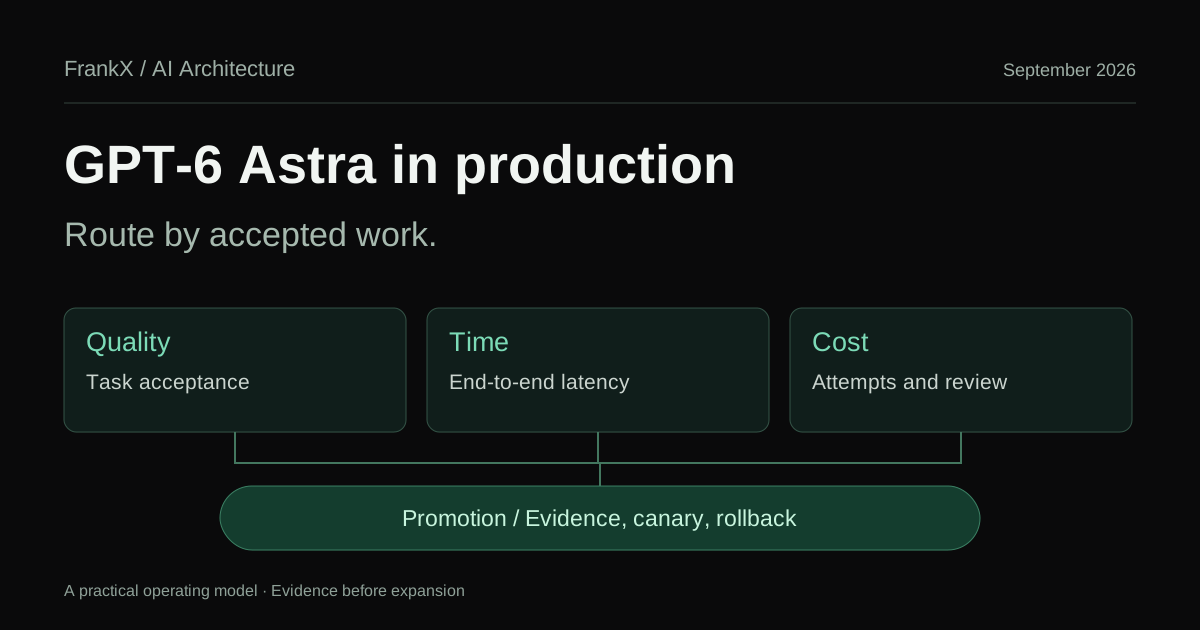
GPT-6 Astra: model economics and production architecture
Evaluate GPT-6 Astra for organizational adoption with workload routing, independent grading, accepted-task economics and a controlled path into production.
Read article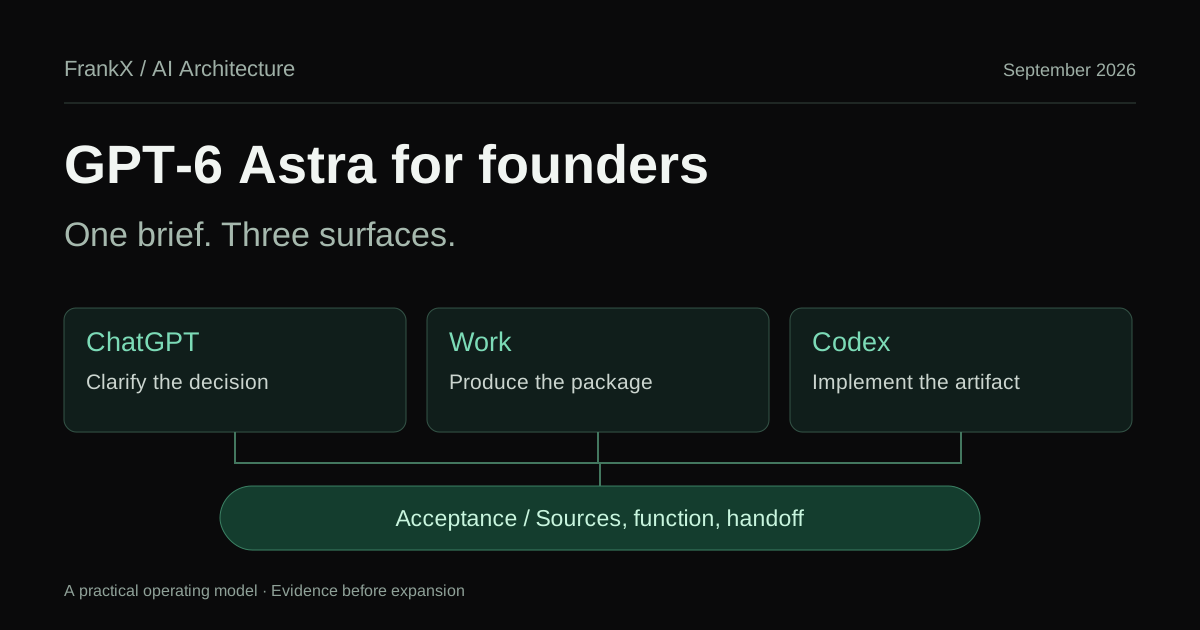
GPT-6 Astra for founders: ChatGPT, Work and Codex
Turn GPT-6 Astra into a useful founder workflow across ChatGPT, Work and Codex, with clear briefs, source checks, web design tests and reviewable handoffs.
Read article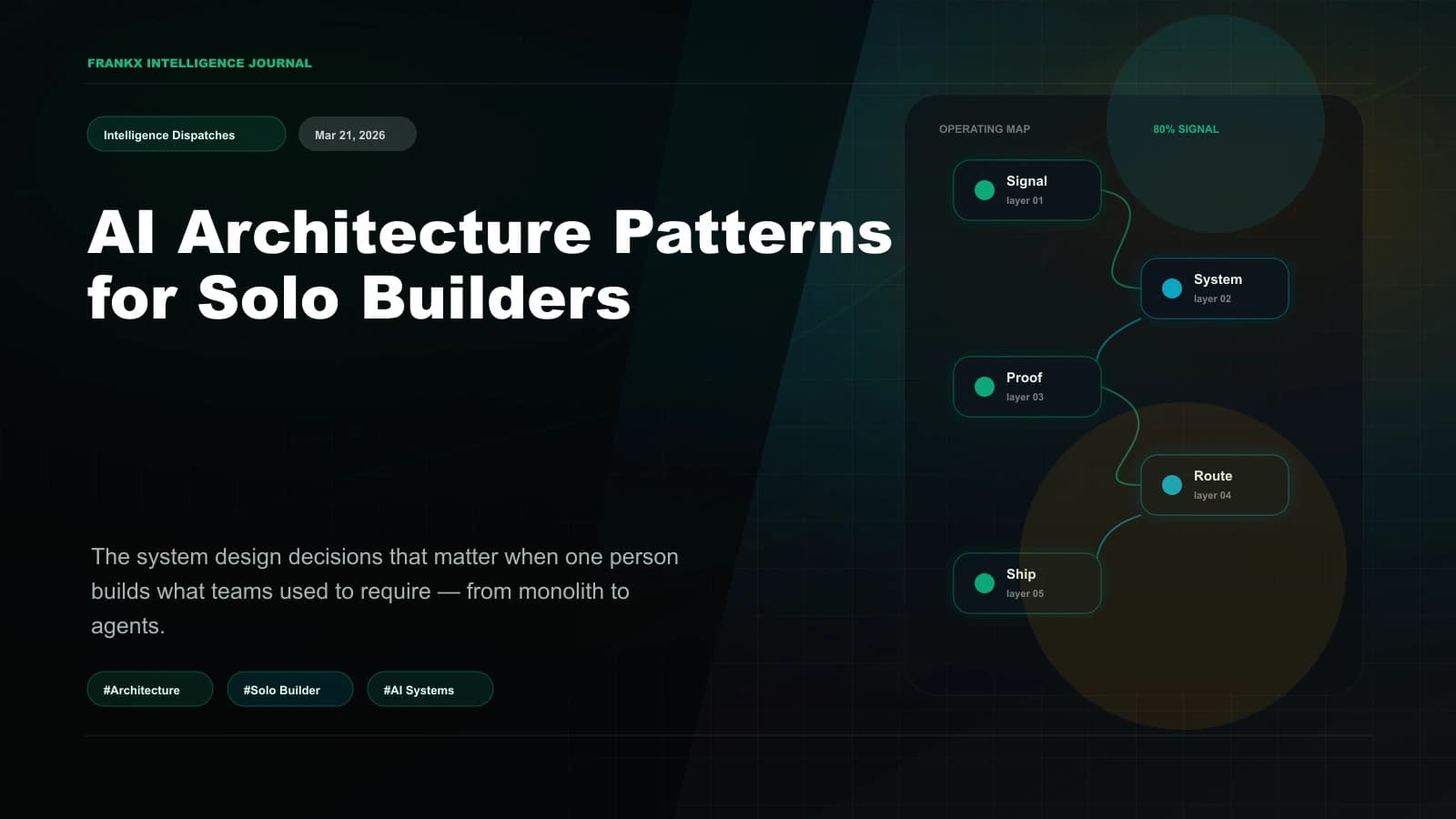
AI Capability Is Abundant. Architecture Is Still the Work.
Where AI skills and architecture create real value: turning workshops, field notes, compute, and infrastructure into durable systems that survive change.
Read article