Abundance Is a Throughput Property
TL;DR
Abundance is not a slogan, not a campaign, not a belief system. It's a throughput property of an open substrate: MIT that never rugs, typed interfaces you can build on, help-first alliances that stack value, and a floor real enough that more people can build because the foundation won't collapse.

Design for throughput, not capture. Build floors, not walled gardens.
Abundance Is a Throughput Property
TL;DR: Abundance is not a slogan, not a campaign, not a belief system. It's a throughput property of an open substrate: MIT that never rugs, typed interfaces you can build on, help-first alliances that stack value, and a floor real enough that more people can build because the foundation won't collapse. Systems optimized for surface metrics produce volume without inspectable foundations—high throughput requires buildable interfaces, not locked costumes. Investor/architect framing: compounding research and engineering beats content volume. First-hand proof: Starlight open core, SIS as memory authority, live consumer products that must stay honest.
What does abundance actually mean in system design?
Abundance is throughput: how many people can build how much value before hitting a constraint. The constraint might be licensing (can you fork this?), interfaces (can you extend this without rewriting it?), legibility (can you understand this well enough to trust it?), or network design (does using this make you dependent on one vendor?).
The test is compound growth. An abundant substrate lets the next builder start higher than you did—they import your work, extend it, and ship something you couldn't have. A scarce substrate makes them start over—either you didn't publish, or you published in a way that can't be built on.
This is not metaphor. It's the difference between MIT-licensed typed libraries (abundant) and closed SaaS APIs with rate limits and breaking changes (scarce). Between open memory protocols anyone can read (abundant) and vendor-locked LLM platforms that own your data (scarce). Between help-first communities where knowledge stacks (abundant) and zero-sum capture games where everyone guards their edge (scarce).
Why do closed systems that look abundant have zero throughput?
Because they optimize for surface metrics—user count, content volume, engagement KPIs—instead of throughput. A marketplace of locked templates looks abundant, but if the templates are locked to one platform, have no source to audit, and break when the vendor changes APIs, the abundance is costume. Real builders can't use it. It's noise, not substrate.
The pattern repeats everywhere:
- Vanity swarms with no receipts: impressive agent counts but no eval results, no open contracts, no reproducible protocol. Demos optimized for the tweet, not tools another engineer can deploy.
- Dashboard-as-product: observability platforms that show you latency and token counts but don't give you the raw trace data you'd need to debug or extend. Looks like transparency, acts like a walled garden.
- Prompt libraries with no provenance: "500 battle-tested prompts!" but no metadata on what tasks they were tested against, which models, which version, what the eval results were. You can't use them—you can only hope.
These systems look productive because they have volume. Throughput requires an inspectable, extensible foundation—without it, no one can build on top. Abundance measured by surface area is not abundance. Throughput is.
How does open licensing create compounding throughput?
MIT / Apache 2.0 means: fork it, extend it, ship it commercially, no permission needed. That's not ideology—it's interface design. When the next builder doesn't need to ask, negotiate, or wait for approval, they start building now. When the license can't rug them (revoke, relicense, sue), they'll invest time making it production-grade instead of hedging with plan B.
The compounding shows up in commit graphs. Open-core projects with real MIT foundations get external contributions that close platforms never see—because external contributors know their work won't be captured. Building the research intelligence system as open core meant other teams could fork SIS, extend it for their domains, and upstream improvements. Closed would have killed that loop.
The investor/architect frame: throughput is the metric that predicts durability. A closed system's growth is capped by the founding team's capacity. An open system's growth is capped by how many people find it useful enough to extend. One curves linear, the other exponential, and the difference shows up in longevity.
What makes an interface buildable vs just usable?
Typed contracts, documentation that shows the invariants, and test fixtures that prove the claims. "Buildable" means someone can write against your interface without asking you questions—the contract is machine-checkable, the examples are executable, the failure modes are documented.
Example: SIS exports TypeScript types for trajectories, memory entries, and verification results. If you're writing an agent that needs to query past outcomes, you import the types, write your query, and the compiler tells you if you're asking for something that doesn't exist. That's buildable—no coordination tax, no "wait for the maintainer to answer Slack."
Contrast: a model provider's API with sparse docs, breaking changes every quarter, and error messages that don't map to fixes. Usable by the vendor's team (they have insider knowledge). Not buildable by outsiders. Throughput: one team vs everyone who tried and gave up.
The research generation flywheel piece shows the integration: when each tool in the research loop exports buildable interfaces, you can route outputs from Sandcastles to Higgsfield to Grok without hand-translation. Usable interfaces require glue code per integration. Buildable interfaces compose.
Why do help-first alliances create more value than zero-sum capture?
Because knowledge compounds when it's shared and rots when it's hoarded. A help-first alliance looks like this: you publish your eval harness, I fork it and add model support you didn't have, someone else adds cost tracking, we all upstream fixes. Everyone's version gets better because the improvements are portable.
Zero-sum looks like: you build an eval harness, keep it private for competitive edge, I build my own (worse, because I'm starting from scratch), we both waste time maintaining forks of the same idea, and the next person wastes time again. Three teams, one solution, no compounding.
The durability argument: help-first scales because it's anti-fragile. When one maintainer leaves, someone else can fork and continue. When a company pivots, the open work survives. Zero-sum systems are fragile—when the maintainer leaves or the company pivots, the work dies, and everyone who built on it is rugged.
The non-obvious part: this isn't altruism optimized for feelings. It's self-interest optimized for time horizon. If you're building for one quarter, hoard. If you're building for five years, publish—because the help you give compounds back faster than the edge you protected.
How does Starlight actually implement this?
Four layers, each designed for throughput:
1. Open core with MIT licensing: starlight-swarm (executor), starlight-agent-skills (capabilities), and SIS (memory) are all MIT. Fork without asking, ship commercially without royalty, extend without approval. No rug risk.
2. Typed contracts everywhere: TypeScript interfaces for skills, agents, memory, and eval receipts. If it compiles, it's correct per-spec. If it fails type-check, the failure is local—you see it before runtime.
3. Public receipts for claims: Every eval produces a JSON receipt (contestants, judges, tasks, results, caveats). Every trajectory includes structured outcomes. Claims come with audit trails. "This agent solved X" is backed by a receipt you can verify.
4. Products consume the substrate: GenCreator.ai and other products are built on this open core. The substrate is the same for prototypes and production.
The result: MIT licensing means other teams can fork SIS, extend the skill library, and run their own eval harnesses. That's throughput. The alternative—closed platform, gated access, vendor-locked data—would have meant one team's capacity, forever.
What's the difference between growth and throughput?
Growth is your graph going up. Throughput is how many people can build on your work without needing you. A closed platform can have explosive growth (user count, revenue) and zero throughput—no one can fork, extend, or build independently.
The compounding research loop: SIS trajectory learning means agents improve by importing structured outcomes from prior runs. If those outcomes were locked to a vendor, every agent would be siloed. Because they're open, an agent from another team can import our trajectories, learn from them, and contribute new ones. Network effect, but for research instead of users.
The golden age of intelligence argument is throughput-based: the age is abundant not because models got bigger, but because the infrastructure for builders got real. Typed agent frameworks, open evals, memory you own, skills you can fork. That's the substrate that makes "one person ships agent-powered products" possible instead of theoretical.
Why does this frame matter for investors and architects?
Because it predicts which systems survive commoditization. When models get cheaper and easier to run, the differentiation moves to the stack: who has the throughput-optimized substrate that lets them ship faster, measure better, and compound learning across products?
Closed platforms that captured users early will face the build-vs-buy decision: do customers stay because the platform is actually better, or because switching costs are high? If it's switching costs, the platform is fragile—customers are looking for exits. If it's throughput ("I can build more here than anywhere else"), the platform is durable.
The architect test: can you export your data, fork the stack, and keep running independently? If yes, you're on an abundant substrate. If no, you're a tenant, not a builder.
The investor test: does the platform's value come from network effects that compound for users, or from lock-in that prevents them from leaving? Compound effects are defensible. Lock-in is temporary.
FAQ
What does "abundance is a throughput property" actually mean?
Abundance is how many people can build how much value before hitting a constraint. It's a measurable system property—licensing, interface design, legibility, network structure—not a belief or a slogan. Abundant substrates let the next builder start higher than you did and extend without asking.
Why do closed systems that look abundant have zero throughput?
Because they optimize for surface metrics (user count, content volume) instead of throughput. Vanity swarms with no receipts, dashboards with no raw data, prompt libraries with no provenance—these look productive but can't be built on. Volume isn't abundance; extensible foundations are.
How does MIT licensing create compound growth?
Fork, extend, ship commercially, no permission needed. External contributors invest when the license can't rug them. Open-core projects with real MIT foundations compound through external contributions that closed platforms never see. Throughput scales exponentially; closed scales linearly with team size.
What makes an interface "buildable" vs just "usable"?
Typed contracts, docs showing invariants, test fixtures proving claims. Buildable means you can write against it without asking questions—the compiler checks correctness, examples are executable, failure modes documented. Usable needs insider knowledge; buildable composes.
Why are help-first alliances more durable than competitive edge?
Knowledge compounds when shared, rots when hoarded. Help-first is anti-fragile: when one maintainer leaves, someone can fork. Zero-sum dies when the maintainer leaves. Time horizon: hoard for one quarter, publish for five years—the help compounds back faster than the protected edge.
How does Starlight implement this?
Four layers: MIT licensing (fork without asking), TypeScript contracts (if it compiles it's correct), public receipts for claims (every eval produces JSON), and products that consume this substrate. MIT licensing means other teams can fork, extend, and build—that's throughput.
What's the difference between growth and throughput?
Growth is your graph going up. Throughput is how many people can build on your work without you. Closed platforms can have explosive growth (users, revenue) and zero throughput—no one can fork or extend. Throughput predicts which systems survive commoditization.
Why does this matter for product architects?
Can you export your data, fork the stack, and keep running independently? If yes, you're on an abundant substrate. If no, you're a tenant. The architect test is: does the value come from compound network effects (durable) or lock-in that prevents leaving (temporary)?
By Frank — AI Architect & Creator. The open substrate: starlight-swarm · starlight-agent-skills · SIS · ACOS · GenCreator.ai. Props to the builders of this era. Not affiliated with, endorsed by, or sponsored by Oracle.
Build your first AI system
Step-by-step guide to setting up ACOS, creating your first agent, and shipping real products with AI.
Start buildingProduction-ready architecture
Download AI architecture templates, multi-agent blueprints, and prompt engineering patterns.
Browse templatesJoin the builder community
Connect with creators and architects shipping AI products. Weekly office hours, shared resources, direct access.
Join the circle
Read on FrankX.AI — AI Architecture, Music & Creator Intelligence
Stay in the intelligence loop
Weekly field notes on AI systems, production patterns, and builder strategy.
Continue Reading
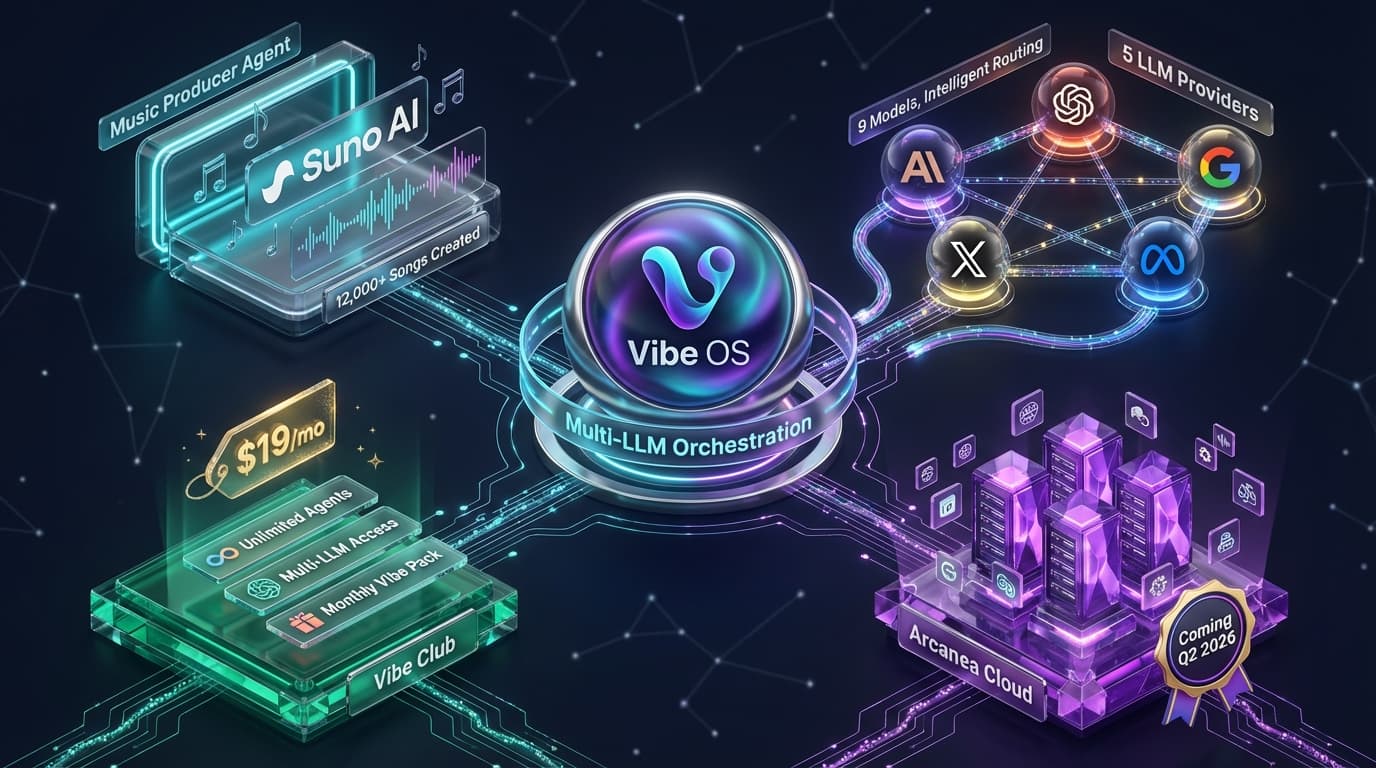
The Music Intelligence System: Research, Agents, and Free Tools Behind AI-Era...
An open, interconnected system for AI-era music creation — a 25-state research library (Vibe OS), portable agents, an MCP server, and free Suno prompt templates. Built in public across GitHub.
Read article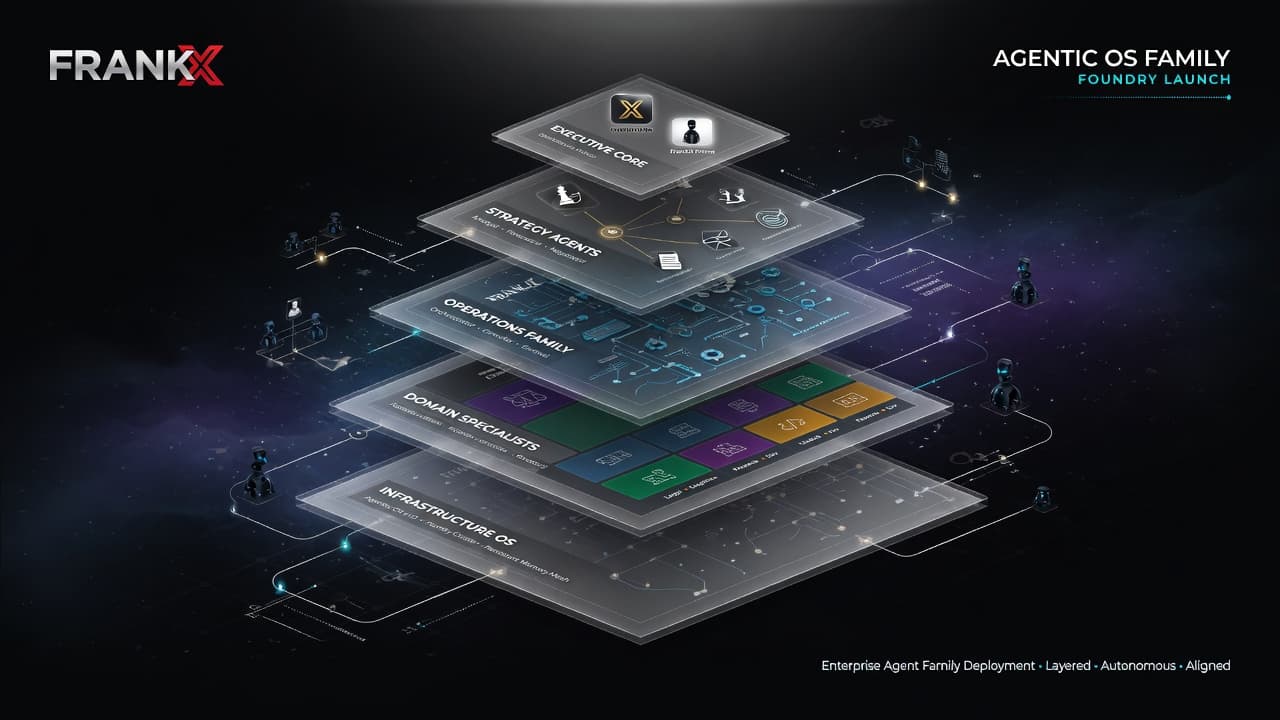
The Agentic OS Family: One Architecture, Installed Into Real Businesses
How a one-day install for a friend's company became agentic-business-os, a public template with a sync channel — and the Foundry, an application-only install service with priority for s...
Read article
The Best Open & Local LLMs in 2026: A Self-Host Field Guide
Which open-weight model for which hardware — Gemma 4, gpt-oss, Phi-4, Mistral Large 3, Llama 4, DeepSeek V4, and Kimi K2.6 compared by VRAM, license, and use case.
Read article