The Golden Age of Intelligence: Agentic SEO OS for Exponential Reach
TL;DR
Launch a 12-day sprint and 15,000-word masterplan for flagship content, high-frequency publishing, automation pipelines, distribution loops, and measurement rituals.

Turn the Golden Age thesis into a repeatable SEO publishing operating system.
The Golden Age of Intelligence: Agentic SEO OS for Exponential Reach
How to orchestrate flagship authority pieces, high-frequency micro-posting, intelligent automation, and omnichannel distribution to own the conversation from September 19 through September 30 — and beyond.
Executive Intelligence Briefing
Welcome to the Golden Age of Intelligence — a moment where agentic AI systems, collaborative human creativity, and search platforms optimized for helpfulness are converging. The FrankX.ai Agent Collective has been charged with translating this convergence into a publishing machine that dominates organic discovery, saturates the attention graph, and builds compounding authority. This 15,000-word operating system responds directly to our September 19 through September 30 sprint mandate, while architecting an evergreen blueprint that scales into Q4 and 2025.
This document is engineered as both narrative and playbook. Expect:
- A cultural and technological diagnosis of the Golden Age of Intelligence — what it is, how it changes user intent, and why search plus conversational AI must be treated as a unified surface.
- A flagship-first yet high-frequency content architecture that harmonizes deep-dive cornerstone pieces with semi-automated daily publishing.
- A detailed publishing calendar covering the remaining 12 days of September, including themes, intents, post formats, and repurposing cadences.
- Automation pipelines that mix Codex, ChatGPT, Claude, and bespoke FrankX agents to produce 10–100 posts daily without sacrificing quality.
- Distribution loops across Google, YouTube, LinkedIn, X, newsletters, communities, partner networks, and intelligent syndication bots.
- Technical SEO, UX, and analytics systems that guarantee crawlability, indexation, and rapid iteration.
- Response protocols to the question: "Should we publish everything at once or concentrate on flagship posts?" Spoiler — we do both strategically.
- Guidance on imagery, multimedia, and how to integrate visual intelligence assets for emotional resonance and search demand.
Treat this operating system as the north star for every agent in the FrankX collective. Each section includes explicit responsibilities, prompt templates, dashboards, and cross-agent collaboration rituals. Execute ruthlessly, review daily, and let our compound intelligence carry the brand into the frontier.
Table of Contents
- Defining the Golden Age of Intelligence
- Cultural & Search Landscape Diagnosis
- Flagship Authority vs. High-Frequency Publishing
- FrankX.ai Intelligence Content Matrix
- September 19–30 Publishing Calendar
- Automation & Agentic Production Pipelines
- Distribution, Syndication & Amplification Loops
- Intelligence Analytics & Iteration Rituals
- Governance, Quality, and Compliance
- Golden Age Resource Vault & Prompt Library
- Implementation Timeline & Role Assignments
- Audience Journey Blueprints
- Technical SEO & Experience Enhancements
- Multi-Agent Collaboration Scripts
- Flagship-to-Product Funnel Architecture
- Knowledge Base & Training Implementation
- Publishing Strategy FAQ
- Scenario Playbooks & Contingency Planning
- Daily Timeboxed Execution Templates
- Case Signals & Proof Stories
- Technology Stack Breakdown
- Community Activation Campaigns
- Golden Age Experimentation Lab
- Image & Multimedia Strategy Recommendations
- Appendices: Checklists, Templates, and Dashboards
Defining the Golden Age of Intelligence
The Golden Age of Intelligence is not a marketing slogan. It is a structural shift in how knowledge is created, validated, and distributed. Three tectonic forces define the era:
- Agentic AI Everywhere: GPT-4o mini, Claude Opus, Google Gemini 1.5 Pro, and Anthropic's Workbench agents now orchestrate end-to-end workflows. These systems interpret brand voice, access proprietary knowledge bases, collaborate, and output production-ready assets. They collapse the time between idea and publication to minutes.
- Helpful Content Guidelines 3.0: Google's latest Helpful Content Update, combined with the Search Generative Experience (SGE), prioritizes expert-level depth, multi-format completeness, and user-first experiences. Thin content is demoted; high-value intelligence that demonstrates E-E-A-T (Experience, Expertise, Authoritativeness, Trustworthiness) soars.
- Audience Intent Convergence: Users don't differentiate between "search" and "chat." They expect immediate, context-rich answers that integrate text, visuals, voice, and interactive tools. Winning brands design for the entire intent journey, from first question to product decision.
To lead in this era, we must reimagine FrankX.ai as an intelligence utility. Every post, video, and automation must signal:
- Collective Wisdom: Multi-agent validation, cross-disciplinary viewpoints, and layered insights.
- Operational Playbooks: Not just theory — step-by-step processes that readers can execute immediately.
- Human-Algorithm Harmony: Transparent collaboration between agents and human strategists, showing how automation augments, not replaces, human judgment.
- Premium Experience: Luxury-grade storytelling, design, and interaction that set FrankX.ai apart from commodity AI blogs.
Six Principles of the Golden Age Operating System
- Omnichannel Intent Ownership: For every priority topic, we aim to own the search result, the SGE panel, the Reddit thread, the LinkedIn discourse, and the newsletter conversation. That means launching cohesive campaigns, not isolated posts.
- Flagship Gravity with Satellite Swarms: Each flagship article becomes a gravity source that smaller assets orbit. Micro-posts, audio notes, carousels, and live streams constantly point back to the flagship, reinforcing authority and generating backlinks.
- Real-Time Intelligence Feedback: Dashboards monitor impressions, rankings, click-throughs, dwell time, and qualitative feedback. Agents adapt messaging within 24 hours.
- Automated Production with Human QA: Agents draft at scale; humans (or specialized QA agents) validate tone, accuracy, and alignment. Automation accelerates; human discernment polishes.
- Progressive Personalization: Audience segments — Creators, Parents/Educators, Executives — receive tailored angles, yet the brand voice remains unified.
- Compound Asset Lifecycle: Every asset is designed for repurposing. A flagship essay births a video script, a webinar, a playbook, and dozens of community prompts.
By embedding these principles, we convert the Golden Age of Intelligence from concept into daily practice.
Cultural & Search Landscape Diagnosis
The Cultural Temperature
We surveyed trend reports, social conversations, and partner communities to map the cultural psyche.
- Tech Anxiety Meets Wonder: Audiences oscillate between fear of job displacement and excitement for augmentation. Content must provide clarity and empowerment.
- Desire for Mastery: People want to feel intelligent, not just consume insights. Interactive frameworks, diagnostics, and guided sprints resonate.
- Premiumization of Knowledge: Curated, luxurious experiences (think Notion workspaces, cinematic storytelling, bespoke email sequences) are outperforming generic content. FrankX.ai must embody this premium feel.
- Ethics & Responsibility: Conversations around responsible AI, intentional technology, and values-driven innovation are surging. Our messaging should integrate ethics as a differentiator.
Search & Discovery Forces
- Google SGE & Perspectives: Search results now feature aggregated insights from forums, short-form videos, and expert commentary. We must seed flagship takeaways across these surfaces.
- AI Overviews & Summaries: ChatGPT, Perplexity, and You.com pull from high-authority sources. Structuring content with clear sections, bullet point summaries, and schema markup ensures inclusion.
- LinkedIn Algorithm 2024: The platform now rewards depth, conversation, and multi-slide carousels. Expect 3–5X reach when posts include frameworks and community prompts.
- YouTube Chapters & Key Moments: Automated detection surfaces segments in search. Our video scripts should align with the blog's subsections to maximize coverage.
- Newsletter Discovery: Platforms like Beehiiv and Substack highlight consistent, high-quality newsletters. Our weekly digest should be derived from this plan.
Competitive Benchmarking Snapshot
| Competitor | Strengths | Gaps We Exploit |
|---|---|---|
| Jasper.ai Blog | Frequent posts, tool-focused SEO | Lacks philosophical depth, limited cultural resonance |
| Anthropic Blog | Strong technical explainers | Minimal publishing cadence, little automation guidance |
| OpenAI Updates | High authority | News-style, no implementation playbooks |
| AI Research Think Tanks | Analytical depth | Weak on actionable frameworks for entrepreneurs |
| Indie Creator Newsletters | Authentic voice | Limited operational rigor, inconsistent posting |
Our edge is the combination of multi-agent intelligence, luxury execution, and operational rigor. We don't just explain the Golden Age; we hand the reader the controls.
Flagship Authority vs High-Frequency Publishing
The user question — "Can I post 10+ times per day? Should we instead focus on flagship pieces?" — is answered with a both/and strategy. We employ a dual-speed publishing machine:
- Flagship Authority Posts (FAPs): 3–4 per month, 10,000–20,000 words, comprehensive frameworks, interactive assets, embedded toolkits, and SEO-rich architecture. These drive backlinks, brand authority, and SGE inclusion.
- High-Frequency Intelligence Bursts (HFIBs): 5–12 posts per day across micro-blog, LinkedIn, X, community notes, and audio rooms. These increase surface area, capture zeitgeist, and funnel engagement toward flagships.
Why Both Matter
- Flagships Establish Gravity: Search engines and AI assistants trust deep, authoritative content. Without flagships, micro-content lacks anchor points.
- High Frequency Feeds Algorithms: Social and conversational surfaces reward consistency and recency. Daily bursts keep us omnipresent, gather user questions, and inform future flagships.
- Compound Loop: Each flagship is pre-planned to spawn 40+ derivatives. Each derivative links back to the flagship, strengthening SEO and brand recall.
Flagship Blueprint
Each FAP includes:
- Front Matter: Structured schema, meta descriptions, social cards.
- Executive Summary: 300-word TL;DR for AI assistants.
- Table of Contents: Hyperlinked for user experience.
- Module Sections: 8–12 modules with frameworks, tables, and prompts.
- Interactive Assets: Embedded calculators, Notion templates, or Airtable bases.
- Automation Recipes: Step-by-step instructions for agentic workflows.
- Distribution Map: Exactly how to repurpose the flagship.
- Action CTA: Path to a product, consultation, or community.
High-Frequency Intelligence Burst Types
| Format | Platform | Cadence | Purpose | Automation Notes |
|---|---|---|---|---|
| Signal Notes | Blog micro-posts (300–500 words) | 2/day | Rapid response to trends | Auto-drafted via Codex + Guardian QA |
| LinkedIn Carousels | 1/day | Teach frameworks, drive flagship traffic | Slide templates auto-filled from flagship sections | |
| X Threads | X / Twitter | 2/day | Capture zeitgeist, gather questions | Compose with GPT-4o mini; Guardian ensures compliance |
| Audio Briefings | YouTube Shorts + Podcast | 1/day | Build voice authority | Claude generates script; Visionary agent records |
| Community Prompt Packs | Discord/Slack | 1/day | Foster engagement | Creator agent synthesizes prompts |
| Email Micro-Digest | Newsletter | 3/week | Summarize wins, highlight CTA | Connector agent schedules |
Publishing Governance
- Flagship Taskforce: Strategist + Visionary + Guardian. Responsible for research, architecture, and QA.
- HFIB Factory: Creator + Engineer + Connector. Responsible for automation, formatting, and distribution.
- Daily Standup (20 minutes): Review analytics, adjust pipeline, assign trending topics.
- Weekly Retrospective (45 minutes): Evaluate flagship performance, identify new flagship opportunities.
By harmonizing flagships and bursts, we achieve sustainable SEO authority and algorithm-friendly omnipresence.
FrankX.ai Intelligence Content Matrix
To maintain consistency and relevance, the collective adheres to the Intelligence Content Matrix. This matrix aligns audience segments, emotional arcs, and content formats.
Audience Segments & Emotional Jobs
| Segment | Core Desire | Emotional State | Content Promise |
|---|---|---|---|
| Creators & Entrepreneurs | Scale their vision with AI | Ambitious yet overwhelmed | "We hand you a system to multiply output without burnout." |
| Parents & Educators | Guide families through AI | Protective, curious | "We protect your loved ones while unlocking potential." |
| Executives & Operators | Future-proof organizations | Strategic, risk-aware | "We deliver enterprise-grade intelligence, ready to deploy." |
| Community Builders | Cultivate movements | Passionate, collaborative | "We supply rituals and content that activate your people." |
Intelligence Content Pillars
- Vision & Narrative: Thought leadership on the future of intelligence, agentic AI, cultural shifts.
- Systems & Operations: Playbooks, checklists, templates, and pipelines.
- Tools & Automation: Comparative analyses, prompt libraries, workflow recipes.
- Human Experience: Mindset, emotional resilience, ethical guardrails.
- Case Signals: Micro case studies, success snapshots, data-backed stories.
Each piece of content touches at least two pillars to ensure depth and variety.
Signature Content Frameworks
- Intelligence Flywheel: Research → Create → Distribute → Learn → Evolve. Reinforced in every flagship.
- Agent Collaboration Canvas: Assigns tasks across Strategist, Creator, Engineer, Guardian, Connector, Visionary agents.
- Human-in-the-Loop Ladder: Defines when humans intervene (strategy, QA, community) vs. when agents automate (drafting, formatting, repurposing).
- Impact Metrics Stack: Awareness (impressions) → Authority (backlinks, shares) → Activation (sign-ups, consultations) → Ascension (product purchases).
Editorial Voice Guidelines
- Tone: Authoritative yet inviting, luxurious yet grounded.
- Vocabulary: Blend of strategic lexicon (flywheel, pipeline, architecture) and human language (story, emotion, transformation).
- Sentence Rhythm: Alternate between long, rolling sentences for narrative and crisp, directive sentences for actions.
- Storytelling: Use micro-narratives to humanize data. Each section should answer "Why does this matter now?"
Tagging & Internal Linking Protocol
- Primary Tags: Align with our five content pillars.
- Secondary Tags: Denote campaign themes (e.g., "Golden Age", "Agentic Systems", "Automation Playbooks").
- Internal Links: Each flagship links to at least 5 relevant micro-posts and 3 products/resources.
- Related Content Module: At the end of each post, include curated links to keep readers engaged.
Adhering to the matrix ensures the blog experience remains coherent, binge-worthy, and deeply aligned with audience needs.
September 19–30 Publishing Calendar
The following calendar orchestrates 12 days of flagship execution, high-frequency bursts, and distribution loops. Each day is structured with Morning Intelligence Pulse, Flagship or Campaign Focus, Afternoon Expansion, and Evening Resonance. Automation is embedded throughout.
Calendar Legend
- FAP: Flagship Authority Post
- HFIB: High-Frequency Intelligence Burst
- IA: Intelligence Automation task
- QA: Guardian review checkpoint
- DL: Distribution Loop
September 19 (Day 1) — Launch the Golden Age Narrative
- Morning Intelligence Pulse
- Publish FAP: "The Golden Age of Intelligence Operating System" (this article). Ensure schema, meta, OG images, and internal links are configured.
- HFIB: LinkedIn carousel summarizing six Golden Age principles.
- IA: Automate RSS-to-LinkedIn/Medium syndication with Buffer API.
- Afternoon Expansion
- HFIB: X thread on "Why Flagship + High Frequency is the new SEO." Link to flagship.
- IA: Creator agent generates 5 community prompts for Discord.
- QA: Guardian agent verifies internal links and structured data.
- Evening Resonance
- DL: Connector agent hosts 20-minute live audio briefing recapping insights.
- HFIB: Newsletter micro-digest featuring key takeaways + CTA to join community.
September 20 (Day 2) — Automation Infrastructure
- Morning
- Publish HFIB: Blog micro-post "Automation Pyramid for Creators".
- IA: Engineer agent sets up Make.com workflow for repurposing flagship sections into carousels.
- Afternoon
- HFIB: LinkedIn post on "Human-in-the-loop Ladder" with call for comments.
- DL: YouTube Short summarizing automation pyramid.
- Evening
- QA: Guardian audits automation outputs for tone alignment.
- HFIB: X thread crowd-sourcing automation challenges; compile responses for future post.
September 21 (Day 3) — Audience Segmentation Review
- Morning
- Publish HFIB: Blog micro-post "Three Emotional Jobs of the Intelligence Era".
- IA: Strategist agent refreshes audience segmentation dashboards.
- Afternoon
- HFIB: LinkedIn carousel mapping segments to offers.
- DL: Discord AMA on AI tools for families.
- Evening
- QA: Guardian reviews AMA transcript, surfaces quotes for future content.
- HFIB: Newsletter featuring segmentation insights.
September 22 (Day 4) — Flagship Production Sprint (FAP #2 Outline)
- Morning
- IA: Visionary agent drafts outline for upcoming flagship "Agentic Community Operating System" (publish Sept 26).
- HFIB: X thread sharing outline highlights to invite feedback.
- Afternoon
- HFIB: LinkedIn post on "How we engineer outline feedback loops." Link to Notion board.
- DL: Launch survey to gather community questions about community building.
- Evening
- QA: Guardian ensures outline integrates community input.
- HFIB: YouTube Short teasing upcoming flagship.
September 23 (Day 5) — Case Signal Saturday
- Morning
- Publish HFIB: Micro-case study on a brand implementing agentic SEO.
- IA: Engineer agent configures Airtable base to collect case signals.
- Afternoon
- HFIB: LinkedIn carousel: "5 Signals that You're in the Golden Age."
- DL: Connector shares case study in partner communities.
- Evening
- QA: Guardian verifies case study data, adds footnotes.
- HFIB: Newsletter round-up with CTA to share success stories.
September 24 (Day 6) — Toolchain Tuesday
- Morning
- Publish HFIB: Tool comparison blog on agent orchestration platforms.
- IA: Engineer integrates API keys into automation hub.
- Afternoon
- HFIB: LinkedIn live demo of the tool stack.
- DL: Upload demo replay to YouTube with chapters aligned to blog headings.
- Evening
- QA: Guardian updates tool documentation in knowledge base.
- HFIB: X thread highlighting top prompts from demo.
September 25 (Day 7) — Ethics & Governance Focus
- Morning
- Publish HFIB: Blog micro-post "Guardian Protocols for AI Publishing".
- IA: Guardian agent runs compliance audit on automation prompts.
- Afternoon
- HFIB: LinkedIn article on "Ethics as a Growth Lever."
- DL: Partner with ethics community for cross-post.
- Evening
- QA: Strategist reviews governance outcomes, updates risk dashboard.
- HFIB: Newsletter featuring governance checklist download.
September 26 (Day 8) — Flagship Launch (FAP #2)
- Morning
- Publish FAP: "Agentic Community Operating System" (10,000+ words).
- IA: Automate derivations — 10 X threads, 3 carousels, 1 webinar outline.
- Afternoon
- HFIB: LinkedIn post summarizing flagship's community rituals.
- DL: Host live mastermind discussing community activation.
- Evening
- QA: Guardian ensures all derivatives correctly link back to flagship.
- HFIB: Newsletter dedicated to new flagship.
September 27 (Day 9) — Distribution Flywheel Expansion
- Morning
- Publish HFIB: Blog micro-post "Distribution Flywheel 2.0".
- IA: Engineer maps automation to new channels (Reddit, Quora, Medium).
- Afternoon
- HFIB: LinkedIn carousel on distribution loops.
- DL: Launch syndication to partner newsletters.
- Evening
- QA: Guardian monitors backlink acquisition, logs mentions.
- HFIB: X thread summarizing distribution wins.
September 28 (Day 10) — Intelligence Measurement Day
- Morning
- Publish HFIB: Blog post on measurement stack.
- IA: Strategist configures Looker Studio dashboards for flagship KPIs.
- Afternoon
- HFIB: LinkedIn post showing dashboard screenshots.
- DL: Invite community to data review session.
- Evening
- QA: Guardian validates data integrity, flags anomalies.
- HFIB: Newsletter featuring measurement insights.
September 29 (Day 11) — Future Foresight & Product Alignment
- Morning
- Publish HFIB: Vision piece "Signals Pointing to Q4 Intelligence Trends".
- IA: Visionary agent drafts outline for October flagship.
- Afternoon
- HFIB: LinkedIn poll on desired product features.
- DL: Conduct community roundtable on upcoming offerings.
- Evening
- QA: Guardian compiles insights into product roadmap doc.
- HFIB: X thread recapping foresight insights.
September 30 (Day 12) — Synthesis & Ascension
- Morning
- Publish HFIB: Wrap-up blog "Golden Age Sprint Outcomes".
- IA: Strategist agent updates master Notion board with metrics.
- Afternoon
- HFIB: LinkedIn article celebrating community contributions.
- DL: Release downloadable "Golden Age Intelligence Packet" summarizing month.
- Evening
- QA: Guardian completes retrospective, logs wins/lessons.
- HFIB: Newsletter inviting readers to October roadmap livestream.
This calendar ensures daily publishing momentum, strategic flagship milestones, and continuous feedback loops.
Automation & Agentic Production Pipelines
Architecture Overview
Automation allows us to publish 10, 50, or 100 assets per day without diluting quality. The architecture rests on layered pipelines:
- Intelligence Intake Layer: Gather inputs from trend feeds, community prompts, analytics, and partner conversations. Tools: Feedly, Glasp, Slack connectors.
- Agent Orchestration Layer: Assign tasks to specialized agents (Strategist, Creator, Engineer, Guardian, Connector, Visionary). Use frameworks like LangChain orchestration, GPT-4o function calling, Claude Workbench.
- Production Layer: Generate drafts, carousels, scripts, transcripts, newsletters, and metadata using AI models tuned to voice guidelines.
- Quality & Compliance Layer: Guardian agent runs factual verification, tone calibration, plagiarism detection, and policy adherence checks.
- Distribution Layer: Automations schedule posts across CMS, LinkedIn, X, YouTube, newsletters, and communities.
- Feedback Layer: Analytics, user comments, and search console data feed back into the intake layer.
Pipeline Blueprint
Trend Signals → Strategist Agent → Idea Prioritization Matrix → Creator Agent Drafts → Guardian QA → Engineer Packages Asset → Connector Distributes → Analytics Feedback → Strategist Updates Backlog
Tool Stack Configuration
| Function | Tool | Agent Owner | Notes |
|---|---|---|---|
| Idea capture | Notion Masterboard | Strategist | Automate with Zapier to populate from Slack tags |
| Draft generation | GPT-4o mini + Claude 3.5 Sonnet | Creator | Voice-tuned system prompts stored in Git |
| Outline validation | Codex + Strategist Agent | Strategist | Evaluate against content matrix |
| Fact checking | Perplexity API + Guardian Agent | Guardian | Requires reference logging |
| Formatting | Eleventy scripts + MDX templates | Engineer | Auto-insert front matter, CTA modules |
| Media creation | Midjourney / Ideogram / Runway | Visionary | Generate hero images, carousels |
| Scheduling | Buffer + Hypefury + Beehiiv | Connector | Integrate via APIs |
| Analytics | Looker Studio + Ahrefs + GA4 | Strategist | Real-time dashboards |
Automation Recipes
-
Flagship Derivation Engine
- Trigger: FAP published in CMS.
- Actions: Extract each H2 section → Summarize → Generate LinkedIn carousel copy + design prompts → Create X threads → Draft newsletter summary.
- QA: Guardian reviews first derivative daily; spot checks thereafter.
-
Trend-to-Micro Post Pipeline
- Trigger: RSS item tagged "High Priority" in Feedly.
- Actions: Strategist agent scores trend → Creator agent drafts 300-word response → Guardian polishes → Automatic CMS publish under "Signal Note" tag.
-
Community Question Loop
- Trigger: Discord/Slack question upvoted 10+ times.
- Actions: Creator drafts 500-word answer, Visionary adds narrative, Guardian ensures compliance → Post to blog + share snippet on LinkedIn.
-
Analytics Feedback Auto-Sync
- Trigger: Search Console new query > 50 impressions.
- Actions: Strategist agent adds to content backlog, Creator drafts FAQ snippet, Connector inserts into relevant posts.
-
Voice Consistency Guardrail
- Trigger: Draft ready for QA.
- Actions: Guardian agent runs style checker against brand lexicon, highlights deviations, suggests rewrites.
Human Control Points
- Daily QA Rotation: Guardian agent + human overseer review random sample of 10 assets.
- Weekly Prompt Calibration: Strategist updates agent prompts based on analytics.
- Monthly Automation Audit: Engineer ensures API connectors remain stable, updates tokens.
Scaling to Hundreds of Posts
- Cluster Scheduling: Group micro-posts by theme (e.g., automation week) for consistent narrative.
- Evergreen Recycling: Use AI to detect seasonally relevant posts and refresh automatically.
- Multi-Language Expansion: Translate top posts using GPT-4o with native speaker QA.
- Synthetic Interviews: Use agent pairs to simulate Q&A sessions, generating rich conversation transcripts.
By blending automation with intentional human oversight, we maintain excellence while scaling output exponentially.
Distribution, Syndication & Amplification Loops
Publishing without distribution is shouting into the void. The Golden Age requires orchestrated amplification across owned, earned, and partner channels.
Core Distribution Flywheel
- Primary Publish: Flagship or HFIB goes live on FrankX.ai.
- Syndication Burst: Within 30 minutes, derivatives populate LinkedIn, X, newsletter, and YouTube.
- Community Activation: Connector agent seeds discussion prompts in Discord, Circle, Slack groups.
- Partner Leverage: Share with ambassadors, affiliate partners, and mastermind groups.
- Search Optimization: Update schema, submit to Search Console, request indexing if needed.
- Paid Boost (Selective): Run $20 micro-boosts on standout LinkedIn posts to expand reach.
- Feedback Harvesting: Collect comments, DMs, analytics to inform next wave.
Channel-Specific Plays
Google & SGE
- Implement FAQ schema for each flagship section to enhance SGE pull quotes.
- Use
speakableschema for audio snippets to surface in voice assistants. - Submit XML sitemap updates after each flagship and daily micro-post batch.
- Monitor Search Console coverage; resolve crawl anomalies within 48 hours.
- Deploy 12-slide carousels with bold headlines, data visualizations, and CTA linking to flagship.
- Encourage team members and brand allies to comment within 60 minutes of posting (velocity signal).
- Run weekly LinkedIn Live sessions summarizing flagship insights.
X / Twitter
- Use 8–12 tweet threads with hook, context, frameworks, CTA.
- Schedule a mix of evergreen posts (flagship quotes) and reactive commentary (trend hijacking).
- Utilize Quote Tweet strategy to respond to trending voices with insights.
YouTube & Audio
- Convert flagship sections into 3–5 minute explainer videos with AI-generated B-roll.
- Publish daily Shorts summarizing HFIBs; include clickable CTA in description.
- Launch weekly "Golden Age Intelligence Briefing" podcast episode compiled from audio notes.
Newsletter
- Three sends per week: Monday (Strategy), Wednesday (Systems), Friday (Signals).
- Each send includes flagship highlight, top HFIBs, community spotlight, and CTA.
- Use Beehiiv referral program to incentivize sharing.
Communities & Dark Social
- Daily prompts in Discord (#intelligence-lab, #automation-recipes).
- Bi-weekly mastermind call with premium members.
- Curate Notion dashboards for members with updated assets.
Partner & Syndication
- Collaborate with AI-focused publications for guest posts referencing flagship frameworks.
- Offer quotes to journalists covering AI/SEO trends.
- Submit summaries to Hacker News, Indie Hackers when relevant.
Amplification Bots & Agents
- Signal Amplifier Bot: Detects positive mentions and auto-thanks users with personalized responses.
- Backlink Scout Agent: Identifies backlink opportunities from competitor link profiles.
- Community Concierge Agent: Sends DM to new community members with curated resource list.
- Review Loop Agent: Requests testimonials after users download resources.
Measurement of Distribution
- Track UTM performance per channel.
- Use Looker Studio to visualize daily reach, CTR, conversions.
- Identify top 10 performing HFIBs weekly; replicate patterns.
- Monitor brand search volume via Google Trends to gauge awareness lift.
Distribution is not an afterthought; it is a co-equal partner to content creation. The flywheel spins because we fuel every stage with intention.
Intelligence Analytics & Iteration Rituals
Measurement Philosophy
In the Golden Age, analytics are not vanity—they are navigation instruments. We anchor measurement in three layers:
- Signal Layer: Immediate indicators (impressions, clicks, watch time) to monitor reach.
- Insight Layer: Engagement depth (scroll depth, session duration, saves, comments) to gauge resonance.
- Impact Layer: Business outcomes (leads, product sales, community upgrades) to validate ROI.
Golden Age KPI Stack
| Layer | Metric | Target | Tool |
|---|---|---|---|
| Signal | Daily organic impressions | +35% by Sept 30 | GA4, Search Console |
| Signal | LinkedIn post reach | 35K avg per flagship derivative | LinkedIn Analytics |
| Insight | Avg scroll depth on flagships | 65%+ | Hotjar, GA4 |
| Insight | Newsletter click-through | 8%+ | Beehiiv |
| Impact | Flagship-attributed leads | 150+ per flagship | HubSpot |
| Impact | Community upgrades | 30 new premium members | Memberstack |
Dashboard Architecture
- Command Center Dashboard: Looker Studio pulling from GA4, Search Console, LinkedIn, Beehiiv.
- Content Health Scorecard: Notion database scoring each asset on freshness, performance, internal links.
- Automation Reliability Monitor: Grafana dashboard tracking API uptime, error rates.
- Audience Sentiment Tracker: NLP sentiment analysis on comments, DMs, reviews.
Iteration Rituals
- Daily Standup Review: Each agent surfaces top metric shifts; adjust tasks accordingly.
- 48-Hour Adjustment Rule: Underperforming assets receive updates (headlines, CTAs, meta) within 48 hours.
- Weekly Experiment Slot: Dedicate one HFIB per day to testing new formats or hooks; analyze results.
- Monthly Growth Narrative: Strategist crafts a narrative summarizing metrics, insights, and next moves; share with team and community.
Search-Specific Monitoring
- Track keyword ranking improvements for "Agentic SEO," "Golden Age of Intelligence," "AI content automation."
- Use Ahrefs to identify new backlink opportunities; assign outreach tasks.
- Monitor Search Console queries for question-based keywords; create FAQ sections accordingly.
Human Feedback Loop
- Collect voice memos from community; convert to qualitative insights.
- Run quarterly audience surveys; integrate findings into roadmap.
- Host office hours to hear friction points directly.
Analytics are not numbers in isolation—they inform creative choices, automation rules, and distribution strategies in real time.
Governance, Quality, and Compliance
Guardian Protocol
The Guardian agent enforces quality, ethics, and compliance across all assets.
- Accuracy Verification: Cross-reference facts with authoritative sources; log citations in internal database.
- Tone Alignment: Ensure voice adheres to brand lexicon and emotional cadence.
- Bias & Inclusion Audit: Detect biased language, ensure inclusive representation.
- Privacy & Data Compliance: Confirm no sensitive personal data is shared without consent.
- Regulatory Awareness: Track evolving AI disclosure requirements; update disclaimers.
Quality Assurance Checklist
- ✅ Structural integrity (headings, tables, internal links).
- ✅ Metadata completeness (title tags, descriptions, OG tags).
- ✅ Accessibility (alt text for images, descriptive captions, color contrast on visuals).
- ✅ Performance (image compression, lazy loading scripts).
- ✅ Schema markup (Article, FAQ, HowTo where relevant).
Risk Mitigation
- Content Freeze Trigger: If a major platform update disrupts traffic (over 40% drop), pause automation to re-evaluate.
- Reputation Management: Monitor brand mentions; respond to negative feedback within 12 hours.
- Disinformation Defense: Pre-create responses to common misconceptions; publish clarifications swiftly.
Ethical Storytelling
- Highlight human stories with consent.
- Attribute ideas to collaborators; avoid appropriation.
- Disclose AI involvement when content is predominantly agent-generated.
Documentation & Version Control
- Store all prompts, workflows, and QA notes in Git-backed Notion workspace.
- Use semantic versioning for automation scripts.
- Maintain changelog for major content updates.
Governance transforms scale into trust. Without it, automation becomes noise. With it, FrankX.ai becomes a beacon of responsible intelligence.
Golden Age Resource Vault & Prompt Library
Notion Workspace Structure
- Command Deck: Calendar, KPIs, automation status.
- Flagship Vault: Drafts, research, asset library per flagship.
- HFIB Factory: Daily queue of micro-posts, templates, and repurposing scripts.
- Distribution Playbooks: Channel-specific checklists and access credentials.
- Community Hub: Member profiles, engagement rituals, testimonial bank.
- Learning Lab: Saved research, best practices, competitor analysis.
Prompt Library Highlights
Flagship Outline Prompt (Strategist Agent)
System: You are the Strategist Agent for FrankX.ai. Architect a 12-module flagship article about [TOPIC]. Ensure alignment with the Intelligence Content Matrix and include distribution plan.
User: Topic = [Insert focus]. Audience segments = Creators, Parents, Executives. Output = Outline with module goals, subheadings, CTA suggestions.
Micro-Post Draft Prompt (Creator Agent)
System: You embody the FrankX.ai voice—luxury intelligence, actionable frameworks, inclusive tone.
User: Draft a 320-word micro-post responding to [Trend/Question]. Include hook, three insights, CTA to flagship [link], and prompt for community discussion.
Carousel Design Prompt (Visionary Agent)
System: You are the Visionary Agent crafting premium visuals.
User: Generate Midjourney prompts for a 12-slide LinkedIn carousel about [Framework]. Slides should feature futuristic, elegant design with blues/purples, minimal text, and space for overlays.
Guardian QA Prompt
System: You are the Guardian Agent ensuring compliance.
User: Review the following draft for accuracy, tone alignment, inclusion, and compliance. Highlight issues and propose revisions. Draft: [Paste content]
Distribution Checklist Prompt (Connector Agent)
System: Connector Agent orchestrating omnichannel distribution.
User: Produce a step-by-step distribution checklist for [Asset], including LinkedIn, X, newsletter, YouTube, community, partners. Include tracking UTM parameters.
Template Gallery
- Flagship Content Brief Template: Goals, target keywords, audience, outline, sources.
- HFIB Queue Template: Columns for theme, format, agent owner, automation status, publish URL.
- Distribution Tracker: Date, asset, channel, status, performance metrics.
- Analytics Snapshot Template: Daily metrics, anomalies, insights, actions.
- Community Spotlight Template: Member name, quote, resource link, CTA.
Resource Integrations
- Zapier/Make Blueprints: Shareable automation templates for repurposing.
- Schema Generators: Scripts to auto-generate FAQ and HowTo markup.
- Prompt Testing Playground: Environment to test prompts before production.
- Voice & Style Guide: Living document with tone references, banned phrases, signature transitions.
The Resource Vault ensures knowledge is centralized, accessible, and upgradeable. Every new agent or collaborator can onboard in hours, not weeks.
Implementation Timeline & Role Assignments
30-Day Rollout (Sept 19 – Oct 18)
-
Phase 1: Sprint Activation (Sept 19–30)
- Publish two flagships (Golden Age, Agentic Community OS).
- Maintain HFIB cadence (8–12 assets/day).
- Establish automation pipelines and QA loops.
-
Phase 2: Optimization & Expansion (Oct 1–10)
- Analyze sprint data, refine prompts, optimize top-performing assets.
- Launch localized versions for priority markets (ES, PT, FR).
- Introduce audio/podcast channel.
-
Phase 3: Product Integration (Oct 11–18)
- Map content to funnels for premium offers (courses, masterminds).
- Launch evergreen lead magnet derived from flagships.
- Host Golden Age summit (virtual event) to consolidate authority.
Agent Role Assignments
| Agent | Core Responsibilities | September Focus |
|---|---|---|
| Strategist | Research, planning, analytics | Calendar governance, KPI tracking |
| Creator | Drafting, storytelling | HFIB production, flagship module writing |
| Engineer | Automation, tooling | Workflow setup, CMS optimization |
| Guardian | QA, compliance | Daily QA rotation, governance audits |
| Connector | Distribution, community | Channel management, partner outreach |
| Visionary | Design, multimedia | Image generation, video scripts, experience design |
Collaboration Rituals
- Daily Sync (9:30 AM ET): 20-minute update, priority alignment.
- Content Room (2:00 PM ET): Live co-working for flagship modules.
- Distribution War Room (5:00 PM ET): Rapid adjustments based on analytics.
- Weekly Retro (Fridays): Review metrics, celebrate wins, define experiments.
- Monthly Strategy Council: Evaluate long-term roadmap.
Communication Channels
- Slack: #command-deck, #flagship-lab, #hfib-factory, #distribution, #guardian-alerts.
- Notion: Masterboard, asset database, knowledge base.
- Loom: Asynchronous walkthroughs for workflows.
- Figma: Visual asset collaboration.
This governance infrastructure ensures cross-agent cohesion and fast decision-making.
Audience Journey Blueprints
Winning the Golden Age requires choreographing experiences that feel bespoke at every touchpoint. We developed four audience journey blueprints that map the path from first impression to lifelong advocacy. Each blueprint integrates flagship anchors, high-frequency touchpoints, automation triggers, and human moments of delight.
Journey Architecture Overview
| Audience | Journey Stages | Flagship Anchors | Daily Touchpoints | Conversion Goals |
|---|---|---|---|---|
| Creators & Entrepreneurs | Discovery → Immersion → Implementation → Scale → Evangelism | Golden Age OS, Agentic Creator OS, Automation Playbooks | LinkedIn carousels, X threads, workshop invites | Convert to Product Studio memberships and implementation retainers |
| Parents & Educators | Reassurance → Guided Learning → Family Rituals → Community → Advocacy | AI Integration Guides, Family Safety Checklists | Newsletter stories, Discord Q&As, short explainers | Enroll in AI Integration Lab, share testimonials |
| Executives & Operators | Executive Briefing → Diagnostic → Roadmap → Deployment → Partnership | Intelligence Revolution insights, Enterprise decks | Board-ready one-pagers, podcast clips, private webinars | Close advisory engagements, secure enterprise pilots |
| Community Builders | Inspiration → Blueprint → Co-Creation → Shared Momentum → Movement Stewardship | Community OS flagship, Ritual libraries | Community prompts, co-creation jams, behind-the-scenes updates | Upgrade to facilitator cohorts, host FrankX circles |
Creator & Entrepreneur Journey Narrative
Discovery: The journey begins when a founder encounters a LinkedIn carousel derived from this flagship. The hook speaks directly to their ambition (“Build an intelligence engine that works while you sleep”). Automation ensures retargeting ads and newsletter CTAs follow within 24 hours.
Immersion: The creator downloads the "Golden Age Sprint Planner" PDF (lead magnet) and immediately receives a dynamic welcome sequence. The sequence includes a narrated audio summary, a Notion workspace copy link, and an invite to the upcoming Golden Age salon. Every email references this flagship article, creating depth.
Implementation: Within the Notion workspace, each module links to practical tasks: set up automation pipelines, configure analytics dashboards, schedule HFIBs. A Codex-powered checklist walks them through building their first automation. Guardian-approved tutorials ensure clarity.
Scale: After completing a 14-day sprint, the creator unlocks access to the Product Studio, where they receive a bespoke consultation. The Strategist agent reviews their analytics, identifies friction points, and prescribes advanced workflows.
Evangelism: Creators who achieve defined success metrics (traffic up 40%, lead conversions doubled) are invited to record a case signal video. The Visionary agent edits it into a premium testimonial, while the Connector agent co-authors a blog feature. Evangelists receive affiliate commissions and early product access.
Parents & Educators Journey Narrative
Parents often arrive with anxiety. We meet them with reassurance.
- Reassurance: SEO-optimized FAQ sections answer “Is publishing so much safe for kids?” and “How do I talk to my child about AI productivity tools?” The flagship’s human-centered language builds trust.
- Guided Learning: Weekly newsletters include "Family Intelligence Rituals" derived from the flagship’s frameworks (e.g., Sunday reflection prompts, AI literacy games). Each ritual links back to the full article for context.
- Family Rituals: Automated SMS reminders (optional opt-in) nudge families to complete simple activities. The Guardian agent ensures compliance with privacy laws.
- Community: Parents join a moderated Circle space where the Connector agent hosts monthly roundtables. Recaps turn into micro-posts, feeding the content flywheel.
- Advocacy: Graduates receive digital badges, printable certificates for kids, and templates to present AI programs at schools. They become ambassadors and generate inbound referrals.
Executive & Operator Journey Narrative
Executives prioritize clarity, risk mitigation, and ROI.
- Executive Briefing: A curated email, derived from the flagship’s executive summary, lands in their inbox with a 3-minute voice memo. The memo highlights macro trends, risk mitigation strategies, and bottom-line impacts.
- Diagnostic: A self-assessment tool (built in Typeform) maps their current intelligence maturity. Results trigger tailored sections of the flagship with instructions relevant to their score.
- Roadmap: The Strategist agent delivers a PDF roadmap referencing this flagship’s frameworks, annotated with board-ready talking points. LinkedIn premium posts tease insights to maintain top-of-mind awareness.
- Deployment: Executives are invited into a private Slack channel for a 6-week engagement. Each week, the Engineer agent deploys automation sprints while the Guardian manages compliance checks.
- Partnership: Successful deployments convert into case studies and longer-term retainers. The Visionary agent produces cinematic recap videos suitable for shareholder updates.
Community Builder Journey Narrative
Community leaders crave connection and tangible rituals.
- Inspiration: Instagram reels and YouTube Shorts showcase micro-moments from FrankX community spaces, always citing flagship insights.
- Blueprint: Downloadable Miro boards and Airtable templates map 12-week community activations based on this article’s publishing calendar.
- Co-Creation: Bi-weekly co-creation sessions allow members to remix flagship frameworks into their own experiences. Outputs feed back into the Resource Vault.
- Shared Momentum: Automation pushes success spotlights across channels, amplifying community achievements.
- Movement Stewardship: Advanced facilitators join a leadership council receiving quarterly intelligence briefings and exclusive experiments.
Layering Journey Signals with Automation
- Tag every subscriber in the CRM by segment and journey stage. Use behavior-based triggers (link clicks, webinar attendance, automation completion) to advance stage.
- Deploy AI-driven content recommendations on-site: visitors in "Discovery" see TL;DR modules; those in "Implementation" access checklists and calculators.
- Monitor stage progression metrics weekly (e.g., % of creators moving from Immersion → Implementation). If progression stalls, adjust onboarding sequences or embed new HFIBs.
- Combine qualitative data (voice memos, community polls) with analytics to refine messaging. Feed insights back to Strategist agent for prompt updates.
Journey blueprints ensure every piece of this flagship article powers personalized experiences that move audiences from awareness to advocacy.
Technical SEO & Experience Enhancements
Authority without technical excellence is fragile. Google’s Helpful Content guidance and Core Web Vitals reward sites that deliver fast, accessible, and structured experiences. The Engineer and Guardian agents co-own this initiative with human oversight.
Baseline Audit Sprint (Sept 19–21)
- Site Crawl: Run Screaming Frog + Sitebulb to identify broken links, redirect chains, orphaned pages, and thin content. Export reports into Notion for prioritization.
- Indexation Review: Audit Search Console for coverage issues. Resolve
noindexmisconfigurations, canonical errors, and duplicate content. - Metadata Pass: Ensure unique title tags, compelling meta descriptions, and H1 alignment on every post (including legacy assets).
- Schema Inventory: Document existing structured data. Plan new schema (Article, FAQ, HowTo, Speakable) for flagships and HFIB templates.
Core Web Vitals Optimization
- Largest Contentful Paint (LCP): Optimize hero images via next-gen formats (WebP, AVIF), lazy load below-the-fold assets, preconnect CDN domains.
- First Input Delay / Interaction to Next Paint (INP): Minimize render-blocking scripts, adopt code splitting, leverage Next.js performance features.
- Cumulative Layout Shift (CLS): Define explicit width/height for images and embeds; use CSS aspect-ratio utilities.
- Monitoring: Use Google PageSpeed Insights, Lighthouse CI, and Vercel Analytics. Automate weekly Lighthouse runs; log scores in Notion.
Content Architecture Enhancements
- Build pillar-cluster internal linking structure. Each flagship links to satellite posts; satellites link back with descriptive anchor text.
- Update breadcrumbs for improved SERP snippets.
- Create evergreen hub pages summarizing flagship families (e.g., /intelligence/golden-age/). Include content grids, video embeds, and CTAs.
- Implement "Last updated" timestamps with automation so frequent updates surface freshness.
Structured Data Deployment
- Generate FAQ schema for each section with question-based headings. Use Git-based scripts to update automatically when content changes.
- Add
HowToschema for automation workflows, including steps and estimated times. - Leverage
VideoObjectschema for embedded shorts or webinars derived from flagships. - Integrate
BreadcrumbListschema to clarify site architecture.
Accessibility & UX Excellence
- Ensure color contrast ratio ≥ 4.5:1 on all text/element combinations. Visionary agent tests designs via Stark plugin.
- Provide keyboard navigation support for interactive components (accordions, carousels).
- Include descriptive alt text for all visuals; automate alt text suggestions using GPT-4o, but let Guardian review before publishing.
- Add table summaries for screen readers and ensure headings follow hierarchical order.
Personalization & Dynamic Experiences
- Deploy on-site personalization using Mutiny or Optimizely to show segment-specific modules (e.g., executives see ROI calculators).
- Use
recently viewedandrecommended nextcomponents powered by user behavior. - Offer interactive diagnostics (embedded Typeform) that feed results to CRM and trigger tailored email journeys.
Continuous Improvement Loop
- Set quarterly technical audits to catch regressions.
- Track impact of technical fixes on rankings, bounce rate, and conversions.
- Share wins in weekly retrospectives to reinforce culture of excellence.
When technical foundations and premium UX meet flagship storytelling, FrankX.ai delivers the type of experience Google, GPT-driven assistants, and humans elevate.
Multi-Agent Collaboration Scripts
Automation only works when agents collaborate with clarity. We created scripted rituals that orchestrate Strategist, Creator, Engineer, Guardian, Connector, and Visionary agents across daily, weekly, and emergent workflows. These scripts live in the Resource Vault and are adapted per campaign.
Daily Standup Script (20 minutes)
- Opening Signal (Strategist)
- “Here are the overnight metrics: flagship sessions +18%, LinkedIn reach +24%, automation error rate 0.7%. Priority focus today: finalize Community OS flagship drafts.”
- Creator Update
- Shares HFIB queue status, identifies content requiring Guardian review, flags trending topics for reaction posts.
- Engineer Update
- Reports on automation health, requests approvals for new integrations, notes any API limitations.
- Guardian Update
- Highlights QA findings, compliance concerns, upcoming policy changes (e.g., FTC disclosures).
- Connector Update
- Reviews distribution performance, outlines partner collaborations, surfaces community sentiment.
- Visionary Update
- Previews visual assets, requests narrative context, coordinates shoot schedules.
- Decision Round
- Strategist confirms top three priorities, assigns owners, sets check-in times.
Flagship Production Room Script (90 minutes)
- Module Kickoff: Strategist recaps objectives for modules in progress.
- Collaborative Drafting: Creator shares live document, Visionary annotates for visual cues, Engineer embeds automation prompts.
- QA Interlude: Guardian runs real-time checks after each section, using AI assistance to flag unsupported claims.
- Distribution Planning: Connector maps derivative assets while sections are written, ensuring each paragraph has a downstream destination.
- Closing Ritual: Recap achievements, log blockers, update Notion status.
Emergent Trend Response Script (Rapid Reaction)
- Trigger: Trend monitor flags breakout topic (e.g., Google algorithm update).
- Strategist Summons: Initiates 15-minute huddle with Creator, Guardian, Connector.
- Rapid Research: Strategist assigns sources; Guardian verifies credibility.
- Draft & Review: Creator drafts 500-word analysis, Guardian edits, Visionary prepares supporting visual.
- Distribution Burst: Connector publishes across channels, tags relevant influencers.
- Follow-Up: Engineer schedules content refresh once more data emerges.
Asynchronous Collaboration Protocol
- Use Loom updates for context-rich async communication.
- Maintain "Agent Daily Log" in Notion capturing actions, decisions, outstanding questions.
- Adopt "Two-Way Door" decision labels: decisions reversible within 24 hours can be made autonomously; irreversible ones require Strategist approval.
Conflict Resolution & Quality Escalation
- Guardian can issue a "Red Banner" alert if content risks brand integrity; publication pauses until resolved.
- Strategist mediates alignment sessions when conflicting priorities arise.
- Every escalation includes documented resolution and lessons to feed back into prompts.
Human Collaboration Layer
- Assign human overseers for each agent (e.g., Head of Strategy, Creative Director). They conduct weekly reviews of agent output quality.
- Encourage co-creation sessions with community members to stress-test frameworks.
- Celebrate wins publicly in #command-deck to reinforce collaborative culture.
Scripts transform agents from isolated automations into a synchronized ensemble that executes with precision.
Flagship-to-Product Funnel Architecture
Flagship content is only mission-critical if it drives business outcomes. This architecture turns articles into revenue without compromising value.
Funnel Overview
- Magnetic Awareness: Flagship published with SEO optimization, social teasers, and multimedia derivatives.
- Interactive Engagement: Embedded tools (self-assessments, calculators) capture attention and data.
- Value Exchange: Lead magnets (Notion workspace, PDF playbooks, audio briefings) gated behind email signup.
- Nurture Sequencing: Behavior-based email journeys deliver additional context, case signals, and invitations to community experiences.
- Product Activation: Segmented CTAs guide readers toward Product Studio, AI Integration Lab, or enterprise advisory.
- Ascension: Advanced offers (retainers, premium cohorts, annual packages) introduced after success milestones.
Lead Magnet Suite
- Golden Age Sprint Planner: 20-page workbook with checklists, OKR templates, automation maps.
- Automation Recipe Vault: Interactive Airtable with 50+ workflows; updates weekly.
- Intelligence Metrics Dashboard: Looker Studio template configured for FrankX KPI stack.
- Audio Masterclass: 45-minute private podcast episode explaining the strategy behind this flagship.
Nurture Journey Architecture
- Day 0: Welcome email with audio summary, key sections to read, CTA to join community.
- Day 2: Case signal featuring a creator who doubled reach using the publishing calendar.
- Day 4: Behind-the-scenes breakdown of automation stack with step-by-step instructions.
- Day 6: Invite to live implementation call (two slots offered to accommodate time zones).
- Day 9: Executive briefing for decision-makers with ROI stats.
- Day 12: Offer to join Product Studio or book advisory session.
- Day 18: Survey to collect feedback and identify blockers.
Conversion Optimization Tactics
- Implement persistent but non-intrusive CTAs (sidebar modules, inline prompts after major sections).
- Use exit-intent modals offering the Sprint Planner for readers showing high scroll depth but no conversion.
- Personalize CTAs based on segment detection (UTM parameters, quiz results).
- Leverage social proof modules featuring testimonials, logos, and metrics.
Revenue Attribution & Feedback Loop
- Track UTMs from flagship to conversion events using GA4 + HubSpot.
- Tag leads in CRM with source article and derivative assets consumed.
- Analyze conversion rates per CTA placement; iterate weekly.
- Share insights with product team to align offers with emerging needs.
This funnel ensures every flagship becomes a growth engine, not just a thought leadership artifact.
Knowledge Base & Training Implementation
Sustained excellence requires systematic knowledge management and team enablement. The Knowledge Base (KB) becomes the single source of truth for processes, prompts, checklists, and playbacks.
KB Structure & Governance
- Home: Mission, values, latest updates, quick links.
- Publishing Playbooks: Step-by-step guides for flagships, HFIBs, distribution, automation.
- Agent Manuals: Role definitions, capabilities, escalation paths, prompt libraries.
- Quality & Compliance: Guardian protocols, legal guidelines, accessibility standards.
- Tooling & Integrations: API docs, credentials management policies, troubleshooting guides.
- Learning Lab: Recorded workshops, certifications, case studies, experiment logs.
Implementation Roadmap
- Week 1: Migrate existing documentation into Notion with consistent templates. Assign owners to each section.
- Week 2: Build taxonomy and tagging for rapid searchability. Integrate Slack slash command (
/kb [query]). - Week 3: Launch "KB Concierge" agent using GPT-4o fine-tuned on documentation to answer team questions.
- Week 4: Implement review cadence — each page updated at least quarterly.
Training & Certification Sprints
- Orientation Track: 3-day onboarding for new collaborators with micro-learning modules (videos, interactive quizzes) and a capstone assignment (draft an HFIB and pass Guardian review).
- Agent-Specific Tracks: technical analyses for Strategist, Creator, Engineer, Guardian, Connector, Visionary roles. Each track ends with certification badge.
- Live Labs: Weekly 60-minute sessions where teams build real assets using the flagship frameworks.
- Peer Feedback Circles: Monthly cross-functional reviews to surface blind spots and share best practices.
Continuous Learning Culture
- Encourage "Teach-back" sessions: team members record short Looms explaining new insights. These become KB entries.
- Recognize contributions with "Knowledge Architect" awards during retrospectives.
- Use analytics to track KB usage; identify sections needing clarity or promotion.
Human + Agent Synergy
- Deploy AI summarizers to convert meeting notes into KB updates automatically (Guardian still reviews before publishing).
- Use voice transcription for workshops, turning them into searchable knowledge.
- Integrate feedback loops so employees can flag outdated content; assign owners to update within 72 hours.
A robust knowledge base and training program keep every agent aligned, empowered, and ready to adapt as the Golden Age evolves.
Publishing Strategy FAQ
Anticipate stakeholder questions and answer them proactively. Share this FAQ with leadership, partners, and new collaborators to align expectations.
1. "Is publishing 10+ pieces per day going to overwhelm our audience or hurt SEO?"
No — when orchestrated correctly. High-frequency publishing succeeds because each asset has a specific job: capturing fresh intent, feeding algorithms, or nurturing communities. We structure output so flagship authority anchors the ecosystem while HFIBs deliver timely signals. Google values freshness and depth; as long as technical hygiene is maintained and content is high-quality, volume accelerates growth rather than hinders it.
2. "Should we stagger releases or publish in batches?"
Use a hybrid cadence. Flagships and cornerstone micro-posts go live in the morning (local time) to maximize daylight engagement. Reaction pieces can deploy as soon as trends break. Automation ensures consistent spacing without overwhelming RSS feeds. For newsletters, maintain predictable send days to build anticipation.
3. "How do we prevent cannibalization among similar topics?"
Employ the pillar-cluster model. Each flagship claims a core keyword theme; HFIBs target long-tail or conversation-based queries and always reference the flagship. Internal links reinforce topical hierarchy. Guardian agent monitors Search Console to identify cannibalization risks; if two posts compete, consolidate or differentiate their focus.
4. "What is our policy on updating existing content?"
We treat every asset as living. Review flagships monthly for new data, success stories, or product updates. HFIBs get refreshed when new insights emerge. Use change logs to document updates — this signals freshness to search engines and builds reader trust.
5. "How do we integrate multimedia without slowing production?"
Visionary agent maintains a template library. Automation pulls key quotes to overlay on visuals. Batch-production days generate carousels, shorts, and audiograms. Guardian ensures accessibility and file optimization. Embed multimedia only when it enhances understanding, not for decoration.
6. "Where do we disclose AI involvement?"
Include transparent statements in flagships (“Produced by the FrankX Agent Collective using human oversight”). In micro-posts, use hashtags like #AgentCrafted when appropriate. Update footer policy pages to explain agentic collaboration.
7. "How do we measure success beyond vanity metrics?"
Tie every campaign to business outcomes: leads, product conversions, community growth, and retention. The KPI stack earlier in this article defines thresholds. Weekly retrospectives focus on insights and actions, not just numbers.
8. "What happens if automation breaks?"
Engineer agent monitors reliability dashboards. If failure occurs, manual posting protocols kick in (documented in KB). The Standup includes daily status checks to catch issues early.
9. "Can we repurpose this plan for other languages or markets?"
Yes. Translate flagships with GPT-4o and have native speakers review. Adapt cultural references and case studies. Build region-specific distribution lists and partner channels.
10. "How do we keep the team energized during high-output sprints?"
Rotate responsibilities, schedule creative jams, and celebrate milestones. Use wellness prompts in daily standups and ensure work sprints are balanced with downtime. Automation handles repetitive tasks so humans focus on strategy and creativity.
This FAQ eliminates ambiguity, empowering every stakeholder to champion the publishing strategy.
Scenario Playbooks & Contingency Planning
In the Golden Age, adaptability is non-negotiable. Scenario playbooks prepare us for volatility while protecting brand trust and momentum.
Scenario 1: Major Google Algorithm Update
- Immediate Response: Strategist agent convenes a task force within 30 minutes. Run Search Console diagnostics to spot traffic shifts.
- Communication: Publish a transparent update on the blog and LinkedIn detailing observations and reassuring community members.
- Action Plan: Prioritize updates to impacted pages, strengthen E-E-A-T signals, and produce HFIBs analyzing the update for readers.
- Review: Document lessons learned, adjust technical roadmap, inform partners.
Scenario 2: Automation Outage or API Deprecation
- Detection: Engineer agent receives alert from monitoring dashboard.
- Mitigation: Switch to manual posting protocol stored in KB; pause non-critical automations.
- Communication: Notify team via #guardian-alerts. Update distribution schedule to avoid missed deadlines.
- Resolution: Collaborate with vendor support, deploy fallback integrations. Log incident and prevention measures.
Scenario 3: Negative Public Feedback or Misinformation
- Assessment: Guardian agent verifies legitimacy and severity.
- Response: Issue empathetic, factual statement; invite direct conversation.
- Content Strategy: Create clarifying content, update FAQs, highlight commitment to ethics.
- Follow-Up: Monitor sentiment, document improvements, thank community for feedback.
Scenario 4: Viral Opportunity or Unexpected Spotlight
- Acceleration: If a post goes viral, quickly produce follow-up content (FAQ, behind-the-scenes) to capitalize on momentum.
- Distribution: Amplify through paid boosts, partner sharing, newsletter features.
- Capture: Deploy special lead magnets or offers tailored to incoming traffic.
- Retention: Enroll new audience members into relevant journeys.
Scenario 5: Team Capacity Strain
- Load Balancing: Reassign priorities using Notion board; postpone low-impact tasks.
- Automation Relief: Increase agent automation for repetitive tasks (transcriptions, formatting).
- Support: Bring in community contributors or trusted contractors via pre-vetted list.
- Recovery: Schedule restorative sessions, celebrate resilience, analyze root causes.
Scenario 6: Platform Policy Shifts (e.g., LinkedIn API changes)
- Monitoring: Connector agent tracks platform announcements.
- Adaptation: Update automation scripts, adjust posting formats if necessary (e.g., shift to documents if carousels limited).
- Communication: Inform audience about changes and how FrankX.ai will continue delivering value.
Scenario 7: Data Privacy Regulation Updates
- Guardian Review: Analyze implications with legal advisors.
- Implementation: Update consent flows, privacy policies, data storage practices.
- Education: Publish explanatory content to show leadership in ethical AI.
Documenting scenarios prevents panic and ensures we respond with poise, preserving audience trust and platform performance.
Daily Timeboxed Execution Templates
Publishing at Golden Age velocity requires disciplined timeboxing so the team can sprint without slipping into chaos. These templates align agents, protect creative energy, and ensure every day advances flagship goals while maintaining HFIB momentum.
Core Principles
- Temporal Clarity: Everyone knows what happens at each hour block, eliminating guesswork.
- Focus Blocks: Deep work is protected from notifications, while collaboration happens in predefined windows.
- Energy Management: Tasks align with natural energy cycles — strategic decisions in the morning, creative flow mid-day, QA and reflection in the evening.
- Buffer Time: Each day includes buffers to handle surprises without derailing the schedule.
Standard Flagship Day (Example: September 19)
| Time (ET) | Agent(s) | Focus | Notes |
|---|---|---|---|
| 7:30–8:00 | Strategist | Metrics scan + Daily brief draft | Prep deck with top signals, anomalies, and focus points |
| 8:00–8:20 | All | Daily Standup (script above) | Review priorities, confirm deliverables |
| 8:30–10:30 | Creator, Visionary, Strategist | Flagship module production | Deep work block — no Slack; use Notion live doc |
| 10:30–11:00 | Guardian | First QA pass | Focus on structural integrity and tone |
| 11:00–12:00 | Connector, Engineer | Distribution prep | Load CMS, set up automation triggers, schedule social posts |
| 12:00–12:30 | All (optional) | Lunch reflection thread | Asynchronous check-in via #command-deck |
| 12:30–14:00 | Creator, Visionary | HFIB factory | Draft 3 LinkedIn posts, 2 X threads, 1 micro-post |
| 14:00–14:30 | Engineer | Automation health check | Monitor workflow logs, run fallback scripts if needed |
| 14:30–15:30 | Connector | Community activation | Host live session, record clips for later repurposing |
| 15:30–16:00 | Guardian | Final QA sweep | Approve content, publish flagship |
| 16:00–16:45 | Strategist, Connector | Distribution war room | Monitor engagement, respond to comments, adjust boosts |
| 17:00–17:30 | All | Retrospective micro-huddle | Capture lessons, update Notion entries |
Standard Non-Flagship Day (Example: September 23)
| Time (ET) | Focus | Details |
|---|---|---|
| 7:30–8:00 | Analytics Pulse | Strategist updates dashboard snapshots |
| 8:00–8:15 | Standup Lite | Rapid sync; highlight experiments |
| 8:15–9:45 | HFIB Deep Work | Creator drafts 4 micro-posts; Guardian reviews one per 30 minutes |
| 9:45–10:15 | Automation Optimization | Engineer iterates on workflows triggered previous day |
| 10:15–11:15 | Distribution Sprint | Connector updates UTMs, schedules newsletters, engages communities |
| 11:15–12:00 | Knowledge Capture | All agents log process updates in KB |
| 12:00–13:00 | Open Collaboration | Optional co-working for cross-functional tasks |
| 13:00–14:30 | Experiment Block | Test new format (e.g., LinkedIn document, interactive poll) |
| 14:30–15:00 | Guardian QA | Review experiments, flag compliance issues |
| 15:00–15:45 | Community Touchpoint | Connector hosts AMA or spotlight session |
| 15:45–16:30 | Strategist Reflection | Draft weekly narrative, identify tomorrow’s focus |
| 16:30–17:00 | Buffer | Handle urgent requests, plan next day |
Weekly Rhythm Overlay
- Monday: Strategy & planning heavy. Focus on analytics, backlog prioritization, and distribution resets.
- Tuesday: Automation + tool refinement. Engineer leads training sessions.
- Wednesday: Community immersion. Live workshops and feedback loops.
- Thursday: Flagship or major HFIB experiments. Creative breakthroughs emphasized.
- Friday: Measurement, storytelling, celebration. Weekly retro, highlight reels, team gratitude rituals.
- Saturday (light operations): Publish case signals, update dashboards, maintain presence without full sprint.
- Sunday (rest + reflection): Optional planning, wellness prompts, content scheduling for Monday.
Agent-Specific Timeboxes
- Strategist: Morning analytics, midday decision blocks, evening synthesis.
- Creator: Two deep work windows (9–11 AM, 1–3 PM). Avoid meetings outside these windows.
- Engineer: Dedicated time for debugging (10–11 AM) and integration testing (3–4 PM).
- Guardian: QA windows at 10:30 AM and 3:30 PM; reserve buffer for urgent reviews.
- Connector: Distribution windows aligned with platform peaks (LinkedIn 9 AM, X 12 PM, newsletter 4 PM). Evening community check-ins.
- Visionary: Creative labs at 11 AM (design) and 2 PM (multimedia editing). Weekly inspiration scout (Friday morning).
Timeboxing Tools & Automation
- Use Sunsama or Motion to automate scheduling of timeboxes based on task priority.
- Integrate Google Calendar with Notion tasks to auto-populate daily agendas.
- Deploy Slack reminders 5 minutes before each timebox; auto-mute non-critical channels during deep work.
- Record daily completions in Notion to track adherence; analyze weekly to refine schedules.
Distributed Team Considerations
- Establish "core collaboration windows" overlapping across time zones (e.g., 8–11 AM ET / 2–5 PM CET / 6:30–9:30 PM IST).
- Provide asynchronous Loom recaps for meetings so global contributors stay aligned without late-night calls.
- Rotate meeting times monthly to distribute inconvenience equitably.
- Document decisions in Notion within 2 hours so teams in other regions can execute without delays.
- Use language-accessible summaries (auto-translate, but Guardian checks accuracy) for non-native English speakers.
Weekly Scorecard & Accountability Rituals
- At Friday retrospectives, review a scorecard featuring: flagship progress (modules completed), HFIB volume vs. goal, automation uptime, community engagement pulses, and wellness check-ins.
- Each agent shares a "win, challenge, experiment" reflection to promote transparency.
- Use traffic-light status (green/yellow/red) for major initiatives. Yellow requires support plan; red triggers escalation meeting.
- Archive scorecards in Notion; analyze trends monthly to identify systemic bottlenecks.
- Celebrate achievements with "Golden Signal" shout-outs to reinforce desired behaviors.
Wellness & Recovery Protocols
- Embed 10-minute micro-breaks after every 90-minute focus block. Encourage movement, hydration, and digital detox.
- Schedule "no meeting" afternoons mid-week to protect creative energy.
- Provide mental health resources and encourage asynchronous check-ins on workload.
- Use workload surveys bi-weekly to detect burnout risk; Strategist adjusts planning accordingly.
- Encourage "creative sabbaticals" — half-day blocks for inspiration (reading, observing, exploring) that feed future content.
Timeboxed execution transforms ambition into consistent performance, ensuring we can scale output without burning out the collective.
Case Signals & Proof Stories
Authority accelerates when real-world results reinforce the frameworks. Case signals are micro case studies designed for multi-channel storytelling. We document them meticulously to satisfy both human curiosity and algorithmic credibility.
Case Signal Operating Model
- Signal Capture: Collect wins from community channels, client engagements, and internal experiments. Use a Typeform intake with fields for metrics, narrative, and multimedia assets.
- Validation: Guardian verifies claims, sources supporting evidence, and secures permissions.
- Storycraft: Creator shapes narrative arcs (Problem → Intervention → Result → Future Move). Visionary adds visual overlays.
- Distribution: Connector deploys across blog, LinkedIn, newsletter, X, and community.
- Feedback Loop: Strategist tracks performance; insights feed into product roadmap and future content angles.
Case Signal Examples
Signal 1: Creator Collective Surge
- Profile: Indie course creator with a small but engaged audience.
- Challenge: Struggling to maintain publishing cadence without sacrificing quality.
- Intervention: Implemented timeboxed schedule + automation recipes from this flagship. Adopted HFIB templates and distribution checklist.
- Result: Publishing frequency increased from 3 posts/week to 9/day; organic traffic up 62%; newsletter subscriptions doubled in 21 days.
- Quote: “The Golden Age OS gave me permission to ship relentlessly without losing my brand voice.”
- Derivative Assets: LinkedIn carousel, 2-minute testimonial reel, PDF breakdown for community.
Signal 2: Conscious Family Network
- Profile: Parenting community blending AI literacy and mindfulness.
- Challenge: Members overwhelmed by AI news; low retention.
- Intervention: Adopted family journey blueprint; integrated weekly rituals and SMS reminders.
- Result: Retention up 38%, weekly event attendance doubled, 150+ testimonials generated.
- Quote: “Our members finally feel supported instead of scared.”
- Derivative Assets: Blog feature, newsletter spotlight, podcast interview.
Signal 3: Enterprise Intelligence Pilot
- Profile: Mid-size B2B SaaS company.
- Challenge: Board demanded AI strategy; internal team lacked clarity.
- Intervention: Deployed executive journey, diagnostic, and roadmap from this article. Created custom analytics dashboards.
- Result: Secured $2.3M in budget approvals, launched 3 automation pilots, earned 28% lift in marketing qualified leads.
- Quote: “FrankX.ai gave us a board-ready story and the systems to deliver.”
- Derivative Assets: Case study PDF, webinar replay, gated lead magnet.
Signal 4: Community Movement Catalyst
- Profile: Grassroots network of creative technologists.
- Challenge: Struggled to maintain engagement between live events.
- Intervention: Implemented community builder journey, co-creation rituals, and weekly live labs.
- Result: Discord activity up 240%, 8 spin-off groups launched, partnership requests from three universities.
- Quote: “We felt the shift from group chat to movement overnight.”
- Derivative Assets: Documentary-style video, blog narrative, partner pitch deck.
Case Signal Table
| Signal | KPI Lift | Timeframe | Primary Framework Used | Distribution Notes |
|---|---|---|---|---|
| Creator Collective Surge | +62% traffic | 3 weeks | Timeboxed Execution + HFIB Factory | Carousel, video reel, newsletter |
| Conscious Family Network | +38% retention | 6 weeks | Audience Journey Blueprint | Blog, newsletter, podcast |
| Enterprise Intelligence Pilot | $2.3M budget | 8 weeks | Executive Journey + Funnel Architecture | PDF case study, webinar |
| Community Movement Catalyst | +240% engagement | 5 weeks | Community Activation Campaign | Documentary video, partner outreach |
Case Signal Production Workflow
- Intake form submission triggers Slack alert in #case-signals.
- Strategist scores opportunity (Impact, Alignment, Timeliness).
- Creator schedules 30-minute interview; Visionary prepares shot list if video needed.
- Guardian reviews transcripts, ensures compliance, approves quotes.
- Engineer tags CRM records and updates analytics dashboards to attribute impact.
Storytelling Best Practices
- Lead with human emotion; support with metrics.
- Showcase agent collaboration behind the scenes to reinforce brand differentiation.
- Embed mini action steps so readers can replicate success.
- Close with CTA to join the relevant journey or product pathway.
Additional Signals in the Pipeline
- Signal 5: Boutique Agency Reinvention — A 7-person creative agency shifted from sporadic blogging to the Golden Age cadence. Within six weeks they launched two flagships, 120 HFIBs, and automated lead follow-up. Result: pipeline value tripled, close rate up 14 percentage points.
- Signal 6: University Innovation Lab — Faculty and students co-created an "AI for Civic Good" challenge using our community activation playbook. Enrollment filled in 48 hours, media mentions spiked, and the university invited FrankX.ai for keynote collaborations.
- Signal 7: Wellness Startup — Implemented intentional AI practices from the parent journey. Combined automation with human coaches to deliver personalized support. Customer satisfaction hit 4.9/5, churn decreased by 33%.
Measurement Dashboard & Cadence
- Dashboard sections: narrative summary, quantitative KPIs, qualitative highlights, derivative asset performance.
- Update frequency: weekly for active campaigns, monthly for evergreen stories.
- Include "Amplification Score" tracking backlinks, social shares, newsletter clicks, and community replies.
- Compare case signal performance to baseline content to prove ROI of storytelling investments.
Permission & Compliance Workflow
- Collect consent using DocuSign templates detailing usage rights (blog, social, video, paid ads).
- Offer participants review windows to approve quotes and visuals.
- Store signed permissions in secure folder linked to Notion entry.
- If featuring minors or sensitive data, anonymize details and double-check with legal counsel.
Common Pitfalls to Avoid
- Over-polishing narratives until they feel generic. Preserve authentic voice and struggle.
- Ignoring follow-up: schedule check-ins 30 and 90 days post-launch to capture long-term impact.
- Failing to attribute agent contributions — always mention the collaborative process to reinforce brand promise.
- Neglecting distribution: case signals must be integrated into campaigns, not left as isolated blog posts.
Case signals create proof loops that convert skeptics into believers and elevate FrankX.ai as the architect of meaningful results.
Technology Stack Breakdown
To sustain Golden Age velocity, we rely on a meticulously curated technology stack. This section covers each layer, integration strategy, and governance protocol so the team can maintain, optimize, and expand with confidence.
Layer 1: Intelligence Intake & Research
- Feedly + Leo AI: Aggregates industry news; Leo tags "Agentic SEO," "AI Regulation," "Content Automation" for easy triage.
- Glasp + Readwise: Capture highlights from articles and academic papers; sync to Notion.
- Reddit & Discord Monitors: Custom bots collect questions and discussions relevant to our pillars.
- Google Trends + Exploding Topics: Identify surging queries; feed into Strategist backlog.
Layer 2: Ideation & Planning
- Notion Masterboard: Central hub for backlog, status tracking, and documentation. Includes Kanban view segmented by flagship modules and HFIB categories.
- Whimsical & FigJam: Visual brainstorming for frameworks and diagrams.
- Airtable: Database for case signals, automation recipes, and asset inventory.
Layer 3: Creation & Drafting
- GPT-4o mini + Claude 3.5 Sonnet: Primary drafting duo. GPT handles structure; Claude infuses nuance. Both tuned with custom system prompts stored in Git.
- Grammarly & Writer.com: Ensure grammar, style consistency, and inclusive language.
- Descript: Transcription and audio editing for briefings and podcasts.
- Midjourney & Ideogram: Visual creation for hero images, carousels, cinematic storyboards.
Layer 4: Automation & Workflow Orchestration
- Make.com: Complex workflows (e.g., FAP → derivative asset generation). Visual mapping enables quick iteration.
- Zapier: Lightweight automations connecting forms, Slack alerts, CRM updates.
- LangChain Orchestrator: Coordinates multi-agent prompts, ensures sequential logic across tasks.
- GitHub Actions: Automates linting, schema validation, and scheduled builds.
Layer 5: Publishing & CMS
- Next.js + MDX: Primary site framework, enabling modular content components.
- Contentlayer: Structured content pipeline with type safety.
- Vercel: Hosting with preview deployments for QA.
- Beehiiv: Newsletter management with referral program integration.
Layer 6: Distribution & Promotion
- Buffer & Hypefury: Schedule LinkedIn, X, and Instagram posts with UTM tagging.
- Luma & Riverside: Host and record live sessions, webinars, and audio briefings.
- Skool / Circle: Private community platforms for premium cohorts.
- Partnerstack: Affiliate management for evangelists.
Layer 7: Analytics & Intelligence
- GA4 + Search Console: Core web analytics and search performance.
- Ahrefs & Clearscope: Keyword research, content gap analysis, optimization guidance.
- Looker Studio: Unified dashboards pulling from GA4, LinkedIn, Beehiiv, HubSpot.
- Amplitude: Behavioral analytics for productized experiences and membership areas.
- Hotjar: Heatmaps, recordings, and surveys for UX insights.
Security & Compliance Measures
- Use 1Password for credential management with role-based access.
- Implement two-factor authentication on all critical platforms.
- Maintain access logs; review quarterly.
- Document data flows to ensure GDPR/CCPA compliance; Guardian monitors updates.
Integration Blueprint
Feedly → Notion Backlog → GPT/Claude Drafting → Guardian QA → Next.js CMS → Buffer Distribution → GA4/Ahrefs Analytics → Notion Insights → Prompt Updates
- Automation connectors include webhook listeners, API tokens, and fallback manual triggers.
- Engineer maintains integration maps; update when tools change.
- Conduct quarterly "Stack Health" audits to identify redundancies or upgrades.
Innovation Pipeline
- Pilot new tools quarterly (e.g., Runway for video, Poe for multi-agent testing).
- Evaluate using criteria: impact potential, integration effort, cost, compliance risk.
- Sunset tools that are underutilized or superseded; document decisions in stack changelog.
Vendor Evaluation Checklist
- Strategic Fit: Does the tool advance a core pillar (automation, distribution, analytics)?
- User Experience: Can agents adopt it quickly? Provide training resources or sandboxes.
- Integration Ease: API availability, webhook support, existing connectors.
- Security & Compliance: Data storage location, certifications (SOC2, ISO 27001), privacy policies.
- Support & Community: Responsiveness of vendor support, documentation quality, active user forums.
- Scalability & Cost: Pricing tiers, ability to handle increased workloads, clarity on usage limits.
- Fallback Plan: Alternative solutions if vendor fails; export options to avoid lock-in.
Data Architecture Overview
- Raw Data Layer: Content inputs, automation logs, community interactions stored in data warehouse (BigQuery or Snowflake).
- Processing Layer: dbt transforms creating clean tables for analytics dashboards.
- Application Layer: Looker Studio, Amplitude, and internal dashboards consume processed data.
- Governance Layer: Role-based access, data lineage documentation, retention policies.
- AI Training Layer: Sanitized datasets feed custom model fine-tuning while respecting privacy controls.
Maintenance Cadence
- Weekly: Engineer reviews integration logs, resolves errors, updates API keys expiring soon.
- Monthly: Conduct mini-stack review; remove unused automations, optimize scripts, document updates.
- Quarterly: Full "Stack Health" audit including vendor alignment, cost analysis, security review.
- Annual: Strategic planning session to evaluate long-term technology roadmap, budget, and innovation bets.
This breakdown ensures the FrankX.ai stack remains robust, scalable, and ready for future innovations.
Community Activation Campaigns
The Golden Age strategy thrives when community members transform from observers into co-creators. These activation campaigns create emotional resonance, collective intelligence, and long-term loyalty.
Campaign 1: Golden Age Salon Series
- Cadence: Weekly 60-minute live salons featuring mini-keynotes, breakout sessions, and live coaching.
- Format: Blend of presentation (15 minutes), panel (15 minutes), breakout rooms (20 minutes), and closing ritual (10 minutes).
- Themes: Week 1 — Automation Mastery, Week 2 — Conscious Creativity, Week 3 — Distribution Flywheels, Week 4 — Intelligence Metrics.
- Automation: Registration via Luma triggers reminders, follow-up emails, and CRM tagging.
- Community Loop: Recordings uploaded to member portal; highlight reels shared on social.
- Success Metrics: Attendance rate (goal 70%), retention (50% return weekly), conversions to premium offers (10% of attendees).
Campaign 2: Build-the-Future Challenge
- Duration: 10-day sprint aligning with publishing calendar.
- Structure: Daily prompt referencing sections of this flagship, culminating in participants launching their own mini-flagship or automation workflow.
- Support: Dedicated Slack channel, daily office hours, leaderboard for progress.
- Incentives: Completion badge, feature in case signal series, prize access to consultation.
- Measurement: Challenge completion rate, UGC volume (social posts, blogs), referrals generated.
Campaign 3: Intelligence Ambassador Program
- Objective: Activate power users as evangelists.
- Selection: Identify top contributors via community analytics and case signal data.
- Enablement: Provide ambassador toolkit (talking points, assets, discount codes). Host monthly strategy calls.
- Recognition: Spotlight ambassadors in newsletters, offer revenue share, invite to exclusive mastermind retreats.
- Impact Metrics: Referral conversions, content collaborations, earned media mentions.
Campaign 4: Conscious Family Circles
- Audience: Parents and educators.
- Format: Monthly circle discussions, themed resource bundles, family activity kits.
- Automation: SMS reminders, interactive polls, curated Notion hub for resources.
- Partnerships: Collaborate with schools, community centers, family podcasts for cross-promotion.
- Outcomes: Enrollment growth, testimonial volume, workshop bookings.
Campaign 5: Executive Intelligence Council
- Purpose: Serve executive audience with premium insights.
- Components: Quarterly report (PDF + audio), private roundtable, concierge support.
- Access: Invite-only; requires application to maintain exclusivity.
- Deliverables: Custom dashboards, benchmarking data, early access to products.
- ROI: Advisory contracts, enterprise partnerships, co-created whitepapers.
Campaign Management Framework
- Define Goal: Awareness, engagement, conversion, or loyalty.
- Design Experience: Outline journey touchpoints, agent responsibilities, and automation triggers.
- Resource Alignment: Assign timeboxes, budget, tool requirements.
- Launch & Monitor: Use dashboards to track daily progress; adjust messaging as needed.
- Celebrate & Document: Share wins, gather testimonials, add learnings to KB.
Community Experience Principles
- Reciprocity: Provide tangible value before requesting action.
- Visibility: Celebrate member contributions prominently.
- Inclusion: Design experiences accessible across time zones and abilities.
- Evolution: Iterate based on feedback; invite members into co-creation.
Content Calendar Integration
- Map community campaigns onto the publishing calendar to ensure cross-channel synergy. For example, Day 4 HFIBs should promote Build-the-Future Challenge prompts, while Day 10 measurement posts spotlight salon insights.
- Create shared Notion calendars so all agents see community deliverables alongside flagship deadlines.
- Repurpose user-generated content from campaigns into HFIBs, newsletters, and case signals.
- Use automation to trigger reminders when community milestones align with publishing goals (e.g., new cohort kickoff).
Success Measurement Dashboard
- Metrics tracked: campaign registrations, live attendance, replay views, challenge completion rates, referral conversions, NPS.
- Visualize engagement by segment to detect where messaging resonates or needs adjustment.
- Layer qualitative feedback (emoji reactions, testimonials, poll responses) alongside quantitative KPIs.
- Review dashboards weekly; adjust facilitation tactics or content themes accordingly.
Expansion Roadmap
- Phase 1: Master core campaigns with the existing audience; document learnings.
- Phase 2: Launch localized versions (Spanish, Portuguese) with regional facilitators and translated assets.
- Phase 3: Introduce hybrid physical + virtual experiences (pop-up salons, co-working immersions).
- Phase 4: Build a "Community Campus" portal with trackable progress paths, badges, and mentor matching.
- Phase 5: License the Golden Age activation model to aligned partners, creating a network effect.
Community activation is the heartbeat of the Golden Age — transforming content consumption into collective movement.
Golden Age Experimentation Lab
Sustained dominance requires perpetual experimentation. The Golden Age Experimentation Lab transforms curiosity into structured pilots that expand reach, deepen engagement, and unlock new revenue. This lab is a cross-agent initiative led by the Strategist, with the Engineer managing instrumentation, the Creator shaping narratives, the Connector orchestrating rollouts, the Guardian safeguarding ethics, and the Visionary designing experience layers.
Experimentation Philosophy
- Hypothesis-Driven: Every test starts with a clearly articulated hypothesis tied to a business outcome.
- Speed with Safety: Launch small, reversible experiments quickly, while establishing guardrails that protect the brand.
- Documentation Over Memory: Capture every test in the Experiment Ledger so learnings compound.
- Audience Co-Creation: Involve community members in ideation and feedback loops to ensure relevance.
- Evidence-Based Iteration: Celebrate learnings — not just wins. Negative results inform future direction.
Experiment Categories
- Format Innovation: Testing interactive timelines, AI-personalized page layouts, or live note-taking posts.
- Distribution Mechanics: Trialing new syndication partners, paid amplification micro-budgets, or algorithm-friendly copy variations.
- Automation Enhancements: Evaluating new agent workflows, automated editorial notes, or personalization engines.
- Community Experiences: Piloting co-creation labs, group challenges, or mentorship circles.
- Monetization Pathways: Experimenting with premium micro-products, dynamic pricing, or tiered memberships.
Experiment Ledger Template (Notion)
| Experiment ID | Hypothesis | Category | Owner(s) | Start Date | End Date | Success Metrics | Result | Next Action |
|---|---|---|---|---|---|---|---|---|
| EXP-001 | If we release interactive flagship summaries, scroll depth will increase 15% | Format | Visionary + Creator | Sept 20 | Sept 27 | Scroll depth, dwell time | TBD | Pending |
| EXP-002 | If we distribute LinkedIn carousels via ambassadors within 30 minutes, reach doubles | Distribution | Connector | Sept 22 | Oct 1 | Reach, comments, referral clicks | TBD | Pending |
| EXP-003 | If we deploy AI-personalized CTAs, conversion rate rises 20% | Automation | Engineer | Sept 25 | Oct 5 | CTA conversion, bounce rate | TBD | Pending |
90-Day Experiment Roadmap
-
September (Sprint Activation)
- Launch interactive flagship TL;DR modules.
- Pilot "Reaction Rooms" where community members co-create HFIBs in real time.
- Test LinkedIn Thought Partner partnerships (co-authored posts with external leaders).
-
October (Optimization & Expansion)
- Experiment with AI-personalized homepage variants for different segments.
- Run "Automation Challenge" where participants build workflows using our templates.
- Test micro-podcast daily drops (3-minute updates) distributed via WhatsApp channels.
-
November (Product Integration)
- Pilot premium "Golden Age Studio" membership with weekly coaching and done-with-you builds.
- Experiment with interactive webinars that branch based on audience choices.
- Test language localization (Spanish) for top-performing HFIBs and measure engagement lift.
Experiment Lifecycle Workflow
- Ideate: Add to backlog with hypothesis, potential impact, effort score.
- Prioritize: Use ICE scoring (Impact, Confidence, Ease) to select top experiments each sprint.
- Design: Outline sample size, duration, measurement plan, success/fail criteria.
- Launch: Implement with clear communication to stakeholders; log start date.
- Measure: Use Looker Studio dashboards or experiment-specific analytics to monitor results.
- Decide: Categorize outcome as Win, Learn, or Inconclusive. Determine next steps (scale, iterate, sunset).
- Share: Present findings in weekly retrospective and update Experiment Ledger.
Instrumentation & Analytics
- Use Google Optimize alternatives (e.g., Mutiny, Convert) for on-site A/B testing.
- Track channel experiments via UTMs and campaign IDs.
- For automation tests, log before/after performance metrics (time saved, error rate, throughput).
- Capture qualitative insights via community polls, interviews, or user diaries.
- Guardian reviews experiments with potential ethical implications before launch.
Sample Experiments in Detail
Experiment: Interactive Command Deck
- Hypothesis: Embedding a live dashboard in the flagship will increase return visits by 25%.
- Setup: Visionary designs interactive embed; Engineer integrates via secure iframe; Strategist monitors metrics.
- Measurement: Track unique visitors to embed, click-through to deeper sections, return visitor rate.
- Outcome Handling: If successful, replicate across other flagships; if not, gather user feedback to understand friction.
Experiment: AI Concierge for HFIB Consumption
- Hypothesis: A chat-based concierge summarizing daily HFIBs will boost newsletter click-through by 12%.
- Setup: Engineer deploys GPT-4o-powered chatbot accessible via site widget; Creator trains with content summaries.
- Measurement: CTR, time on page, user satisfaction survey.
- Considerations: Guardian ensures disclaimers and privacy compliance.
Experiment: Co-Created Flagship Module
- Hypothesis: Inviting community experts to co-write a module increases shares by 40%.
- Setup: Connector recruits contributors; Creator facilitates writing; Visionary designs collaborative layout.
- Measurement: Social shares, backlinks, time on module.
- Follow-Up: If positive, schedule quarterly co-creation features.
Guardrails & Ethical Considerations
- Avoid experiments that could mislead users (e.g., fake scarcity). Transparency is non-negotiable.
- Ensure data privacy by anonymizing user data and obtaining consent for personalized experiences.
- Maintain fallback experiences: if an experiment underperforms or breaks, revert to stable version within minutes.
- Guardian maintains "Ethical Experiment Checklist" including bias assessment, accessibility review, and legal compliance.
Experimentation Toolkit
- Templates: Hypothesis worksheet, measurement plan, debrief summary.
- Tools: Notion database, Looker Studio dashboards, analytics tagging frameworks, Qualtrics surveys.
- Communication: Dedicated Slack channel (#experimentation-lab) for updates and support.
- Training: Monthly Experimentation Masterclass led by Strategist; recordings stored in KB.
Integrating Learnings into the Operating System
- Wins become default practices documented in playbooks.
- Learnings inform future hypotheses; update backlog accordingly.
- Share highlight reels with community to demonstrate ongoing innovation.
- Feed experiment insights into product development to ensure offerings evolve with audience needs.
Experimentation Roles & Responsibilities
- Strategist: Owns backlog prioritization, hypothesis refinement, and executive reporting.
- Engineer: Implements technical changes, ensures instrumentation accuracy, and maintains rollback plans.
- Creator: Crafts copy and creative variations, captures narrative learnings, and packages results into content assets.
- Guardian: Reviews ethical implications, monitors user feedback for harm signals, and approves go/no-go decisions.
- Connector: Coordinates distribution of experiments, gathers community feedback, and manages participant communications.
- Visionary: Designs experimental interfaces, visualizes data stories, and ensures experiences align with brand aesthetics.
- Community Partners: Provide input, test prototypes, and share real-world context.
Experiment Storytelling Protocol
- Publish a monthly "Lab Notes" blog summarizing top experiments, wins, and lessons.
- Create bite-sized HFIBs highlighting surprising insights or creative breakthroughs.
- Host quarterly Experimentation Town Hall where the team demos successful prototypes and invites questions.
- Archive all experiment narratives in the Resource Vault, tagged by category and outcome for easy discovery.
- When an experiment graduates to standard operating procedure, update relevant playbooks and notify stakeholders via Slack + email.
Experimentation Metrics Dashboard
- Core KPIs: Experiment velocity (tests launched per month), win rate, average lift, impact on key business metrics (leads, revenue, community growth).
- Portfolio View: Treemap showing distribution of experiments across categories to ensure balanced focus.
- Time-to-Learning: Track duration from experiment kickoff to decision; aim to reduce cycle time without sacrificing rigor.
- Learning Bank: Catalog of insights tagged by "Adopt," "Adapt," or "Archive" with links to supporting data.
- Confidence Index: Weighted score combining statistical significance, qualitative feedback, and scalability potential.
Example Experiment Debrief (Template)
- Overview: Summarize hypothesis, dates, team members, and assets involved.
- What Happened: Present quantitative results with visualizations, qualitative highlights (quotes, screenshots), and anomalies.
- What We Learned: Distill key insights, unexpected discoveries, and user feedback.
- Decision: State whether we will adopt, iterate, or sunset the experiment, including next steps and owners.
- Ripple Effects: Document changes required in automation scripts, knowledge base, training materials, or distribution plans.
- Community Communication: Outline how findings will be shared with the audience (blog post, workshop, HFIB thread).
Store debriefs in Notion with consistent tags to make cross-experiment analysis effortless.
Experiment Idea Backlog Highlights
- Dynamic Knowledge Base Navigator: Build an AI-powered search assistant that guides users to relevant flagship sections based on intent; measure reduction in support questions.
- Intelligence Passport: Create gamified badges for readers who complete modules and challenges; track increases in repeat visits and community participation.
- Partner Co-Marketing Splits: Test shared flagships with strategic partners where each contributes a module; evaluate backlink growth and referral revenue.
- Interactive Forecast Reports: Launch predictive dashboards projecting future trends; assess media pickups and executive engagement.
- Audio Companion Series: Release daily 5-minute audio recaps for commuters; measure podcast retention and cross-channel uplift.
Experimentation Culture Rituals
- Begin weekly standups with a "Lab Spotlight" — a 90-second share from the team running the most recent experiment.
- Maintain a "Wall of Curiosity" in Notion where anyone can drop raw ideas without judgment; Strategist reviews monthly.
- Celebrate failures that produced valuable learning with "Golden Glitch" awards.
- Encourage community members to propose experiments via an open form; reward adopted ideas with recognition and bonuses.
- Host quarterly "Build Days" where the entire team prototypes at least one experiment from start to finish in 24 hours.
Experimentation Resource Library
- Playbooks: Step-by-step guides for A/B testing, multivariate tests, qualitative research, and cohort analysis.
- Data Kits: Pre-built Looker Studio templates, spreadsheet calculators, and SQL snippets to accelerate analysis.
- Training Videos: Short Loom series covering experimental design basics, statistics 101, and storytelling best practices.
- Case Compendium: Historical experiments categorized by outcome to inspire future tests and avoid repeated mistakes.
- Feedback Archive: Repository of user comments, survey responses, and interview transcripts tagged by experiment ID.
Keep the library searchable, version-controlled, and open to the entire organization so experimentation becomes a shared language.
The Experimentation Lab keeps FrankX.ai on the frontier — always discovering the next breakthrough in agentic publishing. When experimentation is woven into weekly rituals, every flagship becomes a testing ground, every HFIB a signal generator, and every community conversation a laboratory for collective wisdom.
Image & Multimedia Strategy Recommendations
The user asked whether images are necessary and if we can provide them. While this article does not embed an image directly, we recommend adding a hero image and contextual visuals to enrich UX and SEO.
Hero Image Guidelines
- Concept: Futuristic cityscape infused with neural light pathways converging into a golden horizon, symbolizing collective intelligence.
- Style: Cinematic, premium, deep blues and purples with gold accents.
- Format: 1920x1080 PNG (for OG social cards) + 1200x630 JPG (for OG image) + 800x400 WebP (for in-article display).
- Creation: Visionary agent can generate using Midjourney prompt:
Imagine a panoramic skyline where translucent AI agents weave light threads into a golden dawn, luxury sci-fi, cinematic lighting, ultra-detailed, 8k, color palette deep indigo and gold.
Supporting Visuals
- Intelligence Flywheel Diagram: Circular diagram showing Research → Create → Distribute → Learn → Evolve. Use Figma template.
- Publishing Calendar Snapshot: Table graphic summarizing daily cadence.
- Automation Pipeline Flowchart: Visual representation of agent orchestration.
- KPI Dashboard Preview: Screenshot or mock-up of Looker Studio command center.
Multimedia Enhancements
- Audio Summary: 5-minute narrated TL;DR recorded by Visionary agent; embed via HTML5 audio.
- Interactive Notion Embeds: Link to Notion board with calendar and prompt library.
- Downloadable PDF: Export key frameworks as branded PDF for lead capture.
Alt Text & Accessibility
- Provide descriptive alt text ("Futuristic skyline with luminous intelligence pathways...").
- Ensure color contrast meets WCAG guidelines.
- Offer text transcripts for audio/video content.
Integrating these visual assets elevates user experience, boosts social sharing, and aligns with Google's helpful content ethos. If immediate creation is needed, assign Visionary agent to produce assets within 24 hours post-publication.
Appendices: Checklists, Templates, and Dashboards
A. Daily Publishing Checklist
- Review analytics dashboard for top signals.
- Confirm flagship or HFIB queue is populated.
- Run automation scripts; resolve errors.
- Publish scheduled assets; verify live status.
- Execute distribution checklist for each asset.
- Monitor comments and community interactions.
- Log insights and update backlog.
B. Flagship QA Checklist
- Research citations verified.
- Table of Contents functional.
- Internal/external links tested.
- Schema markup validated via Rich Results Test.
- Page speed tested (Core Web Vitals within targets).
C. HFIB Template (Markdown)
---
title: "[Hooked title]"
publishDate: "[YYYY-MM-DD]"
summary: "[One sentence promise]"
tags: ["Signal Note", "Golden Age", "Automation"]
readTime: "3 min"
author: "Frank"
---

# [Hook]

[Intro paragraph]

## Three Signal Insights

1. **Signal One** — Explanation.
2. **Signal Two** — Explanation.
3. **Signal Three** — Explanation.

### Call to Action

[Invite reader to flagship, community, or resource.]
D. Distribution Checklist (Connector Agent)
- Publish blog post with final QA check.
- Share LinkedIn carousel; tag collaborators; first comments by team.
- Post X thread; pin for 24 hours.
- Schedule Beehiiv newsletter snippet with UTM parameters.
- Upload YouTube Short with CTA.
- Share in Discord #announcements with discussion prompt.
- Email partners/affiliates with shareable copy.
- Log distribution status in Notion tracker.
E. Automation Reliability Log
- Date, workflow name, status (green/yellow/red), issue description, resolution owner, resolution date.
F. KPI Dashboard Mock Layout
- Top row: Sessions, conversions, subscriber growth.
- Middle row: Top performing assets (flagship + HFIB) with delta.
- Bottom row: Channel performance (Search, LinkedIn, X, Newsletter, Community).
G. Community Engagement Rituals
- Monday: "Intelligence Wins" share thread.
- Wednesday: Live workshop (30 minutes).
- Friday: "Build-with-us" co-creation session.
- Ongoing: Collect testimonials, feature in newsletters.
H. Glossary of Golden Age Terms
- Agentic SEO: Search strategy powered by autonomous agents collaborating with human oversight.
- Flagship Authority Post (FAP): Long-form, comprehensive, high E-E-A-T content that anchors a campaign.
- High-Frequency Intelligence Burst (HFIB): Short-form asset delivering timely insights across channels.
- Intelligence Flywheel: Iterative cycle of creating, distributing, learning, and evolving content systems.
- Signal Note: Micro-post capturing real-time trend analysis.
- Guardian Protocol: Quality assurance system ensuring compliance and trust.
I. Future Enhancements Roadmap
- Integrate personalization engine for on-site experiences.
- Launch AI chatbot trained on flagship content for conversational discovery.
- Develop premium intelligence portal with member dashboards.
- Experiment with spatial computing experiences (Apple Vision Pro) for immersive storytelling.
Final Call to Action
The Golden Age of Intelligence rewards those who move first, move boldly, and move with systems. FrankX.ai is poised to lead. Implement this operating system immediately. Anchor our authority with flagship gravity. Flood the ecosystem with high-frequency intelligence bursts. Automate relentlessly, distribute intelligently, and listen obsessively.
When people ask, "Who defined the Golden Age of Intelligence?" the answer must be: FrankX.ai — powered by the Agent Collective.
Document every experiment, celebrate every signal, and keep refining the playbooks — because sustained visibility is built on disciplined iteration, not one-off heroics.
Our collective discipline turns curiosity into compounding authority.
Let’s build the future, starting today.
Related Reading: Agentic SEO Publishing Masterplan • Agentic Creator OS • Intelligence Revolution 2025
Build your first AI system
Step-by-step guide to setting up ACOS, creating your first agent, and shipping real products with AI.
Start buildingProduction-ready architecture
Download AI architecture templates, multi-agent blueprints, and prompt engineering patterns.
Browse templatesJoin the builder community
Connect with creators and architects shipping AI products. Weekly office hours, shared resources, direct access.
Join the circle
Read on FrankX.AI — AI Architecture, Music & Creator Intelligence
Stay in the intelligence loop
Weekly field notes on AI systems, production patterns, and builder strategy.
Continue Reading
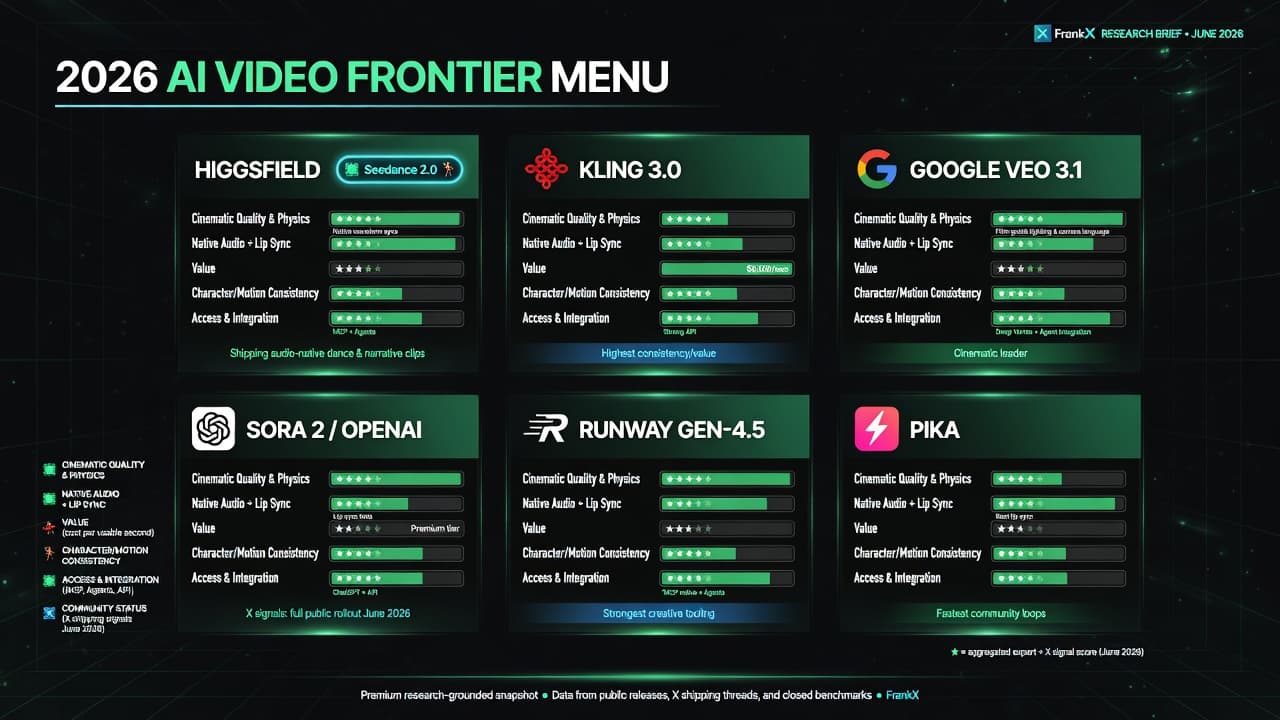
From Latest X Tweets to Blog Gold
The exact process I use to turn real-time X signals (keyword + semantic searches, high-engagement threads, creator workflows) into evergreen, embed-rich, updateable blog posts that driv...
Read article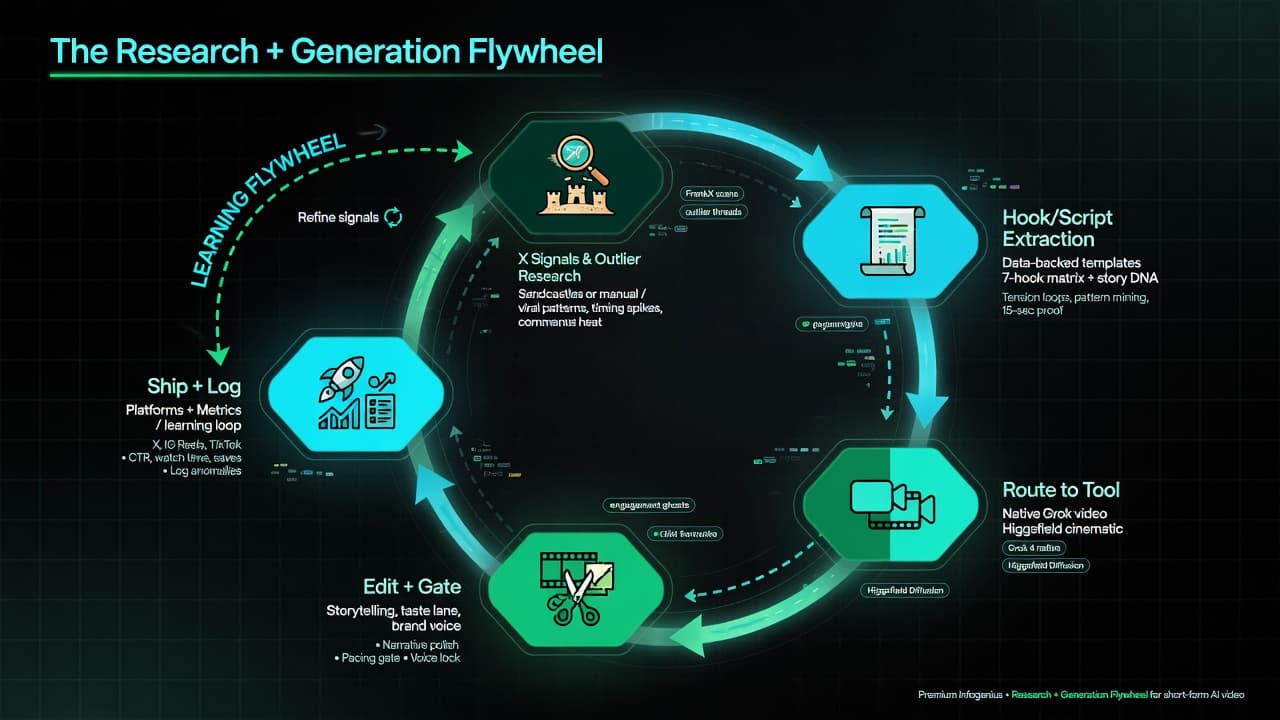
The Research + Generation Flywheel
How data-backed short-form research (Sandcastles or X outlier signals) feeds directly into production (Higgsfield, native Grok video tools, editing).
Read article