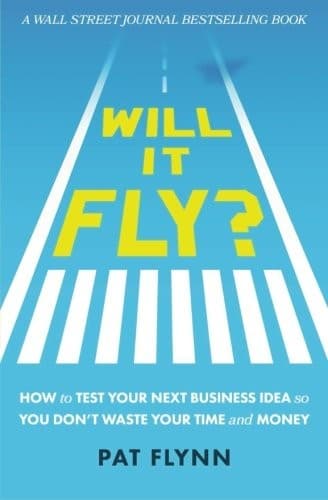
The short answer
Flynn's structured, friendly playbook for testing a business idea before committing to it. Five parts: mission design, development lab, flight planning, flight simulator (validation), and the actual launch. Most useful chapter is the "Place Your Bets" section — a series of escalating tests that surface the truth about whether real customers will pay before you build anything substantial.
Key Insights
- Most business ideas die because nobody validates them with real money before building — pre-validation is the cheapest way to fail or succeed faster
- The "Airport Test" — does your idea solve a specific painful problem for a specific person? — kills bad ideas before they consume time
- A successful productized service starts as a manual service — automate only after you've sold it manually a dozen times
- Pre-orders, deposits, and waitlists are the only validation worth trusting — surveys and "would you buy this?" conversations lie
- Your audience is not a side-effect of your product — it's a precondition. Build the audience first, then sell to it.
Quotes Worth Remembering
11 recorded excerpts. Check the named edition and location before sharing the wording.
Don't fall in love with your business idea. Fall in love with the problem you're solving for someone.
Part One — Mission Design
Flynn's reframe of the "founder passion" trope. Passion for the problem is durable; passion for a specific solution dies the moment the solution doesn't work.
It's much harder to build a business that solves a problem nobody has than one that solves a problem some people have intensely.
Part One — Mission Design
Your idea isn't real until someone has paid for it.
Part Four — The Flight Simulator
The smaller and more specific your audience, the faster you will grow.
Part One — Mission Design
Most validation tests fail not because the idea was bad — but because the test was bad.
Part Four — The Flight Simulator
You're not selling a product. You're selling the result the product produces.
Part Two — Development Lab
A pre-order is the most expensive validation a customer can give you. Take it seriously.
Part Four — The Flight Simulator
Stop guessing what your customer wants. Ask them, watch them, then build it.
Part Three — Flight Planning
You can't expect people to pay for something they don't need.
Part Two — Development Lab
A business is not a hobby. It must serve someone other than you.
Part One — Mission Design
The clearer the problem, the easier the marketing.
Part Two — Development Lab
Chapter-by-Chapter
Each chapter carries a key idea and a short summary, so you can find the argument again.
01Part One — Mission Design
Define the specific problem, the specific person, and the specific aspiration before designing anything.
OpenClose
Flynn's discovery exercises. The Airport Test. The "ideal customer avatar" exercise — a real person, not a demographic. The "what does success look like in 1, 5, 10 years" exercise. The chapter is meant to slow you down before you build, not to be skipped because you're excited.
02Part Two — Development Lab
Build a hypothesis, not a product — and write down the assumptions that must be true for the hypothesis to work.
OpenClose
Flynn walks through structured ideation. Brainstorm-and-cull techniques, the "would I bet $5,000 on this?" test, identifying the riskiest assumptions for each idea, and producing a falsifiable hypothesis: "Customer X will pay $Y for solution Z." If you can't state it that precisely, you're not ready to test.
03Part Three — Flight Planning
Map the specific tests you'll run before committing — and the criteria for pass/fail in advance.
OpenClose
Pre-validation planning. Flynn covers structured customer interviews (without leading questions), competitor analysis (what they do well and badly), and channel hypothesis (where will the customer come from?). The chapter's gold is the "decision tree" — you commit, in advance, to specific outcomes triggering specific next steps.
04Part Four — The Flight Simulator
Sell the product before you build it — pre-orders, deposits, or paid waitlists are the only honest tests.
OpenClose
The book's most actionable chapter. Flynn details five validation tactics: paid pre-orders, deposit-based wait-lists, "buy now" landing pages with click-through tracking, manual service first (productize after), partner pre-sale. Each is a different intensity of commitment from customer. Honest tests force a "yes" with money.
05Part Five — Ready for Takeoff
Launch deliberately with a small dedicated audience first; scale only after you've heard the same praise twice from strangers.
OpenClose
The launch chapter. Flynn covers email-list build (smallest viable launch list), affiliate partner outreach, the staged launch sequence (founders, beta, public), and the post-launch listening period. The framework is anti-Hollywood — small-deliberate-and-listening beats viral-and-scattered.
06Bonus — Common Mistakes and Recovery
Specific antipatterns kill more validations than bad ideas — recognize and avoid them.
OpenClose
Flynn's patterns from coaching readers. Common mistakes: leading questions in customer interviews; surveys instead of money-on-the-table tests; building before validating; obsessing over branding before there's a product; ignoring paying customers because they don't match the avatar. Each gets a specific corrective.
Best For
Frequently Asked Questions
Is Will It Fly? a Lean Startup book?
+
Adjacent. Lean Startup is the canonical text for product-market fit; Will It Fly? is the practitioner's implementation manual focused on solo entrepreneurs and small teams. Lean Startup gives you the principles; Will It Fly? gives you specific scripts, exercises, and templates. Read Ries first if you want the theory; Flynn first if you want the to-do list.
What is the "Airport Test"?
+
Flynn's test for whether your idea is specific enough. Imagine sitting next to someone on a plane. Can you describe what you do, who it's for, and what specific problem it solves in 30 seconds, without buzzwords? If yes, your idea is concrete. If no, you don't have an idea yet — you have a category.
What is the "Place Your Bets" sequence?
+
Flynn's escalating-validation framework. Bet 1: free conversations with target customers. Bet 2: pre-orders or deposits without a finished product. Bet 3: paid betas with a minimum-viable version. Bet 4: full launch. Each bet costs more time/money and demands more commitment from customers. Pass each gate before raising the next bet.
Is the book mainly for online businesses?
+
Mostly, yes. Flynn's background is online (Smart Passive Income blog/podcast). Most examples are courses, ebooks, productized services, software, and content businesses. The validation framework adapts to physical products, but readers in restaurant/manufacturing/local-service should expect to translate.
How long does the validation process take?
+
Flynn argues 2-6 weeks for most validation. Some businesses validate in a weekend with a Google AdWords + landing-page test. Larger businesses (B2B, regulated industries) take 2-3 months. The point isn't speed — it's avoiding 6 months of building without ever talking to a customer.
Continue Reading
If Will It Fly? opened a door, these books walk you through it. Curated for reason, not algorithm — each entry explains why it pairs with this book.
Superfans
by Pat Flynn
Flynn's 2019 sequel. Will It Fly? validates the idea; Superfans grows the audience that pays for it. The natural next book.
Get the bookThe Lean Startup
by Eric Ries
The canonical text on validation. Ries gives you the theory; Flynn gives you the implementation. Read Ries for the rigor; Flynn for the to-do list.
Get the bookThe Mom Test
by Rob Fitzpatrick
Specifically on customer interviews — how to ask questions that actually surface truth, not validation-friendly noise. Required for Flynn's Part Three to work.
Get the bookThe 4-Hour Workweek
by Tim Ferriss
Ferriss's muse-validation framework prefigures Flynn's. Different vocabulary, similar method. Read together for the breadth of practitioner-validation thinking.
Get the bookCompany of One
by Paul Jarvis
The principled small-business book. Flynn's solo-entrepreneur audience overlaps; Jarvis articulates the philosophy of staying small that makes Flynn's validation discipline matter.
Get the bookThe E-Myth Revisited
by Michael Gerber
Gerber's framework — work on the business, not in it — is the post-validation systemization Flynn alludes to. After Will It Fly? validates the idea, E-Myth shows how to scale it.
Get the bookGo Deeper — Videos
Each link opens a YouTube search for this book. Pick a named speaker before you treat a recording as a source.
Pat Flynn — Smart Passive Income Podcast
Pat Flynn
Flynn's long-running podcast — the natural extension of his books. Specific case studies of validators succeeding and failing in real time.
Will It Fly? — Pat Flynn (Talk)
Pat Flynn
Flynn presenting the book's framework live. Most useful for readers who want the visual and verbal version of the validation flowchart.
Pat Flynn — How to Validate a Business Idea
Pat Flynn
Compressed walkthrough of the Will It Fly framework. Best for readers who want the validation core in 30 minutes before reading the full book.
Pat Flynn on the Tim Ferriss Show
Tim Ferriss Show
Long-form Ferriss interview. Wider context — Flynn's career arc, business model evolution, lessons from coaching thousands of readers through validation.
If You Liked This, Read Ours
Our Book
The Great Transition
Building in the Age of AI
A clear-eyed guide to the shift happening now — from employment to ownership, from credentials to capability. Eight chapters on what to build, why now, and how to position yourself.
Read freeThe FrankX Newsletter
One book breakdown like this. One spotlight from the operating loop. Every Friday.