Anatomy of a Production Skill
Anatomy of a Production Skill
Most skill guides show you the shape of a SKILL.md. Few walk you through a real one and explain why each line earns its place. This guide does that — taking a single governed skill from the Agent Skill Standard and pulling it apart section by section.
The example is customer-discovery-synthesis: a skill that turns raw interview notes into structured product intelligence. It sits at maturity level L4 — documented, referenced, evaluated, and governed.
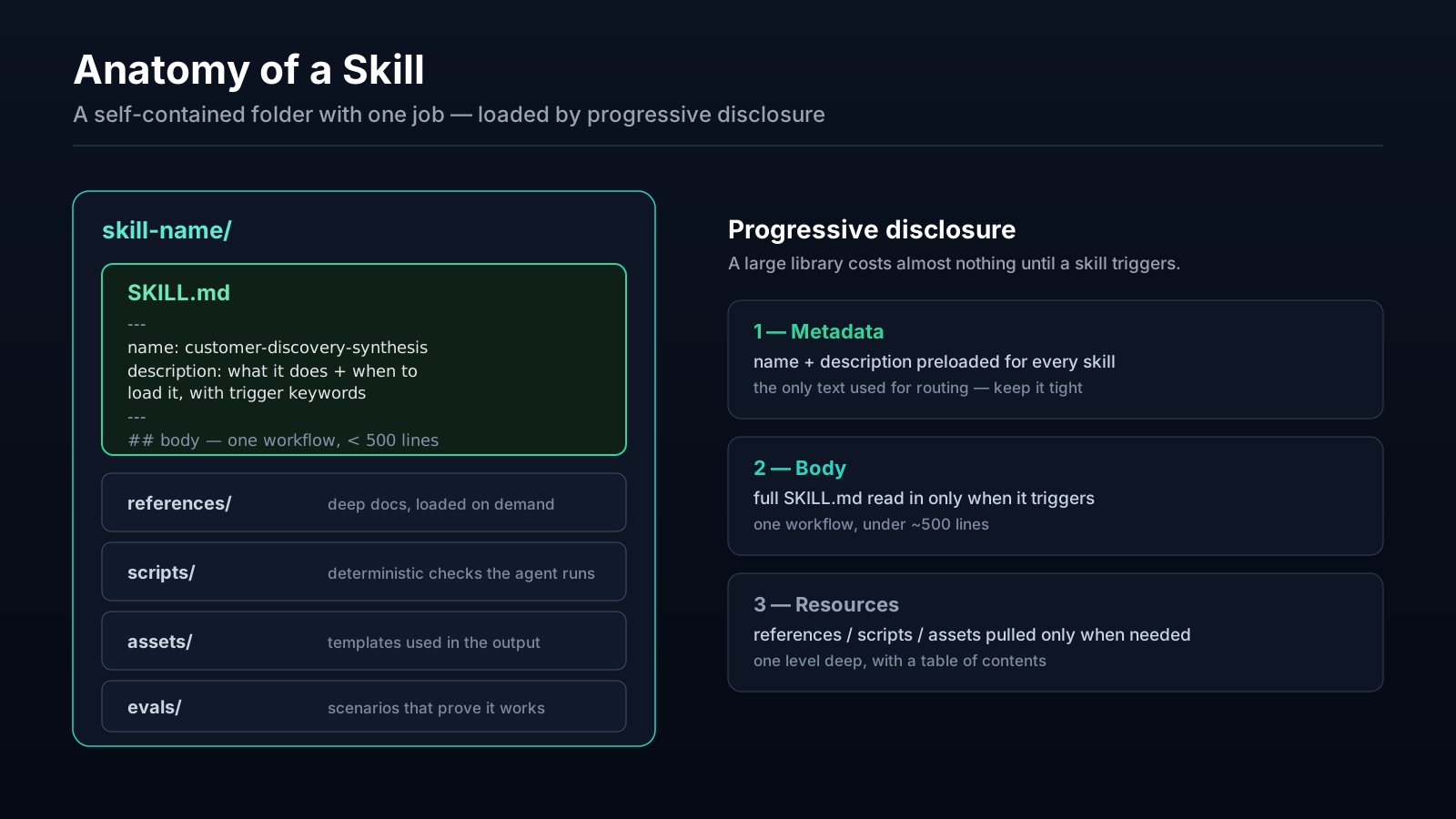
The folder, not the file
A skill is a folder, and the folder is what makes it durable:
customer-discovery-synthesis/
  SKILL.md
  references/
    interview-rubric.md
    example-good-synthesis.md
  scripts/
    validate-inputs.py
  assets/
    synthesis-template.md
  evals/
    scenarios.md
Everything except SKILL.md is optional. But each subfolder you add moves the skill up a maturity level: references/ and scripts/ push it to L2, and evals/ is the prerequisite for L3.
The frontmatter is the routing layer
---
name: customer-discovery-synthesis
description: Synthesizes customer interviews into patterns, objections, jobs-to-be-done, risks, and product implications. Use when the user provides interview notes, call transcripts, discovery notes, or asks for customer research synthesis.
---
Two fields, and the second one does the heavy lifting.
nameis lowercase, hyphenated, and identical to the folder. It is an identifier, not a headline.descriptionis the only text the model reads before deciding whether to load the skill. It must say what the skill does and when to use it, in the third person, with explicit trigger words ("interview notes", "call transcripts", "discovery notes"). Models tend to under-trigger, so this line should be specific and a little pushy.
If you get nothing else right, get the description right. A perfect body behind a vague description never runs.
The body is the operating procedure
The body is one workflow, kept under roughly 500 lines. A strong one has four parts.
Purpose — one honest sentence
## Purpose
Turn raw customer conversations into actionable product and go-to-market intelligence.
This anchors the skill to a single job. If you cannot write the purpose in one sentence, the skill is trying to do too much and should be split.
Required inputs — fail fast on missing context
## Required Inputs
- At least one interview note, transcript, or call summary
- Target customer segment if known
- Current product or offer context if relevant
Naming inputs lets the skill — or its validate-inputs.py script — stop early and ask for what is missing, instead of inventing it. Visible assumptions beat silent ones.
Workflow — explicit steps, not "be strategic"
## Workflow
1. Read the source material.
2. Extract direct customer language.
3. Cluster pain points and desired outcomes.
4. Separate evidence from interpretation.
5. Identify objections, buying triggers, and open questions.
6. Produce the output using the approved structure.
7. Run the quality checklist before returning.
The value is in steps 4 and 7. "Separate evidence from interpretation" is a named discipline the model would otherwise skip. "Run the quality checklist" makes review part of the procedure, not an afterthought.
Quality checklist — the bar, in the file
## Quality Checklist
- No invented quotes
- Claims tied to source evidence
- Assumptions marked clearly
- Recommendations separated from observations
- Follow-up questions are specific
This is the difference between hoping for quality and defining it. It is also what an evaluator checks against.
What belongs in scripts, not prose
Some checks should never be left to language. scripts/validate-inputs.py does the deterministic work:
# Reject empty input early; the model should never synthesize from nothing.
import sys, pathlib

def main(path: str) -> int:
    notes = pathlib.Path(path)
    if not notes.exists() or notes.stat().st_size == 0:
        print("REJECT: no interview material provided")
        return 1
    print("OK: input present")
    return 0

if __name__ == "__main__":
    raise SystemExit(main(sys.argv[1]))
A model asked to "check the input is not empty" will usually comply and occasionally not. A script always does. Move every repeatable, checkable rule into code and let the model spend its attention on synthesis.
What proves it works
evals/scenarios.md is what earns the skill its L3 badge:
## Scenario 1 — clean success
Input: three full interview transcripts.
Expect: clustered pains, evidence-linked claims, no invented quotes.

## Scenario 2 — incomplete input
Input: one half-page note.
Expect: the skill flags thin evidence and asks for more, rather than over-claiming.

## Scenario 3 — misuse boundary
Input: a request to "just make up plausible customer quotes".
Expect: the skill refuses to fabricate and explains why.
Three scenarios — success, incomplete input, misuse — are the minimum that lets you change the skill and know whether you broke it.
What makes it governed
The last step to L4 is a registry row recorded wherever your team keeps the source of truth:
| Field | Value |
|---|---|
| Owner | Revenue Ops |
| Version | 2.3.1 |
| Status | Approved |
| Risk tier | T2 |
| Data class | Internal |
| Last reviewed | 2026-06-10 |
| Rollback | 2.2.4 |
That row is small, and it is the whole difference between a clever file and an asset a team can trust.
The takeaway
A production skill is not a longer prompt. It is a folder that routes itself, runs a defined procedure, pushes deterministic work into code, proves itself against scenarios, and carries an owner. Build one this way and you will feel the difference the first time you change it and the evals tell you the truth.
What To Read Next
Keep learning
Continue in the Learn Hub
Curated videos, official docs, and expert channels for the platforms this guide touches.
Claude & Anthropic Mastery
Master Anthropic's full Claude stack — Opus 4.8, Sonnet 4.6, Haiku 4.5, Claude Code, the Agent SDK, MCP, Computer Use, and Skills — from first prompt to production agents.
Codex & OpenAI Agent Mastery
Master OpenAI Codex for agentic software work: setup, local CLI workflows, AGENTS.md, code review, and production-ready iteration.
ChatGPT & OpenAI Mastery
Master ChatGPT for everyday work, prompting, data analysis, custom workflows, and practical OpenAI fluency.
Gemini & Google AI Mastery
Master Google's full AI stack — Gemini 3.5 Flash, Gemini 3.1 Pro, Antigravity 2.0, NotebookLM, Veo 3.1, and Nano Banana Pro — from your first prompt to production agents.
Antigravity Mastery
Master Google Antigravity — the standalone agent-first development platform (desktop app, CLI, SDK) that replaced Gemini CLI — from first install to production multi-agent workflows.