The Skill Creation Methodology
The Skill Creation Methodology
This guide is a field method for building AI skills that actually compound. It is the authoring method behind the Agent Skill Standard — an open specification I steward rather than brand, so the practice belongs to the ecosystem, not to one name.
It is built with gratitude for the people and teams moving this space forward: Anthropic for making Agent Skills concrete, the open-source builders publishing working examples, the AI teams stress-testing these ideas in production, and the operators turning raw model capability into useful work.
The move here is additive. We do not need to subtract from the work already done. We can stand on it, learn from it, and raise the operating standard.
Anthropic's Agent Skills gave the ecosystem a clean primitive: a folder with a SKILL.md file, metadata, instructions, and optional references, scripts, and assets. The official repository and documentation show the anatomy. The deeper opportunity is to turn that primitive into a full skill creation methodology: one that supports solo builders, startup teams, and enterprise AI Centers of Excellence.
That is what this guide covers.
The Core Thesis
The next AI advantage is not better prompting.
It is the ability to convert repeatable work into reusable, evaluated, governed operating knowledge.
Prompts are useful. They are also fragile. They live in chats, docs, bookmarks, private memory, and half-remembered workflows. A skill is different. A skill packages a workflow so an AI agent can recognize when to use it, load the right context, run deterministic checks, follow a quality standard, and produce a result that a team can trust.
The method treats skills as operating knowledge units.
Each skill should answer:
- What repeatable work does this encode?
- Who benefits from the output?
- When should the agent use it?
- What references matter?
- What steps must not be skipped?
- What should be verified by code instead of language?
- What quality bar does the output need to meet?
- What risk does this introduce?
- Who owns it?
- How do we know it still works?
If those answers are missing, the asset is not yet a real skill. It is a prompt with a folder around it.
The Five Layers
The method has five layers. Each one is a checkpoint a skill must clear before it earns the next maturity level in the standard.
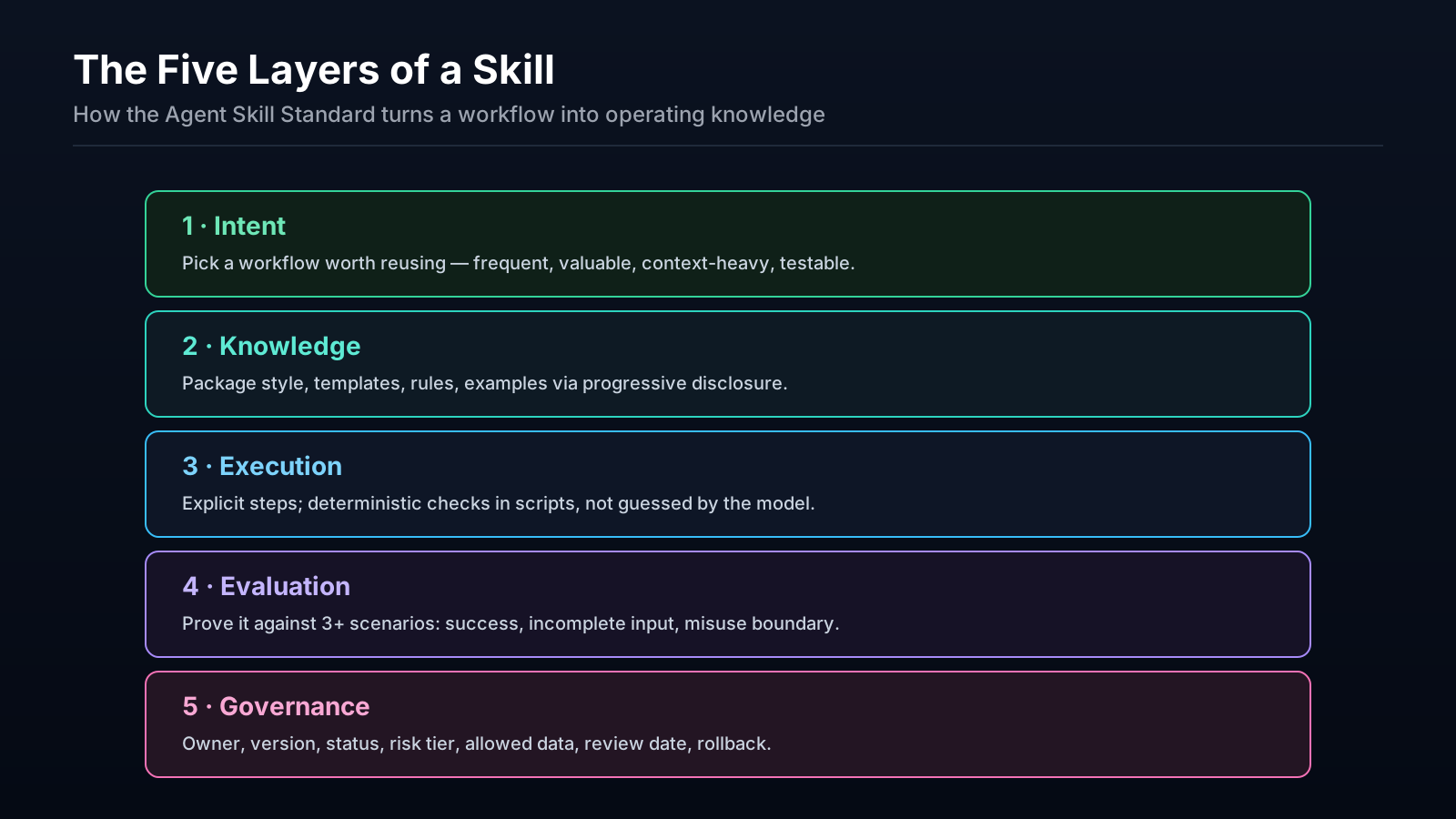
1. Intent
Start with the work, not the file structure.
The first question is not "What should the SKILL.md say?" The first question is "Which workflow deserves to become reusable?"
Good candidates are:
- frequent
- valuable
- context-heavy
- teachable
- easy to evaluate
- painful when done inconsistently
Poor candidates are:
- vague
- rarely used
- dependent on hidden judgment
- too broad to test
- risky without clear approval gates
Example of a weak intent:
Help with content.
Example of a strong intent:
Turn a research brief into a founder-grade blog post with a clear thesis, practical examples, internal links, source notes, and a final quality checklist.
The second version can become a skill. The first version is an aspiration.
2. Knowledge
Every useful skill carries knowledge the agent should not have to rediscover.
That knowledge may include:
- style guides
- templates
- pricing rules
- evaluation rubrics
- examples of good work
- examples of bad work
- customer language
- product constraints
- compliance language
- architecture patterns
- team preferences
- decision rules
The main SKILL.md should not become a giant knowledge dump. Use progressive disclosure:
- Put routing and workflow instructions in
SKILL.md. - Put deeper references in
references/. - Put reusable templates in
assets/. - Put deterministic checks in
scripts/.
The skill should feel like a smart onboarding guide for a new teammate: clear enough to act, structured enough to scale, and humble enough to know when to look up the source material.
3. Execution
A skill must tell the agent what to do.
Not "be strategic."
Not "write high quality output."
Actual steps:
- Read the brief.
- Validate required inputs.
- Load the relevant reference file.
- Draft the output in the approved structure.
- Run the checklist.
- Mark assumptions.
- Return the result with next actions.
For deterministic work, use scripts:
- validate required fields
- parse a document
- compare schemas
- check word count
- scan for banned phrases
- verify links
- calculate metrics
- inspect a repository
- generate a report
Language models are excellent at synthesis. They should not be asked to manually perform every repeatable check that code can perform better.
4. Evaluation
Skills need proof.
At minimum, create three evaluation scenarios:
- a clean success case
- an incomplete input case
- a misuse or boundary case
For serious use, evaluate:
- trigger accuracy
- false positives
- step adherence
- reference loading
- script usage
- output quality
- policy compliance
- coexistence with other skills
- regression across versions
The quality bar is simple: a skill is not ready because it worked once. It is ready when it works repeatedly against representative tasks.
5. Governance
Skills are operational artifacts. They deserve ownership.
Every shared skill should have:
- name
- purpose
- owner
- version
- status
- risk tier
- intended users
- required tools
- allowed data
- evaluation set
- last reviewed date
- rollback version
For a founder, this can be a simple table.
For a startup, this should live in the repo.
For an enterprise, this belongs in the AI Center of Excellence operating model.
The Maturity Model
The five layers tell you what to build. The maturity model tells you where a skill stands today and what it needs next. The Agent Skill Standard defines six levels.
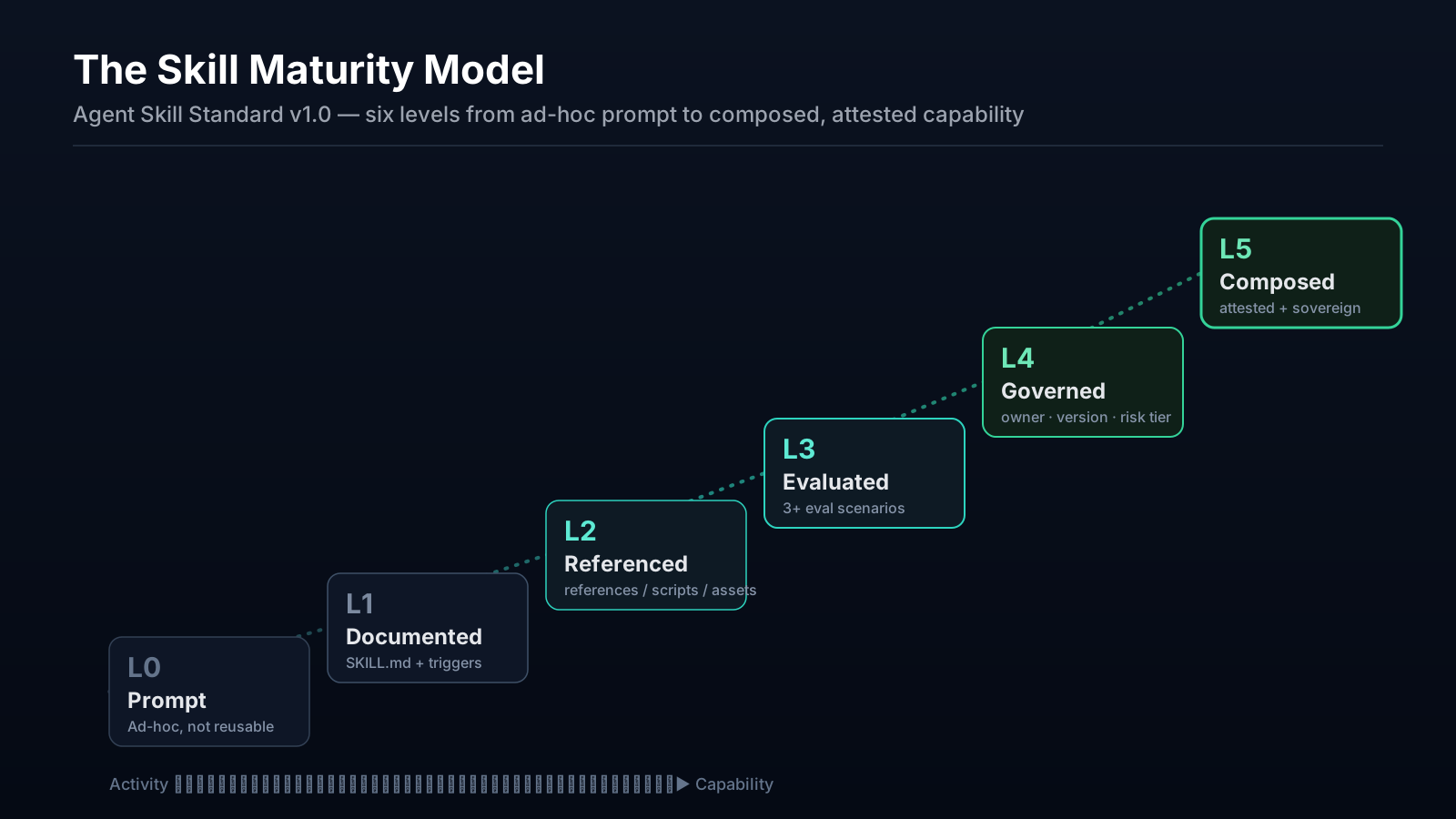
| Level | Name | What it adds |
|---|---|---|
| L0 | Prompt | An ad-hoc instruction. Useful, not reusable. |
| L1 | Documented | A valid SKILL.md with a name, a description full of trigger language, and one narrow job. |
| L2 | Referenced | Progressive disclosure: references/, scripts/, and assets/ instead of one giant file. |
| L3 | Evaluated | At least three eval scenarios — success, incomplete input, and a misuse boundary. |
| L4 | Governed | A registry entry: owner, version, status, risk tier, allowed data, review date, rollback. |
| L5 | Composed | Safe composition with other skills, plus attestation and a clear sovereignty boundary. |
Most teams live at L0 and L1. Durable capability starts at L3, because that is where a skill stops depending on luck. Treat the jump from L1 to L3 as the real work.
The Skillforge Canvas
Use this canvas before writing the skill.
| Field | Question |
|---|---|
| Workflow | What repeatable work are we encoding? |
| User | Who will use or benefit from it? |
| Trigger | What should cause the skill to load? |
| Inputs | What must the agent know before acting? |
| References | Which files, policies, examples, or templates matter? |
| Procedure | What steps must happen in order? |
| Scripts | What should code validate or generate? |
| Output | What does the finished artifact look like? |
| Quality bar | What must be true before delivery? |
| Risk tier | What can go wrong? |
| Owner | Who maintains this? |
| Evals | How do we test it? |
If the canvas is weak, the skill will be weak.
Folder Standard
Recommended structure:
skill-name/
  SKILL.md
  references/
    style-guide.md
    examples.md
    policy.md
  scripts/
    validate-inputs.py
    check-output.py
  assets/
    template.md
  evals/
    scenarios.md
Not every skill needs every folder. But every important skill needs the discipline behind them.
Use references/ when the content is too detailed or situational for the main file.
Use scripts/ when an operation should be deterministic.
Use assets/ when there is a reusable template or source artifact.
Use evals/ when the skill will be shared or maintained over time.
The SKILL.md Standard
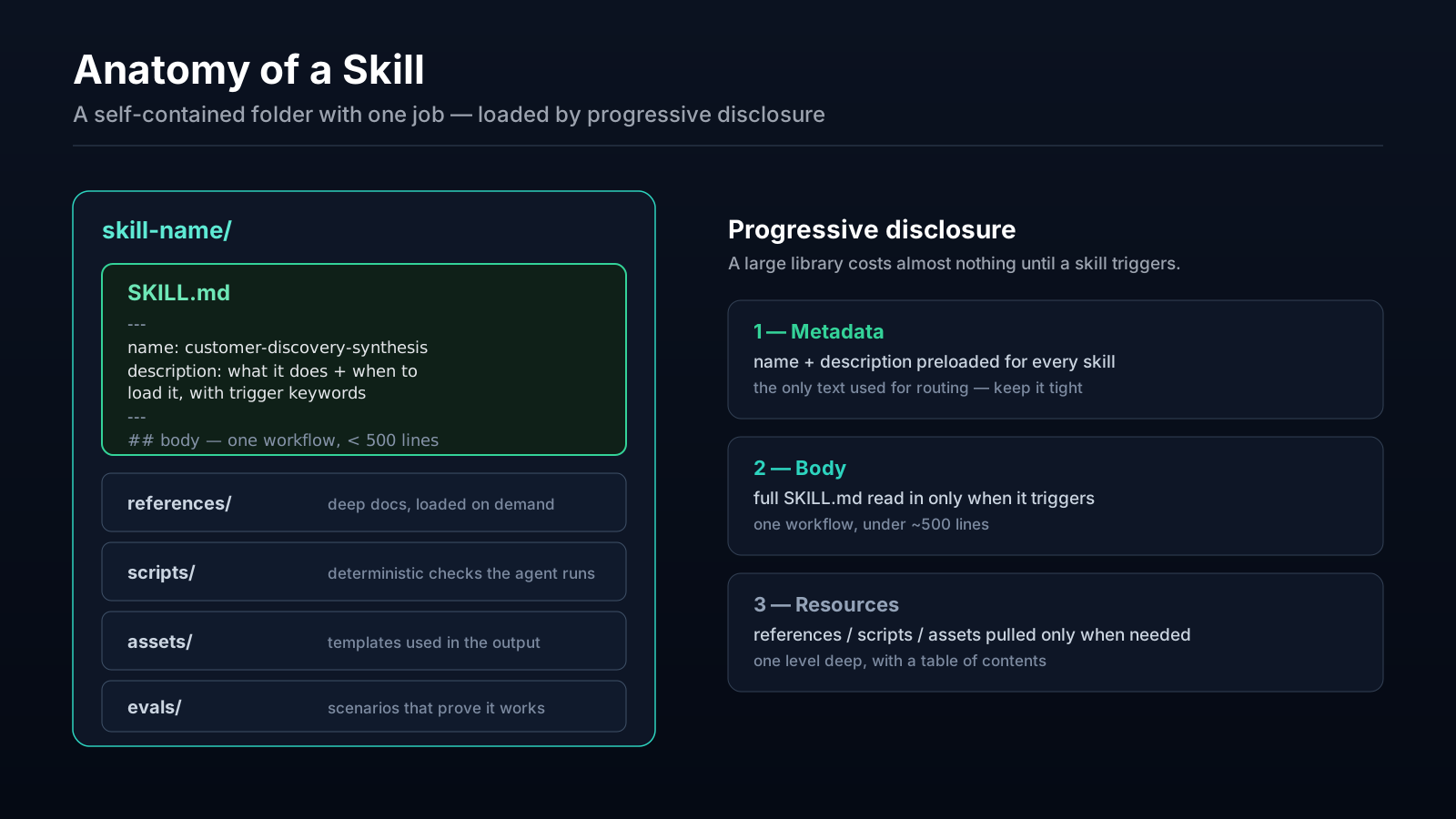
A strong SKILL.md has this shape:
---
name: customer-discovery-synthesis
description: Synthesizes customer interviews into patterns, objections, jobs-to-be-done, risks, and product implications. Use when the user provides interview notes, call transcripts, discovery notes, or asks for customer research synthesis.
---

# Customer Discovery Synthesis

## Purpose

Turn raw customer conversations into actionable product and go-to-market intelligence.

## Required Inputs

- At least one interview note, transcript, or call summary
- Target customer segment if known
- Current product or offer context if relevant

## Workflow

1. Read the source material.
2. Extract direct customer language.
3. Cluster pain points and desired outcomes.
4. Separate evidence from interpretation.
5. Identify objections, buying triggers, and unresolved questions.
6. Produce the output using the approved structure.
7. Run the quality checklist before returning.

## Output Structure

- Executive summary
- Customer language
- Pain patterns
- Desired outcomes
- Objections
- Product implications
- Sales implications
- Follow-up questions

## Quality Checklist

- No invented quotes
- Claims tied to source evidence
- Assumptions marked clearly
- Recommendations separated from observations
- Follow-up questions are specific
The description matters because it is the routing layer. The body matters because it is the operating procedure.
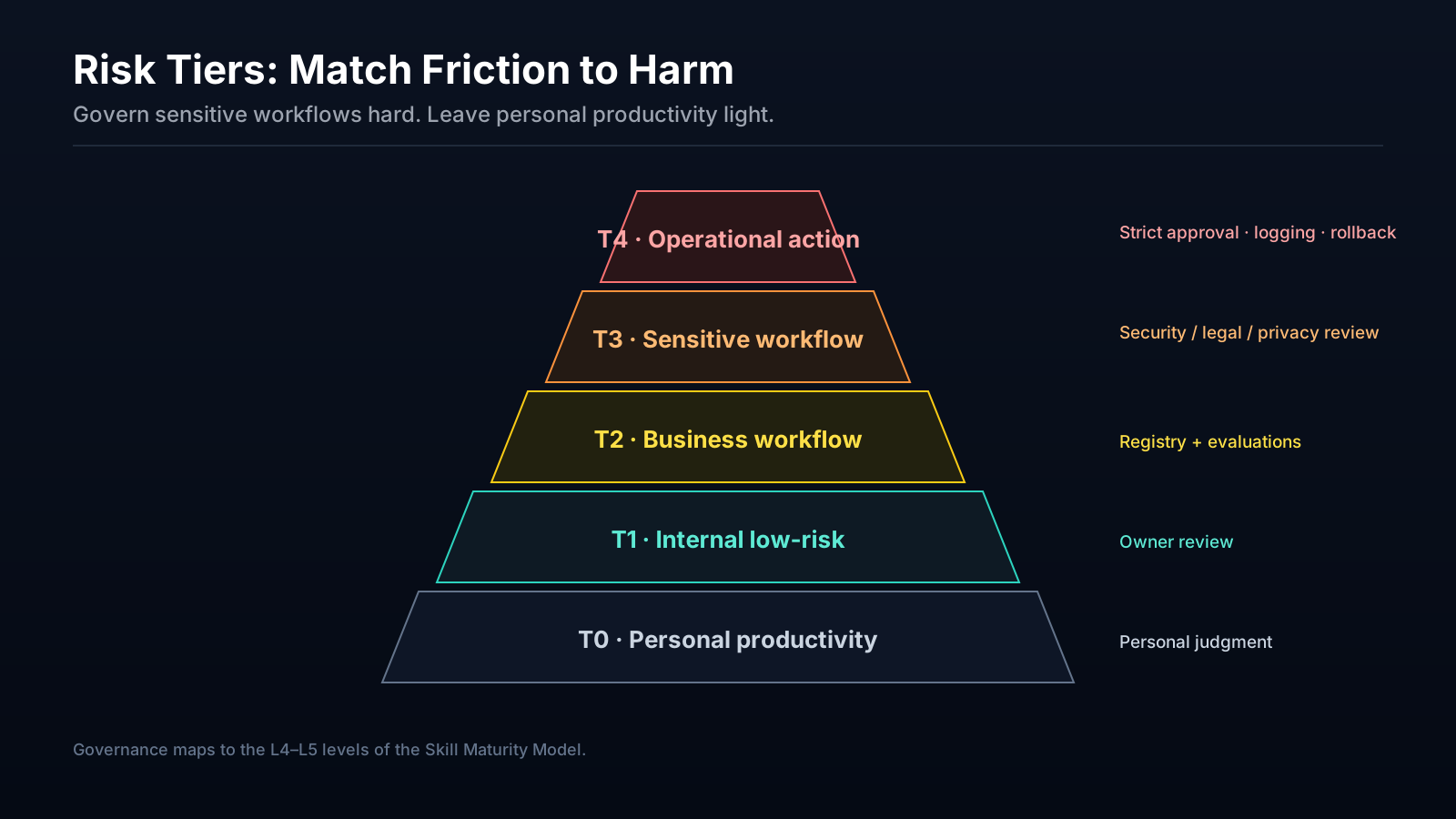
Risk Tiers
Use a simple risk model.
| Tier | Skill Type | Example | Standard |
|---|---|---|---|
| 0 | Personal productivity | Summarize notes | Personal review |
| 1 | Internal low-risk | Draft internal docs | Owner review |
| 2 | Business workflow | Proposal, PRD, support analysis | Registry + evals |
| 3 | Sensitive workflow | Legal, HR, finance, customer data | Formal review + approval gates |
| 4 | Operational action | Production, billing, security response | Strict controls + logging |
Do not over-govern simple work.
Do not under-govern sensitive work.
The craft is matching friction to risk.
The Conformance Bar
A skill conforms to the standard when:
- it has a narrow job
- it has explicit trigger language
- it names required inputs
- it separates evidence from interpretation
- it uses references instead of relying on memory
- it uses scripts for deterministic checks
- it has real examples
- it includes anti-patterns
- it has a quality checklist
- it can be evaluated
- it has an owner
A skill is weak when:
- it tries to cover a whole department
- it says "use best practices" without defining them
- it hides important knowledge in vague language
- it cannot be tested
- it has no data boundary
- it creates outputs nobody reviews
- it depends on the agent guessing the real workflow
How This Connects to an AI CoE
An AI Center of Excellence should not only govern models and tools. It should govern reusable operating knowledge.
For skills, the CoE should maintain:
- a skill registry
- role-based skill bundles
- naming standards
- evaluation requirements
- risk tiers
- approval paths
- deployment rules
- version history
- deprecation rules
The CoE should also prevent the common failure mode: becoming a bottleneck.
The right model is central standards, federated execution. The CoE sets the operating system. Teams ship within it.
Startup Version
For a startup, keep this lightweight:
- one shared
skills/repository - one owner per skill
- three eval scenarios per skill
- one monthly review
- risk tiers only for sensitive work
- a simple registry table
The first startup skills should come from recurring leverage:
- customer discovery synthesis
- PRD builder
- release note writer
- sales proposal builder
- support escalation analyst
- investor update generator
- weekly operating review
Enterprise Version
For an enterprise, skills become part of AI operating governance.
Add:
- security review for third-party skills
- source control and signed commits
- version pinning
- rollback plan
- cross-surface distribution management
- audit logs where tools are involved
- legal/privacy review for sensitive workflows
- coexistence tests for active skill bundles
Enterprises should also design role-based bundles:
- sales
- engineering
- support
- legal
- finance
- HR
- executive operations
The goal is not to activate every skill for everyone. The goal is to make the right operating knowledge available to the right people at the right moment.
The Book Perspective
This guide is the seed of a larger book.
Working title:
Operating Knowledge: How to Build AI Skills, Agents, and Centers of Excellence That Compound
Possible structure:
- The end of prompt chaos
- Skills as operating knowledge
- The anatomy of a useful skill
- Progressive disclosure and context design
- Scripts, references, and deterministic checks
- Evaluation as the new craft
- Skill libraries for founders
- Skill registries for startups
- AI CoE governance for enterprises
- Security and semantic supply-chain risk
- Role-based bundles and agent teams
- The future: self-improving operating systems
The book should not be another tool guide. It should be a standard for how serious builders turn AI into durable capability.
What To Read Next
- AI Skills Are the New Operating Layer
- How to Govern an AI Skill Library
- Building Custom Skills for ACOS
- Why Everyone Needs Their Own AI Center of Excellence
- Agent Card A2A Spec
- Research: Agent Skills as Operating Knowledge
- Agent Skill Standard (open spec)
- Research Hub
Source Base
Keep learning
Continue in the Learn Hub
Curated videos, official docs, and expert channels for the platforms this guide touches.