Vibe OS: Engineering Neuro-State with the RPM Model
TL;DR
Stop treating AI audio like a slot machine. Use the RPM Model to engineer the biological state of your users. Here is specific code for your prompt strategy.

You'll learn actionable architectural frameworks, core implementation steps, and production strategies for vibe os engineering neurostate with the rpm model.
Vibe OS: Engineering Neuro-State with the RPM Model
You are ignoring the most powerful variable in your tech stack. It’s not your model context window. It’s not your latency. It’s Biology.
When a user opens your app, their brain is vibrating at a specific frequency. Usually, it's the wrong one—fractured, anxious, high-beta noise. Your job isn't to show them a UI. Your job is to change their state.
Most creators treat AI music (Suno, Udio) like a jukebox. You type "Lo-fi beats," hit generate, and get background muzak. That is failure. Here is how you stop guessing and start engineering.
The RPM Shift: Don't Ask for a Song
Tony Robbins’ RPM (Result, Purpose, Map) isn't just for productivity. It is the physics of intent. Apply it to audio, and you stop getting "songs" and start getting drugs.
1. Result: Define the Neuro-Target
Don't tell the AI you want "Jazz." The AI doesn't know what "Jazz" does to a human nervous system. Tell yourself: What is the specific listening intention?
- The Bad Prompt: "Make me upbeat coding music."
- The Vibe OS Target: "I need to drive the user's brain waves from 20Hz (Beta/Stress) down to 10Hz (Alpha/Flow) within 45 seconds to prevent rage-quitting the onboarding flow."
See the difference? One is a genre. The other is a prescription.
2. Purpose: The Strategic "Why"
Why does this audio exist? If you can't answer this, play silence.
- Purpose: urgency without anxiety.
- Scenario: Your user is in a checkout flow. You want them to move fast (Urgency) but feel safe (Trust).
- The Sonic Translation: You need a driving tempo (110 BPM) but zero dissonance. No minor 2nds. No sharp transients. Just warm, rolling forward momentum.
3. Map: The Topological Formula
Now—and only now—do you write the prompt. You map your neuro-target to the four vectors the LLM understands: Time, Key, Texture, Shape.
The "Deep Work" Formula
You want to keep a developer in the zone for 4 hours.
- Vector 1 (Time):
122 BPM, steady 4/4 kick, minimal syncopation.(Syncopation demands attention; steady beats regulate it). - Vector 2 (Key):
D Dorian Mode.(It's not as happy as Major, not as sad as Minor. It is "Serious/Focused"). - Vector 3 (Texture):
Brown noise layer, tape saturation, Rhodes piano with low-pass filter at 800Hz.(High frequencies trigger alertness; we want to cut them).
Your Prompt:
"Genre: Deep House Focus. BPM: 122. Inst: Muted kick drum, warm analog bass, rhodes chords (D Dorian), continuous brown noise bed. Texture: Lo-fi, dusty, rolled-off highs. No vocals. Continuous loop object."
The "Show, Don't Tell" Test
Run that prompt. Do you feel the difference? A generic "Study Beats" track plays a melody that distracts you. The Vibe OS track disappears. It becomes furniture for your mind. It holds you in the pocket.
Your Move
Stop playing the slot machine. Look at your product. Identify the friction points where users drop off due to stress, boredom, or fear. Then, don't just fix the UX. Score the emotion. Prescribe the Result. Define the Purpose. Build the Map. Engineers write code. Architects design Vibe.
Related Articles
- The FrankX Intelligence Ecosystem — How Vibe OS fits in the full stack
- The Science of State Change Music — Research behind the sound
- Music as Consciousness Technology — 12,000 songs later
- Suno Prompt Engineering Guide — Create with intention
Build your first AI system
Step-by-step guide to setting up ACOS, creating your first agent, and shipping real products with AI.
Start buildingProduction-ready architecture
Download AI architecture templates, multi-agent blueprints, and prompt engineering patterns.
Browse templatesJoin the builder community
Connect with creators and architects shipping AI products. Weekly office hours, shared resources, direct access.
Join the circle
Read on FrankX.AI — AI Architecture, Music & Creator Intelligence
Stay in the intelligence loop
Weekly field notes on AI systems, production patterns, and builder strategy.
Continue Reading
Best Cheap AI Music Generator 2026: Free Tiers and Commercial Rights Compared
A creator with 12,000+ AI songs compares the cheapest AI music generators in 2026 — Suno, Udio, AIVA, Riffusion, Soundraw, Mubert — on price, free-tier limits, and the one thing that de...
Read article
Suno vs Udio 2026: Which AI Music Tool Is Safe to Release Commercially
After 12,000+ AI songs, here's the honest 2026 verdict on Suno vs Udio — and the licensing change that makes one of them risky to release commercially right now.
Read article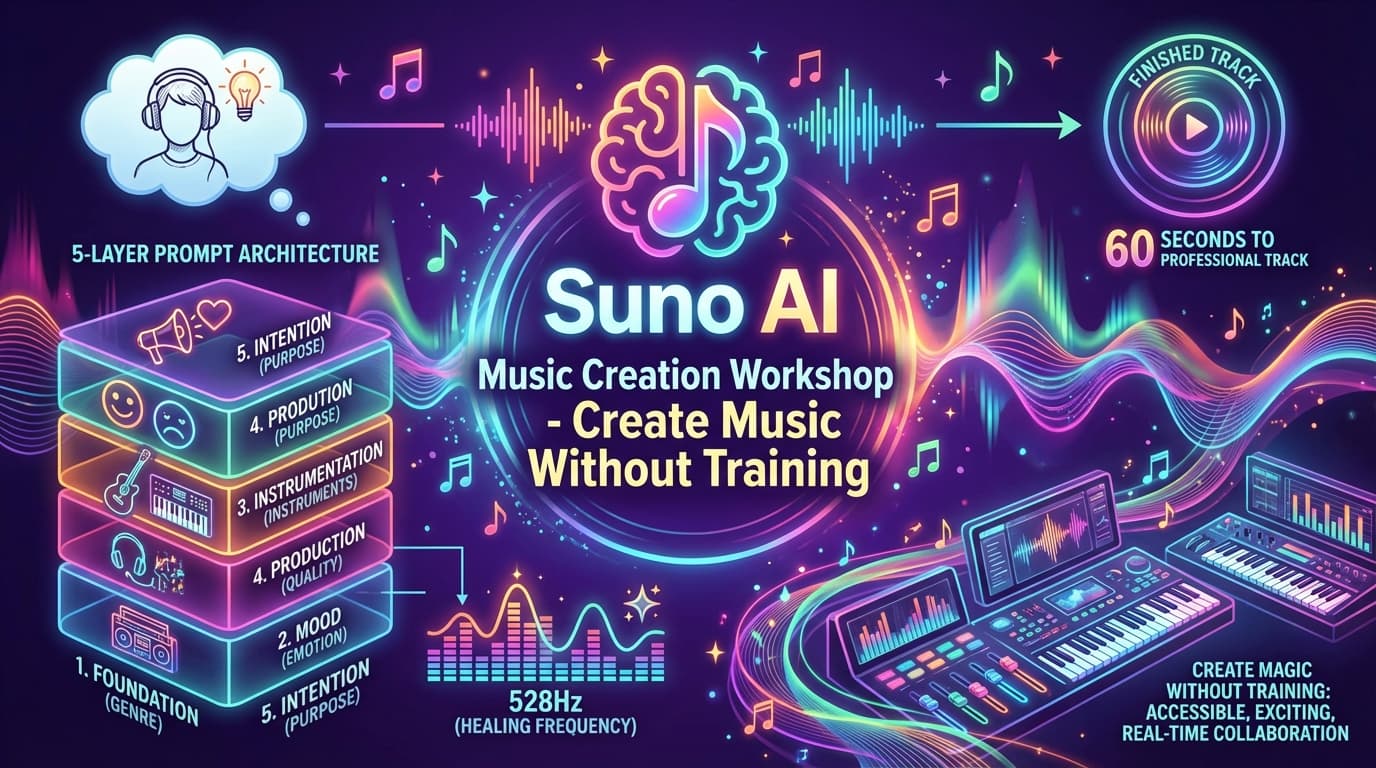
Create Music Without Musical Training: The Suno AI Music Creation Workshop
Transform your ideas into cinematic soundscapes, meditation-inspired music, and motivation anthems using AI. Learn the 5-Layer Prompt Architecture and aesthetic tuning choices for expressive audio.
Read article