Reality Architecture: From Mental Rehearsal to Shipped Work
TL;DR
Generative AI can shorten the distance from an idea to an inspectable artifact. Mental rehearsal can prepare action in bounded contexts. Neither guarantees market truth; founders still need tests, feedback, and judgment.

Use mental rehearsal and generative AI without confusing a faster prototype with a validated reality.
Reality Architecture is a practical loop:
Imagine → Externalize → Inspect → Test → Update
The phrase is symbolic. The work is operational.
Generative AI makes it cheaper to turn a thought into copy, a diagram, a prototype, a sound, or a working interface. That changes the economics of exploration. It does not remove customers, constraints, evidence, or consequence.
Established: mental imagery can prepare performance
Mental practice has evidence in specific motor-learning and performance settings. It is not the same as lived experience, and its effects depend on the task, population, design, and whether it is combined with physical practice.
- Review of motor-imagery practice and learning
- Systematic review and meta-analysis of imagery practice in athletes
For founders, the safest translation is rehearsal:
- walk through a sales call before the call;
- simulate the questions an investor or customer may ask;
- rehearse the product demo and the failure path;
- picture the operating week after the launch, not only the launch itself.
Rehearsal can reveal missing steps. It cannot tell you whether a customer will buy.
Established: external artifacts improve inspection
An idea held only in the founder’s head is difficult for anyone else to challenge. A written brief, diagram, clickable flow, or prototype creates an object that can be inspected.
Generative AI is useful here because it reduces the cost of the first artifact. The important shift is not “the machine materialized reality.” It is “the team can now react to something concrete.”
Experiential: the founder becomes an editor of possibilities
In my own work, the highest-leverage use of generative tools is rarely the first output. It is the speed of comparison:
- state the intent;
- generate several materially different approaches;
- identify what each approach assumes;
- combine only the parts that survive inspection;
- test the result outside the model.
This is closer to directing and editing than pressing a manifestation button.
The five-stage founder loop
1. Imagine the operating scene
Describe what happens, who acts, what changes, and what could fail. Avoid grand adjectives and friction-free promises. They hide missing mechanics.
2. Externalize more than one direction
Ask for three distinct approaches, not three surface variations. A useful direction changes the structure, audience path, or operating assumption.
3. Inspect the hidden claims
For every output, ask:
- What fact is assumed?
- What user behavior must occur?
- What is being promised?
- Which part is evidence, inference, or taste?
- What breaks under low attention, low trust, or a small screen?
4. Test one consequential uncertainty
Do not validate the pixels while ignoring the business. Test the uncertainty that could invalidate the work: willingness to pay, comprehension, delivery, trust, retention, or technical feasibility.
5. Update the model
Treat feedback as a prediction error, not an attack on the vision. The founder’s job is to preserve the important intent while releasing the unsupported implementation.
Manifestation, translated without cosmology
On FrankX, manifestation can be used as an experiential shorthand for:
Attention + rehearsal + aligned action + feedback
That loop can change behavior and increase the number of relevant actions taken. It does not imply that thought alone controls external events.
The symbolic version can still matter: a founder may use ritual, imagery, or spiritual language to stay connected to meaning. The symbolic lens must remain visible.
The AI boundary
AI compresses artifact production. It does not automatically compress:
- trustworthy research;
- product-market learning;
- legal accountability;
- taste;
- relationship building;
- the time required for a behavior to become reliable.
Fast output can create false confidence because the artifact looks finished before the underlying claim is tested.
A 30-minute practice
- Write the decision in one sentence.
- Rehearse the best case, expected case, and failure case.
- Ask an AI system for three structurally different artifacts or plans.
- Mark every assumption.
- choose the cheapest real-world test.
- Schedule the test before polishing the artifact.
The goal is not to make imagination real by force. It is to make imagination inspectable early enough that reality can improve it.
Build your first AI system
Step-by-step guide to setting up ACOS, creating your first agent, and shipping real products with AI.
Start buildingProduction-ready architecture
Download AI architecture templates, multi-agent blueprints, and prompt engineering patterns.
Browse templatesJoin the builder community
Connect with creators and architects shipping AI products. Weekly office hours, shared resources, direct access.
Join the circle
Read on FrankX.AI — AI Architecture, Music & Creator Intelligence
Stay in the intelligence loop
Weekly field notes on AI systems, production patterns, and builder strategy.
Continue Reading
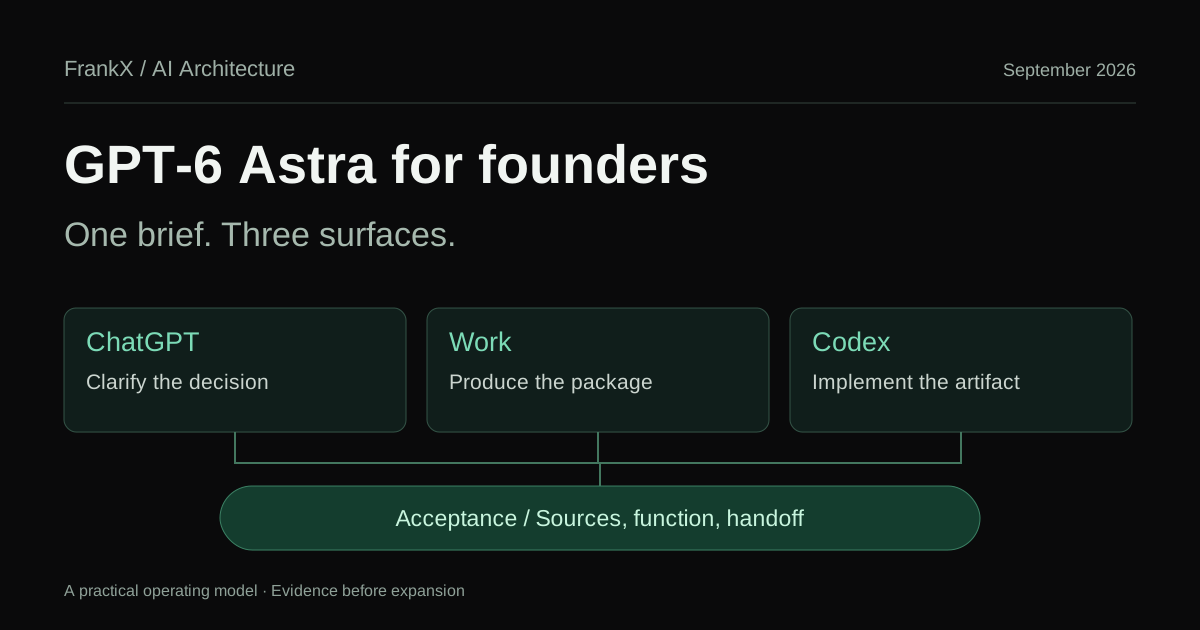
GPT-6 Astra for founders: ChatGPT, Work and Codex
Turn GPT-6 Astra into a useful founder workflow across ChatGPT, Work and Codex, with clear briefs, source checks, web design tests and reviewable handoffs.
Read article
AI Capability Is Abundant. Architecture Is Still the Work.
Where AI skills and architecture create real value: turning workshops, field notes, compute, and infrastructure into durable systems that survive change.
Read article
Agentic Game Dev & Generative Physics: Next-Gen Interactive Worlds
How autonomous NPC cognitive architectures, neural physics simulation, and real-time procedural generation transform interactive world development.
Read article