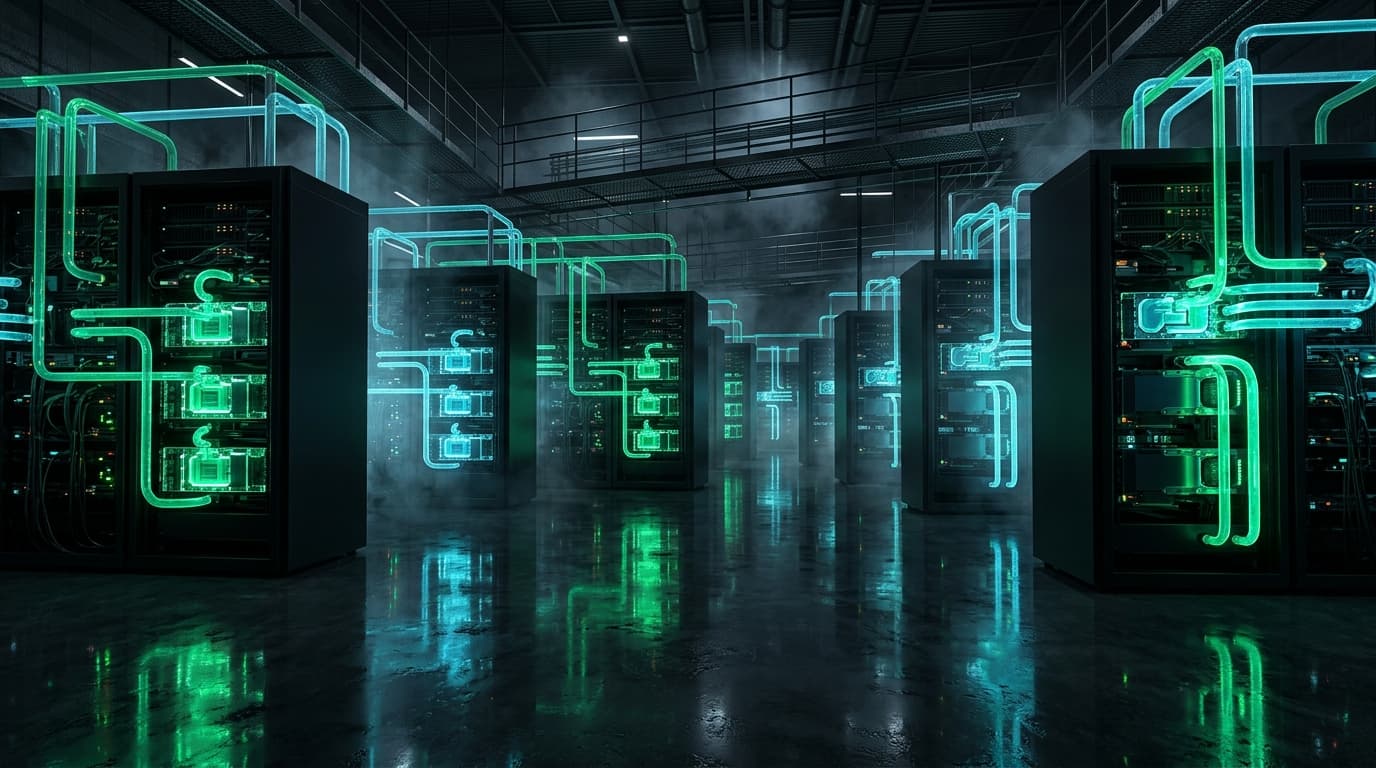
Datacenter Thermodynamics: Liquid Cooling Manifolds & 140kW Racks
TL;DR
As AI compute racks exceed 100 kW to 140 kW in thermal density, air cooling becomes physically impossible. Direct-to-chip liquid cooling manifolds, closed-loop CDUs, and warm-water heat recovery systems reduce PUE below 1.10 while safeguarding multi-million dollar silicon from thermal throttling.

Master the thermal engineering, fluid dynamics, cooling loop architectures, and electrical power distribution models required to operate modern AI supercomputer clusters.
Never deploy high-density compute (H200, B200, NVL72) without dual-redundant CDU loops and automated fluid leak-detection telemetry integrated into your hardware orchestration layer.
The bottleneck of modern artificial intelligence is no longer software architecture alone—it is thermodynamic heat dissipation.
When 72 Blackwell GPUs and 36 Grace CPUs are packed into a single NVIDIA GB200 NVL72 rack, the total power draw exceeds 130 kilowatts. To put this in perspective: a single server rack now consumes the same electrical power as a neighborhood of 100 homes and generates enough continuous heat to boil several liters of water per minute.
┌─────────────────────────────────────────────────────────────────────────────┐
│                    CLOSED-LOOP LIQUID COOLING TOPOLOGY                      │
├─────────────────────────────────────────────────────────────────────────────┤
│  PRIMARY FACILITY LOOP (Treated Industrial Water · 25°C – 32°C Supply)      │
│       │                                                                     │
│       ▼                                                                     │
│  [Cooling Distribution Unit (CDU) · Titanium Plate Heat Exchanger]          │
│       │                                                                     │
│       ▼ (SECONDARY RACK LOOP: Deionized Water + Corrosion Inhibitors)       │
│  [Stainless Steel Rack Manifolds]                                           │
│       ├──► Quick-Disconnect Couplings (Dripless Dripless Fittings)          │
│       ├──► Micro-Channel Cold Plates (Direct-to-GPU Die Interface)          │
│       └──► Return Manifold (Warm Water Return: 45°C – 55°C)                │
│                 │                                                           │
│                 ▼                                                           │
│  [Heat Rejection: Adiabatic Dry Coolers or District Heating Mesh]           │
└─────────────────────────────────────────────────────────────────────────────┘
1. Why Air Cooling Collapsed at 30 kW
Q_dot = m_dot × Cp × ΔT
Because air has a very low density (~1.2 kg/m³) and specific heat capacity (Cp ~ 1.005 kJ/kg·K), cooling a 140 kW rack with air requires moving massive volumes of air at near-hurricane speeds. The fan power required to push that much air exceeds 25 kW per rack, destroying efficiency.
Liquid (water-glycol mixture) has over 3,000 times the volumetric heat capacity of air, allowing compact 1-inch tubes to absorb and transport hundreds of kilowatts silently with minimal pumping power.
2. Direct-to-Chip (D2C) vs. Single-Phase Immersion
| Technology | Implementation Model | PUE Target | Maintenance Complexity | Hardware Compatibility |
|---|---|---|---|---|
| Direct-to-Chip (D2C) | Cold plates attached directly to dies; air cools secondary components | 1.08 – 1.15 | Low (standard rack serviceability) | 100% standard OEM servers (NVIDIA, Dell, HPE) |
| Single-Phase Immersion | Servers submerged in dielectric hydrocarbon fluid | 1.03 – 1.06 | High (fluid handling, crane required) | Requires modified chassis, warranty considerations |
| Two-Phase Immersion | Fluid boils on die surface and condenses on vapor coils | 1.02 – 1.04 | Extreme (PFAS environmental regulations) | Phased out globally due to chemical restrictions |
Direct-to-Chip (D2C) has emerged as the global enterprise standard for 95% of hyperscale AI deployments.
3. High-Voltage DC (HVDC) Power Architecture
In addition to fluid dynamics, modern AI factories have eliminated legacy 120V/208V AC power distribution in favor of 400V DC or 48V DC busbars inside the rack:
- Eliminates multiple AC/DC power supply bricks per server node.
- Reduces copper weight by 60%.
- Eliminates 8% to 12% in cumulative rectification heat losses inside the datacenter hall.
Complete AI Infrastructure Series
- Part 1: AI Infrastructure & Hardware Economics: Blackwell, LPUs, and AI Factories
- Part 2: Hyperscaler AI Cloud Matrix: AWS vs. GCP vs. Azure vs. CoreWeave
- Part 3: LPU & Wafer-Scale Economics: Why SRAM Beats HBM3e
- Part 4: Datacenter Thermodynamics: Liquid Manifolds & 140kW Racks
- Part 5: Cost-Per-Verified-Outcome: Enterprise AI Hardware TCO
Build your first AI system
Step-by-step guide to setting up ACOS, creating your first agent, and shipping real products with AI.
Start buildingProduction-ready architecture
Download AI architecture templates, multi-agent blueprints, and prompt engineering patterns.
Browse templatesJoin the builder community
Connect with creators and architects shipping AI products. Weekly office hours, shared resources, direct access.
Join the circleTags

Read on FrankX.AI — AI Architecture, Music & Creator Intelligence
Stay in the intelligence loop
Weekly field notes on AI systems, production patterns, and builder strategy.