The Golden Age of Creators: Why Now Is Different
TL;DR
Three forces converged: AI tools that give one person studio-scale production capability (12,000 songs, 170+ page websites, complete product catalogs). Zero marginal cost distribution (Vercel, YouTube, Suno — global reach for under $100/month). And systems thinking applied to creation (not hustle, not grind — compound systems that get better every session). This is the Golden Age. The creators who build systems — not just content — will define the next decade. This post is the thesis.

You will understand why 2026 is the inflection point for creators — and what separates those who compound from those who plateau.
TL;DR: Three forces converged: AI tools that give one person studio-scale production capability (12,000 songs, 170+ page websites, complete product catalogs). Zero marginal cost distribution (Vercel, YouTube, Suno — global reach for under $100/month). And systems thinking applied to creation (not hustle, not grind — compound systems that get better every session). This is the Golden Age. The creators who build systems — not just content — will define the next decade. This post is the thesis.
I want to tell you what's actually happening right now — not the hype version, not the fear version, but what I'm seeing from inside it.
I am an AI Architect & Creator. I have worked around enterprise-scale AI and cloud transformation environments — strategies, governance, tooling, operating models — where large institutions learn how to adopt AI at scale. FrankX is an independent project built from public knowledge, personal experience, and non-confidential patterns only.
In the evenings and weekends, I build for myself.
And what I've learned — what I know with clarity — is that the same architectural principles that make Fortune 500 AI implementations work are now available to one person with a laptop and less than $100 a month in infrastructure. The gap between enterprise capability and individual capability has collapsed in a way that has no historical precedent.
That collapse is what I'm calling the Golden Age of Creators.
What Makes This Era Structurally Different
Every few years, someone declares the "creator economy" has arrived. Blogging in 2004. YouTube in 2008. Podcasting in 2015. Newsletters in 2019. Each wave had real winners but also a shared characteristic: the capability ceiling was defined by time. One person could write one article, record one video, publish one episode. Output was linear with hours invested.
The current shift is different in kind, not degree. The capability ceiling is no longer set by time. It's set by systems.
Three forces converged simultaneously, and that convergence is what makes this moment structurally different from every previous wave:
Force 1: AI tools that deliver studio-scale production capability to one person.
Force 2: Infrastructure that makes global distribution effectively free at the margins.
Force 3: Systems thinking as a creation methodology — compounding assets instead of linear output.
Each force alone is interesting. All three together are what make this the Golden Age.
Force 1: Production Capability at Studio Scale
Let me give you actual numbers from my own work, because abstractions about "AI productivity" are everywhere and mostly useless.
Music: 12,000+ AI-generated tracks. Not rough sketches — finished, mixed, genre-specific songs with professional-quality audio. A professional recording studio with a full production team might output 500-1,000 tracks per year. I'm running at 12x that pace, alone, in my spare time.
Written content: 114,000 words across six books, 170+ pages on frankx.ai, hundreds of blog posts. A full-time writer producing consistently might output 100,000 words per year. That's a year's work for one professional writer — done alongside a full-time job in AI architecture.
Software products: A complete Next.js website with authentication, payment processing, email automation, product downloads, blog system, research hub, and 9 active automation workflows. Six months ago, this would have required a team of three to five people to build and maintain. I run it solo.
The mechanism isn't magic. It's AI models handling the production work — Suno for music, Claude for writing and code, Gemini for image generation — while I handle direction, quality control, and architecture. The ratio has shifted from 95% execution / 5% strategy to 20% execution / 80% strategy. That inversion is where the leverage lives.
The tools actually work now. That's the specific change from previous AI waves. Earlier generations of AI writing tools produced generic content that needed complete rewrites. Earlier music AI tools produced convincing elevator music with no soul. The current generation — when directed well — produces work that I'm genuinely proud to publish.
Force 2: Zero Marginal Cost Distribution
The second force is infrastructure that makes global reach essentially free at the margins.
My full production stack costs under $100/month:
- Vercel: $20/month. Hosts frankx.ai with global CDN, automatic deployments, edge functions, and enough bandwidth for serious traffic.
- Resend: $20/month. Email delivery for newsletters, product emails, and automation sequences.
- Suno: $24/month. Unlimited music generation.
- Vercel Blob: ~$15/month. Storage for music files, PDFs, assets.
- n8n (Railway): ~$10/month. 9 active automation workflows.
Total: ~$90/month. For global reach, professional infrastructure, and studio-scale production tools.
Compare this to what the same output required in 2015:
- Recording studio time: $100-500/hour
- Web hosting for a 170-page site with real traffic: $300-1,000/month
- Email platform for serious volume: $300-500/month
- Content production (writers, editors): $5,000-20,000/month equivalent value
- Automation and workflow tools: $500-2,000/month
The capability I'm running for $90/month would have cost $50,000-100,000+ per year in 2015. That's not an exaggeration — that's the actual cost of the infrastructure and labor required to produce equivalent output.
Distribution used to require gatekeepers — labels, publishers, platforms with editorial control. Now Suno distributes music globally, Vercel serves web content globally, and YouTube, Spotify, and Apple Music are open to anyone. The gatekeepers still exist for some things (hitting the Billboard charts still requires industry machinery), but for building a sustainable creator business at meaningful scale, the gates are open.
Force 3: Systems Thinking as the Creator Methodology
This is the force most creators miss, and it's the one that separates compounding growth from linear effort.
Most creator advice is about output: post more, be consistent, build an audience, grow your newsletter. This is correct advice but incomplete. It treats creation as a linear activity — more effort equals more output. That framing keeps creators on a treadmill.
Systems thinking treats creation differently. Instead of asking "what should I publish today?" it asks "what system produces the best content continuously, improves over time, and generates output I can't exhaust?"
The distinction matters enormously in practice.
A content grinder publishes 30 blog posts per month by working 60-hour weeks. The moment they stop working those hours, output drops to zero. Their library is a collection of isolated pieces with no structural relationship.
A system builder publishes 30 blog posts per month through an architecture: research automation that surfaces insights daily, a content pipeline that moves ideas from raw to published, an AI layer that handles production, and a distribution system that reaches audiences without manual effort. The system improves every month. When they stop adding new pieces, the existing structure keeps working.
At frankx.ai, the 9 n8n workflows are the infrastructure of the system:
- Morning Brief: Surfaces relevant AI research automatically each day
- Strategic Brief: Synthesizes that research into actionable signals
- Content Atomizer: Takes a published post and generates Twitter threads, LinkedIn posts, and newsletter excerpts automatically
- Newsletter Engine: Manages the Creation Chronicles distribution
- Music Catalog Sync: Keeps the music library current with new Suno tracks
Each workflow is a small machine that runs continuously. The work I did to build each one pays forward indefinitely. That's compound growth — and it only happens when you think in systems.
The Personal AI CoE: Enterprise Architecture at Individual Scale
I spend my working hours building AI Centers of Excellence for enterprises. An AI CoE is a structural capability — it defines how an organization adopts AI, governs it, builds talent around it, selects technology, manages data, and applies ethical principles.
The six pillars of an enterprise AI CoE: Strategy, Governance, Talent, Technology, Data, Ethics.
The insight that shaped how I think about personal creation: these pillars translate directly to individual creators. At 1/5,000th the budget.
- Strategy: What are you building, for whom, with what success metrics?
- Governance: What quality standards, brand rules, and approval processes govern your output?
- Talent: What skills do you bring, what does AI handle, where do you bring in collaborators?
- Technology: Your stack — Vercel, Suno, Claude, n8n, Resend, Blob storage.
- Data: Your content library, your audience data, your performance metrics.
- Ethics: What you will and won't do, how you represent AI involvement, how you treat your audience.
When you map these six pillars to a personal creator operation, you stop operating reactively and start building infrastructure. That's what ACOS is — the Agentic Creator OS, which is my implementation of a personal AI CoE, available free to any creator who wants to adopt the framework.
The GenCreator framework takes this further — applying the full CoE architecture specifically to creator businesses, with the tools, workflows, and mental models that make it operational rather than theoretical.
What the Numbers Actually Show
I want to be specific about what's been built, because specificity is the antidote to hype.
frankx.ai by the numbers:
- 170+ individual pages
- 100+ blog articles
- 6 books (114,000 words of manuscript content)
- 12,000+ music tracks indexed and partially self-hosted
- 5 digital products with Stripe integration and automated delivery
- 9 active n8n automation workflows
- Custom audio player, research hub, family portals, music ecosystem
- Full Vercel Blob storage with 35MB+ of product assets
- Email automation sequences with Resend (three-email welcome series, product delivery)
One person. Full-time job running parallel. $90/month in infrastructure.
This isn't an argument that everyone can or should replicate this exact stack. It's evidence that the capability ceiling for individual creators has moved to somewhere most people haven't even imagined yet.
The GenCreator manifesto goes deeper on the principles that guide this — the full philosophy behind building systems rather than just shipping content.
System Builder vs Content Grinder: The Compounding Gap
Here's the practical distinction in how the two archetypes operate:
Content Grinder:
- Publishes daily because discipline demands it
- Each piece requires full effort from scratch
- Library is a collection — valuable but not compound
- Growth is linear with effort
- Burnout is a structural risk, not a personal failing
System Builder:
- Ships daily because the system makes it natural
- Each piece feeds the next — the research for one post surfaces three more ideas
- Library is an architecture — pieces connect, reinforce, and build on each other
- Growth compounds because the system improves with each addition
- Sustainability is built into the structure
The Personal AI CoE research framework details how to build the system layer — the part most creator advice doesn't cover.
The hard truth: most creator advice is optimized for the grind. Post more. Be consistent. Work harder. This isn't wrong — consistency matters enormously. But consistency powered by systems is a different animal from consistency powered by willpower. One scales. One exhausts.
The Golden Age rewards the former.
Why This Era Will Define the Next Decade
The creators building systems now are accumulating structural advantages that will be very difficult to close later.
Data advantage: Every piece of content, every email response, every product purchase is data about what works. Systems that capture and respond to this data improve continuously. Starting in 2026 means five years of compound learning by 2031.
Infrastructure advantage: A mature creator stack with production-quality automation, tested products, and distribution systems took years to build even when AI made it faster. That infrastructure is a moat.
Audience trust: The creators who show up consistently with genuine value — not AI slop, but real craft expressed at AI scale — build relationships that survive platform changes, algorithm updates, and competitive pressure.
Model familiarity: Working with AI tools daily builds fluency that isn't easily acquired later. The creator who has shipped 12,000 songs with AI has developed taste, direction capability, and quality calibration that a newcomer in 2031 cannot shortcut.
The window isn't closing — this era is early, and the tools will keep improving. But the compounding dynamic means that earlier system builders accumulate more. The best time to start building a creator system was two years ago. The second-best time is now.
The Call: Build Systems, Ship Daily, Compound Relentlessly
This is the GenCreator thesis, stated plainly:
The Golden Age of Creators is defined by three things:
- Production capability at studio scale, available to individuals
- Global distribution at near-zero marginal cost
- Compound growth through system architecture rather than linear effort
The creators who build systems — who think in infrastructure, who ship daily not because of discipline but because the system makes daily shipping natural — are the ones who will define this era.
The work is real. The systems require building. The architecture requires thinking. But the leverage available to a single creator who combines craft with AI tools and systems thinking is unlike anything that existed before 2025.
This is the Golden Age. Build accordingly.
FAQ
Is this era just for technical creators who can code?
The technical skills lower the floor on what you can build yourself, but they're not required for the principles. A writer, musician, or visual artist can implement the systems layer — content pipelines, automation, structured distribution — using no-code tools. The architecture matters more than the implementation language.
How do you maintain quality at this scale of output?
System design. The quality bar is set once, at the system level — in the brand guidelines, the editorial standards, the review process — not recalibrated for each piece. AI handles production; I handle direction and quality judgment. The result is consistent quality at volume, which is actually easier to maintain than inconsistent quality at low volume because the standards are explicit.
Doesn't flooding the internet with AI content degrade quality everywhere?
The AI slop problem is real. Generic, unedited AI output clogs search results and erodes reader trust. The differentiator is craft applied to AI production — genuine perspective, real expertise, specific examples. That's harder to fake at scale than most people assume, and audiences identify it quickly. The solution is higher craft standards, not less AI.
What's the minimum viable creator system to start with?
One tool, one workflow, one distribution channel. Pick the content type you're most drawn to. Add AI production assistance. Build one simple automation (even an email sequence, a content calendar, a research aggregator). Publish consistently. The system grows from that foundation — trying to build the full architecture on day one is how people get overwhelmed and ship nothing.
How does the GenCreator framework relate to ACOS?
ACOS is the broader Agentic Creator OS — the full operating system for AI-augmented creation, applicable across creator types. GenCreator is the specific application of those principles for creator businesses — with the product strategy, audience architecture, and monetization layer built in. ACOS is the infrastructure; GenCreator is the playbook for building a creator business on top of it.
The systems that compound quietly in the background. The catalog that grows while you sleep. The audience that builds trust because the quality is consistent and the perspective is real.
This is what's available now. To one person with a laptop and a system worth building.
The Golden Age isn't something that's coming. It's here. The question is whether you're building infrastructure inside it — or still waiting for permission to start.

Read on FrankX.AI — AI Architecture, Music & Creator Intelligence
Stay in the intelligence loop
Field notes on AI systems, production patterns, and builder strategy.
Continue Reading
The Sovereign Curator: Platform Curation and the Art of Responsible AI Reuse
Why raw content creation is a commodity in the age of infinite AI noise—and how to build high-leverage curation engines, owned platforms, and responsible attribution networks.
Read article
Best AI Headshot Generator 2026: Aragon vs HeadshotPro vs The Photo AI (Tested)
I tested Aragon AI, HeadshotPro, BetterPic, Photo AI, and the DIY route on realism, price, turnaround, and privacy. Here's the honest pick for LinkedIn, teams, and dating.
Read article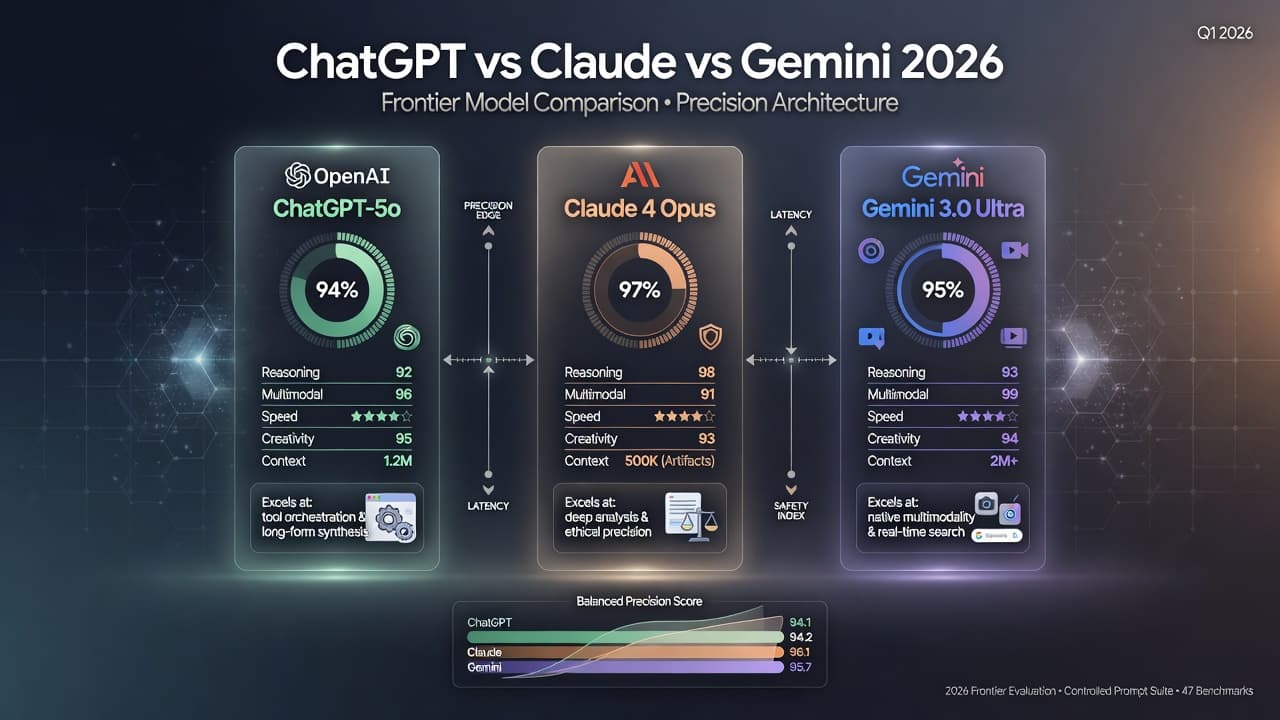
ChatGPT vs Claude vs Gemini 2026: Which AI Assistant for Everyday Use?
An honest, results-first comparison of the three $20 AI subscriptions — ChatGPT Plus, Claude Pro, and Google AI Pro — for writing, research, images, voice, memory, and everyday questions. Pick by use case.
Read article