AI Video Generation in 2026: Sora, Runway, Kling, Veo
TL;DR
— By mid-2026 the market split into three clear lanes. Google Veo 3.1 is the safest all-rounder — best prompt adherence, native audio, 4K. Kling 3.0 (Kuaishou) is the strongest value-to-quality pick and now competes at the top, not the budget end — multi-shot storyboard mode.

You will know which AI video tool fits your workflow and budget — from 15-second clips to full production.
Updated 2026-06-05. The video model landscape turned over hard this spring — Sora's standalone product was discontinued, Veo and Runway shipped new generations, and Kling moved from value pick to top tier. This guide reflects the current state, not the spring-2026 one.
For the freshest X-primary-source snapshot (June 2026 community shipping signals, MCP/agent examples, access friction, affiliate reality, and menu-wide head-to-head), see the dedicated dispatch "Best AI Video Generators June 2026: What Creators on X Are Actually Shipping With".
TL;DR — By mid-2026 the market split into three clear lanes. Google Veo 3.1 is the safest all-rounder — best prompt adherence, native audio, 4K. Kling 3.0 (Kuaishou) is the strongest value-to-quality pick and now competes at the top, not the budget end — multi-shot storyboard mode at roughly $0.10/second. Runway Gen-4.5 stays the pro favorite when you need granular control — camera moves, motion brush, reference-driven character consistency. Sora 2 is no longer a starting point: OpenAI discontinued the standalone Sora web/app on 2026-04-26 (it survives only inside ChatGPT, with the API sunsetting in September). The model everyone is testing right now is Seedance 2.0. For most creators the practical stack is Veo 3.1 for hero/narrative, Kling 3.0 for volume.
The State of AI Video Right Now
Two years ago, AI video meant jittery 4-second clips with hands that looked like they belonged to a different species. That era is over.
In 2026, AI video generation is production-viable. I have used it for YouTube intros, product demos, social shorts, and music video sequences. The outputs are not always perfect — but they are consistently good enough to ship.
The shift that made this possible: temporal coherence. Early models treated video as a sequence of images. Current models understand motion as a continuous physical process. That one architectural change explains why 2026 video looks like video, not animated images.
This guide covers every major tool, what each one actually does well, and how I wire them into the content pipeline at frankx.ai.
The Six Tools Worth Knowing
Sora 2 (OpenAI) — discontinued as a standalone product
Sora set the cinematic benchmark when OpenAI broadened access in early 2026. It no longer makes sense as a starting point. OpenAI discontinued the standalone Sora web and app on 2026-04-26, and the Sora API is scheduled to sunset on 2026-09-24. The model itself wasn't bad — it was reportedly burning roughly $15M/day against negligible revenue, and OpenAI folded it back into ChatGPT rather than running it as a separate product.
Where it survives: Sora 2 generation is still available inside ChatGPT for Plus ($20/month) and Pro ($200/month) subscribers. If you already pay for ChatGPT, you can still generate — you just can't build a standalone Sora workflow or rely on the API long-term.
What it still gets right (inside ChatGPT): Long-form coherence, intentional camera movement, strong prompt fidelity on complex scenes.
Best for: Existing ChatGPT Pro users generating the occasional hero clip. Not a tool to architect a new pipeline around — pick Veo 3.1 or Runway for that.
Migration note: If you built anything on the Sora API, plan your move to Veo 3.1 or Runway Gen-4.5 before the September API shutdown.
Runway Gen-4.5
Runway is the pro-control tool. Gen-4 landed early in 2026 and the current Gen-4.5 (with a 4.5.5 point release) is the favorite whenever you need granular creative control rather than one-shot quality — camera moves, motion brush, and reference-driven character consistency.
What makes the Gen-4 line matter is the combination of consistency and control. Run the same prompt twice and you get visually similar results, and you can steer the result with a motion brush and reference images instead of re-rolling the dice. That repeatability plus directability is the foundation of a real video production workflow.
What it gets right: Granular control — camera moves, motion brush, reference-driven character consistency are best-in-class. Image-to-video is strong. The editing suite integration is real — you can stay inside Runway for rough assembly.
What limits it: Raw quality now trails Veo 3.1 and Kling 3.0 on cinematic lighting and native audio (Runway's strength is control, not the top of the quality leaderboard). Complex multi-subject scenes can still lose detail at the edges.
Best for: Production workflows where directability matters more than maximum fidelity — YouTube intros, product demos with specific motion, reference-driven character work, B-roll replacement.
Pricing: Standard plan around $15/month; Pro around $35/month, on a per-second/credit model. Check Runway's current pricing page before committing — the Gen-4 line changed the credit math.
Kling 3.0 (Kuaishou)
Kling is no longer "the cheap one." Kling 3.0 closed the gap and now competes at the top of the quality leaderboard while staying the cheapest premium model — roughly $0.10/second. It matches Veo on cinematic lighting and complex motion (hair, liquids, fabric) and adds a multi-shot storyboard mode with native audio sync across cuts, which is genuinely ahead of where most competitors are.
Kuaishou built Kling for the short-form social market and that heritage still shows in the motion aesthetics, but the 3.0 line makes it a serious pick for cinematic multi-shot sequences with subject consistency, not just social volume.
What it gets right: Best quality-per-dollar at the top tier. Multi-shot storyboard with audio sync across cuts. Strong subject consistency. Native portrait (9:16) support. Fast generation.
What limits it: Fine-grained creative control still trails Runway's motion-brush/reference tooling. Some detailed scene prompts get simplified interpretations.
Best for: Creators who want top-tier cinematic output at volume without Veo/Runway pricing — short-form social, multi-shot sequences, anyone optimizing cost-per-quality.
Pricing: Free tier with watermarks; premium generation around $0.10/second. The cheapest way to reach near-top-tier quality in 2026.
Google Veo 3.1
Veo is now the safest all-rounder in the market. Veo 3.1 leads on prompt adherence, ships native audio, and outputs 4K (3840×2160) in both landscape and portrait — making it the strongest single pick for narrative scenes, establishing shots, and anything where you describe a complex scenario and need it rendered accurately.
Give it a complex descriptive prompt — setting, mood, camera angle, subject behavior, and now sound — and Veo 3.1 interprets it more faithfully than competitors. The native-audio generation in particular removes a whole post step.
What it gets right: Best-in-class prompt adherence. Native audio generation. 4K landscape and portrait. Deepening integration with Google's ecosystem (Workspace, YouTube). The all-around default when you're not sure which tool to reach for.
What limits it: Premium pricing relative to Kling. Less granular shot-level control than Runway's motion brush. Access runs through Google's AI subscriptions.
Best for: Narrative and establishing shots, hero content, anyone who wants the highest-fidelity single tool, creators already in the Google ecosystem.
Pricing: Available through Google's AI subscription tiers (Google One AI / Gemini plans). Confirm the current tier and per-generation limits on Google's pricing page — Veo 3.1 4K outputs consume more quota than 1080p.
Pika 2.0
Pika occupies the creative experimentation space. The motion controls are the most expressive of any tool — you can specify object-level motion independently of the background, control camera simultaneously, and define transition timing.
What it gets right: Creative control depth. For music videos, abstract sequences, and stylized visual content, Pika gives you parameters that other tools do not expose. The "Pikaffects" system lets you apply transformation effects (inflate, deflate, melt, explode) that are genuinely useful for creative production.
What limits it: The realism ceiling is lower than Sora or Veo 2. Outputs lean stylized. For straightforward representational video — a person walking down a street — Runway or Kling will perform better.
Best for: Music videos, artistic content, visual experiments, creators whose brand is stylized rather than realistic.
Pricing: Basic plan $8/month. Standard $20/month. Pro $55/month.
Luma Dream Machine
Luma entered the market with strong physics simulation — fluid motion, material behavior, environmental interaction. The cloth simulation and liquid rendering are notably good.
What it gets right: Physical realism in motion. Product demonstration videos where the product needs to move naturally. Environments with complex material interactions (water, fabric, glass).
What limits it: Character animation is weaker relative to environmental animation. Prompt fidelity on specific compositions can be inconsistent.
Best for: Product demos, brand films with physical objects, environmental sequences.
Pricing: Free tier with watermarks. Plus $29.99/month. Pro $99.99/month.
Seedance 2.0 (ByteDance) — the one to watch
Seedance is the model that keeps surfacing in blind creator tests through mid-2026, especially for image-to-video workflows. ByteDance built it with the same short-form DNA as Kling's lineage, and in head-to-head comparisons creators keep picking it without knowing which model produced the clip — the strongest signal there is.
What it gets right: Image-to-video fidelity. Motion quality that holds up in blind tests against the premium tier. Aggressive iteration pace.
What limits it: Newer ecosystem — tooling, API maturity, and pricing transparency lag the established players. Worth piloting, not yet worth rebuilding your whole pipeline around.
Best for: Image-to-video work, creators who want to stay on the frontier, anyone running their own blind A/B on output quality.
Pricing: Evolving — check ByteDance's current Seedance tiers before committing volume.
Tool Comparison Table
Current as of 2026-06-05.
| Tool | Quality Tier | Native Audio | Best Use Case | Pricing Note |
|---|---|---|---|---|
| Veo 3.1 | ★★★★★ | Yes (4K) | Safest all-rounder, narrative, hero | Google AI subscription |
| Kling 3.0 | ★★★★★ | Yes (multi-shot) | Top quality-per-dollar, multi-shot | ~$0.10/sec |
| Runway Gen-4.5 | ★★★★☆ | No | Granular control, reference-driven | ~$15–35/mo, per-credit |
| Seedance 2.0 | ★★★★☆ | — | Image-to-video, frontier pick | Evolving |
| Sora 2 | ★★★★☆ | Yes | ChatGPT users only (discontinued) | Inside ChatGPT Plus/Pro |
| Pika 2.x | ★★★☆☆ | — | Creative / stylized effects | ~$8–55/mo |
| Luma | ★★★★☆ | — | Product demos, physics | Free/$29.99 |
Practical Stacks by Creator Type
Short-Form Social Creator (TikTok / Reels / Shorts)
Primary: Kling for volume. Secondary: Pika for stylized sequences.
The math: at $8/month you can generate 30-50 clips. Pick your best five per week and you have a full content calendar. Quality at 9:16 on mobile is indistinguishable from Runway to most viewers.
Workflow: write 10 concepts, batch-generate in Kling, cut in CapCut or Descript, layer audio. Total active time per clip: under 15 minutes.
YouTube Channel (5-15 min videos)
Primary: Runway Gen-4.5 for B-roll and intros (directability). Secondary: Veo 3.1 for quarterly hero content (fidelity + native audio).
The YouTube channel problem is B-roll. Every talking head video needs visual context. AI video solves this — instead of paying for stock footage subscriptions, generate specific B-roll that matches your script exactly. A 12-minute video needs 15-20 B-roll clips, well within a single Runway plan's monthly credits.
Product Demo / Brand Content
Primary: Veo 2 or Luma depending on product category.
For digital products, Veo 2's prompt fidelity lets you specify exact UI interactions and brand scenarios. For physical products — consumer goods, accessories, packaging — Luma's physics simulation produces more natural product motion.
Music Video Production
Primary: Pika for creative sequences. Secondary: Runway for narrative sections.
Music videos operate on different aesthetic rules than documentary or brand content. Stylization is the point. Pika's transformation effects and object-level motion control make it the right tool for visual interpretations of audio. Use Runway when the video needs characters performing coherent actions across 30+ seconds.
Integration with the Content Pipeline
The most efficient setup wires AI video generation into your automation layer. I use n8n for this — the same platform covered in the 9 automation workflows for creators.
The pattern: a webhook in n8n receives a video brief (concept, style, duration, platform). A code node formats the prompt according to tool-specific syntax. The generation API is called. Output URL is logged to a Google Sheet for review. Approved clips get distributed via platform API or uploaded to a shared Notion board.
Runway and Pika both have APIs. Kling's API is in beta. Sora's API is in limited access. Veo 2's API is in development through Google Cloud.
The practical reality in early 2026: you still trigger most generations manually. The API ecosystem is 6-12 months behind the UI tools. But the infrastructure exists — and building the n8n workflows now means your pipeline is ready when full API access arrives.
For a structured approach to AI creative tools, the research hub at /research/ai-creative-tools tracks tool updates, pricing changes, and quality comparisons as the market evolves. The prompt library has video generation prompts organized by use case and tool.
The Reality Check: What AI Video Actually Replaces
This question comes up every time the topic surfaces: is AI video replacing editors?
The answer, from daily use: AI video is replacing stock footage. That is the practical category displacement happening right now.
Stock footage has always been a compromise — you pick the closest clip from a library and accept that it does not quite match your script. AI video eliminates that compromise. You generate exactly what you described.
Editors are not being replaced — they are being freed from the constraint of available footage. The skilled editor who knows how to prompt AI tools, select the best outputs, and cut a coherent sequence is more valuable in 2026 than they were in 2024. The manual skills compound with AI capability rather than competing with it.
What is being replaced: stock footage subscriptions ($50-300/month for most creators), generic B-roll that audiences recognize as library footage, the compromise of "close enough."
What is not being replaced: editorial judgment, pacing instinct, narrative structure, sound design, color grading. The production skills remain essential.
What to Watch in the Next 12 Months
Three developments worth tracking:
Consistent characters across clips. Every tool struggles with this. Runway Gen-4.5's reference-driven character system and Kling 3.0's multi-shot storyboard (with subject consistency across cuts) are the current front-runners. True cross-clip character consistency at production scale will unlock narrative video formats that are currently impractical.
Real-time generation. Runway already has a faster "draft" mode. The trajectory points toward generation speeds under 30 seconds for 10-second clips within the year. That changes the workflow completely — you can generate, review, and iterate in the same creative session without batch-and-wait cycles.
Audio-reactive generation. Pika has early audio-reactive features. Generating video synchronized to a music track — with camera movement, visual effects, and transitions mapped to the audio waveform — is technically close. When it works at production quality, it changes music video economics entirely.
If you are building a creator system that includes video, the GenCreator framework at /gencreator has the architecture for wiring all of these tools into a coherent production workflow rather than treating each as a standalone experiment.
FAQ
Is Sora still worth it for independent creators?
Not as a primary tool. OpenAI discontinued the standalone Sora product in April 2026 — it now lives only inside ChatGPT (Plus/Pro), and the API sunsets in September. If you already pay for ChatGPT Pro, you can still generate the occasional hero clip. But don't architect a workflow around it. For a new pipeline, Veo 3.1 (fidelity + native audio) or Kling 3.0 (quality-per-dollar) are the right anchors.
Can AI video match professional cinematography?
For ambient sequences, environmental B-roll, and stylized creative content — yes, with careful prompting. For content requiring specific human performances, precise brand interactions, or complex multi-person scenes — professional cinematography still leads. The gap is closing, but it has not closed.
How do I maintain visual consistency across a series of clips?
Use style reference images and locked prompt templates. Runway's image-to-video mode is the most consistent for this. Define your visual aesthetic in a single seed image, then generate all clips from that reference. Maintain a prompt template with locked elements (color temperature, camera distance, lighting style) and variable elements (action, composition). Consistency comes from discipline in prompting, not from the tool alone.
What is the best tool for someone just starting with AI video?
Veo 3.1 for most people in 2026 — it's the safest all-rounder, handles audio natively, and you describe what you want in plain language. If budget is the priority, start on Kling 3.0's free tier (near-top-tier quality at the lowest cost). Reach for Runway Gen-4.5 once you specifically need shot-level control (camera moves, motion brush, reference characters).
Will AI video improve enough to replace all stock footage within two years?
For most creator use cases — yes. The category of generic B-roll (cityscapes, people working, product close-ups, nature sequences) will be entirely AI-generated within 24 months. Unique, location-specific, or talent-dependent footage will retain value. The stock footage platforms are already pivoting toward AI licensing models in response.
Related resources: AI creative tools research hub | Prompt library for video generation | GenCreator production framework
Build your first AI system
Step-by-step guide to setting up ACOS, creating your first agent, and shipping real products with AI.
Start buildingProduction-ready architecture
Download AI architecture templates, multi-agent blueprints, and prompt engineering patterns.
Browse templatesJoin the builder community
Connect with creators and architects shipping AI products. Weekly office hours, shared resources, direct access.
Join the circle
Read on FrankX.AI — AI Architecture, Music & Creator Intelligence
Stay in the intelligence loop
Weekly field notes on AI systems, production patterns, and builder strategy.
Continue Reading
Best AI Video Generators June 2026
X-aggregated signals on Higgsfield, Seedance 2.0, Kling 3.0, Veo 3.1, Sora 2, Runway and the rest. Head-to-head on control, audio, value, consistency.
Read article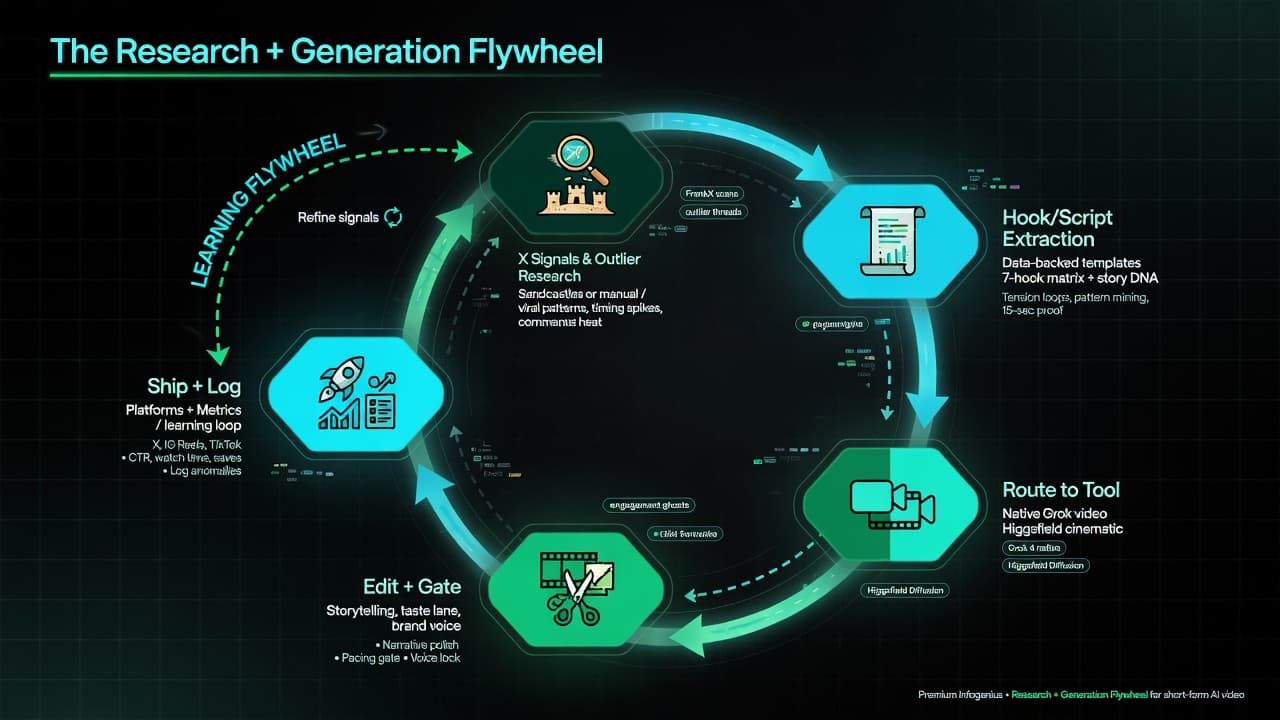
The Research + Generation Flywheel
How data-backed short-form research (Sandcastles or X outlier signals) feeds directly into production (Higgsfield, native Grok video tools, editing).
Read article
Best AI Tool for YouTube Shorts and TikTok 2026
The best AI tools for automated YouTube Shorts and TikTok in 2026 — Opus Clip, AutoShorts, Faceless.so, Submagic, and CapCut compared on automation, quality, scheduling, and price.
Read article