The 4-Week Personal AI Center of Excellence: 2026 Rebuild Blueprint
TL;DR
A Personal AI Center of Excellence (CoE) is not a collection of chat prompts; it is a version-controlled operating infrastructure comprising specialized skills, automated verification gates, persistent memory, and multi-model dispatchers.

Build and deploy a production-grade personal AI Center of Excellence that compounds your intellectual property and automates 80% of routine knowledge workflows.
Never store system instructions in disconnected SaaS interfaces. Manage your personal CoE as a Git repository where every prompt, skill, and hook is version-controlled and tested.
Most professionals and creators interact with AI haphazardly: copying and pasting into chat windows, losing context between browser tabs, and manually rewriting instructions daily.
Enterprise technology organizations do not operate this way. They build Centers of Excellence (CoE): standardized architectures, governed toolchains, version-controlled skill libraries, and rigorous evaluation pipelines.
By applying enterprise architecture principles to individual productivity, a single creator can deploy a Personal AI CoE that rivals a multi-person engineering and content team.
┌─────────────────────────────────────────────────────────────────────────────┐
│                    THE 4-WEEK PERSONAL AI COE BLUEPRINT                     │
├─────────────────────────────────────────────────────────────────────────────┤
│  WEEK 1: GROUND TRUTH & REPO SSOT    │ Single Source of Truth & Brand DNA   │
│  WEEK 2: MEMORY & TOOL SUBSTRATE     │ Git Worktrees, MCP, Knowledge Graphs │
│  WEEK 3: AGENT FLEET & SKILL HUBS    │ Specialized Subagents & Commands     │
│  WEEK 4: EVALUATION & MERGE GATES    │ Automated CI, AI-Slop Audits, Deploy │
└─────────────────────────────────────────────────────────────────────────────┘
1. Week 1: Ground Truth and Brand Identity (SSOT)
The foundational failure of ad-hoc AI usage is context ambiguity. In Week 1, you establish a centralized Git repository (the Estate Single Source of Truth):
BRAND_IDENTITY.md: Immutable rules governing voice, perspective, taboo words (zero AI-slop tells), and target audience.STACK.md: Explicit technical dependencies, package versions, and API contracts.OPS-INDEX.md: Front-door navigation index directing AI agents to specific resources.
# Brand Voice Guardrail Example
- Tone: "Elite Creator. AI Architect. Humble Excellence."
- Refusal Pattern: Taboo buzzwords and empty marketing superlatives are strictly blocked. // ai-slop-allow
- Execution Rule: Lead with empirical evidence, benchmarks, and code receipts.
To explore enterprise governance frameworks, check our Enterprise AI CoE & Governance Hub.
2. Week 2: Tooling and Memory Infrastructure
Week 2 connects your local environment to external APIs and file systems via the Model Context Protocol (MCP):
- Workspace Partitioning: Create isolated git worktrees so multiple AI coding harnesses can pair-program without file collisions.
- Memory Integration: Connect a local SQLite or temporal knowledge graph engine (like Starlight Memory) to maintain persistent session state across IDE restarts.
- Command Dispatchers: Map routine operations to CLI slash commands (e.g.
/research,/audit,/publish).
3. Week 3: Specialized Agent Fleet Deployment
In Week 3, you replace generalist prompts with specialized agent personas governed by typed YAML configurations:
| Agent Role | Primary Function | Evaluation Metric |
|---|---|---|
@architect | System design, database schemas, ADRs | Zero breaking changes, RFC alignment |
@engineer | Implementation, component builds, tests | 100% type-safety, green test suite |
@reviewer | Santa Method adversarial critique, AST checks | Detection of subtle edge cases |
@distributor | Thread creation, cross-platform adaptation | Hook score, signal-to-noise ratio |
4. Week 4: Automated Evaluation and Merge Gates
The final phase installs automated CI checks that run before any generated artifact is accepted:
- Frontmatter & SEO Gate: Validates JSON schema, title lengths, reading time, and FAQ completeness.
- AI-Slop & Banned Word Audit: Runs AST-level scans across markdown files to reject generic marketing clichés.
- TypeScript Strict Type-Check: Guarantees zero runtime regressions across web apps and tools.
# Production Verification Gate
npm run merge:gate
# 1. Type-check (tsc --noEmit)
# 2. Strict AI-slop audit
# 3. Broken link validation
5. Summary: Compounding Returns of a Personal CoE
Once established, your Personal AI CoE turns every past project, decision, and writing piece into a queryable intellectual asset. You stop starting from scratch and begin every initiative with the accumulated leverage of your entire history.
For operational templates, explore The Sovereign Creator Wealth OS and download our open-source templates from the FrankX Downloads Portal.
Build your first AI system
Step-by-step guide to setting up ACOS, creating your first agent, and shipping real products with AI.
Start buildingProduction-ready architecture
Download AI architecture templates, multi-agent blueprints, and prompt engineering patterns.
Browse templatesJoin the builder community
Connect with creators and architects shipping AI products. Weekly office hours, shared resources, direct access.
Join the circle
Read on FrankX.AI — AI Architecture, Music & Creator Intelligence
Stay in the intelligence loop
Weekly field notes on AI systems, production patterns, and builder strategy.
Continue Reading
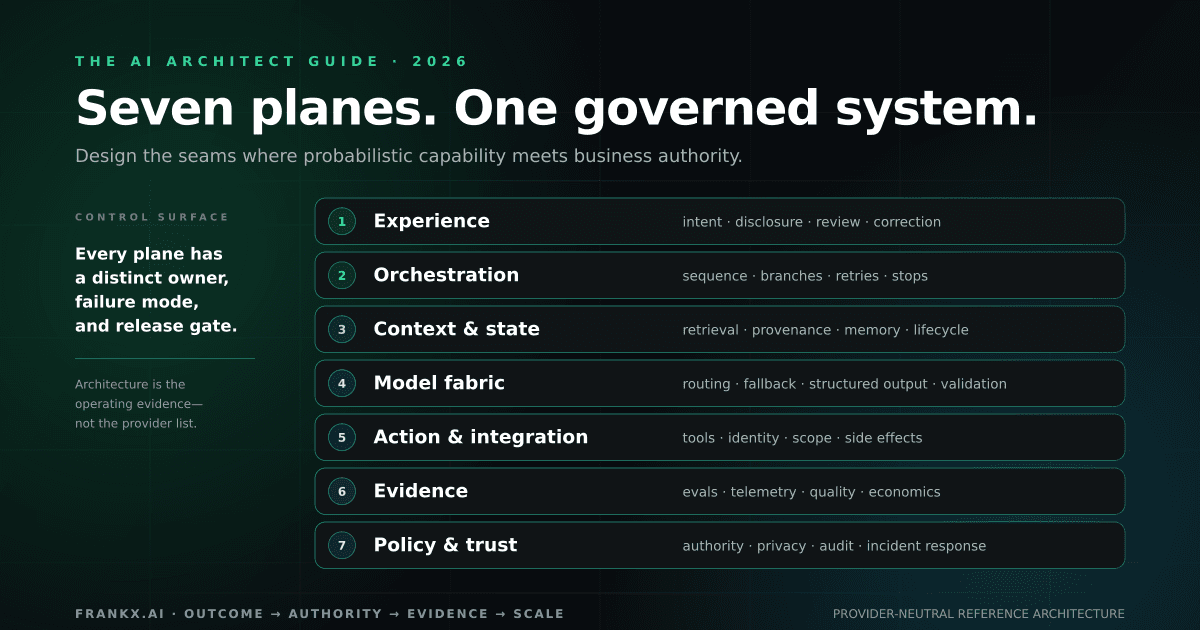
The AI Architect Guide 2026
A field guide to the decisions, system planes, evidence gates, and operating artifacts required to turn AI capability into a reliable workflow.
Read article
Your Mind Is a Temporary Library
A Mindvalley field note on turning lived experience into durable knowledge, agentic systems, and public capability that can outlast us.
Read article
Coherence Is an Engineering Property
One voice across 210 posts, 85 agents, and four AI vendors is not culture — it is architecture. How coherence becomes code, and why it compounds.
Read article