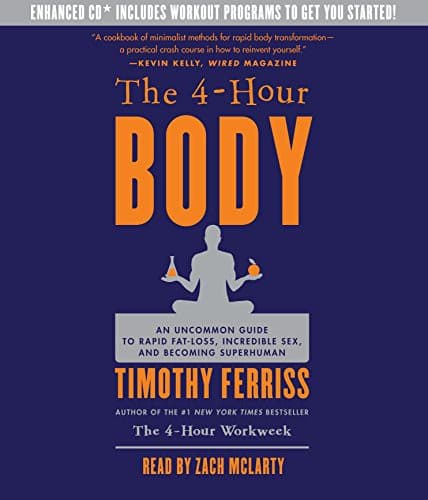
The short answer
Ferriss applies his 80/20 lifestyle-design lens to the human body — fat loss, muscle gain, sleep, sex, sport. Rather than write a comprehensive textbook, he delivers minimum-effective-dose protocols for each domain. Some claims (slow-carb diet, Occam protocol) are well-supported; others (cold thermogenesis, ice-bath weight loss) are speculative. The 80/20 framework is the contribution; treat specific protocols as hypotheses.
Key Insights
- The "minimum effective dose" is the smallest input that produces the desired outcome — anything beyond is wasted at best, harmful at worst
- Slow-carb diet (lean protein, legumes, vegetables, no white carbs, one cheat day weekly) outperforms most popular diets for sustainable fat loss
- For muscle gain, the Occam Protocol (one set to failure on key compound lifts, twice a week) trumps high-volume conventional routines for most people
- Sleep optimization (ammonium chloride, low-dose cold exposure, consistent timing) compounds — small improvements daily produce large cumulative gains
- Self-experimentation with measurement is the bypass for evidence gaps — track inputs and outputs systematically; treat your body as N=1 in lieu of waiting for N=10,000 trials
Quotes Worth Remembering
11 recorded excerpts. Check the named edition and location before sharing the wording.
Recall that we are looking for the minimum effective dose (MED) in all things. More is not better.
Fundamentals — Rules That Change the Rules
It is possible to become world-class, enter the top 5% of performers in the world, in almost any subject within 6-12 months.
Pre-hab
Diet without exercise can take you the entire distance for fat loss. Exercise without diet, almost never.
Subtracting Fat — Slow-Carb Diet
Don't make excellence a habit. Make non-mediocrity a habit.
Pre-hab
There are no rules in self-experimentation, except: it has to be safe, it has to be measurable, it has to be reversible.
First and Foremost
The body remembers what you train it to do — for better and for worse.
Adding Muscle — From Geek to Freak
Most diets fail because most people stop. The slow-carb diet was designed to be hard to stop.
Subtracting Fat — Slow-Carb Diet
Even superhumans were ordinary humans before they tested boundaries.
On Living
Not exercising and being lazy are not the same thing.
Subtracting Fat — Spot Reducing
Ferriss's pushback on the moralizing of fitness — the absence of structured exercise is not evidence of laziness, just absence of structured exercise.
It's much easier to take 30 seconds and have one bite than to commit hours of training to undoing the damage.
Subtracting Fat — Slow-Carb Diet
Doing the unrealistic is easier than doing the realistic.
On Living
Ferriss's observation that ambitious goals attract more help and less competition than mediocre ones — counter-intuitive but operationally true.
Chapter-by-Chapter
Each chapter carries a key idea and a short summary, so you can find the argument again.
01Part 1 — Fundamentals: Start Here / The Minimum Effective Dose
Find the smallest input that produces the desired outcome — and stop there.
OpenClose
Ferriss's framing chapter. Most fitness advice prescribes maximum effort in maximum directions. Minimum effective dose inverts the question: what is the absolute least I must do for the outcome I want? Applied to fat loss, muscle gain, sleep, and sex — each has its own MED.
02Part 2 — Subtracting Fat: Basics / The Slow-Carb Diet
Lean protein, legumes, vegetables, no white carbs, one weekly cheat day. Six rules.
OpenClose
The book's most-implemented protocol. Six rules: (1) avoid white carbs, (2) eat the same few meals over and over, (3) don't drink calories, (4) don't eat fruit, (5) take one cheat day per week, (6) measure progress weekly. Most readers report 5-15 lbs of fat loss in the first month.
03Part 2 — Subtracting Fat: Advanced
Strategic supplementation (PAGG stack), cold thermogenesis, and other "if you want faster" levers.
OpenClose
Ferriss's advanced fat-loss tactics. The PAGG stack (policosanol, alpha-lipoic acid, garlic extract, green tea flavanols) for fat oxidation. Cold thermogenesis via ice baths or cold showers for brown fat activation. Targeted hypertrophy for body recomposition. These add 20-30% to slow-carb results for the willing.
04Part 3 — Adding Muscle: From Geek to Freak / Occam Protocol
One all-out set to failure on key compound lifts, twice a week, beats high-volume conventional routines for most.
OpenClose
Ferriss's muscle-gain chapter. The Occam Protocol: 1 set of 5-7 reps to absolute failure on machines (5/5 cadence), once or twice a week, with progressive overload. Total time: 30 minutes per session. Most readers gain 5-15 lbs of muscle in 8 weeks. The protocol's elegance is fewer variables to mess up.
05Part 4 — Improving Sex
A handful of specific techniques (the 15-minute orgasm, on-demand control) outperform vague advice in the field.
OpenClose
Ferriss's sex chapter, predictably the most-discussed at parties. Specific techniques sourced from interviews with sex researchers and practitioners. The chapter is graphic but instructional. The minimum-effective-dose framing applies here too — most "better sex" comes from a small set of specific moves, not generic effort.
06Part 5 — Perfecting Sleep
Sleep is the highest-leverage performance variable — and the most fixable.
OpenClose
For many readers the most valuable chapter. Ferriss covers protocols for falling asleep faster (Yogi Tea, ammonium chloride supplements), staying asleep (cooling mattress pads, blackout protocols), and waking refreshed (consistent timing, light exposure, deliberate hydration). Sleep before all other interventions.
07Part 6 — Reversing Injuries
Most chronic injuries respond to specific small interventions that conventional medicine doesn't prioritize.
OpenClose
Ferriss's injury chapter draws on his own and others' chronic problems. Tactics include Egoscue Method exercises, Active Release Technique (ART), specific rehab protocols for back, knees, shoulders. Ferriss is explicit: this is not medical advice, but it is the protocols that worked for him and his interviewees.
08Part 7 — Running Faster and Farther
Ultra-marathon is more about technique and metabolic conditioning than mileage volume.
OpenClose
Ferriss applies MED to running. The chapter centers on Brian MacKenzie's CrossFit Endurance methodology — much less mileage, more high-intensity intervals, focused technique work. Critics note this isn't how elite ultramarathoners actually train; supporters note it works much better than marathon-mileage approaches for amateurs with finite training time.
09Part 8 — Getting Stronger
Skill-based strength (the Olympic lifts, gymnastics moves) outperforms generic strength work for total athleticism.
OpenClose
Ferriss's strength chapter draws on Olympic lifters and gymnasts. Argues the kettlebell swing alone — done correctly, ~75 reps — is the most efficient single posterior-chain exercise. The chapter is a primer on the lifts that produce the most carry-over to other sports.
10Part 9 — From Swimming to Swinging
Skills look mysterious until they're decomposed — most adult skill acquisition fails because nobody decomposed.
OpenClose
Ferriss covers learning swimming (Total Immersion method), juggling, baseball power-hitting, basketball shooting, and surfing. The thread: each skill has a specific decomposed sequence that, learned in order, produces fast competence. Generic "practice more" advice misses this entirely.
11Part 10 — On Longer and Better Life
Specific blood-test protocols and supplementation are more useful than generic anti-aging advice.
OpenClose
Ferriss's longevity chapter. Standard biomarker panels worth tracking, supplementation regimens (Resveratrol, certain antioxidants), the case for periodic fasting. The chapter draws on Aubrey de Grey, Peter Attia, and others. Aged better than expected — much of it now mainstream in longevity medicine.
12Part 11 — Closing Thoughts: Spirituality
After optimizing the body, ask why you optimized it.
OpenClose
Closing reflection. Ferriss interviews Coach Sommer, gymnastics legend, on the relationship between physical mastery and meaning. The book's final note: the body is necessary infrastructure, but optimizing it is not the point. The point is what you do with the resulting health, energy, and time.
Best For
Frequently Asked Questions
Is the slow-carb diet the same as keto or paleo?
+
Different. Slow-carb permits beans and legumes (which keto excludes for being too carby and paleo excludes for being grains). Slow-carb mandates a weekly cheat day (which keto and paleo don't). It's closer to a moderate-protein, low-glycemic-load approach with strategic refeeds. Many readers find it more sustainable than strict keto.
Does the cold-thermogenesis weight-loss claim hold up?
+
Partly. Brown adipose tissue activation by cold is real and measurable. The magnitude of weight loss Ferriss claims (2 lbs/week from cold exposure alone) is on the high end of the research and probably overstates the effect. Cold exposure has other benefits (norepinephrine release, recovery) that justify the practice independent of fat loss claims.
Is the Occam Protocol enough to build muscle?
+
For beginners and intermediates, yes — it works well. Advanced lifters typically need more volume to continue progressing. The Protocol's strength is time efficiency and recovery: ~30 minutes twice a week is enough for most people to gain meaningful muscle for the first 2-3 years.
Should I read this if I'm not interested in fat loss or muscle gain?
+
Yes, in parts. The sleep chapter alone justifies the book for many readers. The injury-recovery section is the best single resource for non-elite athletes managing chronic issues. The "perfect posterior" exercise (kettlebell swing) and the "perfect sleep" protocol have outsized impact relative to time invested.
How does this relate to The 4-Hour Workweek?
+
Same author, same framework (minimum effective dose, 80/20, self-experimentation), different domain. If 4HWW is lifestyle design, 4HB is body design. The two books read like two halves of one operating system.
Continue Reading
If The 4-Hour Body opened a door, these books walk you through it. Curated for reason, not algorithm — each entry explains why it pairs with this book.
Atomic Habits
by James Clear
Ferriss prescribes specific protocols; Clear teaches how to install any protocol as a habit. Read together for the operational complement.
Get the bookWhy We Sleep
by Matthew Walker
Ferriss's sleep chapter assumes Walker's framework. Walker is the Berkeley sleep researcher whose book is the canonical primer. Read both for full coverage of sleep optimization.
Get the bookOutlive
by Peter Attia
Attia is the longevity specialist Ferriss draws from heavily. Outlive (2023) is the comprehensive modern longevity book — read it after 4HB for the deeper science behind Ferriss's biomarker approach.
Get the bookThe 4-Hour Workweek
by Tim Ferriss
Ferriss's lifestyle-design book — same framework applied to time and income rather than the body. The two books are companions.
Get the bookBody by Science
by Doug McGuff & John Little
The deeper case for Ferriss's Occam Protocol. McGuff's Big Five (one set, twice weekly, key compound lifts) is the underlying methodology. Read for the physiological argument behind the time-efficient training.
Get the bookBoundless
by Ben Greenfield
The contemporary heir to 4HB. Greenfield's 600-page health-optimization manual covers more recent biohacks (continuous glucose monitors, advanced supplementation) that 4HB couldn't address in 2010.
Get the bookGo Deeper — Videos
Each link opens a YouTube search for this book. Pick a named speaker before you treat a recording as a source.
Tim Ferriss — How to Become a Polymath in 6 Months (Talk)
Various
Ferriss demonstrating the meta-learning framework that anchors 4HB. Useful for readers who care less about specific protocols and more about the underlying skill-acquisition method.
Tim Ferriss on the Slow-Carb Diet (Various interviews)
Various
Ferriss explaining the slow-carb diet across podcasts. Covers the cheat-day mechanics and common implementation mistakes the book leaves implicit.
Tim Ferriss — Cold Exposure and Recovery
Various
Ferriss with various guests (Wim Hof, Andrew Huberman) discussing cold thermogenesis. Update on the 2010 chapter — what's held up, what's been refined.
Doug McGuff — Big Five / Body by Science
Various
McGuff explaining the high-intensity, low-volume training approach Ferriss adapted into Occam Protocol. Read the source if Occam Protocol works for you.
If You Liked This, Read Ours
Our Book
Spartan Mindset
The Discipline of One More
A manual for the relentless. Discipline, training, and the philosophy of pushing past limits. Every chapter is a rep you didn't think you had.
Read freeThe FrankX Newsletter
One book breakdown like this. One spotlight from the operating loop. Every Friday.