Source capture
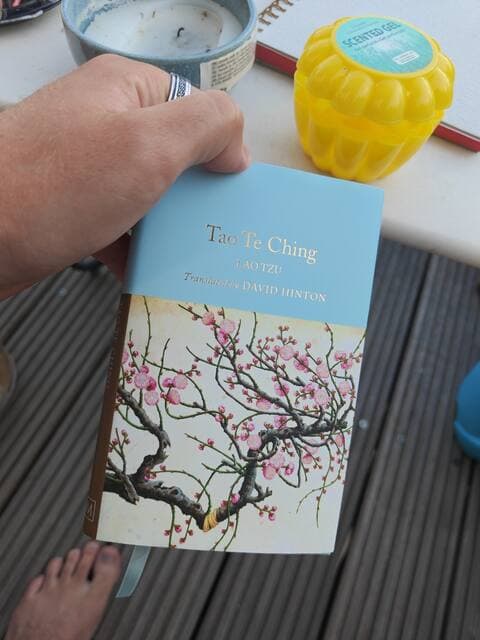
A summer reading capture from a personal copy. The public artifact preserves provenance and the applied idea; the private reflection remains outside the public repository.
Personal reading capture. Public page uses short excerpts and original commentary; readable page photographs remain private source evidence.
The short answer
The Tao Te Ching is a compact study of non-forcing: create the conditions, remove the excess, and let the essential work move. Its value for builders is not withdrawal from ambition, but ambition with enough internal and operational space to last.
Daoism · Primary text
The reading guide
The Tao Te Ching, also written Daodejing, is traditionally attributed to Laozi. Its brief chapters address the Dao, conduct, government, and non-forcing. The field note below is Frank’s application of selected passages, not a substitute for the whole work.
Reading lens: symbolic and religious interpretation; historical details are identified through the sources below.
Choose an edition
The existing reading capture uses David Hinton’s translation, pages 6, 7, 21, and 22. Preserve that edition when following the quotations. Compare other named translations as interpretations; their wording and explanatory choices differ.
A path through the book
Read the opening chapters
Begin with the difficulty of naming and describing the Dao. Allow ambiguity before seeking a rule.
Return to the captured passages
Read chapters 7 and 22 in full around the excerpts. Compare the source with the application below.
Pair with Zhuangzi
Move from compressed verse to stories and shifting perspectives within Daoist thought.
Sources & editions
- David Hinton’s publisher ↗
Translator and edition context for the existing reading capture.
- Penguin Random House: Tao Te Ching ↗
A separate named edition for comparison; not the source of the captured quotations.
An editorial reading guide with original summaries and source links. Modern translations remain the work of their named translators.
Read alongside
At a glance
- Origin
- Emerging. Traditionally attributed to Laozi. Scholars most often place the received text in the 4th–3rd century BCE. Excavated manuscripts show the collection was still being arranged in the late Warring States and early Han.
- Language
- Established. Classical Chinese
- Form
- Established. Received text of 81 short chapters, traditionally read as a Dao section (1–37) and a De section (38–81). Manuscripts differ in order and contents.
- First full reading
- Experiential. About an hour for the received text in a named translation; this page’s field note is one photographed sitting.
No wording from this translation is reproduced on this page.
The Tao Teh King (Sacred Books of the East, vol. 39) — James Legge (comparison pointer only), 1891
No wording reproduced. The quotations already on this page are short excerpts from David Hinton’s copyrighted translation, kept with the photographed pages. James Legge’s 1891 English in Sacred Books of the East, volume 39, is a separate public-domain comparison (Legge died in 1897). His wording is linked from this record and left on his page, so the field note stays with one named edition.
Read one chapter around a photographed page
15 minutesOpen the Hinton copy at page 7 or page 22, the pages already named on this field note. Read the whole chapter those lines sit in, then read the chapter immediately before it. Write two sentences: what the surrounding chapter adds, and which sentence you are leaving in Hinton’s wording. For a second English, open Legge’s 1891 chapter with the same received number and compare the sense. Leave his sentences on his page.
Key Insights
- The alternative to force is not passivity. It is designing clear conditions, then letting the right action move without unnecessary resistance.
- Yielding is strategic range: revise the plan quickly, preserve the principle, and keep the system capable of absorbing shocks.
- Hollow capacity is productive capacity. Unclaimed attention, recovery, and white space are what let durable work continue.
- Authority compounds more cleanly when proof lives in useful systems and lived artifacts rather than constant self-announcement.
- A small portfolio with a real cadence outperforms an ever-expanding field of intentions. Concentration is what makes a body of work recognisable.
Quotes Worth Remembering
2 recorded excerpts. Check the named edition and location before sharing the wording.
In yielding is completion. In bent is straight. In hollow is full.
Chapter 22 — David Hinton translation, p. 22
The operative image is not weakness; it is a system that can flex without losing its centre.
If you aren’t free of yourself, how will you ever become yourself?
Chapter 7 — David Hinton translation, p. 7
An antidote to building an identity-performance machine instead of a body of useful work.
Editorial reading map
An editorial reading map. Each row names a place to start, with the idea to carry and a short summary. Read the text itself for its own order.
01How to use this map
A reading order for the received 81-chapter text.
OpenClose
These rows are an editorial reading map of the received order associated with Wang Bi: 81 short chapters, traditionally grouped as a Dao section (chapters 1–37) and a De section (chapters 38–81). Excavated manuscripts, including Guodian and Mawangdui, arrange and include the material differently. The quotations on this page stay with David Hinton’s translation and the photographed pages.
02The opening (received chapter 1)
The first chapter sets a limit on naming.
OpenClose
The received text opens on the difficulty of fixing the Dao in a definition or a name. Readers use this chapter to notice how quickly a definition becomes smaller than what it points at. When you want the English of the photographed copy, use the pages named in the field note.
03Reversal, emptiness, and yielding (received chapters 2–25)
Completion is described through bending, hollowing, and return.
OpenClose
Early chapters return to pairs that reverse: what bends, what is hollow, what sits low. Chapter 7 and chapter 22 are the passages this field note photographed. The map points at those chapters so a reader can open the same edition and read the lines around the excerpts.
04The close of the Dao section (received chapters 26–37)
The first half keeps returning to the cost of forcing an outcome.
OpenClose
The traditional Dao section runs through chapter 37 in the received order. These chapters speak about weapons, display, and knowing when to stop. Treat the chapter numbers as that received numbering. A manuscript edition can place the same passages somewhere else in the collection.
05The De section (received chapters 38–81)
The second half turns to conduct, government, and the sage who leaves credit unclaimed.
OpenClose
From chapter 38 the received text takes up virtue, ritual, and the government of a state. Later chapters include water, the valley, and the uncarved block as pictures of usefulness that stays quiet. Many political readings of the book begin in this half. The field note’s application sits beside this map and keeps its own scope.
06Manuscripts and editions
Order and wording depend on which witness you open.
OpenClose
The Guodian bamboo slips, found in 1993, preserve part of the collection in an earlier arrangement. The Mawangdui silk manuscripts, found in 1973, place the De material before the Dao material and use different chapter breaks. Hinton’s translation and Legge’s 1891 translation are two English doors into that history. This page quotes only the photographed Hinton pages.
Applied to FrankX
Tao operating experiment
Turn the reading into a constraint, not a mood: one canonical public domain, one production Library OS, and fewer concurrent promises. Let the systems make the case before the narrative does.
Seven days of strategic hollowing
7 daysBefore adding one initiative, link, or dependency, remove or decline one that does not strengthen FrankX, Arcanea, or Starlight Intelligence Systems. Protect one recovery block and one uninterrupted build block each day. At the end of the week, keep only what still moves without force.
Best For
Frequently Asked Questions
What does the Tao Te Ching mean by yielding?
+
It is not surrendering discernment. It is staying adaptable enough to change form without abandoning what matters.
Why is this useful for builders and founders?
+
Because most operational waste comes from forcing too many initiatives, decisions, and identities at once. The book makes subtraction a strategic discipline.
Is this page a summary of the entire Tao Te Ching?
+
No. It is a source-marked field note from one reading session, built around the passages captured here and their original application to creative and operating systems.
Which translation is referenced here?
+
The photographed copy is David Hinton’s translation. Short excerpts are retained only to anchor the public interpretation to the captured pages.
Continue Reading
If Tao Te Ching opened a door, these books walk you through it. Curated for reason, not algorithm — each entry explains why it pairs with this book.
Zhuangzi
by Zhuangzi and later contributors
Tao Te Ching is paired with this book on the Daoism shelf. Read the edition note on each page before comparing wording.
Read on this shelfThe Analects
by Sayings of Confucius, compiled by followers
Tao Te Ching is paired with this book on the Daoism shelf. Read the edition note on each page before comparing wording.
Read on this shelfMeditations
by Marcus Aurelius
Tao Te Ching is paired with this book on the Daoism shelf. Read the edition note on each page before comparing wording.
Read on this shelfThe Untethered Soul
by Michael A. Singer
Tao Te Ching is paired with this book on the Daoism shelf. Read the edition note on each page before comparing wording.
Read on this shelfGo Deeper — Videos
Each link opens a YouTube search for this book. Pick a named speaker before you treat a recording as a source.
If You Liked This, Read Ours
Our Book
Imagination
Unlocking the Power of the Mind
Your imagination is the most powerful technology you possess. This book teaches you how to wield it — creative visualization, mental models, and the architecture of thought.
Read freeThe FrankX Newsletter
One book breakdown like this. One spotlight from the operating loop. Every Friday.