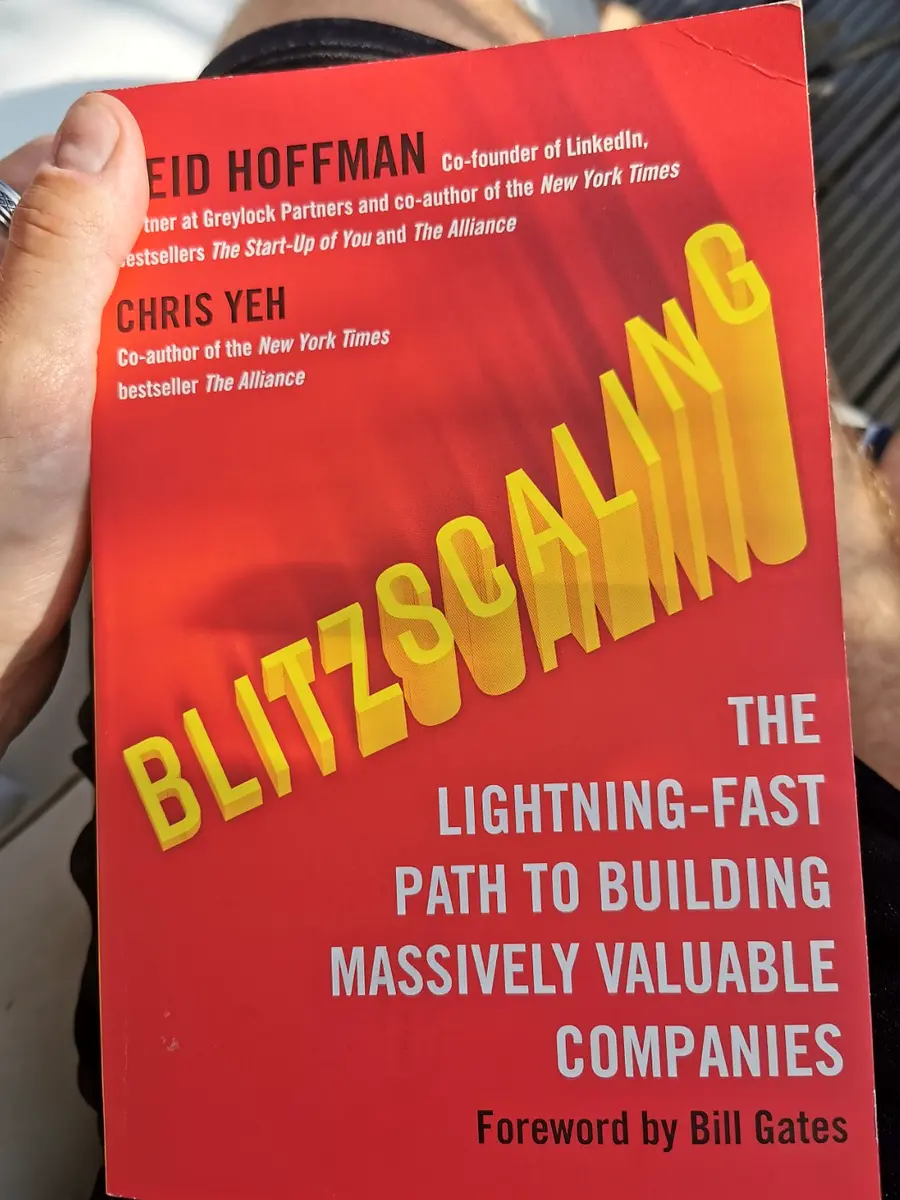
Blitzscaling: The Lightning-Fast Path to Building Massively Valuable Companies
by Reid Hoffman and Chris Yeh
Source capture
A field note from two pages selected during a personal reading session. The cited lines stay crisp, the surrounding page is masked, and the full readable photographs stay private and outside Git.
Personal reading capture. The public page uses two short excerpts, original commentary, and sharp editorial crops with surrounding text masked; full readable photographs remain private.


The short answer
This source-marked field note connects two pages of Blitzscaling: page 83 shows how an internal capability can become a platform, while page 152 argues for a small layer of generalists who can move into undefined work before a specialist hierarchy exists. Together they define a scaling sequence: build adaptable capacity, make the reliable parts reusable, then add management only where coordination has become a recurring constraint.
Key Insights
- Internal infrastructure becomes strategic when it stops being only a cost centre and becomes a capability other people can build on. Amazon turning logistics and computing systems into merchant services and AWS is the model on page 83.
- Software platforms compress coordination. APIs replace repeated person-to-person negotiation, which lets distribution and transaction volume scale without the same growth in human intervention.
- A scaling organisation still needs a small generalist layer. These people enter ambiguous work, cross functions, and shape problems before the company knows which permanent specialist role it needs.
- Management and executive work are different operating modes. Managers turn direction into detailed execution; executives lead managers, hold vision and strategy, and carry responsibility for organisational resolve.
- Role transitions should follow the company's coordination structure, not titles or headcount alone. Contributor, manager, and executive capacity become necessary at different stages and should not be collapsed into one founder-shaped job.
Quotes Worth Remembering
2 recorded excerpts. Check the named edition and location before sharing the wording.
the Networked Age has made them vastly more powerful and valuable.
Business Model Innovation — p. 83
The point is structural: software distribution and APIs remove the geographic and negotiation limits of earlier platforms.
Think of generalists as the “stem cells” of your organization.
Transition #3 — p. 152
Generalists are the temporary adaptive capacity that enters undefined work before the permanent function is obvious.
Applied to FrankX
Build the stem-cell layer before the hierarchy
FrankX, Arcanea, and Starlight Intelligence should share a small generalist operating cell that can enter ambiguous work, assemble specialist agents, and stabilize a repeatable delivery loop. Once a capability becomes reliable, expose it as a template, API, or product surface. Formal management appears only where recurring coordination demands it; executive attention stays on portfolio direction, capital allocation, standards, and organisational resolve.
Fourteen-day role and platform audit
14 daysLabel every active responsibility contributor, manager, or executive. Reclaim the executive work that only the founder can do, assign recurring coordination to an explicit owner, and keep one or two generalists free for undefined cross-venture problems. Then choose one internal capability and define the smallest reusable interface that turns it into a platform asset.
Best For
Frequently Asked Questions
Is this a full summary of Blitzscaling?
+
No. This is a source-marked field note from pages 83 and 152. It makes claims only about the photographed passages and their application to platform and organisational design.
Why connect the platform chapter with the generalist section?
+
They describe two sides of the same scaling move. A platform makes reliable capability reusable; generalists supply adaptive capacity while the capability, role, or market is still undefined.
How does the platform thesis apply to an AI-native venture?
+
When a research, delivery, or agent workflow works repeatedly, stop treating it as private founder craft. Give it a stable contract — a template, skill, API, or governed product surface — so other people and agents can build on it.
When should a founder separate manager and executive work?
+
When recurring coordination across contributors starts consuming the attention required for direction, capital allocation, standards, and long-range choices. The response is a real management layer, not a larger founder task list.
Continue Reading
If Blitzscaling: The Lightning-Fast Path to Building Massively Valuable Companies opened a door, these books walk you through it. Curated for reason, not algorithm — each entry explains why it pairs with this book.
Profit First
by Mike Michalowicz
Michalowicz keeps the cash system visible while Hoffman and Yeh argue for speed. Read them as two constraints on the same company.
Read on this shelfTools of Titans
by Tim Ferriss
Ferriss collects operator tactics. The Blitzscaling field note is two pages on platforms and generalists, not that whole catalog.
Read on this shelfGo Deeper — Videos
Each link opens a YouTube search for this book. Pick a named speaker before you treat a recording as a source.
If You Liked This, Read Ours
Our Book
The Golden Age of Creators
The Democratization of Creative Capability and Distribution
A transformative exploration of how the creator economy crossed $250 billion, how 45 million people now create professionally, and how the barriers to creative expression have evaporated.
Read freeThe FrankX Newsletter
One book breakdown like this. One spotlight from the operating loop. Every Friday.